
Spheroidal graphite iron, commonly known as ductile iron, has gained widespread application across various industrial sectors such as automotive, machinery, pipe manufacturing, wind power, shipbuilding, and high-speed rail due to its high strength, excellent plasticity, and toughness. The global production of castings has been steadily increasing, with spheroidal graphite iron castings showing significant growth. This surge in demand, coupled with stringent environmental regulations, necessitates the development of advanced, eco-friendly production techniques. Traditional nodularization methods, including the sandwich process, cover ladle method, in-mold process, converter ladle method, and pressure magnesium addition, often face challenges such as severe magnesium flare and smoke pollution, slag inclusion, operational difficulties, low automation, and prolonged processing times. In contrast, the wire feeding nodularization process offers notable advantages, including effective desulfurization and deoxidation, reduced nodularizer consumption, high molten metal purity, minimal temperature drop during treatment, reduced smoke and magnesium flare emission, and ease of intelligent control. This process has been successfully applied in the production of large-sized high-chromium cast iron, low-temperature spheroidal graphite iron, vermicular graphite iron, high silicon-molybdenum spheroidal graphite iron, and large-scale ductile iron castings, demonstrating promising engineering prospects. Over the past decade, preliminary research has been conducted on key wire feeding parameters such as cored wire addition amount, treatment temperature, feeding speed, and ladle height-to-diameter ratio, laying a technical foundation for scientific control of the process. However, studies on the influence of cored wire type and core material magnesium content on the quality of spheroidal graphite iron remain limited, hindering the further development and adoption of wire feeding technology. This article investigates the effects of different cored wire types and magnesium contents on magnesium absorptivity, microstructure, and mechanical properties of spheroidal graphite iron under controlled processing conditions, aiming to provide theoretical insights for the design and application of nodularizing cored wires.
In this study, the wire feeding nodularization and inoculation technology was employed to treat molten iron for producing QT450-10 grade spheroidal graphite iron. The experiments were conducted in a foundry setting using a 1-ton medium-frequency induction furnace. The charge composition consisted of 35% pig iron, 40% steel scrap, 25% returns, and 1.75% carbon additive. The nodularization ladle had dimensions of Φ780 mm × 1450 mm, with a height-to-diameter ratio of 1:1.86 and a capacity of 1.5 tons. Prior to wire feeding, 1000 kg of base iron was tapped at approximately 1520°C. A ZWX-20 type wire feeding machine was used for nodularization and inoculation. The casting mold was an iron mold with sand coating, and the pouring temperature was 1480°C. Stream inoculation was applied during pouring using a hand-held feeder. Molten metal temperature was measured with a front-line quick thermometer (thermocouple), and chemical composition was analyzed using a MiniLAB150 direct reading spectrometer. Metallographic specimens, tensile test bars, and impact test blocks were extracted from a 25-mm-thick Y-block. Standard metallographic techniques were used to prepare samples, and an Olympus GX-71 optical microscope along with Image Pro Plus6 software were utilized for microstructure observation and quantitative analysis of nodularity and phase content in the matrix. Mechanical properties were evaluated using an HT-2402-100kN universal testing machine and a JB-300B pendulum impact tester.
Two types of nodularizing cored wires were tested: mixed-core cored wire and alloy-core cored wire. The magnesium content in the core material was set at three levels: 15% Mg, 24% Mg, and 30% Mg. The mixed-core wire was prepared by mechanically blending passivated magnesium granules with other alloy powders, while the alloy-core wire consisted of crushed nodularizer powder. For both types, the addition length of the nodularizing cored wire was fixed at 20 meters based on production experience. The inoculating cored wire, with a core of silicon-barium-iron alloy powder, was added at 21 meters. The feeding speed for both wires was set at 24 m/min. The specifications and chemical composition of the cored wires are summarized in Table 1.
| Wire Type | Diameter (mm) | Si | Ca | Mg | Ba | La | Ce | Al | Linear Density (g/m) |
|---|---|---|---|---|---|---|---|---|---|
| QH-15 Mixed | 13 | 46.1 | 2.614 | 15.21 | 0.233 | 0.548 | 1.377 | 0.809 | 280 |
| QH-24 Mixed | 13 | 48.3 | 2.100 | 23.43 | 3.033 | 0.717 | 0.414 | 0.567 | 250 |
| QH-30 Mixed | 13 | 43.9 | 2.544 | 30.04 | 0.420 | 0.791 | 2.190 | 0.708 | 222 |
| QH-15 Alloy | 13 | 45.0 | 3.000 | 17.00 | 1.108 | 0.606 | 1.534 | 0.857 | 297 |
| QH-24 Alloy | 13 | 48.9 | 2.988 | 24.45 | 7.5 | 0.764 | 0.513 | 0.818 | 230 |
| QH-30 Alloy | 13 | 43.5 | 2.92 | 30.14 | 4.85 | 1.14 | 2.05 | 0.7 | 228 |
| YY-SiBa (Inoculant) | 13 | 63 | 1.4 | – | 1.01 | – | – | – | 260 |
The required chemical composition of the molten iron before and after nodularization is outlined in Table 2. The base iron aimed for a carbon content of 3.75–3.95% and silicon content of 1.0–1.5%, while the treated iron targeted a carbon content of 3.65–3.85%, silicon content of 2.65–2.95%, residual magnesium of 0.025–0.065%, residual rare earths of 0.015–0.04%, and low levels of manganese, phosphorus, and sulfur.
| Molten Iron State | C | Si | Mgres | REres | Mn | P | S |
|---|---|---|---|---|---|---|---|
| Base Iron | 3.75–3.95 | 1.0–1.5 | – | – | ≤0.4 | ≤0.05 | ≤0.03 |
| After Nodularization | 3.65–3.85 | 2.65–2.95 | 0.025–0.065 | 0.015–0.04 | ≤0.4 | ≤0.05 | ≤0.03 |
The magnesium absorptivity was calculated using the following formula, which accounts for the change in sulfur content and the residual magnesium in the treated iron:
$$ \varepsilon_{\text{Mg}} = \frac{(\Delta S \times 0.76 + \text{Mg}_{\text{res}}) \times W_L}{W_{\text{Mg}}} \times 100\% $$
where \( \varepsilon_{\text{Mg}} \) is the magnesium absorptivity in percent, \( \Delta S \) is the change in sulfur content after nodularization in percent, \( \text{Mg}_{\text{res}} \) is the residual magnesium content in the treated iron in percent, \( W_L \) is the mass of the molten iron in kilograms, and \( W_{\text{Mg}} \) is the mass of magnesium added to the iron in kilograms. The added magnesium mass is derived from both the nodularizing and inoculating cored wires:
$$ W_{\text{Mg}} = L_S \times \rho_S \times W_{S,\text{Mg}} + L_I \times \rho_I \times W_{I,\text{Mg}} $$
where \( L_S \) and \( L_I \) are the addition lengths of the nodularizing and inoculating cored wires in meters, \( \rho_S \) and \( \rho_I \) are their linear densities in kg/m, and \( W_{S,\text{Mg}} \) and \( W_{I,\text{Mg}} \) are the magnesium contents in the core materials of the respective wires in percent. This formula highlights the efficiency of magnesium utilization in the production of spheroidal graphite iron.
The chemical composition of the molten iron for each trial and the calculated magnesium absorptivity are presented in Table 3. All compositions met the requirements for QT450-10 spheroidal graphite iron, with residual magnesium ranging from 0.048% to 0.057%.
| Trial | Cored Wire Type | State | C (%) | Si (%) | Mn (%) | P (%) | S (%) | Mgres (%) | Ceres (%) | εMg (%) |
|---|---|---|---|---|---|---|---|---|---|---|
| 1 | QH-15 Mixed | Base | 3.95 | 1.31 | 0.18 | 0.027 | 0.017 | 0 | – | 45.7 |
| Treated | 3.77 | 2.77 | 0.17 | 0.024 | 0.013 | 0.048 | 0.022 | |||
| 2 | QH-24 Mixed | Base | 3.89 | 1.25 | 0.189 | 0.027 | 0.014 | 0 | – | 39.9 |
| Treated | 3.64 | 2.72 | 0.192 | 0.031 | 0.011 | 0.055 | 0.016 | |||
| 3 | QH-30 Mixed | Base | 3.89 | 1.23 | 0.192 | 0.028 | 0.018 | 0 | – | 38.3 |
| Treated | 3.67 | 2.77 | 0.21 | 0.026 | 0.007 | 0.053 | 0.023 | |||
| 4 | QH-15 Alloy | Base | 3.92 | 1.21 | 0.21 | 0.027 | 0.017 | 0 | – | 48.1 |
| Treated | 3.69 | 2.63 | 0.21 | 0.030 | 0.010 | 0.056 | 0.021 | |||
| 5 | QH-24 Alloy | Base | 3.89 | 1.33 | 0.198 | 0.028 | 0.018 | 0 | – | 43.2 |
| Treated | 3.74 | 2.85 | 0.20 | 0.025 | 0.010 | 0.054 | 0.018 | |||
| 6 | QH-30 Alloy | Base | 3.91 | 1.192 | 0.166 | 0.034 | 0.020 | 0 | – | 38.4 |
| Treated | 3.78 | 2.86 | 0.183 | 0.033 | 0.012 | 0.057 | 0.026 |
The influence of cored wire type and magnesium content on magnesium absorptivity is depicted in Figure 1. As the magnesium content in the core material increased, the magnesium absorptivity decreased for both types of nodularizing cored wires. This decline can be attributed to intensified reactions between magnesium and the molten iron at higher magnesium contents, leading to faster vaporization and bubble formation, which reduces the time available for magnesium dissolution and diffusion. For a given magnesium content, the alloy-core cored wire consistently resulted in slightly higher magnesium absorptivity compared to the mixed-core cored wire, with a relative increase ranging from 0.2% to 8.2%. This difference stems from the form of magnesium in the core materials: in the alloy-core wire, magnesium is present as compounds with lower vapor pressure, whereas in the mixed-core wire, it exists as elemental magnesium with higher vapor pressure. The lower vapor pressure in the alloy-core wire reduces the intensity and concentration of magnesium eruption, enhancing magnesium dissolution and minimizing bubble escape. Notably, the residual magnesium content in the treated iron remained relatively stable across all trials, fluctuating within ±0.005%, indicating that cored wire type and magnesium content do not significantly affect residual magnesium levels in spheroidal graphite iron production.
The microstructure of the as-cast spheroidal graphite iron, particularly the graphite morphology, size, and distribution, plays a critical role in determining mechanical properties. Factors influencing graphite crystallization include chemical composition, cored wire type and magnesium content, treatment temperature, feeding speed, and liquid pool depth. Under controlled processing conditions, the graphite characteristics obtained with different cored wires are illustrated in Figure 2. Both types of nodularizing cored wires produced spheroidal graphite iron with nodularity above 85% (corresponding to grade 3 or better) and graphite sizes of 6–7 grade. However, differences emerged with varying magnesium contents. At 15% magnesium, both wires yielded similar nodularization effects. As magnesium content increased, the mixed-core cored wire led to a higher number of large graphite nodules and less uniform distribution. Moreover, with rising magnesium content, the average graphite nodule diameter tended to increase for both wires, while roundness slightly decreased. This is primarily due to enhanced desulfurization and deoxidation at higher magnesium contents, which increases slag formation and reduces effective nucleation sites in the molten iron, thereby decreasing graphite nodule count and promoting larger nodule growth.
Quantitative analysis of graphite parameters is summarized in Table 4. The nodularity for mixed-core cored wire was slightly lower than that for alloy-core cored wire, and both decreased with increasing magnesium content. The graphite nodule count also declined with higher magnesium content, but the mixed-core wire consistently produced more nodules, albeit with smaller average diameters. The graphite precipitation amount remained relatively stable across different magnesium contents, suggesting that magnesium content does not markedly influence the total graphite formation in spheroidal graphite iron. The average graphite nodule diameter increased with magnesium content for both wires, reinforcing the observation that higher magnesium levels reduce nucleation efficiency.
| Cored Wire Type | Mg Content (%) | Nodularity (%) | Graphite Nodule Count (per mm²) | Graphite Precipitation Amount (%) | Average Nodule Diameter (μm) |
|---|---|---|---|---|---|
| QH-15 Mixed | 15 | 90.2 | 285 | 10.5 | 25.3 |
| QH-24 Mixed | 24 | 87.5 | 260 | 10.8 | 27.1 |
| QH-30 Mixed | 30 | 85.8 | 240 | 10.3 | 28.5 |
| QH-15 Alloy | 15 | 91.5 | 270 | 10.6 | 24.8 |
| QH-24 Alloy | 24 | 89.3 | 250 | 10.7 | 26.4 |
| QH-30 Alloy | 30 | 86.7 | 230 | 10.4 | 27.9 |
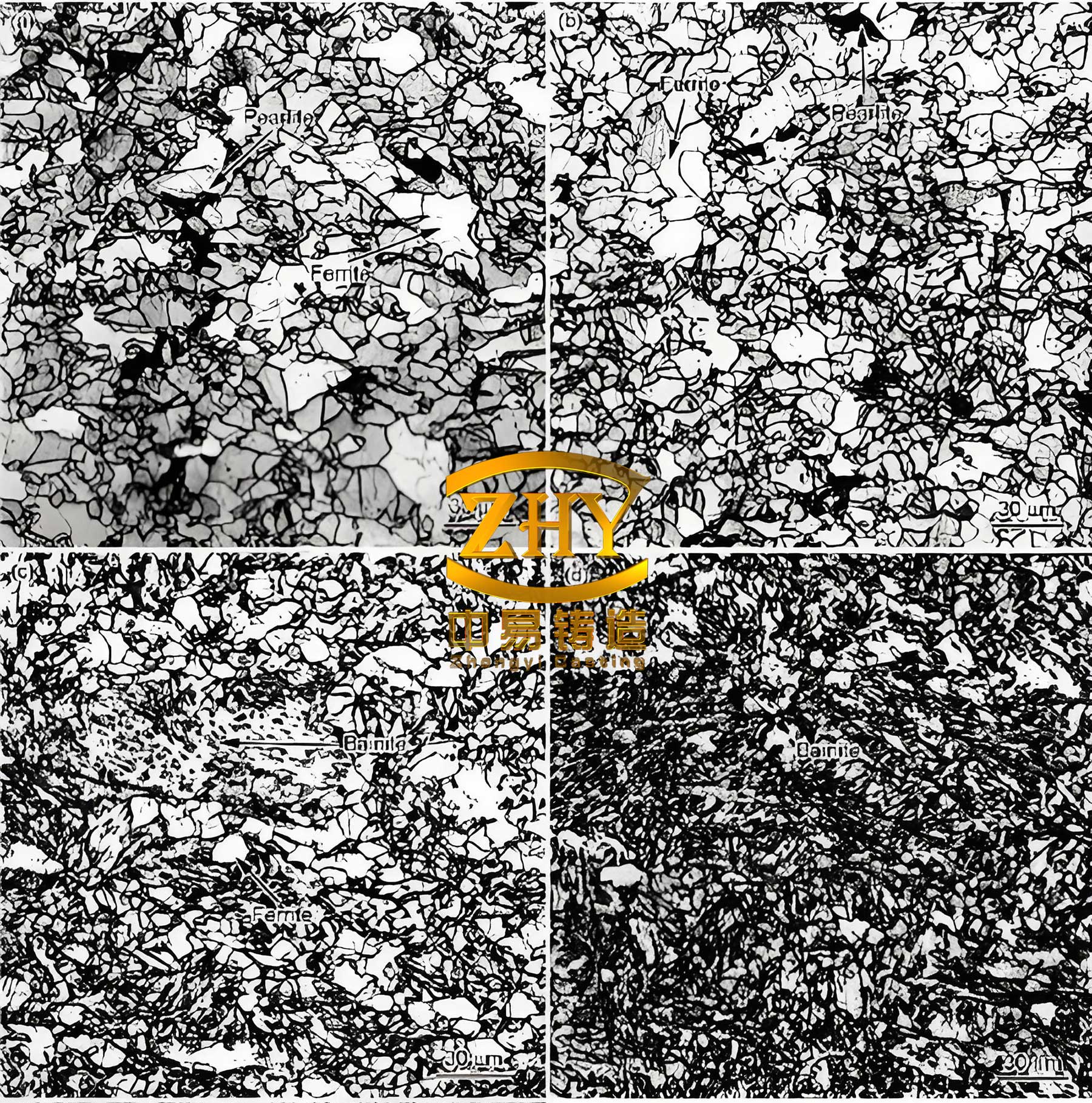
The matrix structure of the spheroidal graphite iron, as shown in Figure 3, consisted of ferrite, pearlite, and spheroidal graphite, with ferrite being the predominant phase. Quantitative analysis of the matrix phases is presented in Table 5. Except for the 24% magnesium level, where notable differences occurred between the two wire types, the pearlite content for 15% and 30% magnesium levels was similar. This variation at 24% magnesium may be attributed to fluctuations in production parameters, such as cooling rates or minor compositional shifts. The matrix structure significantly impacts the mechanical properties of spheroidal graphite iron, with higher pearlite content generally enhancing strength but reducing ductility.
| Cored Wire Type | Mg Content = 15% | Mg Content = 24% | Mg Content = 30% |
|---|---|---|---|
| Mixed-Core | 25.8 | 36.8 | 24.2 |
| Alloy-Core | 18.4 | 10.1 | 24.5 |
The mechanical properties of the spheroidal graphite iron, as per GB/T1348-2009 for QT450-10 grade, are listed in Table 6. For magnesium contents of 15% and 30%, both cored wire types yielded comparable tensile strength, yield strength, elongation, and hardness. The mixed-core cored wire produced slightly higher tensile strength and hardness but lower elongation compared to the alloy-core wire. At 24% magnesium, differences were more pronounced, with the mixed-core wire showing higher strength and lower ductility. All trials met the standard requirements for QT450-10 spheroidal graphite iron: tensile strength ≥450 MPa, yield strength ≥310 MPa, elongation ≥10%, and hardness in the range of 160–210 HBS. The yield-to-tensile ratio ranged from 0.66 to 0.70, which is typical for spheroidal graphite iron. Impact energy varied widely from 4.4 J to 13.2 J, with the low value for the mixed-core wire at 15% magnesium possibly due to production variabilities, warranting further investigation. These results underscore the importance of cored wire selection in optimizing the balance between strength and toughness in spheroidal graphite iron.
| Cored Wire Type | Mg Content (%) | Tensile Strength, Rm (MPa) | Yield Strength, Rp0.2 (MPa) | Rp0.2/Rm | Elongation, A (%) | Hardness (HBS) | Impact Energy, Ak (J) |
|---|---|---|---|---|---|---|---|
| QH-15 Mixed | 15 | 527.30 | 354.55 | 0.67 | 14.6 | 187 | 4.4 |
| QH-24 Mixed | 24 | 541.30 | 356.58 | 0.66 | 15.2 | 192 | 9.8 |
| QH-30 Mixed | 30 | 489.53 | 331.44 | 0.68 | 20.9 | 174 | 9.0 |
| QH-15 Alloy | 15 | 515.25 | 343.78 | 0.67 | 16.6 | 170 | 12.0 |
| QH-24 Alloy | 24 | 474.17 | 329.08 | 0.69 | 20.3 | 162 | 13.2 |
| QH-30 Alloy | 30 | 497.73 | 348.57 | 0.70 | 21.2 | 180 | 11.1 |
In summary, this study demonstrates that under fixed process conditions, the type and magnesium content of nodularizing cored wires significantly influence the production of spheroidal graphite iron. The alloy-core cored wire consistently achieved higher magnesium absorptivity than the mixed-core wire, with a relative advantage of 0.2–8.2%. As magnesium content increased, absorptivity decreased for both wires, but residual magnesium remained stable. Microstructurally, both wires produced spheroidal graphite iron with nodularity above 85% and graphite sizes of 6–7 grade. However, the mixed-core wire resulted in slightly lower nodularity, higher graphite nodule counts, and smaller average diameters. With rising magnesium content, nodularity and nodule count declined, while average diameter increased. Mechanically, the mixed-core wire tended to yield higher strength and hardness but lower plasticity and toughness compared to the alloy-core wire. At 15% magnesium content, both cored wire types produced spheroidal graphite iron meeting the microstructure and mechanical property standards for QT450-10 grade. These findings highlight the trade-offs between wire types and emphasize the need for careful selection based on desired properties in spheroidal graphite iron applications. The wire feeding process proves to be a viable and controllable method for producing high-quality spheroidal graphite iron, with potential for further optimization through adjustments in wire composition and processing parameters.
The production of spheroidal graphite iron via wire feeding nodularization involves complex interactions between thermodynamic and kinetic factors. The magnesium absorptivity can be modeled using a simplified rate equation that considers the dissolution and reaction of magnesium in molten iron. Assuming first-order kinetics for magnesium loss due to vaporization, the effective magnesium available for spheroidization can be expressed as:
$$ \frac{d[\text{Mg}]}{dt} = k_1 [\text{Mg}]_0 – k_2 [\text{Mg}] $$
where \( [\text{Mg}]_0 \) is the initial magnesium concentration added, \( [\text{Mg}] \) is the concentration in the iron at time \( t \), \( k_1 \) is the rate constant for dissolution, and \( k_2 \) is the rate constant for vaporization. Integrating this equation provides insight into the time-dependent magnesium content, which affects nodularization efficiency. Additionally, the nodularity of spheroidal graphite iron can be correlated with residual magnesium and sulfur content through empirical relationships. A common form is:
$$ \text{Nodularity} = A \times \frac{[\text{Mg}_{\text{res}}]}{[S]} + B $$
where \( A \) and \( B \) are constants derived from experimental data. This equation underscores the importance of the magnesium-to-sulfur ratio in achieving high nodularity in spheroidal graphite iron. Furthermore, the graphite nodule count per unit area, \( N \), can be related to cooling rate \( \dot{T} \) and nucleation potency \( I \) by:
$$ N = C \times I \times \dot{T}^n $$
where \( C \) is a material constant and \( n \) is an exponent typically between 0.5 and 1.0. These formulas aid in understanding and controlling the microstructure development in spheroidal graphite iron during wire feeding processing.
From an industrial perspective, the choice between mixed-core and alloy-core cored wires for spheroidal graphite iron production depends on specific application requirements. For components demanding high strength and wear resistance, such as gears or crankshafts, the mixed-core wire may be preferable due to its ability to enhance strength and hardness. Conversely, for parts requiring superior ductility and impact resistance, like pipe fittings or automotive suspension components, the alloy-core wire might offer better performance. Economic factors, such as wire cost and magnesium efficiency, also play a role. The higher magnesium absorptivity of alloy-core wires could lead to reduced nodularizer consumption and lower production costs for spheroidal graphite iron. Environmental considerations favor wire feeding technology due to minimized emissions, aligning with green manufacturing trends. Future research could explore the effects of additional alloying elements in cored wires, such as cerium or lanthanum, on the properties of spheroidal graphite iron, or investigate the synergy between wire feeding parameters and ladle design for large-scale production. Advanced modeling techniques, including computational fluid dynamics (CFD) simulations of magnesium bubble dynamics in molten iron, could further optimize the wire feeding process for spheroidal graphite iron. In conclusion, this study provides a foundation for refining wire feeding nodularization, contributing to the sustainable advancement of spheroidal graphite iron manufacturing.