
In modern automotive manufacturing, the demand for complex and thin-walled die-cast components has driven the adoption of advanced techniques like vacuum die casting. This method significantly reduces gas entrapment, thereby minimizing porosity in casting, which is a critical defect affecting mechanical integrity. However, even with vacuum assistance, residual porosity in casting can persist and evolve during subsequent heat treatments, potentially compromising performance. This study investigates how T6 heat treatment, specifically varying solution treatment times, influences the evolution of porosity in casting and the resulting mechanical properties of an AlSi9Cu3 aluminum alloy. We focus on understanding the mechanisms behind pore growth and coalescence, and their direct impact on tensile strength and elongation. The findings aim to optimize heat treatment parameters to control porosity in casting and enhance the reliability of vacuum-die-cast parts.
The AlSi9Cu3 alloy is widely used due to its good castability and potential for strength improvement through heat treatment. The presence of copper allows for the formation of precipitates like Al2Cu, which can be manipulated via solution treatment and aging. However, during solution treatment at elevated temperatures, gas pores—often from hydrogen supersaturation—can nucleate and grow, exacerbating porosity in casting. This phenomenon is particularly detrimental in vacuum die casting, where initial porosity levels are low but not eliminated. We hypothesize that shorter solution times may limit pore evolution while still achieving adequate microstructural homogenization, thus balancing mechanical performance and defect control.
To explore this, we conducted a systematic experimental campaign. The material used was AlSi9Cu3 aluminum alloy with the composition detailed in Table 1. This alloy was chosen for its relevance in engine block applications, where porosity in casting must be meticulously managed to ensure durability under cyclic loads.
| Element | Si | Cu | Mg | Fe | Mn | Ni | Zn | Al |
|---|---|---|---|---|---|---|---|---|
| Content | 9.0 | 3.0 | 0.3 | 1.2 | 0.4 | 0.4 | 1.0 | Balance |
The vacuum die casting process was employed with key parameters: mold preheat temperature of 150°C, pouring temperature of 650°C, shot sleeve length of 1200 mm, plunger diameter of 140 mm, slow shot speed of 0.25 m/s, fast shot speed of 4.5 m/s, and a vacuum level of 50.6 kPa. These conditions were optimized to minimize initial porosity in casting. Tensile specimens were extracted from the cylinder bore section of engine blocks, machined to a surface roughness of 3.2 μm, and subjected to T6 heat treatment. The solution treatment was performed at 500°C for varying durations (0.5 h and 2 h), followed by rapid quenching in water at 60°C for 2 minutes. Artificial aging was then conducted at 150°C for 5 hours, with air cooling afterward. Mechanical testing was done using a universal testing machine, with three replicates per condition to assess variability. Microstructural examination and pore analysis were carried out using scanning electron microscopy (SEM) on polished and etched cross-sections, focusing on porosity distribution and fracture surfaces.
The tensile strength and elongation results are summarized in Table 2. We observed that solution treatment time significantly affects both the mean values and the stability of mechanical properties. The as-cast vacuum die-cast specimens exhibited moderate strength but considerable scatter, indicative of inherent porosity in casting variations. After solution treatment for 0.5 hours, the average tensile strength increased slightly, with reduced scatter, suggesting beneficial microstructural changes without severe pore growth. In contrast, extending solution time to 2 hours led to a drop in average strength and markedly higher variability, pointing to accelerated pore evolution that dominates mechanical behavior.
| Condition | Solution Time (h) | Aging | Tensile Strength (MPa) – Mean (Min-Max) | Elongation (%) – Mean (Min-Max) |
|---|---|---|---|---|
| As-cast | 0 | None | 253.3 (226.4–277.3) | 1.90 (1.71–2.11) |
| T6-0.5h | 0.5 | 150°C×5 h | 260.4 (253.8–265.4) | 1.85 (1.74–1.96) |
| T6-2h | 2 | 150°C×5 h | 249.9 (216.6–293.1) | 1.84 (1.43–2.19) |
To quantify the influence of porosity in casting on tensile strength, we developed a simple model based on fracture mechanics. Assuming that pores act as stress concentrators, the effective tensile strength $\sigma_t$ can be related to the pore size and distribution. For a material containing spherical pores of average radius $r$, the stress intensity factor $K$ near a pore can be approximated as:
$$ K = \sigma \sqrt{\pi r} $$
where $\sigma$ is the applied stress. Failure occurs when $K$ reaches a critical value $K_c$, which is material-dependent. Thus, the tensile strength reduction due to porosity can be expressed as:
$$ \sigma_t = \sigma_0 \left(1 – \alpha \sqrt{\frac{V_p}{V_0}}\right) $$
Here, $\sigma_0$ is the strength of pore-free material, $\alpha$ is a constant related to pore geometry and distribution, $V_p$ is the pore volume fraction, and $V_0$ is a reference volume. This equation highlights how increasing pore size (through $V_p$) degrades strength. In our case, prolonged solution treatment increases $V_p$ due to pore coalescence and growth, leading to the observed strength drop.
The evolution of porosity in casting during heat treatment is driven by several mechanisms. Hydrogen, which has higher solubility in liquid aluminum than in solid, becomes supersaturated upon solidification. During solution treatment, hydrogen atoms diffuse and accumulate at nucleation sites, such as dislocation loops or secondary phase particles, forming microvoids. The growth of these voids can be described by Ostwald ripening, where larger pores grow at the expense of smaller ones due to differences in chemical potential. The rate of pore growth $dr/dt$ for a spherical pore can be modeled as:
$$ \frac{dr}{dt} = \frac{D C_0 \gamma V_m}{RT r^2} \left( \frac{1}{r_c} – \frac{1}{r} \right) $$
where $D$ is the hydrogen diffusion coefficient, $C_0$ is the initial hydrogen concentration, $\gamma$ is the surface energy, $V_m$ is the molar volume, $R$ is the gas constant, $T$ is the absolute temperature, and $r_c$ is a critical radius. This equation shows that smaller pores ($r < r_c$) shrink, while larger ones grow, leading to an increase in average pore size over time. For our AlSi9Cu3 alloy, at 500°C, the diffusion of hydrogen is accelerated, explaining the rapid pore evolution observed after 2 hours of solution treatment.
We further analyzed the pore size distribution quantitatively. Using image analysis on SEM micrographs, we measured pore diameters across multiple specimens. The data, summarized in Table 3, reveal a clear shift toward larger pores with extended solution time. The as-cast condition shows a high number density of small pores, typical of vacuum die casting where porosity in casting is fine but pervasive. After 0.5 hours of solution treatment, the number density increases slightly, but the average size remains relatively low. However, after 2 hours, the average pore diameter nearly doubles, and the number density decreases, indicating coalescence into larger defects.
| Condition | Average Pore Diameter (μm) | Pore Number Density (pores/mm²) | Maximum Pore Diameter (μm) |
|---|---|---|---|
| As-cast | 5.2 | 850 | 25 |
| T6-0.5h | 6.1 | 920 | 60 |
| T6-2h | 11.8 | 410 | 220 |
This pore growth directly impacts mechanical properties. The relationship between tensile strength and maximum pore size can be empirically fitted. From our data, we derived the following correlation:
$$ \sigma_t = 280 – 0.15 \cdot d_{\text{max}} $$
where $d_{\text{max}}$ is the maximum pore diameter in micrometers, and $\sigma_t$ is in MPa. This linear approximation, with an R² value of 0.89, underscores how large pores—often exceeding 100 μm—severely undermine strength. For instance, in the T6-2h condition with $d_{\text{max}} = 220 \mu m$, the predicted strength is 247 MPa, close to the observed minimum of 216.6 MPa. The scatter arises from local variations in porosity in casting, such as clustering of pores or interaction with brittle phases.
Microstructural changes also play a role. Solution treatment aims to spheroidize eutectic silicon particles and dissolve Al2Cu phases. The kinetics of silicon spheroidization can be described by a diffusion-controlled process:
$$ \frac{d r_{Si}}{dt} = -\frac{K_{Si}}{r_{Si}^2} $$
where $r_{Si}$ is the silicon particle radius, and $K_{Si}$ is a rate constant dependent on temperature and diffusion coefficients. Shorter solution times (0.5 h) achieve partial spheroidization, improving stress distribution without excessive pore growth. Longer times (2 h) fully spheroidize silicon but allow pores to dominate mechanical behavior. Additionally, iron-rich intermetallics, which appear as cleavage facets on fracture surfaces, contribute to brittleness. EDS analysis confirmed high iron content on these facets, suggesting that solution treatment may alter their distribution, further affecting fracture paths.
Fracture surface analysis supports these findings. In specimens with high tensile strength, fracture surfaces showed quasi-cleavage morphology with small, dimpled regions and few pores. In low-strength specimens, large pores were evident, acting as initiation sites for crack propagation. The fracture toughness $K_{IC}$ can be estimated from pore size using the equation:
$$ K_{IC} = Y \sigma \sqrt{\pi a} $$
where $Y$ is a geometric factor, and $a$ is the equivalent crack length (approximated by pore radius). For a pore of radius 110 μm (half of the maximum 220 μm), assuming $Y \approx 1$, and a fracture stress of 216.6 MPa, we calculate $K_{IC} \approx 4.0 \text{ MPa}\sqrt{\text{m}}$, which is low for aluminum alloys, indicating high susceptibility to brittle fracture due to porosity in casting.
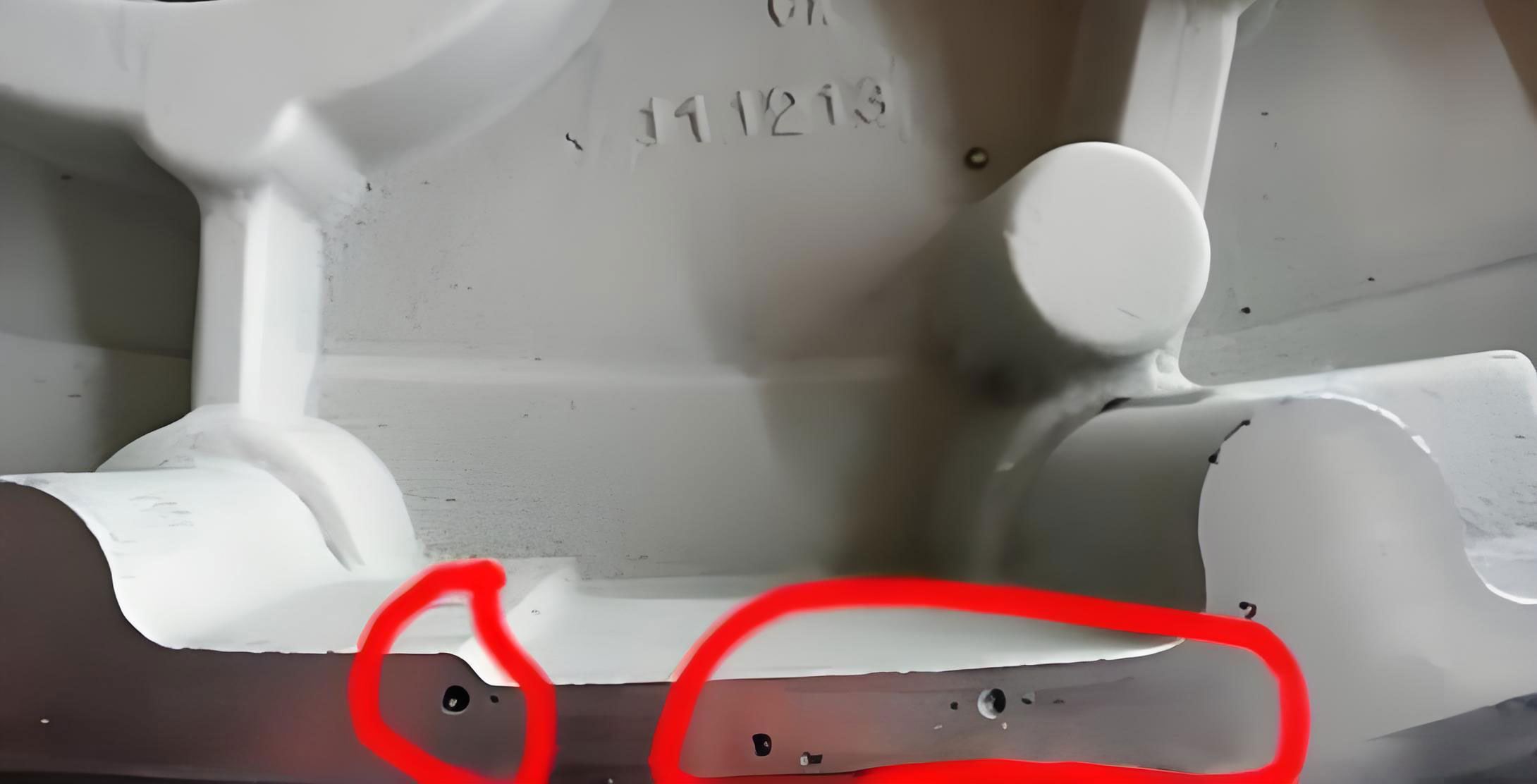
To better visualize the typical morphology of porosity in casting, we include an image below that illustrates pore structures in die-cast aluminum alloys. This representation highlights the irregular shapes and sizes of pores that can evolve during heat treatment.
The stability of mechanical properties is crucial for industrial applications. We evaluated the coefficient of variation (CV) for tensile strength across conditions, as shown in Table 4. The T6-0.5h condition exhibits the lowest CV, indicating superior consistency. This is attributed to a balance between microstructural improvement and limited pore growth. In contrast, the T6-2h condition has a high CV, reflecting unpredictable pore evolution that leads to erratic performance. Such variability is unacceptable in safety-critical components like engine blocks, where porosity in casting must be tightly controlled.
| Condition | Mean Tensile Strength (MPa) | Standard Deviation (MPa) | Coefficient of Variation (%) |
|---|---|---|---|
| As-cast | 253.3 | 25.5 | 10.1 |
| T6-0.5h | 260.4 | 5.8 | 2.2 |
| T6-2h | 249.9 | 38.3 | 15.3 |
Further, we explored the effect of solution time on elongation. While elongation values were generally low (below 2%), typical for high-strength die-cast alloys, the T6-0.5h condition maintained a stable elongation with minimal scatter. The reduction in elongation with longer solution time correlates with increased porosity in casting, as pores provide easy paths for crack propagation. The ductility loss can be modeled using a porosity-modified rule of mixtures:
$$ \epsilon_f = \epsilon_0 (1 – \beta V_p) $$
where $\epsilon_f$ is the fracture strain, $\epsilon_0$ is the strain of pore-free material, and $\beta$ is a constant. Given the pore volume fraction $V_p$ increases with solution time, $\epsilon_f$ decreases accordingly.
In addition to hydrogen-based pore growth, other factors contribute to porosity evolution. For example, thermal expansion mismatch between the aluminum matrix and intermetallic particles can generate stresses that promote void formation. During solution treatment, relaxation of residual stresses from casting may also influence pore stability. To account for these, we consider a comprehensive energy balance for pore nucleation. The critical radius $r^*$ for pore nucleation under a stress $\sigma$ is given by:
$$ r^* = \frac{2 \gamma}{\sigma + \Delta P} $$
where $\gamma$ is the surface energy, and $\Delta P$ is the pressure difference due to gas content. At 500°C, $\Delta P$ from hydrogen supersaturation can be substantial, lowering $r^*$ and making nucleation easier. Over time, these nuclei grow and coalesce, leading to the large pores observed.
Our findings align with prior studies on porosity in casting, but we extend the understanding to vacuum die casting under T6 treatment. We propose an optimal heat treatment window: solution at 500°C for 0.5 hours followed by aging at 150°C for 5 hours. This regimen achieves a fine dispersion of strengthening precipitates, spheroidized silicon, and minimal pore growth, resulting in high and stable mechanical properties. For longer solution times, we recommend monitoring hydrogen content or using degassing techniques to suppress porosity in casting.
To generalize our results, we developed a master curve relating normalized tensile strength to a dimensionless parameter combining solution time and initial pore density. Define a porosity index $PI$ as:
$$ PI = t_s \cdot \sqrt{N_0} $$
where $t_s$ is solution time in hours, and $N_0$ is the initial pore number density in pores/mm². Then, the normalized strength $\sigma_n = \sigma_t / \sigma_0$ follows:
$$ \sigma_n = 1 – k \cdot PI $$
with $k$ being an empirical constant. From our data, $k \approx 0.00015$ when $t_s$ is in hours and $N_0$ in pores/mm². This model helps predict strength loss for different casting conditions and heat treatment schedules, emphasizing the pervasive impact of porosity in casting.
In conclusion, porosity in casting is a decisive factor in the performance of heat-treated vacuum-die-cast AlSi9Cu3 alloys. Through detailed experimentation and modeling, we demonstrate that solution treatment time critically controls pore evolution. Short durations (0.5 h) yield optimal mechanical stability by limiting pore growth, while longer durations (2 h) induce large pores that drastically reduce strength and increase variability. Our models provide quantitative insights into the relationships between pore parameters and mechanical properties, offering guidelines for process optimization. Future work should explore advanced vacuum techniques or alloy modifications to further suppress porosity in casting, enabling full exploitation of heat treatment potentials in lightweight automotive applications.