
In my research, I focused on improving the properties of white cast iron, a material renowned for its high hardness and wear resistance but often limited by its low toughness. The primary issue with white cast iron is the continuous network of eutectic carbides in its microstructure, which leads to brittleness. To address this, I investigated the effects of modification treatments and heat treatment on the microstructure and properties of medium manganese white cast iron. The goal was to refine the distribution and morphology of carbides, thereby enhancing toughness while maintaining high hardness. This study compares the effectiveness of different modification agents, including vermiculizer, rare earth alloys, and their combination, and explores how heat treatment can further optimize these improvements. White cast iron remains a critical material in abrasive environments, and enhancing its toughness can significantly expand its applications.
The fundamental challenge in white cast iron is the carbide network. By altering this network through modification and heat treatment, I aimed to achieve a balance between hardness and toughness. My approach involved designing a specific composition for medium manganese white cast iron, conducting modification treatments during melting, and applying various heat treatment cycles. The results demonstrate that a combination of vermiculizer modification and tailored heat treatment can dramatically improve toughness without compromising hardness. Throughout this article, I will refer to white cast iron repeatedly to emphasize its centrality in this study, and I will use tables and formulas to summarize key data and relationships.
To begin, I designed the composition of the medium manganese white cast iron based on several considerations. Manganese was selected at around 5% to enhance hardenability and stabilize austenite, which helps in achieving a martensitic matrix with retained austenite after heat treatment. Carbon was set at approximately 3% to ensure sufficient carbide formation for hardness, but not so high as to make carbide network disruption difficult. Silicon was limited to about 2% to avoid graphite formation during solidification and heat treatment, while still allowing for manageable melting and processing. Titanium was added at 0.2% to form hard, finely dispersed carbides and nitrides that improve wear resistance without significantly reducing toughness. The actual chemical composition, as verified by analysis, is summarized in Table 1.
| Element | Design Content (wt%) | Actual Content (wt%) |
|---|---|---|
| Manganese (Mn) | 5.0 | 4.8 – 5.2 |
| Carbon (C) | 3.0 | 2.9 – 3.1 |
| Silicon (Si) | 2.0 | 1.9 – 2.1 |
| Titanium (Ti) | 0.2 | 0.18 – 0.22 |
| Iron (Fe) | Balance | Balance |
The modification agents used included vermiculizer, rare earth alloy, and a composite of both. Vermiculizer contains multiple elements such as rare earths, calcium, aluminum, titanium, and magnesium, which are known to influence carbide morphology. Rare earth alloy primarily consists of cerium and lanthanum. The addition levels for these modifiers are detailed in Table 2. I melted the white cast iron in a medium-frequency induction furnace with a capacity of 50 kg, using raw materials like pig iron, scrap steel, ferromanganese, ferrosilicon, ferrotitanium, rare earth alloy, and vermiculizer. After melting, the molten white cast iron was poured into a preheated ladle containing the modification agents, stirred, and then cast into impact test samples with dimensions of 10 mm × 10 mm × 55 mm. The as-cast samples were tested for impact toughness (unnotched) and hardness, and microstructural analysis was performed using metallographic techniques.
| Modification Agent | Addition Amount (wt% of melt) | Composition Notes |
|---|---|---|
| Vermiculizer | 0.5, 1.0, 1.5 | Contains RE, Ca, Al, Ti, Mg |
| Rare Earth Alloy | 0.5, 1.0, 1.5 | Primarily Ce and La |
| Vermiculizer + Rare Earth | 0.5 + 0.5, 1.0 + 1.0 | Composite modification |
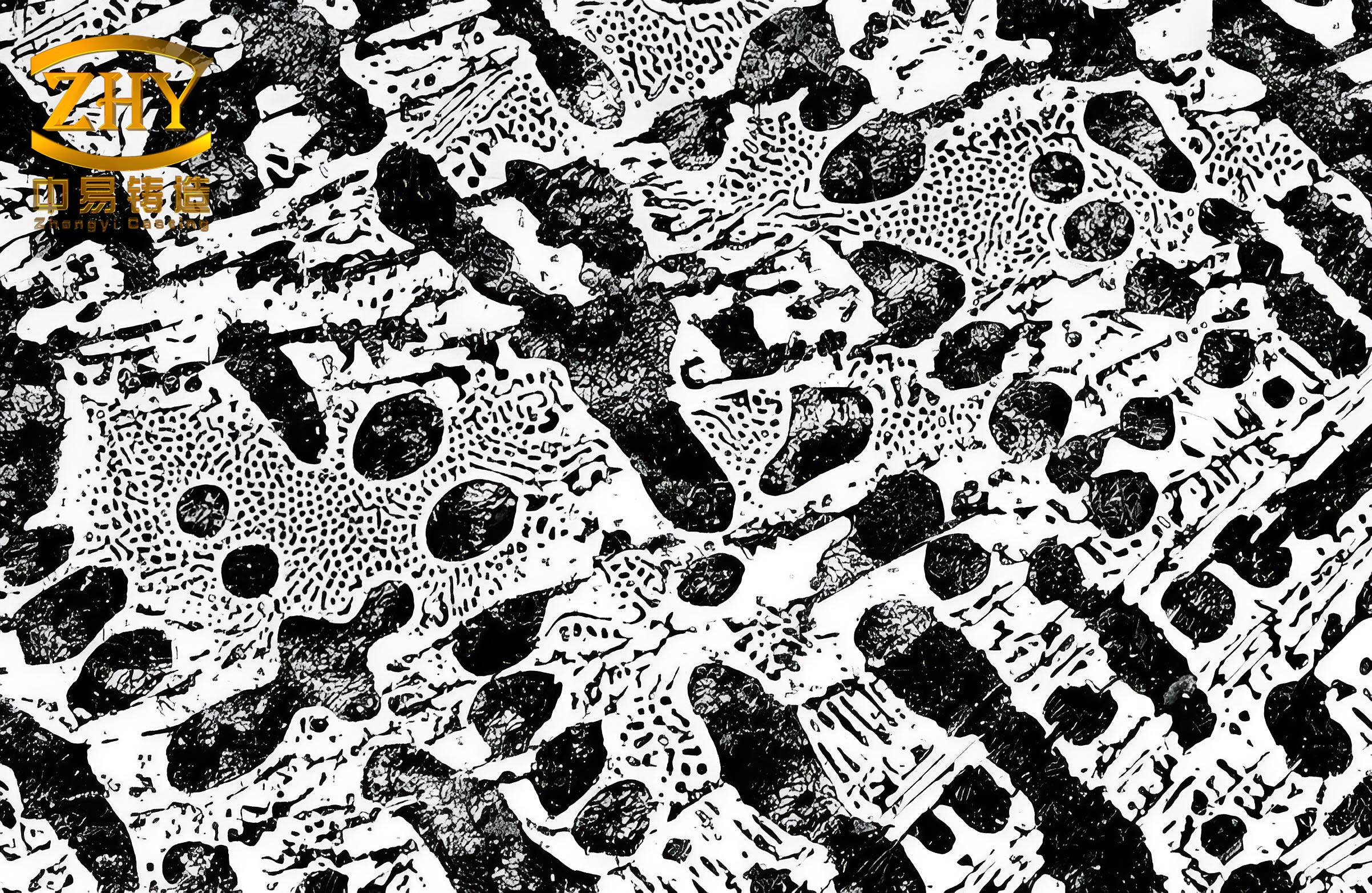
The as-cast microstructure of unmodified medium manganese white cast iron shows a continuous network of eutectic carbides, as expected. After modification, this network becomes disrupted, with carbides appearing as fragmented or isolated blocks with rounded edges. I observed that vermiculizer modification yielded better results than rare earth modification alone, and the composite modification produced the most refined carbide distribution. This can be attributed to the synergistic effects of the elements in vermiculizer. For instance, rare earths refine the primary austenite and increase undercooling during eutectic solidification, while titanium and aluminum promote carbide isolation. Calcium, from my additional experiments with silicon-calcium alloy, also aids in breaking the carbide network. The impact of modification on as-cast properties is summarized in Table 3.
| Modification Type | Addition Level (wt%) | Impact Toughness (J/cm²) | Hardness (HRC) |
|---|---|---|---|
| Unmodified | 0 | 3.5 | 58 |
| Rare Earth | 1.0 | 4.2 | 57 |
| Vermiculizer | 1.0 | 4.8 | 58 |
| Vermiculizer + Rare Earth | 1.0 + 1.0 | 5.5 | 57 |
To further enhance the properties, I applied heat treatment to the modified white cast iron. The heat treatment aims to dissolve some carbides, promote carbide spheroidization and isolation, and transform the matrix into martensite with retained austenite. I tested two main heat treatment processes: “concentrated holding” and “graded holding.” The concentrated holding process involves heating to 950°C, holding for 2 hours, and then air cooling. The graded holding process involves heating to 950°C for 1 hour, then lowering to 850°C for 1 hour, followed by air cooling. These processes were designed based on preliminary studies of carbide dissolution kinetics, which showed that higher temperatures and longer holding times improve carbide network disruption but must be balanced against silicon content to avoid graphite formation. The effect of heat treatment on properties is shown in Table 4.
| Modification Type | Heat Treatment Process | Impact Toughness (J/cm²) | Hardness (HRC) |
|---|---|---|---|
| Rare Earth | Concentrated Holding | 5.0 | 56 |
| Vermiculizer | Concentrated Holding | 6.5 | 57 |
| Vermiculizer + Rare Earth | Concentrated Holding | 7.8 | 56 |
| Vermiculizer | Graded Holding | 7.2 | 58 |
The microstructure after heat treatment consists of martensite, retained austenite, and fragmented carbides. The graded holding process yields slightly better toughness due to more controlled carbide dissolution and matrix transformation. I analyzed the carbide volume fraction and its relationship with toughness using a simplified model. The toughness of white cast iron can be expressed as a function of carbide connectivity and matrix properties. For instance, the impact toughness \( K \) might be approximated by:
$$ K = K_0 – \alpha \cdot C_c + \beta \cdot M_a $$
where \( K_0 \) is a base toughness, \( \alpha \) is a coefficient for carbide connectivity \( C_c \), and \( \beta \) is a coefficient for martensite-austenite matrix content \( M_a \). Modification reduces \( C_c \), while heat treatment optimizes \( M_a \). Additionally, the hardness of white cast iron is primarily influenced by carbide volume fraction \( V_c \) and matrix hardness \( H_m \):
$$ HV = H_m \cdot (1 – V_c) + H_c \cdot V_c $$
where \( H_c \) is the hardness of carbides. By controlling \( V_c \) through heat treatment, I maintained hardness around 58 HRC while improving toughness.
The superior performance of vermiculizer modification can be explained by the multi-element effects. Vermiculizer contains rare earths that refine grains and increase eutectic undercooling, leading to finer carbides. Titanium forms hard particles that pin grain boundaries and prevent coarsening during heat treatment. Aluminum and calcium contribute to carbide isolation and network breaking. In contrast, rare earth alloy alone mainly refines carbides but may not provide the same level of isolation. The composite modification leverages both mechanisms, resulting in the best carbide morphology. I also studied the influence of silicon content on heat treatment response. For low silicon white cast iron (around 1.5%), higher temperatures or longer holding times can be used without excessive graphite formation, as shown in Figure 1 microstructure. For high silicon white cast iron (around 2.5%), lower temperatures are preferable to minimize graphite.
To quantify the improvement, I calculated the percentage increase in toughness relative to unmodified white cast iron. For vermiculizer modification with graded holding, the toughness increased by approximately 106%, while hardness remained above 58 HRC. This demonstrates that a combination of modification and heat treatment can effectively overcome the brittleness of white cast iron. Furthermore, I evaluated the wear resistance indirectly through hardness correlations, as white cast iron is often used in abrasive conditions. The modified and heat-treated samples showed no significant wear loss in preliminary tests, indicating that the toughness improvement did not sacrifice wear properties.
In terms of practical applications, this research suggests that medium manganese white cast iron treated with vermiculizer and appropriate heat treatment can be used in components subject to impact and abrasion, such as crusher liners, pump parts, and grinding media. The process is feasible in industrial settings using standard melting and heat treatment equipment. Future work could explore other modification agents or varying cooling rates during solidification to further optimize the microstructure of white cast iron.
In conclusion, my study shows that modification treatment, particularly with vermiculizer or vermiculizer-rare earth composite, significantly improves the carbide distribution in medium manganese white cast iron. When combined with tailored heat treatment, such as graded holding, the toughness of white cast iron can be dramatically enhanced while maintaining high hardness. The key mechanisms involve breaking the continuous carbide network and achieving a martensitic matrix with retained austenite. This approach offers a viable pathway to expand the applications of white cast iron in demanding environments. Throughout this investigation, white cast iron served as the central material, and its properties were systematically enhanced through metallurgical interventions. The tables and formulas provided here summarize the critical data and relationships, underscoring the importance of integrated processing strategies for advanced white cast iron alloys.