
Heavy-section nodular cast iron, also known as ductile iron, is a critical material in various industrial applications due to its excellent mechanical properties, cost-effectiveness, and versatility. As a metallurgist, I have extensively studied the challenges associated with producing high-quality heavy-section nodular cast iron castings, which often exhibit issues such as shrinkage porosity, inverse chill, and graphite degeneration. In this analysis, I will delve into the elemental composition that governs the performance of these castings, emphasizing the roles of basic elements, alloying elements, and trace elements. The focus is on optimizing the composition to mitigate defects and enhance properties, particularly for thick-walled sections where slow cooling rates lead to microstructural inhomogeneities. Throughout this discussion, the term “nodular cast iron” will be frequently referenced to underscore its significance in engineering contexts.
The production of heavy-section nodular cast iron involves careful control over melting, inoculation, and cooling processes. However, the inherent challenges arise from the large thermal mass, which prolongs solidification and promotes element segregation. This can result in degraded graphite sphericity, formation of intercellular compounds, and reduced mechanical integrity. To address these issues, a fundamental understanding of the elemental interactions is essential. In this article, I will systematically categorize the elements into three groups: basic elements, alloying elements, and trace elements. Each group will be explored in detail, with tables and formulas summarizing their effects. The goal is to provide a comprehensive guide for foundry engineers and researchers working with heavy-section nodular cast iron.
First, let’s consider the basic elements that form the foundation of nodular cast iron. These include carbon (C), silicon (Si), manganese (Mn), sulfur (S), phosphorus (P), rare earth elements (like cerium, Re), and magnesium (Mg). Carbon and silicon are particularly crucial as they influence graphite formation and matrix structure. For heavy-section nodular cast iron, the carbon equivalent (CE) is a key parameter, often calculated using the formula: $$CE = C + \frac{Si}{3} + \frac{P}{3}$$ This formula helps predict the eutectic point and solidification behavior. Ideally, the CE should be near the eutectic composition to minimize undercooling and promote uniform graphite nucleation. In practice, for thick sections, the carbon content is typically maintained between 3.4% and 3.7%, while silicon is controlled at 1.8% to 2.2%, with adjustments based on wall thickness. Higher silicon levels can embrittle the ferrite matrix, whereas lower levels may increase carbides formation.
Manganese and sulfur are often considered detrimental if not properly managed. Manganese tends to segregate in thick sections, stabilizing pearlite and reducing ductility. Thus, for ferritic grades, manganese is kept below 0.3%, and for pearlitic grades, below 0.5%. Sulfur, a strong anti-nodularizing element, must be minimized to reduce the consumption of nodularizing agents like magnesium. Typically, residual sulfur is maintained between 0.005% and 0.03%. Phosphorus, due to its high segregation tendency, should be limited to below 0.02% to avoid phosphide eutectics and cold cracking. Magnesium and rare earth elements are essential for graphite nodulization. The residual magnesium content, often represented as Mgres, is critical; it is usually kept between 0.04% and 0.06%, with a ratio of Mgres/Sres around 1.5 to 2.0 to ensure effective nodularization without promoting shrinkage defects.
To summarize the basic elements, I have compiled Table 1, which outlines their roles, optimal ranges, and effects on heavy-section nodular cast iron. This table serves as a quick reference for foundry practice.
| Element | Symbol | Optimal Range (wt.%) | Primary Role | Key Effects |
|---|---|---|---|---|
| Carbon | C | 3.4–3.7 | Graphite former | Enhances fluidity, reduces chilling tendency; high CE promotes graphite nodularity. |
| Silicon | Si | 1.8–2.2 | Graphitizer, ferrite strengthener | Increases strength and ductility; excess leads to embrittlement and slag formation. |
| Manganese | Mn | 0.1–0.4 | Pearlite stabilizer | Improves hardenability; segregates in thick sections, reducing toughness. |
| Sulfur | S | <0.03 | Anti-nodularizer | Consumes nodularizing agents; low levels improve graphite morphology. |
| Phosphorus | P | <0.02 | Impurity | Forms brittle phosphides; causes segregation and shrinkage. |
| Magnesium | Mg | 0.04–0.06 | Nodularizing agent | Promotes graphite sphericity; excess causes porosity and microshrinkage. |
| Rare Earths | Re (e.g., Ce) | 0.01–0.03 | Nodularizing aid | Neutralizes trace elements, improves nodularization efficiency. |
Moving on to alloying elements, these are added to enhance specific properties such as strength, hardenability, and corrosion resistance. Common alloying elements in heavy-section nodular cast iron include nickel (Ni), chromium (Cr), copper (Cu), molybdenum (Mo), and vanadium (V). Nickel is a weak carbide former that improves toughness and low-temperature impact resistance. It is often added in amounts of 0.1% to 1.0% for ferritic grades used in cryogenic applications. Chromium, a strong carbide former, increases pearlite content and wear resistance but can lead to carbide networks if segregated; thus, it is limited to below 0.05% in most heavy-section nodular cast iron castings. Copper, similar to nickel, promotes pearlite and enhances machinability, with typical additions below 0.5% to avoid embrittlement.
Molybdenum is valuable for improving high-temperature strength and suppressing ferrite formation. Additions of 0.1% to 0.3% can prevent inverse chill and enhance graphite nodularity. Vanadium, another carbide former, is used sparingly (below 0.1%) to avoid excessive carbide precipitation and reduced ductility. The interaction between alloying elements can be complex, and their effects are often quantified using empirical formulas. For instance, the pearlite-promoting tendency can be estimated by a combined factor: $$P_{eq} = Ni + Cu + 2Mo + 3Cr$$ where each element is in weight percent. This factor helps in designing compositions for desired matrix structures in heavy-section nodular cast iron.
Table 2 summarizes the alloying elements, their functions, and recommended ranges for heavy-section nodular cast iron. This table aids in selecting appropriate alloying strategies based on application requirements.
| Element | Symbol | Optimal Range (wt.%) | Primary Role | Key Effects |
|---|---|---|---|---|
| Nickel | Ni | 0.1–1.0 | Austenite stabilizer | Enhances toughness, low-temperature impact strength, and pearlite formation. |
| Chromium | Cr | <0.05 | Carbide former | Increases hardness and wear resistance; excess causes carbide networks and brittleness. |
| Copper | Cu | <0.5 | Pearlite promoter | Improves machinability and strength; high levels reduce ductility. |
| Molybdenum | Mo | 0.1–0.3 | Matrix strengthener | Suppresses ferrite, enhances high-temperature properties, and prevents inverse chill. |
| Vanadium | V | <0.1 | Carbide former | Increases hardness; excess leads to carbide segregation and reduced elongation. |
Trace elements, though present in minute quantities, play a pivotal role in graphite morphology and nucleation. These include antimony (Sb), bismuth (Bi), lead (Pb), tin (Sn), and tellurium (Te). In heavy-section nodular cast iron, trace elements can either improve or degrade graphite sphericity depending on their concentration and interaction with nodularizing agents. Antimony, for example, when added in amounts of 0.006% to 0.010%, can neutralize excess rare earths and enhance graphite nodularity. Bismuth, at 0.008% to 0.010% with a ratio of Re/Bi around 1.4–1.9, promotes stable nuclei for graphite formation. Lead and tin are anti-nodularizing but can be beneficial in small doses; lead below 0.004% may improve thermal conductivity, while tin below 0.08% refines pearlite and prevents graphite degeneration.
Tellurium is a potent inoculant that reduces shrinkage porosity, but it must be limited to below 0.003% to avoid graphite distortion. The effects of trace elements are often non-linear, and their control requires precise addition techniques. A general formula for evaluating trace element impact is: $$TE_{index} = \frac{Sb + Bi + Pb + Sn + Te}{Re + Mg}$$ where low values indicate favorable conditions for nodular graphite in heavy-section nodular cast iron. This index helps foundries monitor trace element interactions.
Table 3 provides an overview of trace elements, their typical ranges, and influences on heavy-section nodular cast iron. This table is essential for quality control in melting operations.
| Element | Symbol | Optimal Range (wt.%) | Primary Role | Key Effects |
|---|---|---|---|---|
| Antimony | Sb | 0.006–0.010 | Graphite modifier | Improves nodularity when combined with rare earths; excess causes graphite distortion. |
| Bismuth | Bi | 0.008–0.010 | Nucleation aid | Enhances graphite sphericity and ball count; effective with proper Re/Bi ratio. |
| Lead | Pb | <0.004 | Thermal modifier | Reduces thermal conductivity; high levels promote carbide formation and graphite degeneration. |
| Tin | Sn | <0.08 | Pearlite refiner | Increases pearlite content; excess raises brittleness transition temperature and shrinkage. |
| Tellurium | Te | <0.003 | Inoculant | Reduces shrinkage and porosity; excess degrades graphite shape and mechanical properties. |
The application of heavy-section nodular cast iron spans multiple industries, including power generation and wind energy. In thermal power plants, for instance, nodular cast iron is used for turbine casings and valve bodies that operate under high temperatures and pressures. These components often have complex geometries with wall thicknesses ranging from 60 mm to 320 mm. The production of such castings requires stringent control over elemental composition to achieve desired microstructures, such as graphite nodularity above grade 3 and pearlite content over 10%. Non-destructive testing, including ultrasonic inspection with sound velocities exceeding 5500 m/s, ensures integrity. The use of heavy-section nodular cast iron in these applications highlights its reliability and cost-effectiveness compared to steel forgings.
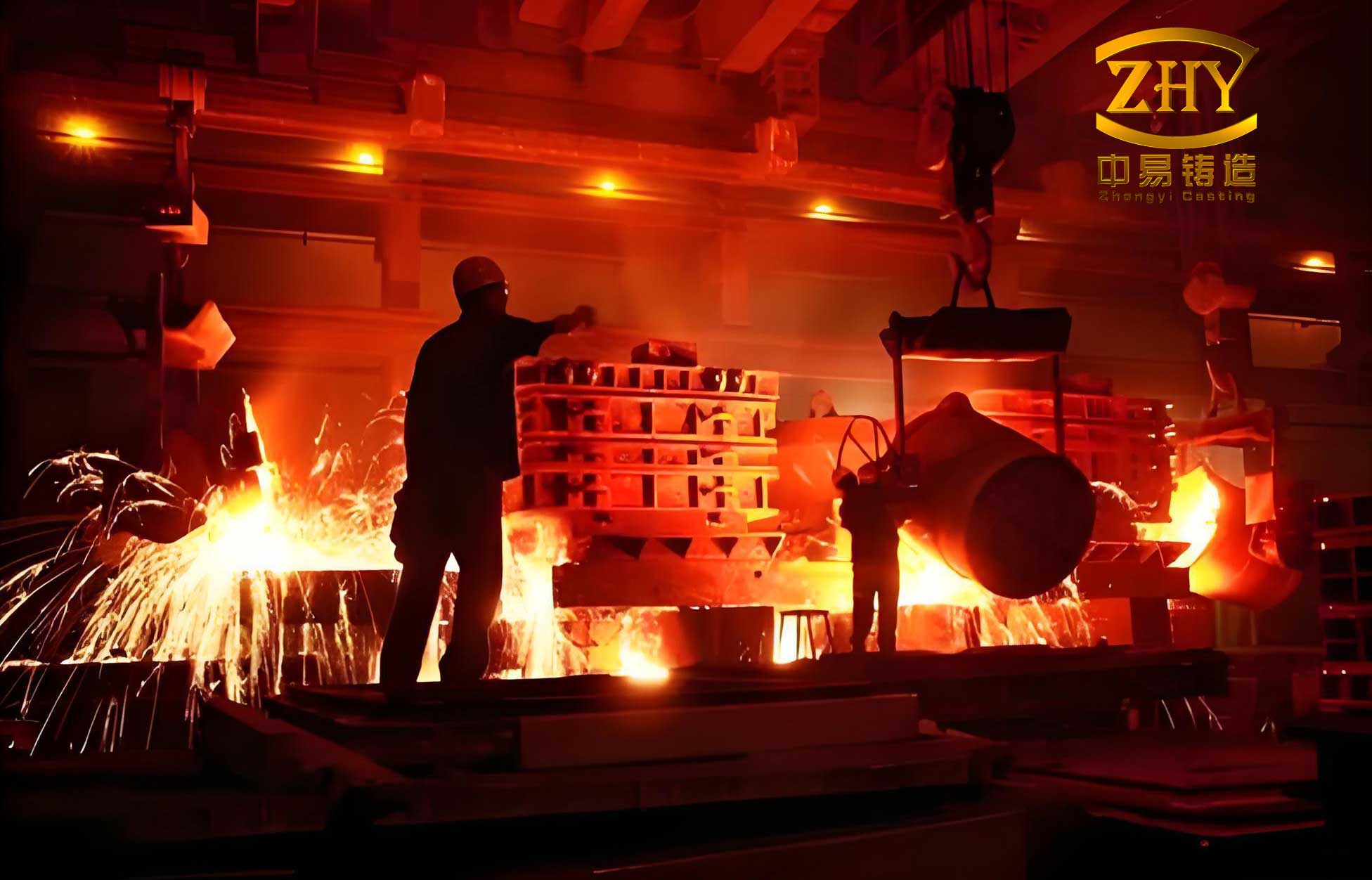
In the wind energy sector, heavy-section nodular cast iron is employed for hubs, bases, bearing housings, and gearbox casings. These components are subjected to dynamic loads and harsh environmental conditions, necessitating high fatigue resistance and low-temperature toughness. Ferritic grades are preferred, with careful attention to trace elements to prevent graphite degeneration. Quality assurance involves magnetic particle inspection, ultrasonic testing, and radiographic examination. The successful use of nodular cast iron in wind turbines underscores its adaptability and performance in sustainable energy infrastructure. As demand for renewable energy grows, the role of heavy-section nodular cast iron becomes increasingly vital, driving innovations in composition and processing.
To further illustrate the relationships between elements, I have developed a series of formulas that model their interactions in heavy-section nodular cast iron. For example, the graphitization potential (GP) can be expressed as: $$GP = C + 0.3Si – 0.5Mn – 2P – 4S + 0.5Mg$$ where higher GP values indicate a greater tendency for graphite formation. Similarly, the chill tendency (CT) is given by: $$CT = 3.2C – 2.5Si – Mn – 5P + 2Cr + 3Mo$$ where positive CT values suggest a risk of carbide precipitation. These formulas, derived from regression analyses of industrial data, assist in predicting microstructure and optimizing compositions for heavy-section nodular cast iron.
Another critical aspect is the solidification modeling of heavy-section nodular cast iron. The cooling rate (CR) in thick sections can be approximated by: $$CR = \frac{k(T_m – T_0)}{\rho c L^2}$$ where \(k\) is thermal conductivity, \(T_m\) is melting temperature, \(T_0\) is ambient temperature, \(\rho\) is density, \(c\) is specific heat, and \(L\) is section thickness. This equation highlights the inverse relationship between cooling rate and thickness, explaining why element segregation is more pronounced in heavy-section nodular cast iron. To compensate, adjustments in composition, such as lowering silicon and carbon, are necessary to maintain graphite nodularity and minimize defects.
In conclusion, the elemental composition of heavy-section nodular cast iron is a delicate balance that dictates its microstructural and mechanical properties. Through this analysis, I have categorized elements into basic, alloying, and trace groups, each with specific roles and optimal ranges. Tables and formulas have been provided to summarize these insights, aiding foundry practitioners in making informed decisions. The applications in power and wind energy demonstrate the material’s versatility, but success hinges on precise compositional control. Future research should focus on advanced inoculation techniques and real-time monitoring to further enhance the quality of heavy-section nodular cast iron. By leveraging this knowledge, manufacturers can produce reliable castings that meet the demanding standards of modern engineering, ensuring the continued relevance of nodular cast iron in heavy-section applications.
As a final note, I emphasize that the production of heavy-section nodular cast iron is both an art and a science. While elemental composition forms the foundation, process parameters such as pouring temperature, inoculation method, and cooling conditions are equally important. A holistic approach, integrating compositional analysis with simulation tools, will pave the way for innovations in this field. The journey to perfecting heavy-section nodular cast iron is ongoing, and I hope this article contributes to that endeavor by providing a comprehensive resource on elemental composition. Whether for turbine casings or wind turbine hubs, the principles outlined here will help achieve castings with superior performance and durability, solidifying the position of nodular cast iron as a material of choice for heavy-section components.