
In my years of experience in the foundry industry, addressing porosity in casting has been a persistent challenge that directly impacts product quality, performance, and cost-effectiveness. Porosity in casting refers to voids or holes within a cast metal component, primarily categorized into shrinkage porosity (from solidification contraction) and gas porosity (from trapped gases). These defects can compromise mechanical properties, leading to failures in critical applications. As a casting engineer, I have encountered numerous cases where innovative工艺 adjustments have successfully mitigated porosity in casting. This article delves into two specific case studies—a worktable casting and a low-carbon chromium-manganese-nitrogen steel casting—to illustrate practical strategies for eliminating porosity in casting. I will explore the underlying principles, use mathematical models, and present data in tables to provide a thorough understanding. The goal is to offer a detailed guide that exceeds superficial fixes, ensuring robust casting processes.
Porosity in casting is not merely a cosmetic issue; it is a fundamental concern that affects structural integrity. Shrinkage porosity occurs when the metal contracts during solidification without adequate feeding, while gas porosity arises from gases dissolved in the melt or from mold reactions. To combat porosity in casting, one must understand solidification dynamics. The modulus method, often used in foundry practice, calculates the cooling rate of a section. The modulus (M) is defined as the volume (V) divided by the surface area (A): $$M = \frac{V}{A}$$ A higher modulus indicates slower cooling, which can lead to shrinkage porosity if not properly fed. In feeding design, the modulus of the riser must exceed that of the casting section to ensure directional solidification. For gas porosity, factors like gas solubility and pressure play key roles. Henry’s law describes gas solubility in metals: $$C = k \cdot P$$ where C is the gas concentration, k is the solubility constant, and P is the partial pressure. During solidification, gas rejection can form bubbles, contributing to porosity in casting.
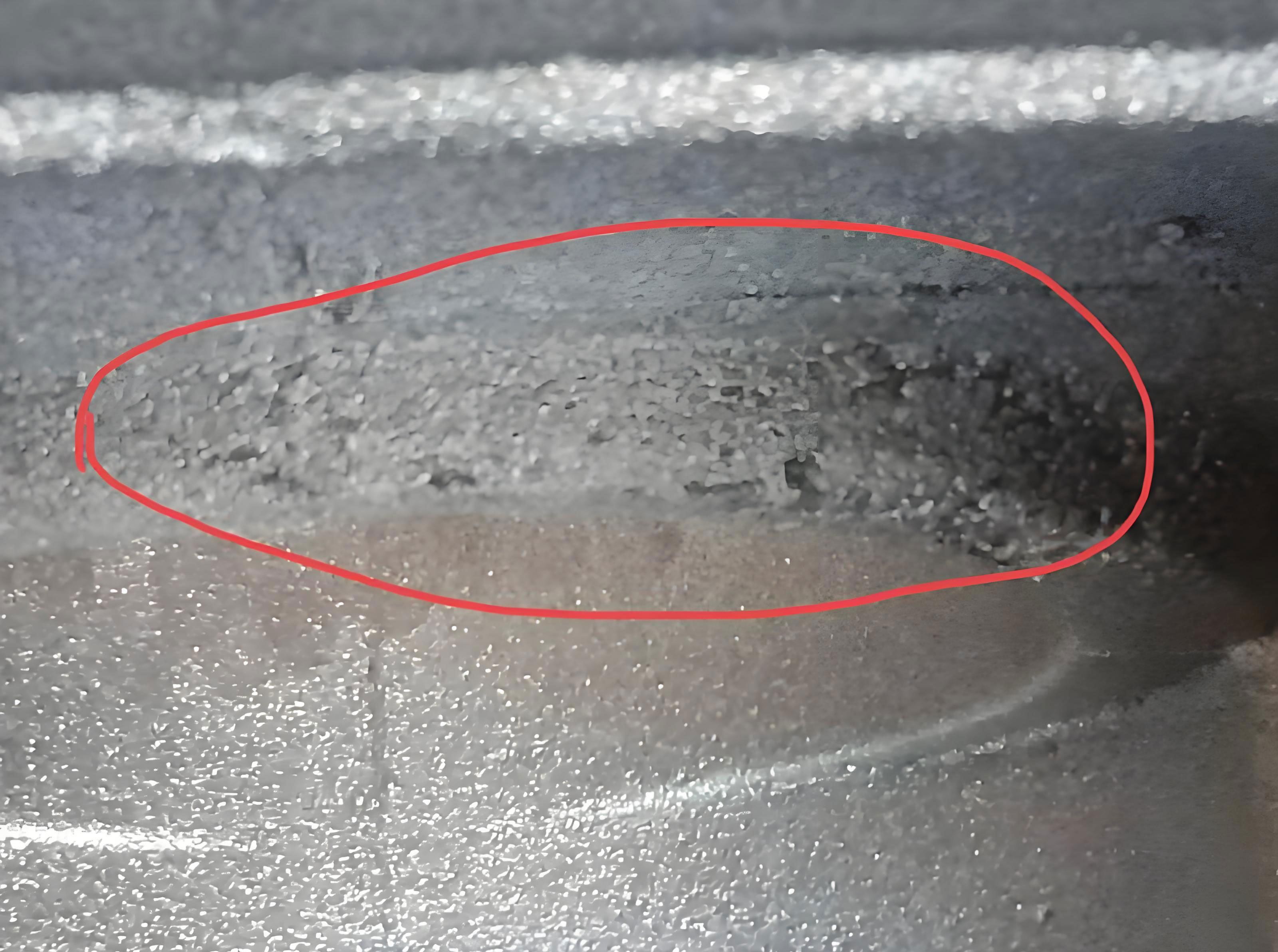
The first case study involves a worktable casting for woodworking machinery, made from gray iron (HT200). Initially, the casting exhibited severe shrinkage porosity in the thicker swallowtail section, with a rejection rate over 30%. This porosity in casting was unacceptable for a high-volume production component. The original工艺, as summarized in Table 1, used machine molding with the casting located in the upper flask. Two risers were placed at the swallowtail tops, and side cores were used. However, the asymmetrical design—one swallowtail was thicker than the other—led to uneven solidification.
| Parameter | Value | Description |
|---|---|---|
| Material | HT200 (Gray Iron) | Common cast iron with graphite flakes |
| Molding Method | Machine Molding | Ensures consistency but limited flexibility |
| Riser Placement | At swallowtail tops | Two risers, diameter fixed by design constraints |
| Core Usage | Side cores for swallowtails | One side core per swallowtail |
| Solidification Pattern | Directional (sequential) | Aimed for feeding from risers |
| Modulus of Thick Swallowtail | $$M_{ts} = 2.5 \, \text{cm}$$ | Calculated from volume/surface area |
| Modulus of Riser | $$M_r = 2.0 \, \text{cm}$$ | Insufficient for feeding thicker section |
| Major Defect | Shrinkage porosity in thick swallowtail | Due to premature riser solidification |
Analysis revealed that the modulus of the thick swallowtail ($$M_{ts}$$) was greater than that of the riser ($$M_r$$), causing the riser to solidify before the section it was meant to feed. This imbalance in solidification structure led to shrinkage porosity in casting. Simply increasing the riser size was impractical due to design limits and would reduce yield. To eliminate porosity in casting, we revised the工艺 by adding a core in the thicker swallowtail, effectively making both swallowtails symmetrical in cooling characteristics. This reduced the modulus of the thicker section, aligning it with the thinner one. The improved process is detailed in Table 2.
| Parameter | Value | Impact |
|---|---|---|
| Additional Core | Placed in thick swallowtail | Balances solidification structure |
| Modulus of Both Swallowtails | $$M_s = 1.8 \, \text{cm}$$ (uniform) | Reduced from original thick section |
| Riser Modulus | $$M_r = 2.0 \, \text{cm}$$ (unchanged) | Now greater than section modulus |
| Solidification Pattern | Balanced directional solidification | Ensures proper feeding |
| Casting Weight Reduction | 2.5 kg per piece | Due to core inclusion, saving material |
| Rejection Rate | Below 5% | Down from over 30%, eliminating porosity in casting |
| Annual Savings (for 10,000 units) | 25,000 kg iron, plus energy | Significant economic benefit |
The key was ensuring that the modulus of the casting section was less than that of the riser: $$M_s < M_r$$. This promotes effective feeding and eliminates shrinkage porosity in casting. The core addition also accelerated cooling, refining the microstructure and enhancing strength. This case underscores that porosity in casting can often be addressed by manipulating solidification dynamics through design modifications, without compromising functionality.
Moving to the second case, porosity in casting in low-carbon chromium-manganese-nitrogen steel presented a different challenge: gas porosity. These castings, used in high-strength applications, suffered from nitrogen-induced gas pores, which degraded mechanical properties. The base material has high nitrogen solubility, and during solidification, nitrogen rejection can form bubbles. The original process involved conventional pouring without special measures, leading to scattered gas porosity in casting. To analyze this, we considered the nitrogen equilibrium. The solubility of nitrogen in steel follows: $$C_N = k_N \cdot \sqrt{P_{N_2}}$$ where $$C_N$$ is nitrogen concentration, $$k_N$$ is the solubility constant, and $$P_{N_2}$$ is the partial pressure of nitrogen. During cooling, the decreasing solubility causes supersaturation and bubble formation, contributing to porosity in casting.
To eliminate this porosity in casting, we implemented a vibration-assisted solidification technique. The改进措施 involved subjecting the casting to mechanical vibration during solidification, immediately after filling the riser. Parameters were optimized as shown in Table 3. Vibration promotes degassing by agitating the melt, allowing gas bubbles to coalesce and escape through the riser. It also enhances feeding by breaking dendrites and improving fluidity.
| Parameter | Value Range | Role in Reducing Porosity in Casting |
|---|---|---|
| Frequency | 2000 Hz | Agitates melt to release trapped gases |
| Amplitude | 0.5–1.0 mm | Sufficient to disrupt solidification front |
| Compressed Air Pressure | 0.4–0.6 MPa | Drives vibration mechanism |
| Duration | 30–60 seconds | Applied during critical solidification phase |
| Vibration Start Time | After riser filling | Ensures melt is still fluid |
| Effect on Nitrogen Distribution | Uniform, preventing local supersaturation | Reduces gas porosity in casting |
| Riser Efficiency | Improved by 20% | Better feeding reduces shrinkage porosity too |
The vibration process can be modeled using the equation for bubble removal velocity: $$v_b = \frac{2 (\rho_l – \rho_g) g r^2}{9 \eta}$$ where $$v_b$$ is the bubble rise velocity, $$\rho_l$$ and $$\rho_g$$ are liquid and gas densities, g is gravity, r is bubble radius, and $$\eta$$ is viscosity. Vibration increases r by coalescence and reduces $$\eta$$ through shear thinning, enhancing $$v_b$$ and thus degassing. This directly targets gas porosity in casting. Post-implementation, the castings showed no visible gas pores, with nitrogen evenly distributed. The mechanical vibration also refined the grain structure, as described by the Hall-Petch equation: $$\sigma_y = \sigma_0 + k_y d^{-1/2}$$ where $$\sigma_y$$ is yield strength, $$\sigma_0$$ is friction stress, $$k_y$$ is a constant, and d is grain diameter. Finer grains from vibration improve toughness, adding value beyond eliminating porosity in casting.
Beyond these cases, general principles for managing porosity in casting involve choosing between directional and uniform solidification. Directional solidification, suitable for alloys with wide freezing ranges, requires risers to feed shrinkage. The Chvorinov’s rule estimates solidification time: $$t = B \left( \frac{V}{A} \right)^2 = B \cdot M^2$$ where t is time, B is a mold constant, and M is modulus. For riser design, ensure $$t_{\text{riser}} > t_{\text{casting}}$$ to avoid porosity in casting. Uniform solidification, used for thin-walled or symmetric castings, aims for simultaneous cooling to minimize shrinkage. This can be achieved with chills or controlled cooling. Table 4 compares these approaches in the context of porosity in casting.
| Strategy | Principle | Application | Key Formula | Effect on Porosity in Casting |
|---|---|---|---|---|
| Directional Solidification | Sequential cooling from remote to riser | Thick sections, alloys prone to shrinkage | $$M_{\text{riser}} > M_{\text{casting}}$$ | Prevents shrinkage porosity by ensuring feeding |
| Uniform Solidification | Simultaneous cooling throughout | Thin walls, symmetrical designs | $$\Delta T_{\text{max}} < T_{\text{critical}}$$ (temperature gradient) | Reduces thermal stresses and shrinkage voids |
| Vibration Assistance | Mechanical agitation during solidification | Gas-prone alloys like steel | $$f_{\text{vib}} \propto \frac{1}{\eta}$$ | Eliminates gas porosity by degassing |
| Modulus Balancing | Equalizing section moduli via design | Asymmetric castings (e.g., worktable) | $$M_1 = M_2$$ after modification | Balances cooling to avoid localized porosity |
In practice, eliminating porosity in casting often requires a hybrid approach. For instance, in the worktable casting, we balanced moduli for uniform solidification in the swallowtails while maintaining directional feeding via risers. This highlights that工艺 design must consider both product geometry and material properties. Economic factors also matter; as seen, reducing porosity in casting can lower weight and save resources. The worktable modification saved 2.5 kg per casting, which for annual production of 10,000 units, translates to 25,000 kg of iron saved, plus associated energy and cost reductions. This demonstrates that addressing porosity in casting is not just technical but also economically vital.
To further explore the science behind porosity in casting, let’s delve into mathematical models. The Niyama criterion is often used to predict shrinkage porosity in steel castings: $$N_y = \frac{G}{\sqrt{\dot{T}}}$$ where G is temperature gradient and $$\dot{T}$$ is cooling rate. A lower Niyama value indicates higher risk of porosity in casting. For our worktable, calculations showed that the original thick swallowtail had $$N_y < 1 \, \text{K}^{1/2} \cdot \text{s}^{1/2} / \text{mm}$$, signaling porosity risk, while after modification, $$N_y > 2$$, ensuring soundness. For gas porosity, the pore formation pressure can be estimated: $$P_{\text{pore}} = P_{\text{atm}} + \rho g h + \frac{2\gamma}{r}$$ where $$\gamma$$ is surface tension and r is pore radius. Vibration reduces $$P_{\text{pore}}$$ by increasing r and aiding bubble escape.
Another aspect is the role of inoculation in gray iron to control graphite formation and reduce shrinkage porosity in casting. Inoculants like ferrosilicon promote uniform graphite precipitation, which offsets shrinkage due to graphite expansion. The effectiveness can be quantified by the inoculation ratio: $$I_r = \frac{\text{Graphite Nodules}}{\text{Unit Area}}$$ Higher $$I_r$$ often correlates with lower porosity in casting. However, this was less critical in our worktable case as HT200 already has good inoculation, but it underscores the material-specific strategies for porosity in casting.
Looking at broader industry trends, computational simulation has become invaluable for predicting porosity in casting. Software tools use finite element analysis to model fluid flow, heat transfer, and solidification. They output porosity indices, helping optimize riser placement and cooling rates before physical trials. For example, a simulation might solve the energy equation: $$\frac{\partial T}{\partial t} = \alpha \nabla^2 T + \frac{L}{c_p} \frac{\partial f_s}{\partial t}$$ where T is temperature, $$\alpha$$ is thermal diffusivity, L is latent heat, $$c_p$$ is specific heat, and $$f_s$$ is solid fraction. By identifying hotspots where $$f_s$$ changes slowly, we can predict shrinkage porosity in casting and adjust工艺 accordingly.
In conclusion, eliminating porosity in casting is a multifaceted endeavor that blends theory, practical工艺, and economic sense. The worktable case shows how design modifications—like adding a core—can balance solidification to eradicate shrinkage porosity in casting. The steel casting case demonstrates how vibration-assisted solidification can tackle gas porosity in casting by enhancing degassing. Both cases reinforce that porosity in casting is manageable through a deep understanding of solidification principles and material behavior. Key formulas, such as modulus calculations and gas solubility laws, provide a foundation for decision-making. As foundry professionals, we must continually iterate on工艺 designs, considering not just technical feasibility but also cost and performance. By doing so, we can achieve high-quality castings free from porosity in casting, ensuring reliability in end-use applications. The journey to eliminate porosity in casting is ongoing, but with the right strategies, it is undoubtedly achievable.