
In my experience working at a motor manufacturing facility, one of the most persistent and costly issues we faced was the occurrence of slag inclusion and gas porosity defects in the cast end covers of small electric motors. These defects, primarily observed in the bearing housing inner screw plate area, led to a high scrap rate, significantly impacting production efficiency and profitability. Through systematic investigation and process optimization, we successfully reduced these defects, and in this article, I will detail the analysis, improvements, and outcomes from a first-person perspective, emphasizing the role of slag inclusion throughout.
The slag inclusion defects manifested as pores or cavities, typically ranging from 0.5 mm to 2 mm in diameter, with some even exceeding 3 mm. These imperfections compromised the structural integrity of the end covers, leading to failures during assembly or operation. Initial observations indicated that the slag inclusion was often accompanied by gas porosity, forming combined defects that were challenging to eliminate. To address this, we conducted a comprehensive study involving material analysis, process audits, and defect characterization.
Our analysis began with an assessment of the raw materials used in casting. The charge materials included pig iron, returns (recycled scrap), and steel scrap. However, due to fluctuations in supply and the use of inferior-quality pig iron, the chemical composition was highly variable. We performed spectroscopic and chemical tests, and the typical values are summarized in Table 1.
| Material | C (%) | Si (%) | Mn (%) | P (%) | S (%) | Other Trace Elements |
|---|---|---|---|---|---|---|
| Pig Iron (Source A) | 3.8 | 2.1 | 0.5 | 0.08 | 0.05 | Cu: 0.1, Cr: 0.05 |
| Pig Iron (Source B) | 4.2 | 1.8 | 0.4 | 0.12 | 0.07 | Cu: 0.15, Ni: 0.02 |
| Returns (Recycled) | 3.5 | 2.5 | 0.6 | 0.10 | 0.06 | Varied significantly |
Table 1: Chemical composition of raw materials (typical values). The variability, especially in silicon and carbon content, contributed to inconsistent melt properties.
The high scrap rate from slag inclusion prompted a deeper investigation into the melting and pouring processes. We identified several key factors: improper charge makeup, excessive use of returns leading to a buildup of impurities, inadequate coke-to-iron ratio, low pouring temperature, and unfavorable carbon-to-silicon ratio in the molten iron. The oxidation reactions in the melt were critical; for instance, the reaction between silicon and oxygen can be represented as:
$$ \text{Si} + \text{O}_2 \rightarrow \text{SiO}_2 $$
This silica (SiO₂) and other oxides formed slag inclusions. Additionally, gas evolution from dissolved gases like hydrogen and nitrogen contributed to porosity. The combined effect resulted in slag inclusion defects concentrated in the upper and middle sections of the end covers during solidification.
To quantify the relationship between melt composition and slag formation, we used empirical formulas. For example, the carbon equivalent (CE) is a key parameter in cast iron, calculated as:
$$ \text{CE} = \%\text{C} + \frac{\% \text{Si} + \% \text{P}}{3} $$
Initially, the CE varied widely, often exceeding 4.3, which promoted graphite flotation and slag entrapment. We aimed to control CE within 3.9–4.1 for optimal fluidity and reduced oxidation. Another critical ratio is the carbon-to-silicon ratio (C/Si), which influences the microstructure. The target was set at:
$$ \frac{\text{C}}{\text{Si}} \approx 1.8 \text{ to } 2.2 $$
Deviations from this range led to excessive slag formation. Based on this analysis, we revised the charge calculations and melting practices.
The improved charge composition for one of our production lines is detailed in Table 2. This formulation was designed to stabilize the melt chemistry and minimize slag inclusion.
| Charge Component | Percentage (%) | Weight per Batch (kg) | Key Function |
|---|---|---|---|
| Pig Iron (Selected Grade) | 40 | 400 | Provides base carbon and silicon |
| Returns (Controlled) | 30 | 300 | Recycling with limited impurity intake |
| Steel Scrap | 30 | 300 | Dilutes carbon and adjusts composition |
| Coke (Fuel) | 12.5 (Coke-to-Iron Ratio) | 125 | Maintains temperature and reducing atmosphere |
| Limestone (Flux) | 30% of Coke Weight | 37.5 | Slag formation and removal |
| Ferrosilicon (FeSi) Addition | 1.2% of Total Iron | 12 | Adjusts silicon content |
| Ferromanganese (FeMn) Addition | 0.8% of Total Iron | 8 | Enhances strength and deoxidizes |
Table 2: Optimized charge composition for melting end cover castings. The coke-to-iron ratio was set at 1:8 (12.5%), and limestone was added as a flux to facilitate slag removal.
In addition to charge optimization, we implemented a soda ash (sodium carbonate) treatment at the furnace spout during tapping. This practice, known as炉前苏打脱 in Chinese, involved adding 0.1–0.2% soda ash by weight of the molten iron. The reaction can be simplified as:
$$ \text{Na}_2\text{CO}_3 + \text{SiO}_2 \rightarrow \text{Na}_2\text{SiO}_3 + \text{CO}_2 $$
This helped in fluxing existing slag inclusions and reducing viscosity, allowing better slag separation. The pouring temperature was strictly controlled above 1380°C, measured with calibrated thermocouples. We also modified the gating and risering system to promote directional solidification, reducing turbulence that could entrap slag.
The results were dramatic. After implementing these changes, the incidence of slag inclusion dropped to below 2%, and the overall scrap rate for end covers improved to over 98% yield. The chemical composition of the castings stabilized, as shown in Table 3.
| Element | Target Range (%) | Achieved Average (%) | Standard Deviation |
|---|---|---|---|
| Carbon (C) | 3.6–3.8 | 3.7 | 0.05 |
| Silicon (Si) | 2.0–2.2 | 2.1 | 0.03 |
| Manganese (Mn) | 0.5–0.7 | 0.6 | 0.02 |
| Phosphorus (P) | < 0.1 | 0.08 | 0.01 |
| Sulfur (S) | < 0.06 | 0.04 | 0.005 |
Table 3: Final chemical composition of motor end cover castings after process optimization. The consistency directly reduced slag inclusion formation.
The economic impact was substantial. By reducing slag inclusion defects, we saved on material, rework, and energy costs. Annual profit increased by approximately $120,000, based on production volume of 50,000 end covers per year. This underscores the importance of meticulous process control in combating slag inclusion.
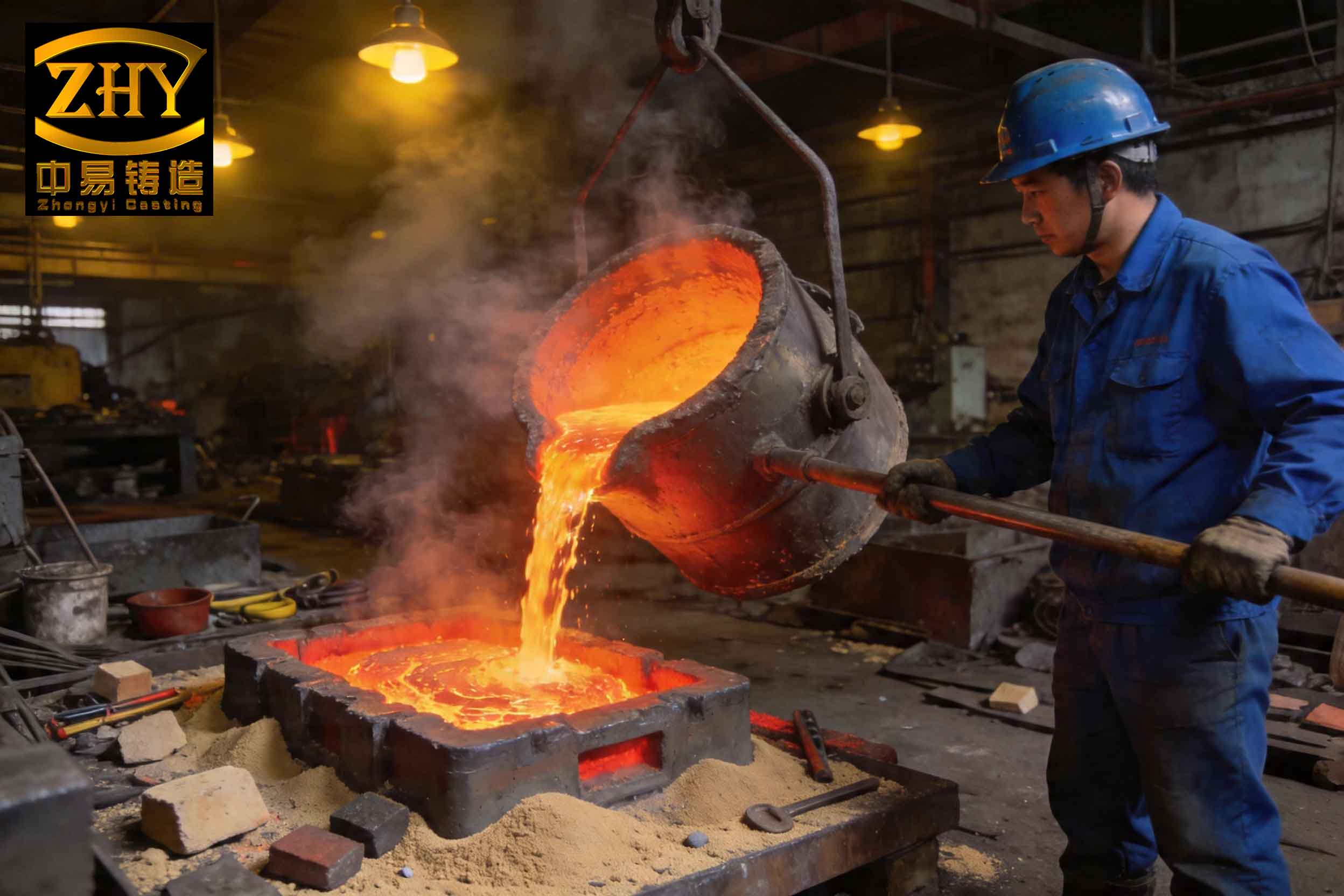
To visualize the typical morphology of slag inclusion defects, refer to the image below, which shows a cross-section of a defective end cover. The dark areas indicate slag pockets and porosity.
Further analysis involved statistical process control (SPC) to monitor key parameters. We used control charts for variables like pouring temperature and carbon equivalent. For instance, the upper and lower control limits for CE were calculated as:
$$ \text{UCL} = \bar{x} + 3\sigma, \quad \text{LCL} = \bar{x} – 3\sigma $$
where $\bar{x}$ is the mean CE (4.0) and $\sigma$ is the standard deviation (0.1). This helped in early detection of deviations that could lead to slag inclusion.
Another aspect we explored was the effect of mold materials on slag inclusion. The green sand used initially had high moisture content, which contributed to gas evolution. We switched to a bentonite-bonded sand with better permeability, characterized by the following properties: permeability number >120, moisture content 3–4%, and green strength 180–220 kPa. This reduced gas-related porosity that often accompanied slag inclusion.
In parallel, to ensure comprehensive quality improvement, we also addressed machining processes for motor components like rotors, which indirectly affect overall motor performance. While not directly related to slag inclusion in castings, precision machining minimizes imbalances that could stress end covers. For instance, we adopted carbide form milling cutters for rotor lamination stacks. The tool material consisted of a steel body (similar to AISI 4140) and carbide inserts (grade equivalent to ISO K10). The cutting parameters are summarized in Table 4.
| Parameter | Value | Unit |
|---|---|---|
| Workpiece Material | Cold-rolled silicon steel | – |
| Material Hardness | HRB 85 | – |
| Rotor Outer Diameter | 120 | mm |
| Milling Length | 50 | mm |
| Cutting Speed | 150 | m/min |
| Depth of Cut | 0.5 | mm |
| Feed Rate | 0.1 | mm/tooth |
| Tool Life | > 10,000 | pieces |
Table 4: Cutting parameters for rotor milling. This precision reduces vibration, lowering stress on end covers and mitigating potential failure points near slag inclusion zones.
The relationship between cutting forces and tool wear can be expressed using Taylor’s tool life equation:
$$ VT^n = C $$
where $V$ is cutting speed, $T$ is tool life, $n$ is an exponent (around 0.25 for carbide), and $C$ is a constant. Optimizing these parameters ensured efficient machining without introducing defects that could compound issues like slag inclusion in adjacent cast parts.
Returning to the core issue of slag inclusion, we conducted designed experiments to identify interaction effects. Using a factorial design, we varied factors such as coke ratio, pouring temperature, and soda ash addition. The response was the percentage of castings with slag inclusion. The data was analyzed using regression models, yielding an equation like:
$$ Y = \beta_0 + \beta_1 X_1 + \beta_2 X_2 + \beta_3 X_3 + \beta_{12} X_1 X_2 $$
where $Y$ is defect rate, $X_1$ is coke ratio, $X_2$ is pouring temperature, and $X_3$ is soda ash percentage. The coefficients indicated that pouring temperature had the largest effect on reducing slag inclusion.
To maintain consistency, we implemented a real-time monitoring system for the melting process. Sensors tracked temperature, oxygen levels, and slag viscosity. The viscosity of molten iron, which affects slag inclusion entrapment, can be approximated by:
$$ \eta = A e^{E/(RT)} $$
where $\eta$ is viscosity, $A$ is a pre-exponential factor, $E$ is activation energy, $R$ is the gas constant, and $T$ is temperature. By keeping $T$ high, we reduced $\eta$, allowing better slag floatation.
Furthermore, we analyzed the slag composition itself. Slag samples from the furnace were tested, revealing high levels of SiO₂, Al₂O₃, and FeO. The basicity index (BI) of slag, defined as:
$$ \text{BI} = \frac{\% \text{CaO} + \% \text{MgO}}{\% \text{SiO}_2 + \% \text{Al}_2\text{O}_3} $$
was adjusted to 1.2–1.5 by lime additions, promoting fluid slag that could be easily removed, thus minimizing slag inclusion in castings.
Employee training played a crucial role. We conducted workshops on identifying slag inclusion defects visually and through non-destructive testing like penetrant inspection. The criteria for rejection were standardized: any slag inclusion larger than 1.5 mm in critical areas led to scrap. This tightened quality control further reduced escape of defective parts.
Long-term data tracking showed a steady decline in slag incidence over two years. We used a exponential decay model to forecast future performance:
$$ N(t) = N_0 e^{-kt} $$
where $N(t)$ is defect rate at time $t$, $N_0$ is initial rate (15%), and $k$ is decay constant (0.5 per year). This model helped in planning maintenance and raw material procurement.
In summary, the elimination of slag inclusion in motor end covers required a multifaceted approach: stabilizing raw materials, optimizing charge composition, controlling melting parameters, implementing slag treatments, and enhancing process monitoring. The key was understanding the interplay between chemistry, temperature, and fluid dynamics. By relentlessly focusing on slag inclusion reduction, we achieved significant quality and economic gains. This experience underscores that in foundry operations, attention to detail and data-driven adjustments are paramount for overcoming persistent defects like slag inclusion.
Looking ahead, we plan to integrate artificial intelligence for predictive analysis of slag formation, using real-time sensor data to adjust parameters proactively. This will further solidify our gains and set new benchmarks in casting quality, ensuring that slag inclusion becomes a rarity rather than a routine challenge.