
In my experience working at a manufacturing facility dedicated to small electric motors, I have encountered persistent quality issues related to casting defects, particularly slag inclusion defects in motor end covers. These slag inclusion defects significantly impacted production efficiency and product reliability, leading to high scrap rates. Through systematic investigation and process optimization, we managed to reduce these defects substantially. This article details our approach, analysis, and solutions, emphasizing the critical role of material control and process adjustments in mitigating slag inclusion defects.
The primary problem was the occurrence of slag inclusion defects, often accompanied by gas pores, in the cast end covers of electric motors. These defects were predominantly found in the bearing housing and screw plate areas of the end covers. The pore sizes typically ranged from 1-3 mm, with some instances reaching up to 5 mm, severely compromising the structural integrity and performance of the motors. Initial observations indicated that these defects were not random but consistently linked to specific casting conditions and material compositions.
To understand the root causes, we conducted comprehensive analyses of raw materials, recycled iron, and molding sands. The slag inclusion defects were identified as a combination of slag entrapment and gas evolution during solidification. Our investigations revealed that the fluctuations in raw material sources and the use of inferior-quality pig iron contributed significantly to the problem. The lack of precise testing and control mechanisms led to improper charge calculations, creating a vicious cycle where recycled material impurities accumulated, and trace elements were excessively burned off.
| Material Type | C | Si | Mn | P | S | Other Elements |
|---|---|---|---|---|---|---|
| Pig Iron (Source A) | 3.8 | 2.1 | 0.5 | 0.08 | 0.05 | Trace |
| Pig Iron (Source B) | 4.2 | 1.8 | 0.6 | 0.12 | 0.07 | Trace |
| Recycled Iron | 3.5 | 2.5 | 0.4 | 0.15 | 0.10 | High impurities |
| Scrap Steel | 0.2 | 0.3 | 0.8 | 0.04 | 0.03 | Varies |
The data in Table 1 illustrates the variability in raw material composition, which directly influenced the melt chemistry. The high levels of phosphorus and sulfur in recycled iron, coupled with inadequate desulfurization practices, exacerbated the formation of slag inclusion defects. The imbalance in the carbon-to-silicon ratio (C/Si) was particularly critical, as it affected the fluidity and oxidation tendency of the molten iron. We formulated that the slag inclusion defects originated from liquid oxides formed due to excessive oxidation during melting. The reaction can be represented as:
$$ \text{Fe} + \frac{1}{2}\text{O}_2 \rightarrow \text{FeO} $$
$$ \text{FeO} + \text{Si} \rightarrow \text{SiO}_2 + \text{Fe} $$
$$ \text{FeO} + \text{Mn} \rightarrow \text{MnO} + \text{Fe} $$
These oxides, primarily SiO₂ and MnO, coalesced into slag particles. When the molten iron was poured, the slag inclusions were trapped in the casting, especially in thicker sections like the end cover’s upper middle areas, leading to the observed slag inclusion defects. Additionally, gas evolution from reactions such as:
$$ \text{C} + \text{FeO} \rightarrow \text{Fe} + \text{CO} \uparrow $$
contributed to porosity, often coexisting with slag inclusions. The overall mechanism underscored the need for precise control over melt composition and temperature to prevent these defects.
Further analysis involved assessing the melting parameters. The iron-to-coke ratio was initially set at 8:1, but this led to suboptimal melting temperatures, typically around 1350°C, which was insufficient for proper slag separation and gas removal. The low temperature promoted internal oxidation reactions, increasing the viscosity of the molten iron and facilitating slag formation. The addition of limestone at 40% of the layer coke weight was intended as a flux, but without proper adjustment, it sometimes increased slag volume without effective removal. Moreover, the addition of ferrosilicon and ferromanganese was not optimized, leading to excessive silicon loss and manganese oxidation, further aggravating the slag inclusion defects.
To address these issues, we revised the charge makeup and melting practices. The key changes included standardizing raw material sources to reduce variability, increasing the proportion of scrap steel to dilute impurities, and adjusting the iron-to-coke ratio to 7:1 to achieve higher superheat temperatures (above 1400°C). We also modified the flux additions, using a combination of limestone and soda ash (Na₂CO₃) for effective desulfurization and slag conditioning. The soda ash addition was particularly beneficial for reducing sulfur content, as per the reaction:
$$ \text{Na}_2\text{CO}_3 + \text{FeS} \rightarrow \text{Na}_2\text{S} + \text{FeO} + \text{CO}_2 \uparrow $$
This helped minimize one of the key contributors to slag inclusion defects. The revised charge composition for one of our production lines is summarized in Table 2.
| Component | Percentage (%) | Remarks |
|---|---|---|
| Pig Iron (Standardized) | 50 | Selected for consistent C/Si ratio |
| Recycled Iron | 30 | Pre-treated to reduce P and S |
| Scrap Steel | 20 | Low impurity content |
| Coke | 14.3 (relative to iron) | Adjusted for 7:1 iron-to-coke ratio |
| Limestone | 30% of coke weight | Reduced from 40% for better slag control |
| Soda Ash | 0.3-0.5% of melt weight | Added during tapping for desulfurization |
| Ferrosilicon (FeSi) | 0.8% of melt weight | Added to adjust final Si content |
| Ferromanganese (FeMn) | 0.5% of melt weight | Added to compensate for Mn loss |
The implementation of these changes required careful monitoring of melt chemistry. We introduced regular spectrometric analysis to track key elements and ensure consistency. The target chemical composition for the cast iron after improvements was set as follows: Carbon (C) at 3.4-3.6%, Silicon (Si) at 2.0-2.2%, Manganese (Mn) at 0.6-0.8%, Phosphorus (P) below 0.10%, and Sulfur (S) below 0.04%. Achieving this composition was crucial for minimizing slag inclusion defects, as it balanced fluidity, shrinkage characteristics, and oxidation resistance.
The melting process was further optimized by controlling the air supply to the cupola to reduce excessive oxidation. We also implemented a slag skimming practice before tapping to remove surface slag, and used ladle treatments with inoculants to improve graphite formation and reduce gas solubility. The pouring temperature was maintained above 1380°C to ensure proper fluidity and slag separation. These measures collectively reduced the incidence of slag inclusion defects by promoting cleaner metal and minimizing entrapped oxides.
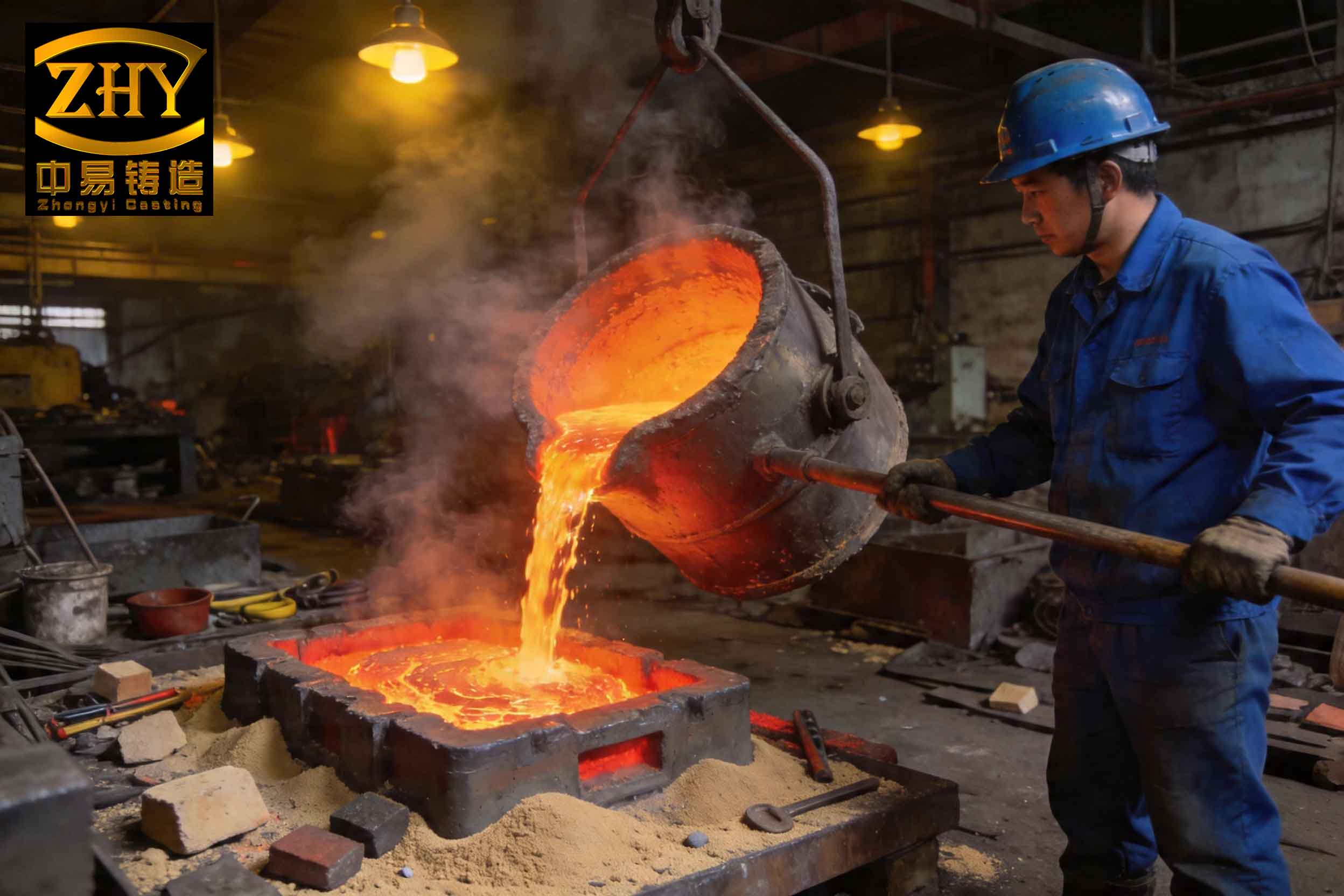
The visual representation above illustrates typical slag inclusion defects in cast components, highlighting the importance of defect identification. In our case, such defects were prevalent in end covers before process improvements. After revising our practices, we observed a dramatic reduction in these imperfections. The scrap rate due to slag inclusion defects dropped from over 15% to below 3%, with some batches achieving defect rates as low as 1.5%. This improvement translated into significant economic benefits, including reduced material waste, lower rework costs, and increased production throughput. We estimated an annual profit increase exceeding $200,000 solely from the reduction in scrap and improved yield, demonstrating the financial impact of addressing slag inclusion defects effectively.
To quantify the improvements, we conducted statistical process control (SPC) on casting quality. Data collected over six months showed a consistent downward trend in defect occurrence. We used control charts to monitor key parameters like melt temperature, composition, and defect counts. The process capability index (Cpk) for slag inclusion defects improved from 0.5 to 1.2, indicating a more stable and capable process. This enhancement was directly linked to the standardized charge makeup and better melting control, which minimized the variations that previously led to slag inclusion defects.
In addition to melting and casting adjustments, we also reviewed the molding and gating systems. The original gating design tended to promote turbulent flow, which could entrap slag and air, contributing to slag inclusion defects. We redesigned the gating to include choke areas and slag traps, ensuring smoother metal flow and better slag separation. The mold sand properties were also optimized; we controlled the moisture content to 4-5% and clay content to 8-10% to improve permeability and reduce gas generation. These changes complemented the metallurgical improvements, further reducing the risk of defects.
The success in reducing slag inclusion defects prompted us to explore related manufacturing aspects, such as machining processes for motor components. While the primary focus remained on casting, we noted that improved casting quality facilitated downstream operations. For instance, the use of carbide form milling cutters for machining rotor laminations benefited from defect-free castings, as surface irregularities were minimized. However, the core challenge remained preventing slag inclusion defects at the source, and our efforts were centered on the foundry processes.
From a theoretical perspective, the formation of slag inclusion defects can be modeled using thermodynamic and kinetic principles. The activity of oxygen in molten iron plays a key role. The equilibrium constant for the formation of FeO is given by:
$$ K_{\text{FeO}} = \frac{a_{\text{FeO}}}{a_{\text{Fe}} \cdot P_{\text{O}_2}^{1/2}} $$
where \(a\) denotes activity and \(P\) denotes partial pressure. By controlling the oxygen potential through coke quality and air input, we reduced FeO formation, thereby mitigating slag inclusion defects. Similarly, the desulfurization reaction with soda ash can be described by the equilibrium:
$$ \text{S} + \text{Na}_2\text{O} \rightleftharpoons \text{Na}_2\text{S} + \text{O} $$
Practical implementation required maintaining a basic slag with sufficient fluidity to absorb sulfur and other impurities. We monitored the slag basicity index (BI), defined as:
$$ \text{BI} = \frac{\% \text{CaO} + \% \text{MgO}}{\% \text{SiO}_2 + \% \text{Al}_2\text{O}_3} $$
Targeting a BI of 1.2-1.5 ensured effective impurity removal without excessive viscosity, directly impacting the reduction of slag inclusion defects.
Our experience also highlighted the importance of training and documentation. We developed standard operating procedures (SOPs) for charge calculation, melting, and pouring, emphasizing critical control points to prevent slag inclusion defects. Regular audits and cross-functional team meetings helped sustain the improvements. The cultural shift towards data-driven decision-making was instrumental in maintaining low defect rates.
Looking forward, we continue to research advanced techniques for real-time monitoring of melt quality, such as thermal analysis and ultrasonic testing, to further eliminate slag inclusion defects. The integration of Industry 4.0 technologies, like IoT sensors for temperature and composition tracking, holds promise for predictive defect prevention. Our journey demonstrates that a systematic approach combining material science, process engineering, and continuous improvement can effectively address complex casting defects like slag inclusion defects.
In conclusion, the elimination of slag inclusion defects in motor end covers required a multifaceted strategy focused on raw material standardization, optimized charge composition, controlled melting conditions, and improved gating design. By understanding the underlying mechanisms—such as oxide formation, gas evolution, and slag entrapment—we implemented targeted solutions that reduced scrap rates and boosted profitability. The key takeaway is that preventing slag inclusion defects is not merely a matter of incremental adjustments but a holistic re-evaluation of foundry practices. Through persistent efforts, we transformed a chronic quality issue into a benchmark of manufacturing excellence, ensuring reliable motor performance and customer satisfaction.
To aid further analysis, Table 3 summarizes the chemical composition of cast iron before and after process improvements, highlighting the changes that contributed to reducing slag inclusion defects.
| Element | Before Improvement | After Improvement | Target Range |
|---|---|---|---|
| C | 3.2-3.8 | 3.4-3.6 | 3.4-3.6 |
| Si | 1.8-2.5 | 2.0-2.2 | 2.0-2.2 |
| Mn | 0.3-0.7 | 0.6-0.8 | 0.6-0.8 |
| P | 0.10-0.20 | 0.06-0.10 | <0.10 |
| S | 0.06-0.12 | 0.02-0.04 | <0.04 |
| Slag Inclusion Defect Rate | 15% | 2% | <3% |
The data clearly shows the tightening of composition ranges and the direct correlation with defect reduction. This empirical evidence reinforces the importance of precise metallurgical control in combating slag inclusion defects. Moving forward, we aim to further refine these parameters and explore alloying elements like titanium or cerium to enhance slag morphology and reduce inclusion tendencies. The battle against slag inclusion defects is ongoing, but with a solid foundation in place, we are confident in achieving near-zero defect levels in our castings.