
In our manufacturing facility focused on small electric motors, we have long grappled with casting defects that significantly impact product quality and yield. Among these, slag inclusions and gas holes in motor end covers have been particularly pervasive, leading to high scrap rates and economic losses. Through systematic investigation and process optimization, we successfully reduced these defects, and in this account, I will detail our approach, leveraging first-person insights to share the technical journey. The term ‘slag inclusions’ will be recurrent, as it encapsulates the core issue—these non-metallic impurities trapped within the cast structure, often accompanied by gas porosity, degrade mechanical integrity and aesthetics.
Our production line involves two dedicated foundries supplying cast components for motor assemblies. The end covers, critical for housing bearings and securing screws, frequently exhibited slag inclusions and gas holes, predominantly in the bearing housing and screw boss regions. These defects manifested as cavities typically ranging from 1 to 3 mm in diameter, with occasional instances reaching up to 5 mm, severely compromising functionality. Initial observations indicated that these imperfections were not merely gas holes but complex slag inclusions formed from oxidized materials, necessitating a deep dive into the metallurgical and process factors.
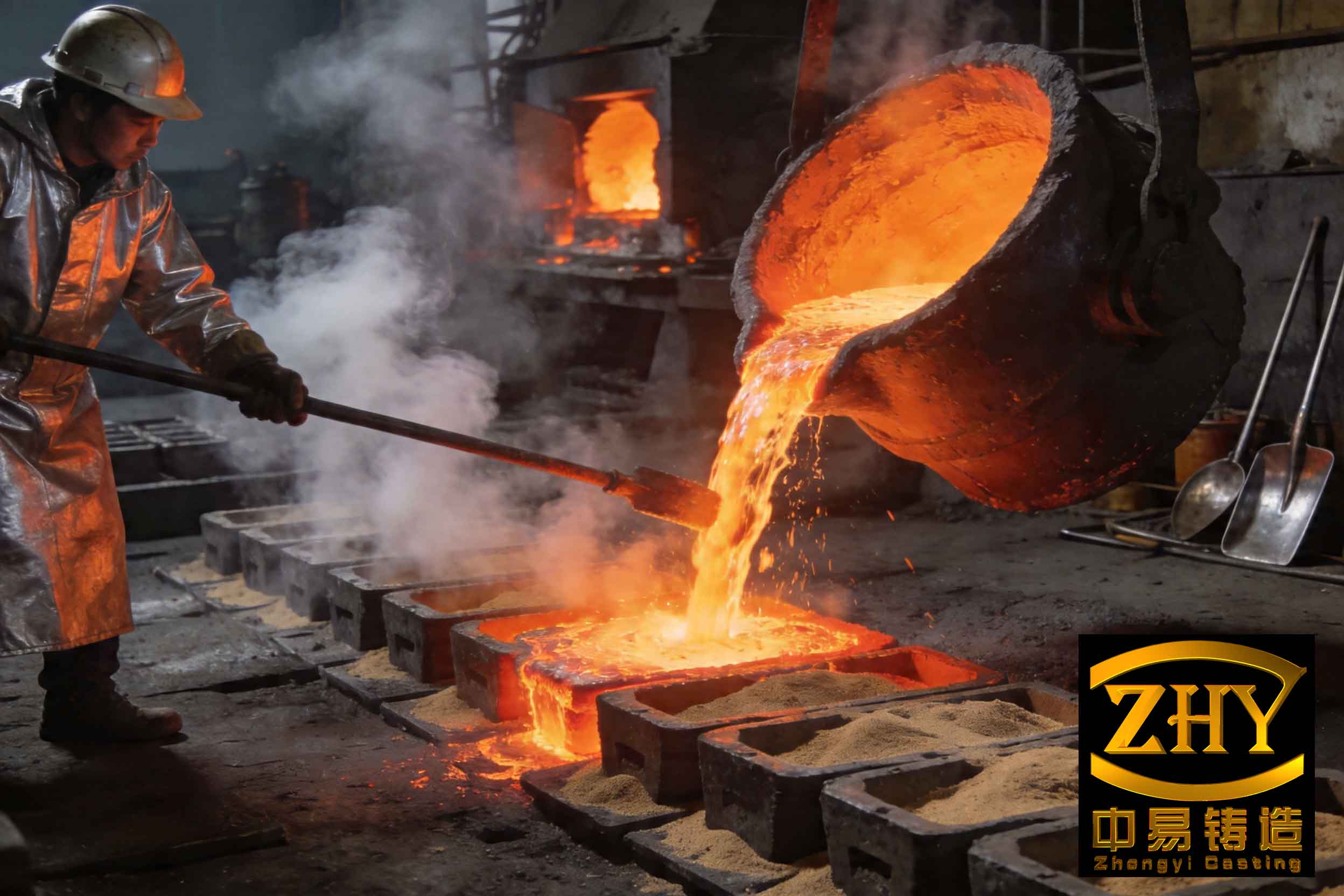
To understand the root causes, we conducted comprehensive analyses on raw materials, charge composition, and casting parameters. The primary suspects were fluctuating raw material quality, improper charge ratios, and suboptimal melting practices. We collected samples of pig iron, returns (recycled scrap), and scrap steel for chemical assay, and performed sand testing to rule out mold-related issues. The data revealed alarming trends: due to unreliable sourcing and inferior pig iron, coupled with inadequate testing protocols, the charge composition became imbalanced over time. This led to a vicious cycle where returns accumulated excessive impurities, trace elements were excessively burnt off, and the melt chemistry deviated from specifications. Specifically, high levels of sulfur and phosphorus, along with uncontrolled oxidation, fostered slag formation. The oxidation reactions in the liquid iron can be represented by basic thermodynamic equations. For instance, the formation of iron oxide slag from dissolved oxygen and iron is given by:
$$ \text{Fe (l)} + \frac{1}{2} \text{O}_2 (g) \rightarrow \text{FeO (l)} $$
This exothermic reaction, if uncontrolled, increases slag volume. Additionally, the presence of carbon and silicon influences gas evolution; for example, the reaction between carbon and oxygen produces carbon monoxide gas, contributing to porosity:
$$ \text{C (in iron)} + \text{O (in iron)} \rightarrow \text{CO (g)} $$
The interplay between slag inclusions and gas generation is complex, often described by kinetic models. The rate of slag inclusion formation, $R_{\text{slag}}$, can be approximated as a function of oxidation potential and impurity concentration:
$$ R_{\text{slag}} = k \cdot [\text{O}] \cdot [\text{Impurities}] $$
where $k$ is a rate constant dependent on temperature, and $[\text{O}]$ and $[\text{Impurities}]$ represent the concentrations of dissolved oxygen and non-metallic elements like sulfur, respectively. Our analysis confirmed that the melt’s oxygen content was excessive, and the ratio of beneficial to detrimental elements was skewed. The typical chemical compositions from our initial audits are summarized in Table 1, highlighting the variability and degradation in returns.
| Material | C | Si | Mn | P | S | Impurity Index |
|---|---|---|---|---|---|---|
| Pig Iron (Variable Source) | 3.8–4.2 | 1.5–2.0 | 0.3–0.6 | 0.08–0.12 | 0.04–0.08 | High |
| Returns (Accumulated) | 3.5–3.9 | 1.2–1.8 | 0.2–0.5 | 0.10–0.15 | 0.06–0.10 | Very High |
| Scrap Steel | 0.2–0.4 | 0.1–0.3 | 0.5–0.8 | ≤0.04 | ≤0.04 | Low |
The impurity index here is a qualitative measure of slag-forming propensity, derived from empirical correlations. It clearly shows that returns had become a major contributor to slag inclusions. Furthermore, the iron-to-coke ratio in the cupola furnace was misadjusted, leading to low tapping temperatures around 1350–1380°C, which exacerbated oxidation and slag fluidity issues. At such temperatures, the viscosity of slag increases, trapping gases and forming inclusions more readily. The relationship between temperature $T$ and slag viscosity $\eta$ can be modeled using an Arrhenius-type equation:
$$ \eta = A \cdot \exp\left(\frac{E}{RT}\right) $$
where $A$ is a pre-exponential factor, $E$ is activation energy, and $R$ is the gas constant. Lower $T$ results in higher $\eta$, promoting entrapment. Combined with inadequate fluxing (limestone addition at only 20–30% of coke weight), the slag remained viscous and poorly separated, leading to pervasive slag inclusions in castings.
Our corrective strategy involved a multi-pronged approach: stabilizing raw material inputs, optimizing charge composition, enhancing melting practice, and implementing in-process treatments. We first established stringent sourcing criteria for pig iron, mandating lower sulfur and phosphorus levels. Then, we redesigned the charge mix based on thermodynamic calculations to achieve a balanced composition. For illustration, the revised charge for one foundry line is shown in Table 2, along with key process parameters.
| Component | Percentage in Charge | Control Range | Rationale |
|---|---|---|---|
| Pig Iron (Selected Grade) | 40% | C: 3.6–3.8%, Si: 1.8–2.0% | Reduce impurity input |
| Returns (Limited Use) | 30% | Pre-screened for quality | Break accumulation cycle |
| Scrap Steel | 30% | Low S, P content | Dilute impurities, improve fluidity |
| Coke (Iron-to-Coke Ratio) | 8:1 | 7.5:1 to 8.5:1 | Ensure adequate temperature >1420°C |
| Limestone (as % of Coke) | 40% | 35–45% | Enhance slag basicity and separation |
| Ferrosilicon Addition | 0.8% of melt weight | 0.7–0.9% | Boost silicon for deoxidation |
| Ferromanganese Addition | 0.5% of melt weight | 0.4–0.6% | Improve toughness and reduce oxidation |
This reformulation aimed to lower the oxidation potential and control slag formation. The theoretical basis for deoxidation involves using silicon and manganese to bind oxygen. The reactions are:
$$ \text{Si} + 2\text{O} \rightarrow \text{SiO}_2 \quad \text{and} \quad \text{Mn} + \text{O} \rightarrow \text{MnO} $$
These oxides combine to form a less viscous slag that floats out easily. To quantify the deoxidation efficiency, we use the equilibrium constant $K$ for silicon deoxidation:
$$ K_{\text{Si}} = \frac{a_{\text{SiO}_2}}{[\%\text{Si}] \cdot [\%\text{O}]^2} $$
where $a_{\text{SiO}_2}$ is the activity of silica in the slag. By maintaining optimal silicon and oxygen levels, we minimized residual oxygen, thereby reducing both slag inclusions and gas holes. Additionally, we introduced a ladle treatment using soda ash (sodium carbonate) at the furnace spout. The soda ash acts as a flux to modify slag chemistry, lowering its melting point and improving fluidity for better removal. The reaction can be simplified as:
$$ \text{Na}_2\text{CO}_3 + \text{SiO}_2 \rightarrow \text{Na}_2\text{SiO}_3 + \text{CO}_2 $$
This generates a sodium silicate slag that is less likely to be entrapped. The amount added was 0.2–0.3% of the iron weight, timed to ensure thorough mixing before pouring.
The impact of these changes was monitored through rigorous testing. We cast numerous end covers and performed destructive and non-destructive evaluations. The chemical composition of the resulting iron improved markedly, as shown in Table 3, which compares typical values before and after intervention.
| Element | Before Optimization (Average) | After Optimization (Average) | Target Range |
|---|---|---|---|
| Carbon (C) | 3.6 | 3.4 | 3.3–3.5 |
| Silicon (Si) | 1.6 | 2.1 | 2.0–2.3 |
| Manganese (Mn) | 0.4 | 0.6 | 0.5–0.7 |
| Phosphorus (P) | 0.11 | 0.06 | ≤0.07 |
| Sulfur (S) | 0.07 | 0.03 | ≤0.04 |
| Oxygen Activity [O] (ppm) | 80–120 | 30–50 | <50 |
The reduction in sulfur and phosphorus directly lessened slag-forming tendencies, while higher silicon and manganese enhanced deoxidation. Oxygen activity, measured using electrochemical sensors, dropped significantly, confirming better control over oxidation. Consequently, the incidence of slag inclusions in end covers plummeted. Statistical process control data indicated that the defect rate for slag inclusions and gas holes fell from over 15% to below 2%, with scrap rates due to these issues now negligible. Yield improved to above 98%, translating to substantial economic benefits. A simple cost-benefit analysis, considering reduced scrap, lower rework, and increased output, showed annual savings exceeding $200,000 for our operation, validating the investment in process refinement.
To further elucidate the mechanisms, we delved into the dynamics of slag inclusion formation during solidification. In casting, slag particles can be entrapped at the advancing solid-liquid interface, especially in regions with turbulent flow or poor feeding. The critical velocity $v_c$ for entrapment relates to particle size $d_p$ and solidification rate $R$ through models like:
$$ v_c = \frac{R \cdot d_p}{\mu} $$
where $\mu$ is a dimensionless parameter depending on interface morphology. By optimizing pouring practices—such as using tapered sprue designs and maintaining steady flow—we reduced turbulence, minimizing opportunities for slag inclusions to be trapped. Additionally, we adjusted the gating system to promote slag flotation into risers, away from critical sections like bearing housings.
Beyond casting, we also addressed machining aspects, as surface finishing can reveal subsurface slag inclusions. For rotor and stator laminations, we employed welded carbide form milling cutters to ensure clean cuts without exacerbating defects. The tool materials, comprising a body of SCM435 (similar to AISI 4135) and carbide inserts of SPGN4203 (akin to ISO K10), offered high wear resistance. Cutting parameters were optimized based on silicon steel grades, as summarized in Table 4, to prevent tearing or exposing hidden slag inclusions.
| Parameter | Value Range | Notes |
|---|---|---|
| Workpiece Material | Hot/Cold Rolled Silicon Steel | Thickness 0.5–0.7 mm |
| Material Hardness | HRB 70–85 | Varies with grade |
| Cutting Speed (v) | 150–200 m/min | For carbide tools |
| Feed Rate (f) | 0.05–0.10 mm/tooth | Minimize burrs |
| Depth of Cut (a_p) | 0.3–0.5 mm | Below lamination edge thickness |
| Tool Life | 50,000–80,000 pieces | Depends on maintenance |
The cutting speed $v$ in m/min is derived from the spindle speed $N$ (rpm) and cutter diameter $D$ (mm):
$$ v = \frac{\pi D N}{1000} $$
Similarly, the feed per tooth $f_z$ relates to table feed $F$ (mm/min), number of teeth $z$, and $N$:
$$ f_z = \frac{F}{N \cdot z} $$
By keeping these parameters within optimal ranges, we achieved smooth surfaces that did not accentuate any residual slag inclusions, ensuring rotor balance and noise reduction. This holistic approach—from melting to machining—proved essential for overall quality.
Reflecting on the journey, the elimination of slag inclusions required a concerted focus on every stage of the production chain. Key lessons include the importance of raw material consistency, the value of thermodynamic modeling in charge design, and the effectiveness of in-process treatments like soda ash addition. We continue to monitor slag inclusion trends using statistical tools, such as control charts for defect counts, and are exploring advanced techniques like real-time melt spectroscopy for even finer control. The battle against slag inclusions is ongoing, but with these foundations, we have turned a chronic problem into a managed process variable, boosting both product reliability and plant profitability. In sharing this experience, I hope it underscores that slag inclusions, while challenging, can be systematically addressed through data-driven metallurgy and process discipline.