
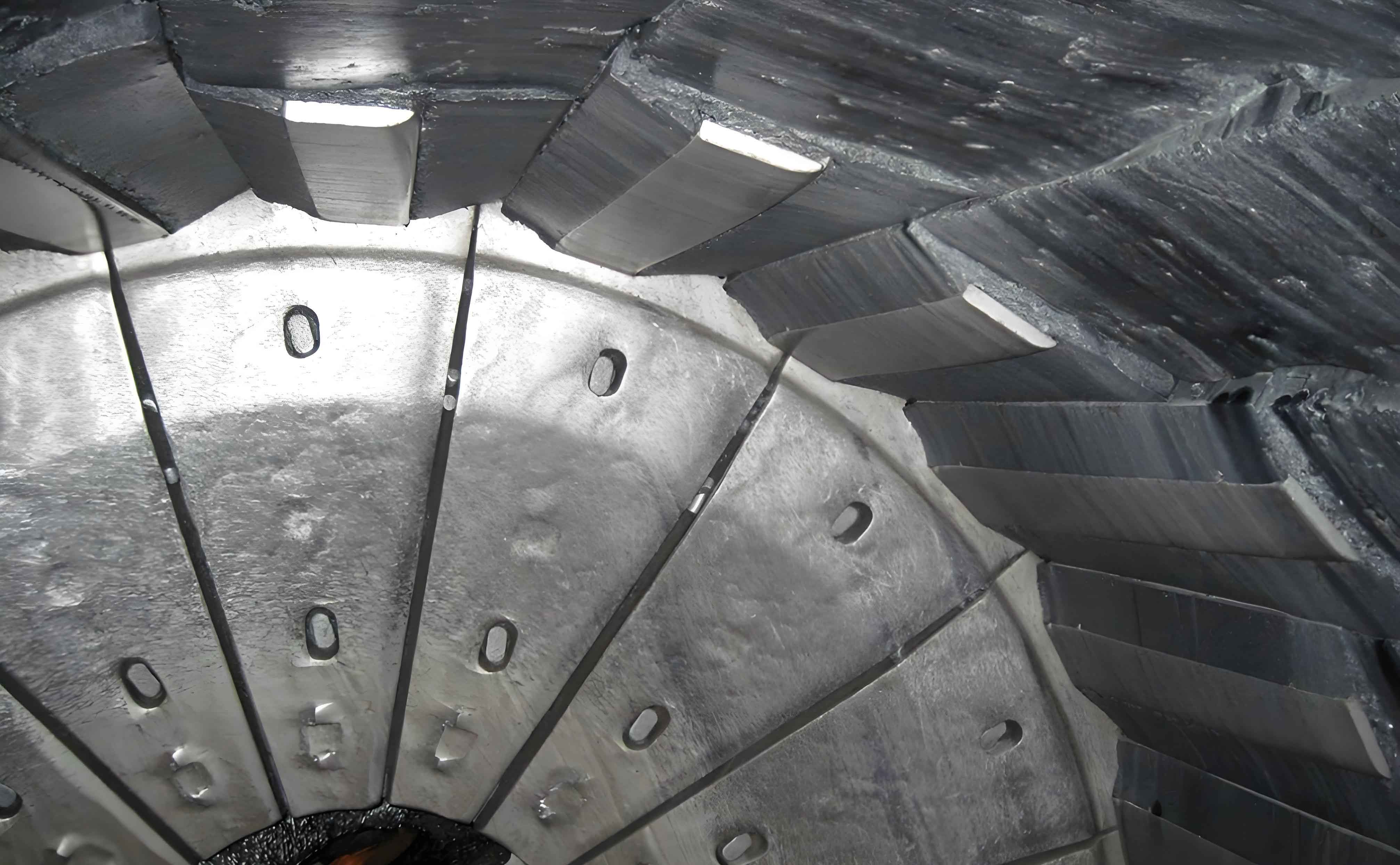
At our facility, we implemented a comprehensive energy-saving initiative targeting cement grinding power consumption. By replacing conventional lining plates with ultra-thin lining plates in the ball mill’s second compartment, we achieved significant reductions in energy usage while maintaining production output. The transformation involved three key modifications: installation of lightweight ultra-thin wave lining plates, optimization of activation ring configuration, and adjustment of grinding media gradation.
Cement Grinding System Configuration
The grinding process employs a roller press + V-separator + Φ4.2m×13m ball mill + separator circuit. Key equipment specifications are summarized below:
| Equipment | Specifications | Key Parameters |
|---|---|---|
| Roller Press | HFCG160-140 | Power: 2×1,120 kW |
| V-Separator | HFV4000 | Capacity: 750-1,100 t/h |
| Ball Mill | Φ4.2m×13m | Power: 3,550 kW |
| Separator | DS-4000 | Power: 200 kW |
The P·O 42.5 cement formulation comprises:
| Material | Proportion (%) |
|---|---|
| Clinker | 73 |
| Gypsum | 5 |
| Limestone | 5 |
| Fly Ash | 12 |
| Slag | 5 |
Ultra-Thin Lining Plate Transformation Strategy
The second compartment’s severely worn lining plates were replaced with ultra-thin lining plates featuring these specifications:
- Thickness: 30 mm (45.5% reduction)
- Unit mass: 12 kg
- Material: Medium-carbon multi-alloy steel
- Hardness: 50–55 HRC
- Impact toughness: 15–20 J/cm²
The mass reduction of the lining plate significantly decreased rotational inertia, directly lowering mill power demand. The relationship between lining plate mass and power consumption is expressed as:
$$ P \propto m \times r^2 \times \omega $$
where \( P \) = power consumption, \( m \) = lining plate mass, \( r \) = mill radius, and \( \omega \) = rotational velocity.
Supporting Process Optimization
Activation Ring Adjustment: Reduced from 6 to 3 circles (126 units total, 100 kg each), increasing material residence time. The grinding efficiency enhancement follows:
$$ \eta = k \cdot \left(1 – e^{-\lambda t}\right) $$
where \( \eta \) = grinding efficiency, \( k \) = material constant, \( \lambda \) = kinetic coefficient, and \( t \) = residence time.
Grinding Media Optimization: Adjusted gradation to accommodate increased effective volume from thinner lining plates:
| Compartment | Media Size (mm) | Loading (t) | Avg. Size (mm) |
|---|---|---|---|
| First | Pre: Ø50/40/30/25/20 | 60 → 48 | 27.8 → 30.8 |
| Post: Ø50/40/30/25/20 | |||
| Second | Pre: Ø30/25/20/17/15 | 150 → 133 | 19.5 → 16.8 |
| Post: Ø25/20/17/15/12 |
Operational Results
After six months of continuous operation with ultra-thin lining plates:
| Parameter | Pre-Transformation | Post-Transformation | Change |
|---|---|---|---|
| Lining Plate Mass | 27.22 t | 15.12 t | -44.5% |
| Grinding Media Load | 210 t | 181 t | -13.8% |
| Output | 220 t/h | 220 t/h | 0% |
| Specific Surface Area | 335 m²/kg | 352 m²/kg | +5.1% |
| Mill Current | 195 A | 170 A | -12.8% |
| Power Consumption | 30 kWh/t | 28.5 kWh/t | -5.0% |
The power reduction achieved through ultra-thin lining plate installation is quantified by:
$$ \Delta E = \frac{P_{\text{mill}} \cdot \Delta t}{Q} $$
where \( \Delta E \) = specific energy reduction (kWh/t), \( P_{\text{mill}} \) = mill power reduction (500 kW), \( \Delta t \) = operating hours, and \( Q \) = production quantity (t).
Economic Impact Analysis
Direct cost savings from ultra-thin lining plate implementation:
| Cost Category | Calculation | Savings (¥) |
|---|---|---|
| Lining Plates & Activation Rings | (27.22t – 15.12t) × ¥9,800/t | 219,794 |
| Grinding Media | (210t – 181t) × ¥7,500/t | 217,500 |
| Electricity (700,000t/yr) | (30 – 28.5) kWh/t × 700,000t × ¥0.65/kWh | 682,500 |
| Total Annual Savings | >1,000,000 |
The ultra-thin lining plate solution demonstrates that mass reduction directly contributes to energy efficiency:
$$ \frac{\Delta P}{P_0} = \alpha \cdot \frac{\Delta m}{m_0} $$
where \( \Delta P / P_0 \) = relative power reduction, \( \Delta m / m_0 \) = relative mass reduction of lining plate, and \( \alpha \) = system-specific coefficient (empirically ~0.85).
Conclusion
The ultra-thin lining plate transformation achieved a 1.5 kWh/t reduction in specific grinding energy while enhancing product quality. Key success factors included the 45.5% mass reduction of lining plates, optimized activation ring configuration, and adjusted grinding media gradation. This lining plate technology significantly lowered rotational inertia, reducing mill drive power by 500 kW without compromising output. Material savings from reduced lining plate and grinding media consumption, combined with energy cost reductions, generated over ¥1 million in annual savings. The ultra-thin lining plate solution proves to be a technically and economically viable approach for cement grinding optimization, with potential for industry-wide adoption.