
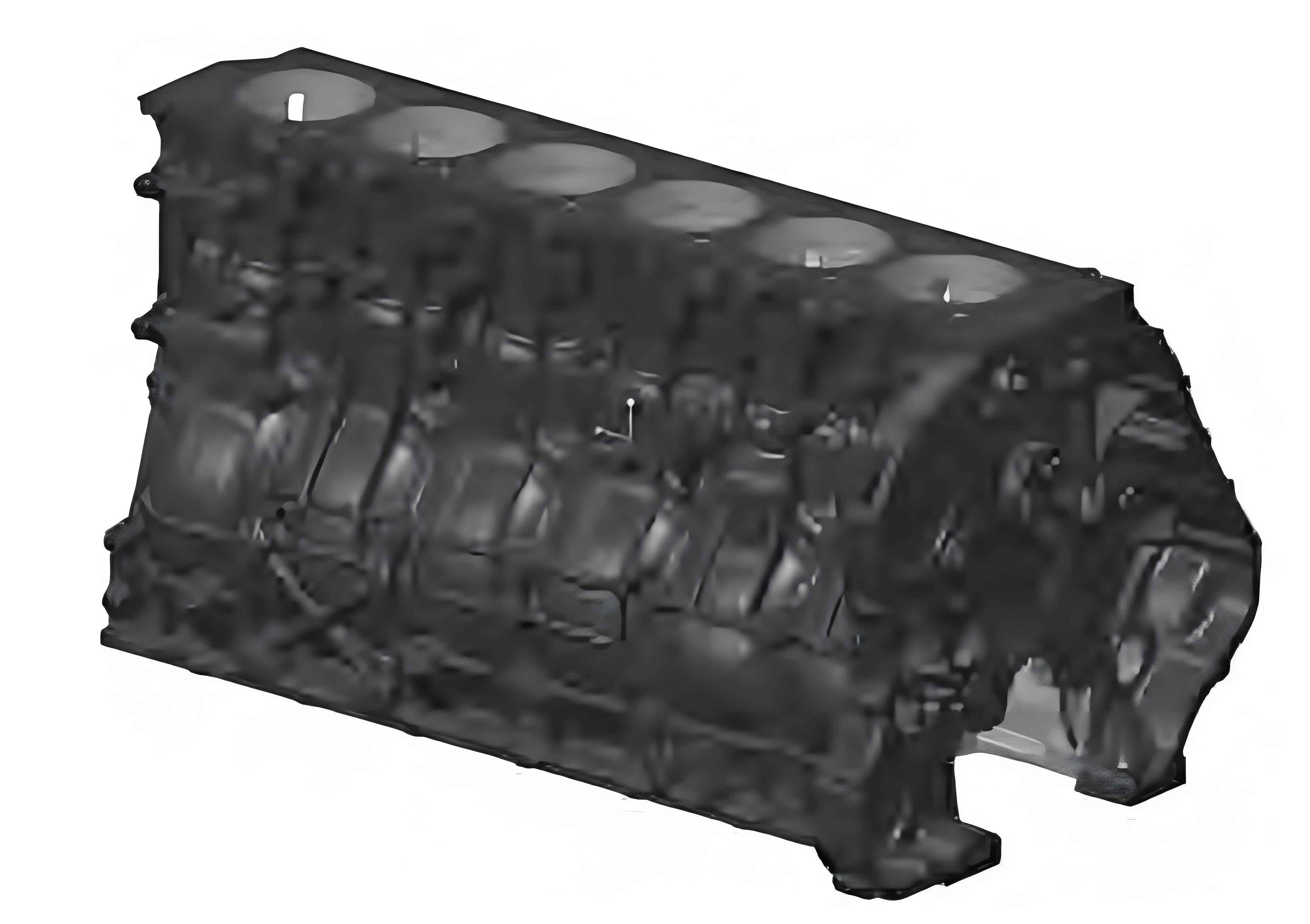
As the structural backbone of internal combustion engines, the engine cylinder block has undergone remarkable transformations through decades of technological innovation. This article explores traditional manufacturing approaches, contemporary material breakthroughs, and emerging thermal management strategies that define modern engine cylinder block development.
1. Traditional Manufacturing Paradigms
Conventional engine cylinder block production relied heavily on cast iron alloys, offering excellent thermal stability but significant weight penalties. The typical manufacturing workflow involved:
| Process Stage | Key Parameters | Limitations |
|---|---|---|
| Sand Casting | Wall thickness ≥4mm | Low dimensional accuracy |
| Machining | ±0.1mm tolerance | High material waste |
| Surface Treatment | Ra 1.6-3.2μm | Limited wear resistance |
The fundamental stress equation for traditional designs:
$$ \sigma_{max} = \frac{P \cdot r}{t} $$
Where:
σmax = Maximum hoop stress (MPa)
P = Combustion pressure (bar)
r = Cylinder radius (mm)
t = Wall thickness (mm)
2. Modern Material Innovations
Advanced materials have revolutionized engine cylinder block construction:
| Material | Density (g/cm³) | Thermal Conductivity (W/mK) | CTE (10⁻⁶/K) |
|---|---|---|---|
| Gray Iron | 7.1 | 54 | 11 |
| Al-Si Alloy | 2.7 | 155 | 21 |
| Hybrid Composite | 1.8-2.2 | 75-90 | 9-14 |
The weight reduction potential follows:
$$ W_{red} = 1 – \frac{\rho_{new}}{\rho_{old}} \cdot \frac{\sigma_{old}}{\sigma_{new}} $$
Where typical values for aluminum engine cylinder blocks yield 40-50% mass reduction compared to cast iron.
3. Advanced Cooling Strategies
Modern thermal management systems employ computational fluid dynamics (CFD) to optimize cooling jacket designs:
$$ Nu = 0.023 \cdot Re^{0.8} \cdot Pr^{0.4} $$
Where:
Nu = Nusselt number
Re = Reynolds number
Pr = Prandtl number
Coolant flow optimization matrix:
| Parameter | Conventional | Advanced |
|---|---|---|
| Flow Rate (L/min) | 80-100 | 120-150 |
| ΔT (Coolant, °C) | 8-10 | 4-6 |
| Heat Rejection (%) | 72 | 88 |
4. Friction Reduction Techniques
Surface engineering achieves remarkable friction coefficients in modern engine cylinder blocks:
$$ \mu = \frac{F_f}{N} = 0.001 \cdot e^{-0.05 \cdot Sn} + 0.03 $$
Where:
μ = Friction coefficient
Sn = Surface nanotexture parameter
Comparative coating performance:
| Coating Type | Thickness (μm) | Hardness (HV) | Wear Rate (10⁻⁶ mm³/Nm) |
|---|---|---|---|
| Plasma Spray | 150-200 | 450 | 2.8 |
| DLC | 2-5 | 2000 | 0.3 |
| Nanocomposite | 10-20 | 1200 | 0.9 |
5. Future Development Trends
The next-generation engine cylinder block integrates smart sensing capabilities with advanced manufacturing:
$$ M_{int} = \sum_{i=1}^{n} \frac{S_i \cdot E_i}{\rho_i} $$
Where:
Mint = Material integration index
S = Strength (MPa)
E = Elastic modulus (GPa)
ρ = Density (g/cm³)
Emerging technologies promise 15-20% efficiency improvements through:
- Additive manufacturing of conformal cooling channels
- Graphene-enhanced aluminum composites
- Self-healing surface treatments
The continuous evolution of engine cylinder block technology demonstrates remarkable progress in balancing performance, efficiency, and environmental requirements. As material science and manufacturing techniques advance, future engine cylinder blocks will likely incorporate adaptive structures and intelligent thermal management systems to meet increasingly stringent emission regulations while maintaining operational excellence.