
With increasingly stringent emission regulations, our research focuses on optimizing the manufacturing process of diesel engine cylinder blocks to achieve superior lubrication/cooling oil passage cleanliness. Through systematic analysis of contamination sources and process improvements, we developed targeted solutions that elevated particle size compliance from 82.8% to 98.2%.
1. Cleanliness Standards and Critical Requirements
The cleanliness of engine cylinder blocks is quantified through two key parameters:
$$ \text{Maximum Particle Size} = \max(d_i) $$
$$ \text{Total Contaminant Mass} = \sum m_i $$
| Component | Stage | Max Particle (mm) | Mass Limit (mg) |
|---|---|---|---|
| Oil Passages | NSVI | 1.0 | 20 |
| FC Stage IV | 0.75 | 20 | |
| Water Jacket | Both | 2.0 | 150 |
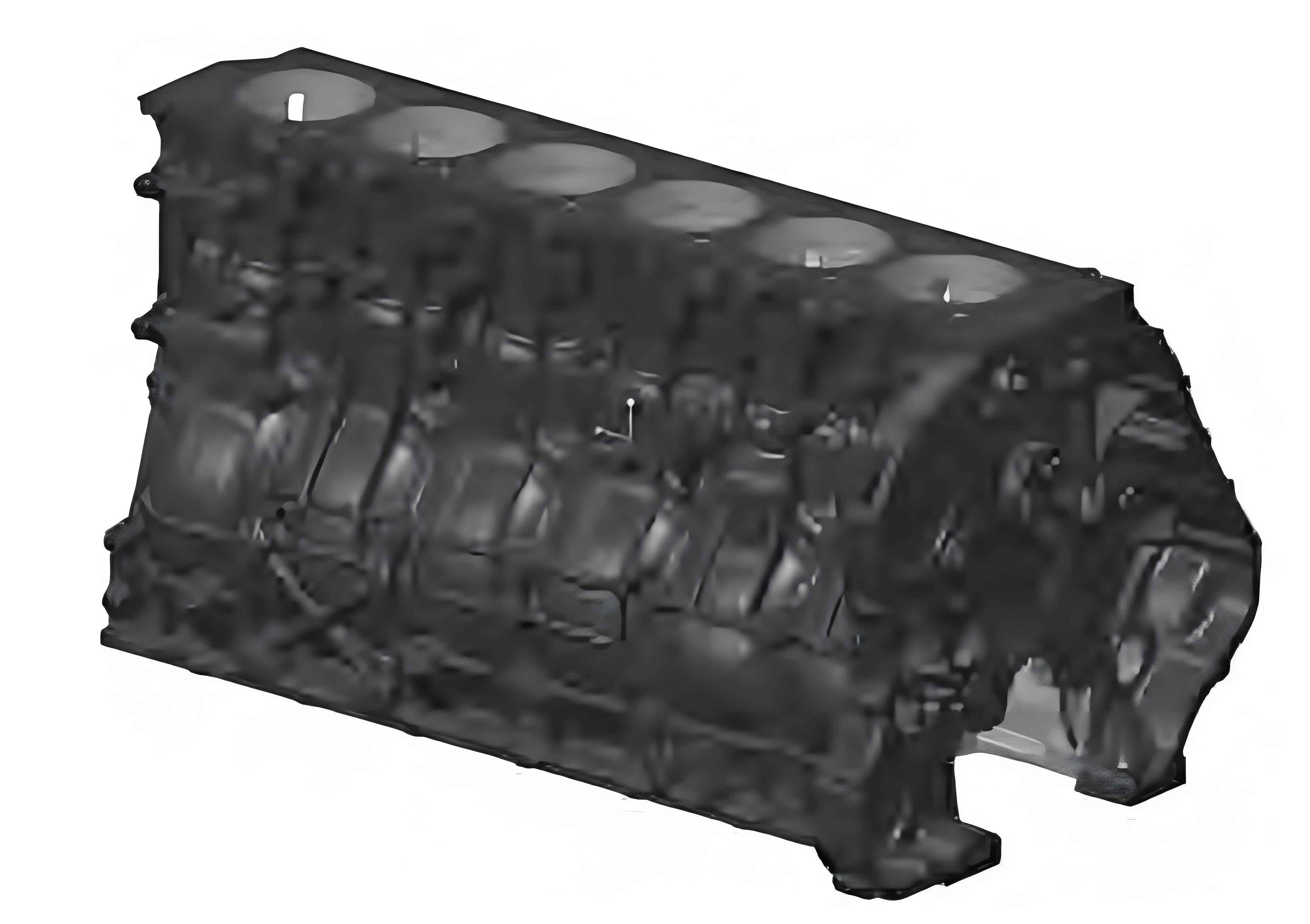
2. Contamination Source Analysis
Three primary contamination sources were identified in engine cylinder block production:
2.1 Casting Process Residues
Casting-generated impurities follow the distribution:
$$ P_c(d) = \frac{1}{\sigma\sqrt{2\pi}}e^{-\frac{(d-\mu)^2}{2\sigma^2}} $$
where μ represents average particle size (0.3-0.8mm) and σ standard deviation (0.15-0.25).
2.2 Machining Debris
Chip generation during drilling/boring operations can be modeled as:
$$ Q = k \cdot f^{0.8} \cdot d^{1.2} $$
Where:
Q = chip volume (mm³/s)
f = feed rate (mm/rev)
d = tool diameter (mm)
k = material constant (0.15 for cast iron)
2.3 Post-Processing Contamination
Cross-contamination probability during inspection follows:
$$ P_c = 1 – e^{-\lambda t} $$
Where λ = 0.03 contamination events/min, t = handling time
3. Comprehensive Improvement Strategy
3.1 Casting Process Optimization
Implemented statistical process control for critical parameters:
| Parameter | Control Limit | Measurement Frequency |
|---|---|---|
| Pouring Temperature | 1350°C ±15°C | Per heat |
| Sand Core Density | 1.65-1.75 g/cm³ | Hourly |
| Shot Blast Intensity | 0.35-0.45 MPa | Shiftly |
3.2 Machining Process Enhancement
Developed tool wear prediction model:
$$ T = \frac{C}{v^a f^b d^c} $$
Where:
T = tool life (min)
v = cutting speed (m/min)
C,a,b,c = material-specific constants
3.3 Cleaning System Upgrade
Modified cleaning sequence with enhanced parameters:
$$ \text{Cleaning Efficiency} = \frac{P \cdot t^{0.5} \cdot N}{A} $$
Where:
P = pressure (bar)
t = exposure time (s)
N = nozzle count
A = surface area (cm²)
| Station | Pressure (bar) | Time (s) | Nozzle Type |
|---|---|---|---|
| Surge Wash | 10 | 45 | Rotary |
| Fixed Wash 1 | 350 | 12 | Needle |
| Fixed Wash 2 | 250 | 8 | Fan |
4. Implementation Results
The optimized process demonstrated significant improvements in engine cylinder block cleanliness:
$$ \text{Process Capability Index} = \frac{USL – LSL}{6\sigma} $$
Improved from Cpk 0.83 to 1.32 for particle size control
Contamination distribution comparison:
| Particle Size (mm) | Original (%) | Improved (%) |
|---|---|---|
| 0-0.3 | 28.7 | 41.2 |
| 0.3-0.5 | 39.5 | 48.1 |
| 0.5-0.75 | 14.6 | 8.9 |
| >0.75 | 17.2 | 1.8 |
5. Maintenance and Monitoring System
Developed predictive maintenance model for cleaning equipment:
$$ R(t) = e^{-\lambda t^\beta} $$
Where:
λ = 0.0031 (failure rate)
β = 1.7 (Weibull shape parameter)
Real-time monitoring parameters for engine cylinder block cleanliness:
| Parameter | Sampling Rate | Control Limit |
|---|---|---|
| Filter Pressure Drop | Continuous | ≤0.8 bar |
| Wash Temperature | 1 Hz | 55±2°C |
| Detergent Concentration | 15 min | 2.5-3.0% |
This comprehensive approach ensures consistent production of high-quality engine cylinder blocks meeting Stage IV emission requirements, while maintaining production efficiency with only 6.3% cycle time increase. Continuous monitoring through advanced statistical process control maintains process capability above Cpk 1.3 for all critical cleanliness parameters.