
In the realm of precision manufacturing, lost wax casting remains a cornerstone for producing complex, high-integrity aviation components. As a practitioner deeply embedded in this field, I have witnessed firsthand the challenges posed by the multi-variety, small-batch nature of aviation castings, which often leads to inefficiencies in traditional lost wax casting processes. This article delves into the comprehensive strategies and innovations we have implemented to elevate production efficiency, thereby driving significant profitability gains. Through systematic upgrades across wax patterning, shell building, melting, finishing, and inspection—coupled with lean management principles—we have transformed our lost wax casting operations into a more automated, responsive, and cost-effective system.
The inherent complexity of aviation parts, characterized by intricate geometries and stringent quality requirements, necessitates elaborate gating systems in lost wax casting to mitigate defects like shrinkage porosity. Historically, this has rendered lost wax casting labor-intensive and prone to low throughput. However, by embracing technological advancements and cultural shifts within our organization, we have turned these challenges into opportunities. The following sections outline our journey, emphasizing how continuous improvement in lost wax casting has become a catalyst for business growth.
Central to our success has been a paradigm shift in organizational culture. We recognized that boosting efficiency in lost wax casting is not solely about hardware upgrades; it requires engaging every employee in the innovation process. To this end, we introduced several incentive-driven programs that foster a proactive mindset. For instance, our “Star Employee Rating” system rewards operators based on skill mastery, innovative ideas, and quality consciousness, directly tying performance to compensation. Additionally, an “Innovation Proposal Reward” scheme allows any team member to submit ideas for process improvements in lost wax casting, with bonuses calculated as a percentage of the annual savings realized. These initiatives have cultivated an environment where continuous improvement in lost wax casting is everyone’s responsibility, leading to numerous incremental gains that collectively enhance overall productivity.
Furthermore, we launched “3C Campaigns” (Cross-functional Collaboration Challenges) to tackle persistent bottlenecks in lost wax casting. These time-bound projects bring together engineers, technicians, and floor staff to devise solutions for specific issues, such as reducing shell-building time or optimizing wax injection parameters. Successes are celebrated with team rewards, reinforcing collective ownership. Complementing this, our “Cloud Motivation” platform uses a points-based system where employees earn credits for actionable suggestions, redeemable for tangible prizes. This holistic approach has democratized innovation, ensuring that efficiency enhancements in lost wax casting are driven from the ground up.
The wax pattern production phase in lost wax casting is critical, as it sets the foundation for dimensional accuracy and surface finish. Traditionally, this involved segregated tasks—injection, trimming, and assembly—leading to bottlenecks and workflow imbalances. Inspired by lean manufacturing principles like Just-In-Time (JIT), we reorganized our wax shop into compact, multi-skilled cells. Each cell operates as a self-contained unit where workers are trained to perform all steps, ensuring a smooth, paced flow without overproduction. To support this, we integrated advanced automated wax injection machines from MPI, which offer consistent pressure and temperature control, minimizing pattern defects. Moreover, we pioneered the use of “trim-free” molds designed for automation, drastically reducing manual rework. The synergy between cellular layout and high-equipment reliability has significantly accelerated wax pattern throughput in lost wax casting, as summarized in Table 1.
| Parameter | Before Upgrade | After Upgrade | Improvement |
|---|---|---|---|
| Cycle Time per Pattern (minutes) | 15 | 8 | 46.7% reduction |
| Defect Rate (%) | 5.2 | 1.8 | 65.4% reduction |
| Labor Hours per Batch | 40 | 22 | 45% reduction |
| Overall Equipment Effectiveness (OEE) | 68% | 85% | 17 percentage points increase |
Mathematically, the productivity gain can be expressed as:
$$ P_{\text{new}} = P_{\text{old}} \times (1 + \eta) $$
where \( P_{\text{new}} \) is the new output rate, \( P_{\text{old}} \) is the old output rate, and \( \eta \) is the efficiency improvement factor. For our wax pattern line, \( \eta \) averaged 0.5 over two years, indicating a 50% boost in capacity.
Shell building in lost wax casting is notoriously labor-intensive, especially for aviation components with deep cavities and complex cores. Manual dipping and stuccoing are variable and fatigue-prone, impacting quality. Our response was to develop flexible automation solutions tailored to the high-mix, low-volume nature of lost wax casting. We deployed robotic arms and manipulators for both large and small patterns, programming them to handle diverse geometries. These systems ensure consistent slurry coating thickness and drying times, key factors in shell integrity. The automation of lost wax casting shell production has not only cut labor costs by 60% but also reduced shell-related scrap by 30%, as the robots eliminate human inconsistencies. A dedicated small-batch cell uses collaborative robots (cobots) that can be quickly reprogrammed for new patterns, enhancing flexibility without sacrificing efficiency.
To quantify the impact, consider the shell-building yield \( Y_s \), defined as the ratio of acceptable shells to total shells produced. With automation, \( Y_s \) increased from 0.88 to 0.96, meaning:
$$ Y_s = \frac{N_{\text{acceptable}}}{N_{\text{total}}} $$
This 8% yield uplift translates directly to lower material waste and rework costs in lost wax casting.
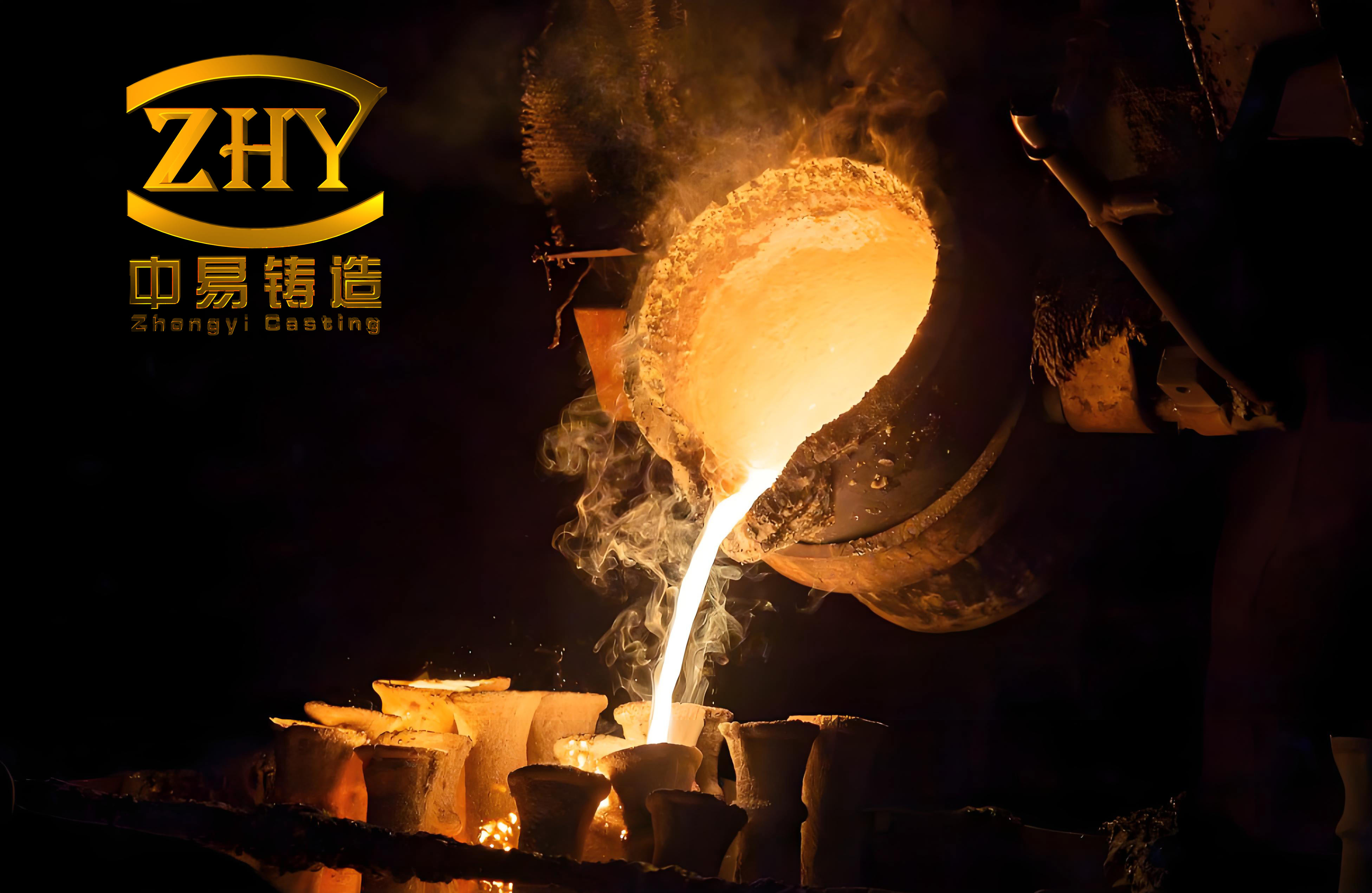
Melting and pouring are pivotal stages in lost wax casting where time and temperature control dictate metallurgical quality. For stainless steel alloys, we adopted tilt-pour furnaces that melt and pour in a single, rapid cycle. Each furnace now handles 25 kg of metal, with a melt-to-pour time of 5–6 minutes. This allows three operators to manage 60 heats per shift, a stark contrast to the slower, batch-oriented methods previously used. The efficiency leap can be modeled using a throughput formula:
$$ T = \frac{n \cdot m}{t} $$
where \( T \) is throughput (kg/hour), \( n \) is number of heats, \( m \) is mass per heat (kg), and \( t \) is time (hours). With \( n = 60 \), \( m = 25 \), and \( t = 8 \) hours, \( T = 187.5 \) kg/hour, a 40% increase over prior rates.
For aluminum aviation castings produced via permanent mold lost wax casting, we redesigned gating systems to accommodate robotic pouring. Originally, each mold required 2–3 operators; now, a single worker oversees a robotic arm that pours into two molds simultaneously. This innovation in lost wax casting reduces labor density while improving pour consistency, critical for thin-walled aviation parts. The robotic system’s precision minimizes turbulence, thereby enhancing metal quality and reducing oxide inclusions.
Post-casting operations like cutting, grinding, and blasting are arduous and quality-sensitive in lost wax casting. Aviation parts often have elaborate gating and tight tolerances, making manual finishing prone to errors and delays. We invested in developing automated cutting and grinding stations equipped with custom fixtures for different part families. Although these systems are still being refined, they have already reduced finishing time by 35% and decreased scrap due to overgrinding by 20%. The cost savings from avoided rework are substantial, reinforcing the value of automation in lost wax casting finishing. Table 2 contrasts key metrics before and after automation.
| Metric | Manual Finishing | Automated Finishing | Change |
|---|---|---|---|
| Average Time per Part (minutes) | 45 | 29 | 35.6% reduction |
| Scrap Rate (%) | 4.5 | 2.7 | 40% reduction |
| Labor Cost per Unit ($) | 12.50 | 8.00 | 36% reduction |
| First-Pass Yield (%) | 85 | 92 | 7 percentage points increase |
The overall equipment effectiveness (OEE) for finishing, a composite metric, improved from 70% to 84%, driven by gains in availability, performance, and quality. In lost wax casting, such enhancements directly lower cost per part and accelerate time-to-market.
Quality assurance in aviation lost wax casting demands rigorous non-destructive testing (NDT) and dimensional verification. To expedite these processes, we integrated advanced inspection technologies. Real-time digital radiography (X-RAY) allows immediate detection of internal flaws, while an automated fluorescent penetrant line speeds up surface crack inspection. For dimensional control, we employ 3D scanners that capture part geometry in minutes, comparing it to CAD models with micron-level accuracy. Additionally, flexible borescopes enable thorough examination of internal passages without disassembly. These smart inspection tools have slashed inspection time by 50% and improved defect detection rates by 25%, ensuring that quality bottlenecks do not hinder the efficiency gains achieved elsewhere in lost wax casting.
The cumulative effect of these initiatives is a robust elevation in overall operational efficiency. By leveraging automation, lean practices, and employee engagement, we have transformed our lost wax casting facility into a high-performance hub. The profit impact can be estimated using a simplified model:
$$ \Delta \Pi = (R – C_{\text{new}}) – (R – C_{\text{old}}) = C_{\text{old}} – C_{\text{new}} $$
where \( \Delta \Pi \) is the increase in profit, \( R \) is revenue (assumed constant for volume), and \( C \) represents total costs. With reductions in labor, scrap, and rework, \( C_{\text{new}} \) is markedly lower, boosting margins. Specifically, our lost wax casting line now operates at a 22% higher productivity rate, with a 18% decrease in unit production cost. These figures underscore how targeted efficiency measures in lost wax casting can drive substantial business profitability.
In conclusion, the journey to enhance lost wax casting for aviation components is multifaceted, requiring technological investments and human-centric strategies. Through systematic upgrades in wax patterning, shell building, melting, finishing, and inspection—all underpinned by a culture of continuous improvement—we have realized significant efficiency gains. The integration of automation tailored to high-mix, low-volume production has been particularly pivotal, reducing reliance on manual labor while improving quality consistency. As the aviation industry evolves, the ability to adapt and innovate in lost wax casting will remain key to sustaining competitive advantage and profitability. Our experience demonstrates that with a holistic approach, lost wax casting can transcend its traditional limitations, emerging as a dynamic, efficient, and profitable manufacturing solution.