
In my experience working with foundry operations, improving the surface quality of machine tool castings has been a critical focus, especially for export markets where aesthetic appeal and precision are paramount. The demand for high-performance machine tool castings necessitates a comprehensive approach, integrating advanced casting technologies, rigorous quality control, and innovative process optimizations. This article delves into the methodologies and practices we have adopted to elevate the surface integrity of machine tool castings, ensuring they meet international standards. I will discuss key aspects such as surface quality metrics, inspection techniques, process and tooling design enhancements, molding materials, coatings, cleaning procedures, and molten iron treatment, all aimed at producing superior machine tool castings.
The surface quality of machine tool castings encompasses several critical indicators that directly impact the final product’s performance and appearance. These include dimensional accuracy, geometric tolerances, surface凹凸度 (such as fins, sand inclusions, flow marks, shrinkage cavities, and protrusions), surface cleanliness (evaluated by the percentage of non-contaminated surface area), flatness deviations, surface roughness for non-machined surfaces, and轮廓清晰度 of structural elements like bosses, windows, and pads. Establishing a robust standard system is essential for consistent quality in machine tool castings. Below is a table summarizing these surface quality indicators and their significance for machine tool castings:
| Indicator | Description | Standard Reference |
|---|---|---|
| Dimensional Accuracy | Precision in overall dimensions and critical features | Based on internal standards stricter than national norms |
| Surface凹凸度 | Presence of defects like fins, sand inclusions, etc. | Visual and comparative assessment |
| Surface Cleanliness | Freedom from sand, coatings, rust, etc. | Percentage-based evaluation |
| Flatness Deviation | Deviation from ideal planar surfaces | Measured with straight edges or comparators |
| Surface Roughness | Texture of non-machined surfaces | Achievable down to $$R_a = 12.5 \, \mu m$$ or lower |
| 轮廓清晰度 | Sharpness of structural details | Visual inspection criteria |
To ensure these standards are met, we employ various inspection methods tailored for machine tool castings. Platform marking inspection is used for critical or new castings, aligning with dimensional tolerance and machining allowance standards. Comparative methods involve using standard templates against the actual castings, while straightedge checks apply to general castings. Indirect measurement techniques and visual observations complement these, providing a holistic assessment. For instance, surface roughness is quantified using profilometers, and the formula for calculating cleanliness percentage is given by: $$ \text{Cleanliness} = \left( \frac{A_{\text{clean}}}{A_{\text{total}}} \right) \times 100\% $$ where $$A_{\text{clean}}$$ is the uncontaminated surface area and $$A_{\text{total}}$$ is the total surface area. This rigorous inspection framework is vital for maintaining the high quality expected in machine tool castings.
In process and tooling design, we prioritize minimizing parting lines to reduce defects like fins and surface irregularities in machine tool castings. By optimizing the number of parting surfaces, we enhance the overall integrity of the mold and cores, leading to better轮廓清晰度 and reduced凹凸度. For example, in complex machine tool castings, we aim for a single parting plane wherever possible. Additionally, the selection of process parameters is critical; we conduct extensive trials to determine optimal values. Draft angles are kept to a minimum, using the thickness addition/subtraction method, and we account for parting line negatives and shrinkage compensation. The shrinkage rate for machine tool castings is determined experimentally, often varying by direction. The general formula for linear shrinkage is: $$ \text{Shrinkage} = \frac{L_{\text{pattern}} – L_{\text{casting}}}{L_{\text{pattern}}} \times 100\% $$ where $$L_{\text{pattern}}$$ is the pattern dimension and $$L_{\text{casting}}$$ is the final casting dimension. For instance, a bed casting might have shrinkage rates of 0.8% in length, 0.6% in width, and 1.0% in height, based on trial results.
We also integrate the latest casting technologies to mitigate surface defects in machine tool castings. This includes applying principles like equilibrium solidification and large-gate outflow, which improve feeding and reduce shrinkage. Advanced cupola melting techniques are employed to achieve high molten iron temperatures, essential for minimizing gas and slag inclusions. The use of fiber filters in molds helps purify the iron, enhancing the surface quality of machine tool castings. Moreover, our mold and pattern fabrication adapts to the diverse product range typical of small to medium-sized foundries. For long-term use, we employ shell patterns made of steel plates filled with low-grade wood, combining durability and cost-effectiveness. These are assembled from standard and custom components, allowing flexibility. Core boxes feature standardized sleeve structures with interchangeable internal parts made of quality wood or cast aluminum, ensuring precision in machine tool castings. The cost of these molds is only 30-40% of full-metal molds, yet they deliver comparable dimensional accuracy and surface finish, making them ideal for variable production demands.
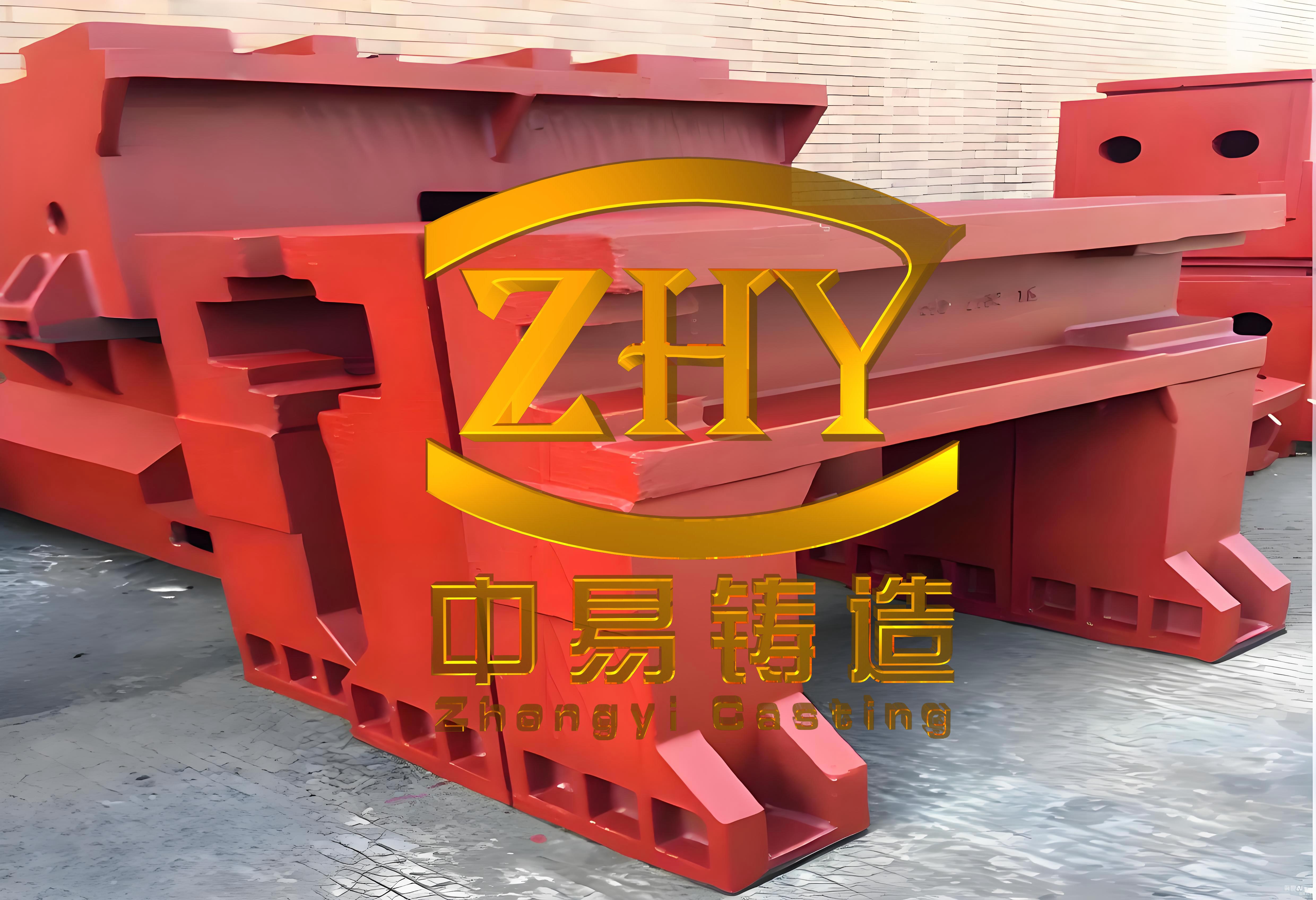
Molding materials and coatings play a pivotal role in achieving the desired surface quality for machine tool castings. For small castings, we use green sand with specific requirements: fine-grained sand (AFS 70-100), low clay content (preferably below 5%), natural sodium bentonite, a blend of high-quality coal dust and heavy oil, and controlled moisture and mixing processes. For medium to large castings, we opt for clay sand with surface-dried molds, emphasizing low expansion to prevent deformation and high permeability to avoid gas defects. The cores for these machine tool castings are made from resin self-setting sand, which significantly improves internal surface quality by reducing gas porosity and ensuring proper venting. The table below outlines the typical composition and properties of molding sands used for machine tool castings:
| Molding Material Type | Key Properties | Application in Machine Tool Castings |
|---|---|---|
| Green Sand | AFS 70-100, clay <5%, sodium bentonite, coal dust/oil blend | Small castings with high surface finish requirements |
| Clay Sand (Surface-Dried) | Coarse quartz-feldspar sand, high bentonite quality, good permeability | Medium to large castings to minimize expansion and gas defects |
| Resin Self-Setting Sand | Controlled resin addition, optimized venting | Cores for internal surfaces, enhancing cleanliness and轮廓清晰度 |
Coatings are crucial for refining surface roughness in machine tool castings, often achieving values as low as $$R_a = 12.5 \, \mu m$$ to $$6.3 \, \mu m$$, and eliminating defects like sand adhesion and inclusions. Our coating formulation includes: 60% graphite sieved to 200 mesh, 30% flake graphite sieved to 100 mesh, 5% activated bentonite, 2% sodium carboxymethyl cellulose, and water. The mixing process involves dry blending in a 100-liter mixer for 10 minutes, then adding pre-soaked activated bentonite and water, followed by 2 hours of milling to a paste consistency. For application, we adjust the density: first coat at 1.4–1.5 g/cm³, second coat at 1.2–1.3 g/cm³. Cores are primarily dipped for efficiency and smoothness, while molds are brush-coated. This approach ensures uniform coverage and superior surface quality for machine tool castings.
Cleaning of machine tool castings is essentially a beautification process that enhances surface integrity. For small castings, we start with rough cleaning in hexagonal barrels, followed by precision treatment in shot blasting rotary tables, and finish with dust-extracted grinders before applying anti-rust paint. For medium and large machine tool castings, we use vibrating shakeout machines to dislodge sand lumps, then proceed to shot blasting chambers, and finally manual grinding with portable tools. This staged cleaning ensures that all surface imperfections are addressed, resulting in machine tool castings that meet export-grade aesthetics. The entire process is designed to maintain the high standards required for machine tool castings, with each step carefully monitored for consistency.
Molten iron quality significantly impacts the surface quality of machine tool castings, particularly in terms of impurity and gas content. High levels of iron oxide can lead to slag inclusions or blowholes, while excessive gases cause subsurface porosity. To counteract this, we focus on elevating molten iron temperature and maintaining a well-instrumented cupola operation. The principle of “high temperature holding, low temperature pouring” guides our pouring practices, reducing defects like gas holes, shrinkage, and sand adhesion. The relationship between temperature and gas solubility can be expressed using Sieverts’ law: $$ C = k \sqrt{P} $$ where $$C$$ is the gas concentration, $$k$$ is a constant, and $$P$$ is the partial pressure. By controlling these factors, we ensure that the iron for machine tool castings is of optimal quality. Additionally, we use thermocouples and spectral analysis to monitor composition, aiming for temperatures above 1420°C to minimize oxidation and gas absorption. The table below summarizes key parameters in molten iron treatment for machine tool castings:
| Parameter | Target Value | Impact on Machine Tool Castings |
|---|---|---|
| Molten Iron Temperature | >1420°C | Reduces slag and gas defects, improves fluidity |
| Holding Time | 5-10 minutes | Allows for degassing and impurity floating |
| Pouring Temperature | 1350-1400°C | Minimizes thermal shocks and surface defects |
| Gas Content (e.g., H₂, N₂) | <50 ppm | Prevents porosity and pinholes |
In conclusion, through a systematic approach encompassing standardized metrics, advanced inspections, optimized processes, and rigorous material controls, we have significantly enhanced the surface quality of machine tool castings. The integration of these practices has not only improved the aesthetic appeal but also the functional reliability of machine tool castings, positioning them competitively in global markets. Continuous innovation and adherence to high standards remain central to our efforts in producing top-tier machine tool castings. As we move forward, we plan to explore further advancements in digital modeling and real-time monitoring to push the boundaries of quality in machine tool castings.