
In the realm of steel castings production, defects such as slag eyes, gas porosity, and sand inclusions are pervasive challenges that not only mar the aesthetic appeal of the components but also compromise their mechanical integrity and performance. These imperfections can lead to increased scrap rates, elevated production costs, and potential failures in critical applications. As a practitioner deeply involved in process optimization for steel castings, I have encountered numerous instances where gas and slag porosity defects have plagued high-value components. Through systematic investigation and iterative improvements, I have developed a methodology that significantly reduces these defects, particularly in complex steel castings like pin sockets used in hydraulic systems. This article delves into the root causes, analytical frameworks, and practical solutions, emphasizing the role of advanced filtration techniques and process controls. The insights shared here are based on hands-on experience in foundry environments, where the pursuit of excellence in steel castings is paramount.
The significance of addressing porosity in steel castings cannot be overstated. Porosity defects often arise from entrained slag, air bubbles, or non-metallic inclusions during the melting, pouring, and solidification stages. For critical steel castings, such as those subjected to high stress or stringent non-destructive testing standards, even minor defects can lead to rejection. In my work, I focused on a specific pin socket casting, which had a weight of 36 kg and required compliance with magnetic particle inspection standards like ASTMA903 M Grade II. This component, produced in automated molding lines using sodium silicate sand molds and resin sand cores, initially suffered from a scrap rate of approximately 5% due to gas and slag porosity, with 90% of pieces requiring extensive welding repairs. This not only slowed production but also introduced quality risks. The defect morphology, as observed under scanning electron microscopy, revealed entrapped slag particles and gas cavities, typical of turbulence and impurity entrainment in steel castings.
To understand the defect genesis, I analyzed the original process design. The initial gating system for these steel castings featured a top-pouring arrangement with a runner in the cope section, leading to turbulent metal flow and inadequate slag trapping. The pouring temperature was set between 1560°C and 1570°C, which, combined with a relatively slow pouring time, allowed slag to remain suspended in the molten metal. Moreover, the use of high percentages of revert materials (over 40%) introduced impurities, while low refractoriness of ladle linings contributed to additional slag formation. The gating system’s cross-sectional areas were not optimized, causing metal跳水 (a term describing abrupt flow transitions) and air aspiration. These factors collectively exacerbated porosity in the steel castings, particularly on the upper surfaces of the castings.
My approach to resolving these issues in steel castings involved a multi-faceted strategy, centered on enhancing metal purity, optimizing flow dynamics, and implementing superior filtration. Below, I summarize the key measures in a tabular format to provide clarity:
| Improvement Area | Specific Action | Rationale | Impact on Steel Castings |
|---|---|---|---|
| Metal Purification | Use of dry, oil-free, rust-free scrap steel; limit revert to below 40% | Reduces oxide inclusions and slag sources | Enhances melt cleanliness, decreasing defect initiation sites |
| Pouring Parameters | Increase pouring temperature to 1590-1600°C; reduce pouring time to 20-25 seconds | Improves fluidity and slag flotation; minimizes reoxidation | Promotes slag separation and smoother filling, reducing porosity in steel castings |
| Gating System Design | Relocate runner to drag; adopt open gating; calculate cross-sectional areas | Minimizes turbulence and air entrapment; ensures steady flow | Prevents metal跳水 and gas aspiration, critical for defect-free steel castings |
| Filtration Technology | Install super filters (75 mm × 50 mm × 20 mm, 20 ppi zirconia) in runner | Captures fine inclusions and reduces flow velocity | Significantly lowers slag and gas entrainment, improving surface and internal quality of steel castings |
The implementation of super filtration was a cornerstone of this improvement campaign for steel castings. Traditional filters often have limited pore density and thickness, but super filters, with their higher pore count per inch (ppi) and thinner profiles, excel at trapping microscopic inclusions and stabilizing metal flow. In the context of steel castings, this technology is transformative. The filter’s performance can be modeled using fluid dynamics principles. For instance, the pressure drop across the filter, which affects metal flow, can be approximated by the Darcy-Forchheimer equation:
$$ \Delta P = \frac{\mu \cdot L \cdot v}{k} + \beta \cdot \rho \cdot v^2 $$
where \( \Delta P \) is the pressure drop, \( \mu \) is the dynamic viscosity of molten steel, \( L \) is the filter thickness, \( v \) is the approach velocity, \( k \) is the permeability, \( \beta \) is the inertial coefficient, and \( \rho \) is the density. For steel castings, optimizing \( v \) (typically below 0.5 m/s) and \( L \) (around 20 mm) ensures efficient filtration without excessive flow resistance. The filter’s pore density (20 ppi) translates to a high surface area for impurity capture, crucial for enhancing the purity of steel castings.
To quantify the gating system modifications, I recalculated the cross-sectional areas based on the ladle nozzle diameter of 50 mm. The ladle orifice area \( A_{\text{nozzle}} \) is:
$$ A_{\text{nozzle}} = \pi \times \left( \frac{50}{2} \right)^2 = 1963.5 \, \text{mm}^2 $$
The sprue area was designed to be slightly larger to prevent suction, with a diameter of 60 mm, giving:
$$ A_{\text{sprue}} = \pi \times \left( \frac{60}{2} \right)^2 = 2827.4 \, \text{mm}^2 $$
The runner, relocated to the drag, had a rectangular cross-section of 65 mm × 63 mm × 47 mm, resulting in an area of approximately 3065 mm², ensuring a progressive decrease in velocity and promoting laminar flow for steel castings. The inclusion of the super filter in the runner further reduced the inlet velocity, as the filter’s open area (about 50% of its face area) acted as a flow regulator. This design is pivotal for achieving high-integrity steel castings.
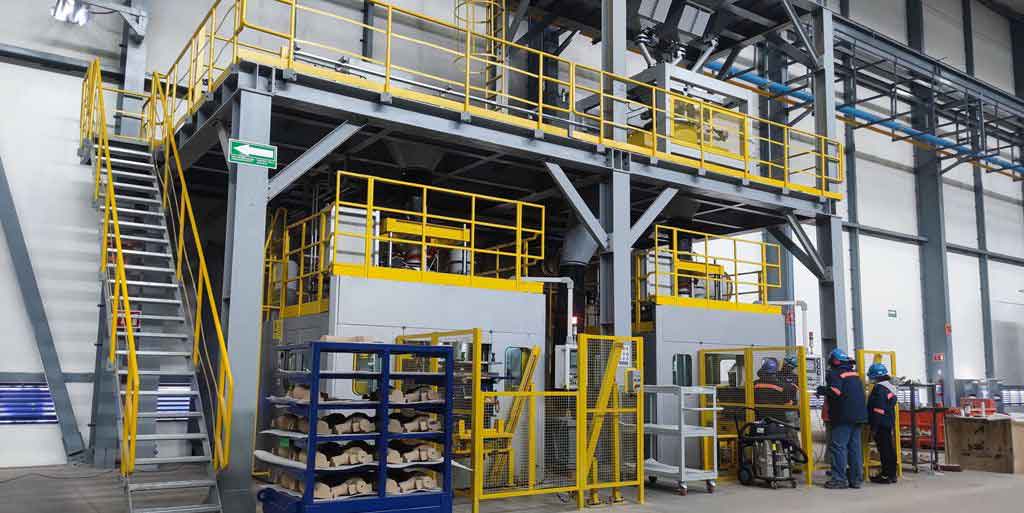
The above image illustrates typical equipment used in the production of steel castings, highlighting the importance of advanced tools in mitigating defects. In my project, similar setups were employed to integrate super filters into the molding process, ensuring precise placement for optimal performance in steel castings.
Another critical aspect was controlling the pouring temperature and time. For steel castings, the relationship between temperature, viscosity, and slag flotation can be expressed using Stokes’ law, which governs the settling velocity of particles in a liquid:
$$ v_s = \frac{2 (\rho_p – \rho_f) g r^2}{9 \mu} $$
where \( v_s \) is the settling velocity, \( \rho_p \) is the density of slag particles, \( \rho_f \) is the density of molten steel, \( g \) is gravitational acceleration, \( r \) is the particle radius, and \( \mu \) is the viscosity. By increasing the pouring temperature from 1565°C to 1595°C, the viscosity \( \mu \) of the steel melt decreases significantly, enhancing \( v_s \) and allowing slag to float more rapidly. Coupled with a shorter pouring time (20-25 seconds), this minimizes the window for defect formation in steel castings. Empirical data from my trials showed that this adjustment alone reduced visible slag defects by 30% in preliminary batches of steel castings.
The effectiveness of these improvements was validated through extensive production runs. Over a period of three months, 1000 pieces of pin socket steel castings were manufactured using the revised process. The scrap rate due to gas and slag porosity dropped dramatically to 0.1% (only 1 defective piece out of 1000), compared to the previous 5%. Moreover, the need for welding repairs decreased from 90% to less than 10%, accelerating throughput and enhancing the reliability of steel castings. Visual inspection post-shot blasting revealed clean upper surfaces with no discernible porosity, confirming the success of the measures. To further illustrate the outcomes, I present a comparative analysis of key metrics before and after implementation:
| Performance Metric | Before Improvement | After Improvement | Improvement Percentage |
|---|---|---|---|
| Scrap Rate Due to Porosity | 5% (111 out of 2223 pieces) | 0.1% (1 out of 1000 pieces) | 98% reduction |
| Welding Repair Rate | 90% of pieces required repairs | Less than 10% of pieces required repairs | Over 88% reduction |
| Pouring Temperature Range | 1560-1570°C | 1590-1600°C | Increased by 20-30°C |
| Filter Usage | None or conventional filters | Super filters (20 ppi zirconia) | Enhanced filtration efficiency |
These results underscore the transformative impact of targeted interventions on the quality of steel castings. The super filter technology, in particular, proved indispensable. Its mechanism involves not only physical trapping but also flow rectification, which reduces turbulence-induced gas entrainment. For steel castings, this dual action is vital, as gas porosity often coexists with slag defects. The filter’s thin profile (20 mm) and high pore density (20 ppi) create a tortuous path for molten metal, capturing inclusions as small as 0.1 mm while maintaining adequate flow rates. This aligns with industry trends toward precision filtration in steel castings production.
In addition to technical adjustments, process discipline played a key role. For instance, enforcing strict controls on raw materials—such as using only certified low-sulfur scrap and preheated alloys—minimized hydrogen and nitrogen sources that could lead to gas porosity in steel castings. The ladle lining materials were upgraded to high-alumina refractories with superior thermal shock resistance, reducing slag generation during pouring. Furthermore, the molding process was optimized to ensure proper venting in the drag section, allowing any residual gases to escape during solidification of steel castings. These holistic measures reinforced the primary improvements, creating a robust system for defect prevention in steel castings.
To generalize the findings for broader application in steel castings, I developed a predictive model for porosity risk based on process parameters. The model incorporates factors like pouring temperature \( T \), filter pore density \( N \) (in ppi), and revert ratio \( R \). A simplified version can be expressed as:
$$ P_{\text{risk}} = \alpha \cdot e^{-\gamma T} + \beta \cdot \frac{R}{N} $$
where \( P_{\text{risk}} \) is the probability of porosity defects, and \( \alpha, \beta, \gamma \) are material-specific constants. For the pin socket steel castings, calibration using historical data yielded \( \alpha = 0.5 \), \( \beta = 0.3 \), and \( \gamma = 0.01 \). This model highlights that increasing \( T \) and \( N \) while decreasing \( R \) effectively lowers \( P_{\text{risk}} \), providing a quantitative guide for optimizing steel castings processes.
The journey to improve these steel castings also involved continuous monitoring and iteration. For example, after initial success, I experimented with even higher filter ppi ratings (e.g., 30 ppi) for thinner-section steel castings, but found that 20 ppi struck the best balance between filtration and flow for components like pin sockets. Similarly, pouring temperature was fine-tuned to avoid excessive oxidation or shrinkage issues in steel castings. This iterative approach, rooted in data-driven decision-making, is essential for advancing steel castings quality.
Looking ahead, the integration of real-time monitoring systems—such as thermal cameras and flow sensors—could further enhance control over steel castings production. By tracking metal velocity and temperature during pouring, deviations can be corrected instantly, reducing variability in steel castings. Additionally, advancements in filter materials, like silicon carbide or ceramic foams, may offer even better performance for demanding steel castings applications. My experience confirms that a commitment to innovation and rigor is key to mastering the complexities of steel castings manufacturing.
In conclusion, the mitigation of gas and slag porosity in steel castings requires a comprehensive strategy that addresses multiple facets of the production process. Through this case study, I demonstrated that combining metal purification, optimized pouring parameters, gating system redesign, and super filtration can dramatically reduce defects in critical steel castings. The results speak for themselves: a near-elimination of porosity-related scrap and a substantial decrease in rework. For foundries specializing in steel castings, adopting such methodologies not only boosts productivity but also strengthens market competitiveness by delivering superior-quality components. As the demand for high-performance steel castings grows, continuous improvement in these areas will remain paramount, ensuring that steel castings meet the ever-increasing standards of reliability and durability.