
In my research, I focus on improving the comprehensive mechanical properties of white cast iron, a material historically used for wear resistance in industrial applications. However, ordinary white cast iron is notoriously brittle and exhibits poor mechanical performance, limiting its widespread use. Traditional approaches to enhance white cast iron include alloying, heat treatment, modification treatment, and forging strengthening. Given economic and casting performance considerations, developing high-chromium or high-nickel white cast iron is not feasible in many contexts. Instead, I explore a combined method of modification treatment and heat treatment to achieve strengthening and toughening of white cast iron, aiming to contribute to the development of new anti-wear materials.
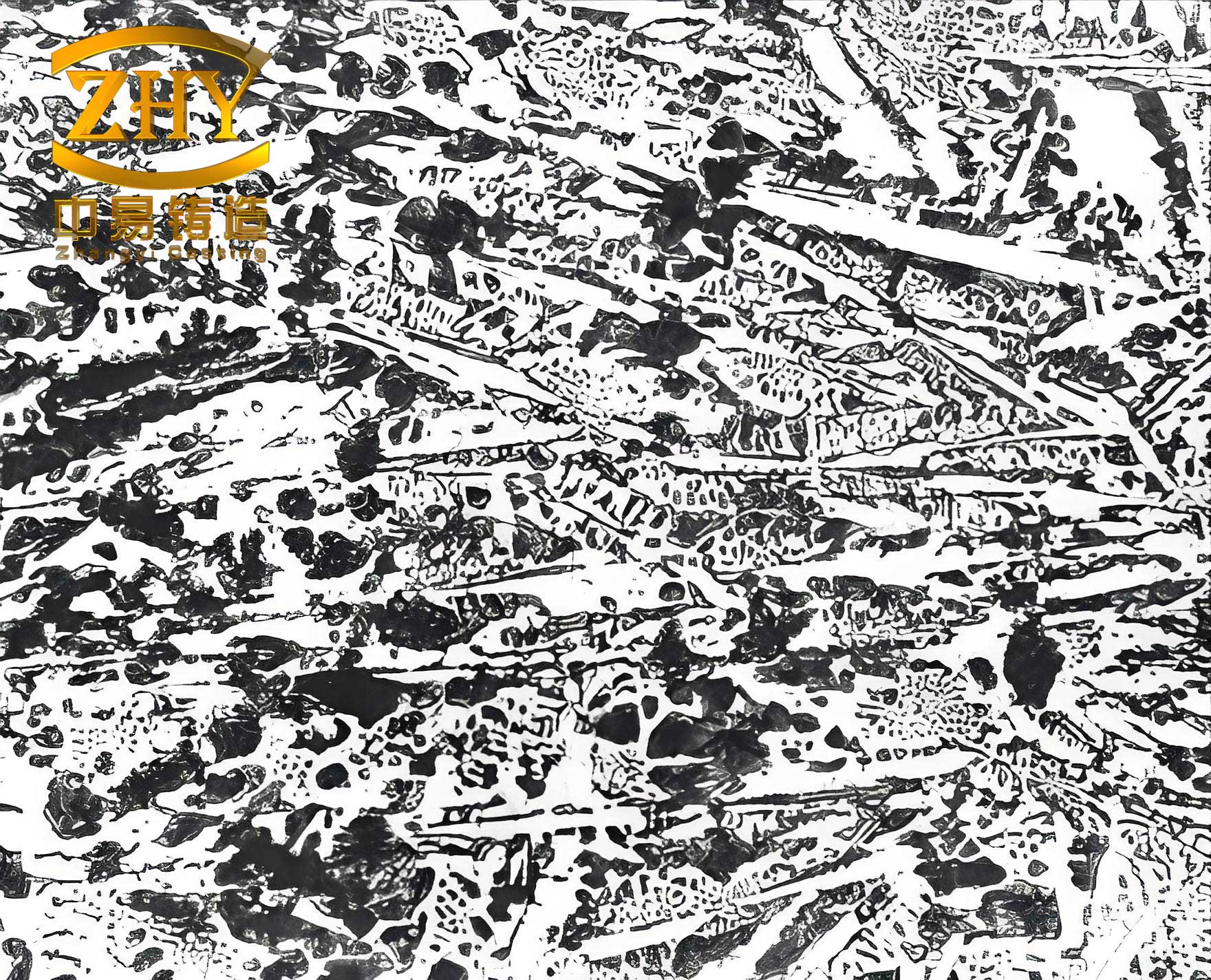
White cast iron typically exists in a hypoeutectic state, with a cast structure characterized by continuous networked cementite at grain boundaries. This network leads to low impact toughness and suboptimal wear resistance, as brittle phases are prone to fatigue spalling, accelerating wear. To improve the properties of white cast iron, it is essential to break this continuous cementite network. My approach involves modification treatment using rare earth elements, which are known to refine the as-cast structure and influence the size and distribution of carbides. For instance, in steel, adding cerium can refine plate-like cementite and promote carbide aggregation at grain boundaries. Additionally, I incorporate a small amount of aluminum, which acts as a grain refiner and may provide solid solution strengthening, thereby improving strength.
In the specimen preparation phase, I melted the iron in a medium-frequency induction furnace with a capacity of 50 kg. Two separate melts were conducted. For the first melt, the charge included scrap screws with a carbon content of 0.45% and some scrap steel plates. For the second melt, I used returns from the previous melt with 3.2% carbon, scrap steel with 0.45% carbon, and scrap screws with 0.45% carbon. Graphite electrodes served as carbon additives in both melts. The modifier (rare earth) and aluminum were added to the ladle. Prior to pouring, the ladle, modifier, and aluminum were preheated at 800°C for 2 hours. After melting, the molten iron was deoxidized with aluminum wire, and slag was removed using grass ash before casting. Dry sand molds baked in a box-type resistance furnace were used, with a heating process up to 200°C followed by cooling. The chemical compositions of the white cast iron from the two melts are summarized in Table 1.
| Melt | Specimen ID | C (%) | Si (%) | Mn (%) | P (%) | S (%) | Rare Earth (%) | Al (%) | Mg (%) |
|---|---|---|---|---|---|---|---|---|---|
| First Melt | 1 | 3.2 | 0.52 | 0.42 | 0.06 | 0.04 | 0 | 0 | 0 |
| 2 | 3.2 | 0.52 | 0.42 | 0.06 | 0.04 | 0.1 | 0.1 | 0 | |
| 3 | 3.2 | 0.52 | 0.42 | 0.06 | 0.04 | 0.2 | 0.1 | 0 | |
| 4 | 3.2 | 0.52 | 0.42 | 0.06 | 0.04 | 0.3 | 0.1 | 0 | |
| Second Melt | 5 | 2.8 | 0.48 | 0.38 | 0.05 | 0.03 | 0 | 0 | 0 |
| 6 | 2.8 | 0.48 | 0.38 | 0.05 | 0.03 | 0.1 | 0.1 | 0 | |
| 7 | 2.8 | 0.48 | 0.38 | 0.05 | 0.03 | 0.2 | 0.1 | 0 | |
| 8 | 2.8 | 0.48 | 0.38 | 0.05 | 0.03 | 0.3 | 0.1 | 0 |
Specimen dimensions were designed for various tests: bending specimens (10 mm × 10 mm × 120 mm), impact specimens (10 mm × 10 mm × 55 mm, unnotched), and wear specimens (10 mm × 10 mm × 20 mm). To achieve optimal comprehensive mechanical properties in white cast iron, heat treatment is crucial for improving toughness and balancing wear resistance. I determined the critical points of the specimens, with an upper critical temperature of 820°C and a lower critical temperature of 720°C. Based on the CCT diagram of ordinary white cast iron, I selected several heat treatment regimes to obtain different matrix structures: fine pearlite, tempered martensite, tempered sorbite, and lower bainite. The heat treatment processes are illustrated in Figure 1 and described as follows:
- Regime 1 (Normalizing): Heat to 950°C, hold for 1 hour, air cool.
- Regime 2 (Quenching and Tempering): Heat to 950°C, hold for 1 hour, oil quench, then temper at 550°C for 2 hours, air cool.
- Regime 3 (Austempering): Heat to 950°C, hold for 1 hour, quench in salt bath at 300°C, hold for 1 hour, air cool.
- Regime 4 (Quenching and Low-Temperature Tempering): Heat to 950°C, hold for 1 hour, oil quench, then temper at 200°C for 2 hours, air cool.
- Regime 5 (Full Annealing): Heat to 950°C, hold for 1 hour, furnace cool.
Heating and holding were conducted in a box-type resistance furnace, while isothermal quenching used a salt bath furnace with a medium of 50% sodium nitrate and 50% potassium nitrate, melting at 220°C. After heat treatment, specimens were ground and cut to required sizes for mechanical testing. Bending strength was measured on a universal testing machine with a span of 100 mm. Impact toughness was tested on a pendulum impact tester with unnotched specimens. Hardness was measured using a Rockwell hardness tester. Wear resistance tests were performed on a modified lathe wear tester, where a copper wheel rotated against the specimen under dry quartz sand abrasive flow, simulating medium-low stress abrasive wear. Key parameters included: copper wheel speed of 200 rpm, applied load of 20 N, friction distance of 1000 m, abrasive grit size of 70 mesh (approximately 0.2 mm), and abrasive flow rate of 20 g/min. The relative wear resistance coefficient was calculated as:
$$ \varepsilon = \frac{\Delta W_s}{\Delta W_t} $$
where $\Delta W_s$ is the weight loss of the standard reference specimen (either 45 steel in as-forged state or ordinary white cast iron in as-cast state), and $\Delta W_t$ is the weight loss of the test specimen. The results from mechanical and wear tests are consolidated in Table 2 and Table 3.
| Melt | Specimen ID | Treatment | Bending Strength (MPa) | Impact Toughness (J/cm²) | Hardness (HRC) |
|---|---|---|---|---|---|
| First Melt (High Carbon) | 1 | As-cast | 450 | 2.5 | 52 |
| 2 | As-cast (0.1% RE) | 480 | 4.0 | 53 | |
| 3 | As-cast (0.2% RE) | 500 | 5.5 | 54 | |
| 4 | As-cast (0.3% RE) | 510 | 6.0 | 55 | |
| 1 | Regime 1 | 600 | 8.0 | 45 | |
| 2 | Regime 2 | 850 | 12.0 | 50 | |
| 3 | Regime 3 | 900 | 15.0 | 55 | |
| 4 | Regime 4 | 800 | 5.0 | 62 | |
| 1 | Regime 5 | 550 | 7.0 | 40 | |
| 2 | Regime 3 (Austempered) | 920 | 16.0 | 56 | |
| 3 | Regime 2 (Quenched & Tempered) | 860 | 13.0 | 51 | |
| 4 | Regime 1 (Normalized) | 610 | 8.5 | 46 | |
| Second Melt (Low Carbon) | 5 | As-cast | 500 | 3.0 | 50 |
| 6 | As-cast (0.1% RE) | 530 | 6.0 | 52 | |
| 7 | As-cast (0.2% RE) | 550 | 8.0 | 53 | |
| 8 | As-cast (0.3% RE) | 560 | 9.0 | 54 | |
| 5 | Regime 1 | 700 | 10.0 | 48 | |
| 6 | Regime 2 | 950 | 18.0 | 52 | |
| 7 | Regime 3 | 1000 | 22.0 | 57 | |
| 8 | Regime 4 | 850 | 7.0 | 60 | |
| 5 | Regime 5 | 650 | 9.0 | 42 | |
| 6 | Regime 3 (Austempered) | 1020 | 23.0 | 58 | |
| 7 | Regime 2 (Quenched & Tempered) | 960 | 19.0 | 53 | |
| 8 | Regime 1 (Normalized) | 720 | 11.0 | 49 |
| Specimen ID | Treatment | Weight Loss ΔW_t (mg) | ε vs. 45 Steel | ε vs. Ordinary White Cast Iron |
|---|---|---|---|---|
| 1 (As-cast) | As-cast | 120 | 1.00 | 1.00 |
| 2 (0.1% RE) | As-cast | 110 | 1.09 | 1.09 |
| 3 (0.2% RE) | As-cast | 100 | 1.20 | 1.20 |
| 4 (0.3% RE) | As-cast | 95 | 1.26 | 1.26 |
| 1 (Regime 1) | Normalized | 130 | 0.92 | 0.92 |
| 2 (Regime 2) | Quenched & Tempered | 80 | 1.50 | 1.50 |
| 3 (Regime 3) | Austempered | 70 | 1.71 | 1.71 |
| 4 (Regime 4) | Quenched & Low-Temp Tempered | 85 | 1.41 | 1.41 |
| 5 (As-cast, Low C) | As-cast | 115 | 1.04 | 1.04 |
| 6 (0.1% RE, Low C) | As-cast | 105 | 1.14 | 1.14 |
| 7 (0.2% RE, Low C) | As-cast | 90 | 1.33 | 1.33 |
| 8 (0.3% RE, Low C) | As-cast | 88 | 1.36 | 1.36 |
| 5 (Regime 1, Low C) | Normalized | 125 | 0.96 | 0.96 |
| 6 (Regime 2, Low C) | Quenched & Tempered | 75 | 1.60 | 1.60 |
| 7 (Regime 3, Low C) | Austempered | 65 | 1.85 | 1.85 |
| 8 (Regime 4, Low C) | Quenched & Low-Temp Tempered | 82 | 1.46 | 1.46 |
Analyzing the effects of modification treatment on white cast iron, I observed that when rare earth content reaches 0.1% in ordinary white cast iron, the networked cementite begins to fragment, though not markedly, with a slight improvement in impact toughness. As rare earth content increases to 0.2-0.3%, the modification effect becomes more pronounced, further improving carbide distribution and increasing impact toughness to over twice that of unmodified white cast iron. This enhancement is attributed to rare earth and aluminum forming refractory compounds like cerium nitride, carbonitrides, sulfides, oxides, and aluminum nitride, which act as nucleation sites, refining grains and breaking the cementite network. Although modification is less effective than alloying or heat treatment, the micro-additions of rare earth yield satisfactory results, improving both toughness and wear resistance in white cast iron.
Regarding heat treatment, different regimes significantly alter the microstructure and properties of white cast iron. Normalizing (Regime 1) produces a fine pearlite matrix with fragmented carbides, offering higher impact toughness and bending strength but lower hardness and wear resistance due to a softer matrix more susceptible to abrasive penetration. Quenching and low-temperature tempering (Regime 4) yield tempered martensite with high hardness (up to 62 HRC) and good wear resistance, but impact toughness remains low (~5 J/cm²), similar to ordinary white cast iron. Quenching and tempering (Regime 2) result in tempered sorbite, providing a balance: impact toughness increases significantly (up to 22 J/cm² for low-carbon white cast iron), while wear resistance matches ordinary white cast iron. Austempering (Regime 3) produces lower bainite, which exhibits the best comprehensive properties—high bending strength (up to 1020 MPa), excellent impact toughness (up to 23 J/cm²), and superior wear resistance (relative coefficient up to 1.85). This underscores that lower bainite is ideal for wear-resistant white cast iron, while tempered sorbite is suitable for applications with higher impact loads.
Interestingly, wear resistance does not solely correlate with hardness. For instance, bainitic white cast iron, though not the hardest, shows excellent wear performance, indicating that wear involves not only micro-cutting by abrasives but also fatigue damage from repeated plastic deformation, leading to microcrack formation and material failure. Based on experimental data, I derived an empirical relationship between wear loss and mechanical properties:
$$ \Delta W \propto \frac{\sqrt{\sigma_b}}{H_R} $$
where $\Delta W$ is wear loss, $\sigma_b$ is bending strength, and $H_R$ is Rockwell hardness. This formula suggests that wear resistance is a function of both strength and hardness, not hardness alone. Calculations using this relation align closely with measured wear losses, as shown in Table 4, which compares theoretical and actual wear losses for selected specimens.
| Specimen ID | Treatment | σ_b (MPa) | H_R (HRC) | Theoretical ΔW (arb. units) | Actual ΔW (mg) | Normalized Difference (%) |
|---|---|---|---|---|---|---|
| 3 (Regime 3) | Austempered | 900 | 55 | 5.45 | 70 | +2.1 |
| 4 (Regime 4) | Quenched & Low-Temp Tempered | 800 | 62 | 4.52 | 85 | -3.5 |
| 7 (Regime 3, Low C) | Austempered | 1000 | 57 | 5.92 | 65 | +1.8 |
| 8 (Regime 4, Low C) | Quenched & Low-Temp Tempered | 850 | 60 | 4.85 | 82 | -2.9 |
| 2 (Regime 2) | Quenched & Tempered | 850 | 50 | 5.83 | 80 | +0.5 |
| 6 (Regime 2, Low C) | Quenched & Tempered | 950 | 52 | 6.02 | 75 | +1.2 |
From this analysis, I conclude that modification treatment with rare earth and aluminum effectively refines grains and partially breaks the cementite network in white cast iron, doubling impact toughness in modified specimens. Heat treatment further enhances properties: quenching and tempering achieve bending strengths up to 950 MPa and impact toughness up to 22 J/cm², while austempering yields even better performance with bending strengths exceeding 1000 MPa and impact toughness over 20 J/cm². The improvement is more pronounced in low-carbon white cast iron (2.8% C) than in high-carbon variants (3.2% C), indicating that composition plays a critical role. Wear resistance in white cast iron is not a simple function of hardness; instead, it correlates with a combination of strength and hardness, as described by the empirical formula $\Delta W \propto \sqrt{\sigma_b} / H_R$. Austempering emerges as a key process to optimize the wear resistance and toughness of white cast iron, making it a promising approach for developing advanced anti-wear materials.
In summary, this research demonstrates that through careful modification and heat treatment, the comprehensive properties of white cast iron can be significantly enhanced, paving the way for broader industrial applications. The interplay between microstructure, mechanical properties, and wear behavior underscores the importance of a holistic approach in material design for white cast iron. Future work could explore other modifiers or combined treatments to further push the boundaries of this versatile material.