
The pursuit of superior wear resistance under extreme impact loading conditions has established high manganese steel castings as a cornerstone material in industries ranging from mining and quarrying to construction and railway. My extensive experience in metallurgy and foundry engineering has consistently reinforced that the legendary performance of this material—exemplified by grades like Hadfield steel—is not a guaranteed outcome of its nominal composition alone. Rather, it is the precise culmination of intelligent alloy design, meticulous casting practice, and a scientifically tailored heat treatment regimen. The journey of a high manganese steel casting from molten metal to a durable, work-hardening component is fraught with potential pitfalls where deviations from optimal practice can dramatically shorten its operational lifespan. In this detailed exposition, I will dissect the fundamental mechanisms at play and systematically outline the integrated process controls necessary to unlock the full potential of high manganese steel casting, transforming it from a merely hard material into a reliably tough and long-lasting engineering solution.
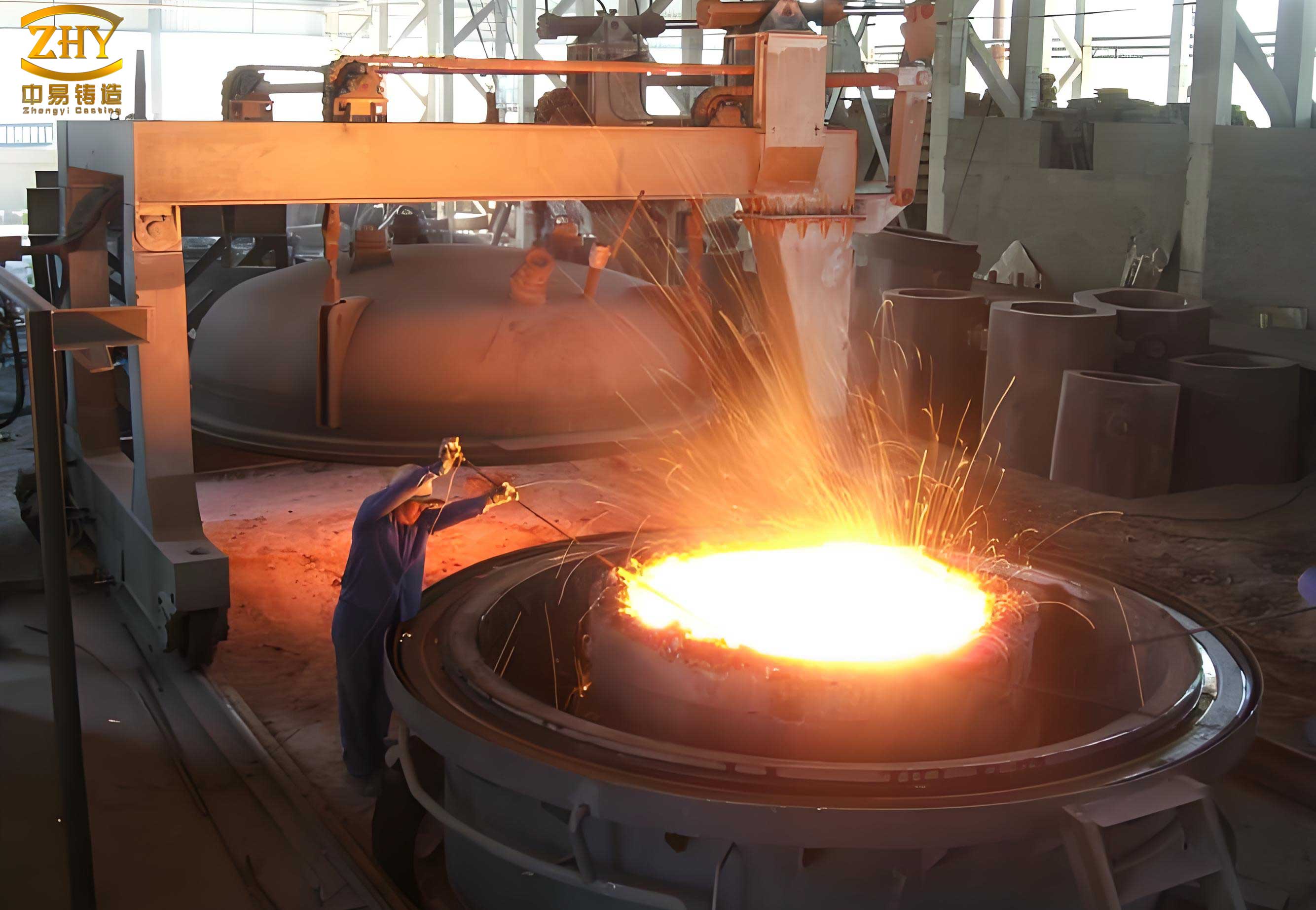
The quintessential behavior of a properly processed high manganese steel casting is rooted in its metastable austenitic microstructure. In the as-cast condition, the structure is a brittle mixture of austenite and a network of carbides, primarily (Fe,Mn)3C, at the grain boundaries. This makes the casting unsuitable for service. The transformative step is solution heat treatment, commonly known as water quenching or “water toughening.” This involves heating the casting to a temperature between 1050°C and 1100°C, holding it to dissolve the carbides completely into a homogeneous solid solution of carbon in gamma-iron (austenite), and then rapidly quenching in water. The result is a single-phase austenitic structure with relatively low initial hardness (typically ~200 HB) but exceptional toughness and ductility.
The magic unfolds in service. When the surface of the austenitic high manganese steel casting is subjected to intense impact and/or high-stress abrasion, it undergoes severe plastic deformation. This deformation triggers a potent strain-hardening mechanism, where the face-centered cubic (FCC) austenite transforms into strain-induced martensite (ε-martensite or α’-martensite) and develops a high density of dislocations and mechanical twins. The surface hardness can skyrocket from ~200 HB to over 500 HB, creating an extremely wear-resistant shell. Critically, the tough, un-deformed austenitic core remains to absorb energy and prevent catastrophic fracture. As the hardened surface layer wears away, the newly exposed austenite subsequently work-hardens, providing sustained wear resistance. The efficacy of this mechanism is summarized by the work-hardening capacity, which can be conceptually related to the strain hardening exponent ‘n’ in the Hollomon equation:
$$ \sigma = K \epsilon^n $$
where $\sigma$ is the true stress, $\epsilon$ is the true strain, and $K$ is the strength coefficient. A high ‘n’ value is desirable for rapid surface hardening. However, this ideal performance is contingent upon achieving a flawless, defect-free austenitic matrix post-heat treatment. Any residual carbides, porosity, or non-metallic inclusions act as stress concentrators, promoting crack initiation and premature failure, thus negating the benefit of work hardening.
I. Foundational Pillar: Precision in Chemical Composition
The journey towards a high-performance high manganese steel casting begins at the melting furnace. The chemical composition is the primary blueprint that dictates the final microstructure, hardenability, and mechanical properties. Straying from the optimal ranges can lead to inherent weaknesses that no subsequent processing can fully rectify.
A. The Critical Carbon-Manganese Synergy
Carbon is the principal agent for achieving high hardness upon work hardening. Manganese is the powerful austenite stabilizer that allows the high-carbon steel to retain its austenitic structure even at room temperature after quenching. Their interaction is paramount.
- Carbon (C): An insufficient carbon content (<1.0%) fails to provide adequate solute for effective work hardening, resulting in poor wear resistance. Conversely, excessive carbon (>1.4% in standard grades) leads to prolific carbide formation in the as-cast state. While solution treatment aims to dissolve these, excessive carbon can cause residual carbides or promote their reprecipitation at grain boundaries during less-than-ideal cooling, embrittling the high manganese steel casting. The carbon content also influences the stacking fault energy (SFE) of austenite, which governs the deformation mode (twinning vs. slip).
- Manganese (Mn): Mn must be present in sufficient quantity to suppress the pearlite and bainite transformation zones, ensuring a fully austenitic structure upon quenching. The classic 11-14% Mn range achieves this. The ratio of Mn to C is a crucial parameter. A low Mn/C ratio (<8) is insufficient to stabilize austenite against carbide precipitation during cooling, leading to embrittlement. A high ratio (>10) is generally sought for heavy-section castings to compensate for microsegregation.
The optimal target can be expressed as a function of section thickness (T, in mm):
$$ \text{Mn/C Ratio} \approx 9.5 + k \cdot \log(T) $$
where $k$ is an empirical constant. For a 100 mm thick casting like a jaw crusher plate, a ratio of 10 or higher is advisable.
B. The Deleterious Role of Impurities
Phosphorus (P) is public enemy number one for high manganese steel casting. It has very low solubility in austenite and segregates strongly during solidification, forming brittle phosphide eutectics (e.g., (Fe,Mn)3P) along grain boundaries. These phases drastically reduce high-temperature ductility, increasing the susceptibility to hot tearing during casting, and provide easy paths for crack propagation in service. Maintaining P levels below 0.04% is critical, with targets under 0.03% being ideal for demanding applications. Sulfur (S) is less harmful in high manganese steels because it readily forms manganese sulfide (MnS) inclusions. While these can be slightly detrimental to impact toughness, their effect is less severe than phosphides. Control to below 0.03% is standard.
C. Strategic Microalloying for Enhanced Performance
While standard ASTM A128 Grade B-4 (ZGMn13) serves many purposes, its limitations in very severe applications or where higher initial hardness is needed can be overcome by microalloying. Adding small amounts of strong carbide-forming elements like Chromium (Cr), Vanadium (V), Titanium (Ti), and Niobium (Nb) provides several synergistic benefits:
- Grain Refinement: Elements like Ti, V, and Nb form stable carbonitrides (e.g., TiC, V(C,N), NbC) that act as potent heterogeneous nucleation sites during solidification, refining the as-cast grain structure. Finer grains improve both strength and toughness via the Hall-Petch relationship: $$ \sigma_y = \sigma_0 + k_y d^{-1/2} $$ where $\sigma_y$ is the yield strength, $\sigma_0$ is the friction stress, $k_y$ is the strengthening coefficient, and $d$ is the average grain diameter.
- Precipitation Strengthening: Fine, dispersed carbides of these elements within the austenitic matrix after heat treatment provide direct strengthening, increasing the initial yield strength and hardness without significantly compromising toughness. This is particularly beneficial during the initial run-in period before full work-hardening occurs.
- Secondary Hardening: Some alloying elements can temper the response to deformation, potentially enhancing the work-hardening rate.
The table below contrasts a standard composition with an optimized, microalloyed composition for a heavy-duty crusher liner application.
| Element | Standard ZGMn13 (ASTM A128) | Optimized High-Performance Grade | Primary Function in Optimized Grade |
|---|---|---|---|
| C | 1.05 – 1.35 | 1.20 – 1.35 | Work-hardening potential |
| Mn | 11.0 – 14.0 | 12.0 – 13.5 | Austenite stabilization |
| Si | 0.30 – 0.80 | 0.30 – 0.50 | Deoxidizer, kept low for heavy sections |
| P (max) | 0.07 | 0.03 | Minimize embrittlement |
| S (max) | 0.05 | 0.02 | Minimize inclusions |
| Cr | – | 1.5 – 2.5 | Solid solution strengthener, improves hardenability |
| Mo | – | 0.3 – 0.6 | Inhibits pearlite formation, enhances strength |
| V | – | 0.08 – 0.15 | Grain refinement via V(C,N) |
| Ti | – | 0.03 – 0.08 | Grain refinement via TiN, deoxidizer |
| Nb | – | 0.03 – 0.06 | Grain refinement via NbC, precipitation strengthening |
II. The Foundry Crucible: Mastering Casting and Solidification
Even with a perfect melt chemistry, a flawed casting process will yield a defective component. The high manganese steel alloy presents specific challenges: high liquidus-solidus range, significant solidification shrinkage, relatively low thermal conductivity, and a propensity for hot tearing due to the long freezing range and low high-temperature strength.
A. Gating and Feeding System Design
The primary objective is to achieve progressive and directional solidification towards strategically placed feeders (risers) to eliminate shrinkage porosity. For complex shapes like a jaw plate, computer simulation of solidification is invaluable. The gating system must be designed to fill the mold smoothly with minimal turbulence to avoid reoxidation and slag entrapment. Multiple ingates are often used to distribute metal flow and reduce thermal gradients. The use of ceramic foam filters in the runner system is highly recommended to trap non-metallic inclusions before the metal enters the mold cavity.
B. Mold and Core Materials
Given the alloy’s high melting point and the presence of reactive MnO, chemical bonding/burning-on to the mold is a risk. Therefore, highly refractory and inert mold faces are essential. Silica sand is common but should be coated with a refractory wash such as zirconia or magnesia-based paints to prevent metal penetration and improve surface finish. For the most demanding high manganese steel casting applications, chromite sand molds or faces provide superior refractoriness and heat transfer characteristics, promoting a finer as-cast structure.
C. Grain Refinement Practice
Achieving a fine as-cast austenite grain size is a direct precursor to superior toughness and more uniform properties after heat treatment. Beyond microalloying additions, foundry practice plays a role. Techniques include:
- Inoculation: Adding small amounts of grain-refining agents (e.g., ferro-titanium, ferro-niobium) just before pouring.
- Controlled Pouring Temperature: Avoiding excessively high superheat reduces the grain growth tendency during solidification.
- Chill Design: Strategically placed metal or graphite chills can accelerate cooling locally, refining the microstructure in critical, thick sections of the high manganese steel casting.
The relationship between cooling rate ($\dot{T}$) and secondary dendrite arm spacing (SDAS, $\lambda_2$), a key microstructural scale, is well-established:
$$ \lambda_2 = A \cdot (\dot{T})^{-n} $$
where $A$ and $n$ are material constants. A smaller $\lambda_2$ correlates with a more homogeneous distribution of microsegregation and better mechanical properties.
III. The Transformative Stage: Precision Heat Treatment
Heat treatment is the non-negotiable final step that activates the potential of the high manganese steel casting. The goal is to achieve a completely carbide-free, homogeneous austenitic microstructure with an optimal grain size.
A. The Solutionizing (Austenitizing) Stage
The casting must be heated to a temperature where all carbides dissolve into the austenite. This temperature is typically between 1050°C and 1100°C. The choice involves a trade-off:
- Lower temperature (e.g., 1050°C): Minimizes grain growth and energy consumption but risks incomplete carbide dissolution if the holding time is insufficient or the carbon content is high.
- Higher temperature (e.g., 1100°C): Ensures complete carbide solution but promotes austenite grain coarsening (following the classic grain growth kinetics: $D^n – D_0^n = K t \exp(-Q/RT)$) and increases the risk of oxidation/decarburization.
For a standard 100 mm thick high manganese steel casting, I recommend a temperature of 1060-1080°C. The holding time is critical and is a function of section thickness. A common rule of thumb is 1 hour per 25 mm (1 inch) of section thickness at the temperature. For our example, a 4-hour soak would be appropriate. Heating must be controlled, especially through the 400-600°C range, where the steel’s plasticity is low and the risk of cracking from thermal stress is high. A slow heating rate (~50-100°C/h) through this range is prudent.
B. The Quenching Stage
This is the most critical and time-sensitive operation. The objective is to “freeze” the single-phase austenitic structure by cooling it so rapidly that there is no time for carbides to reprecipitate at the grain boundaries.
- Transfer Time: The interval from opening the furnace door to complete immersion in the quench tank must be minimized—ideally less than 90 seconds. A longer transfer allows the casting surface to cool below ~900°C, permitting deleterious carbide precipitation.
- Quench Medium: Water is the universal medium. Its temperature should be maintained below 30°C (preferably 10-25°C) to maximize cooling rate. Agitation of the water or movement of the casting is mandatory to break the insulating steam blanket (Leidenfrost effect) that forms on the hot surface, ensuring uniform and rapid heat extraction. The quenching process must continue until the casting is cold to the touch (<50°C).
The severity of quench (H) according to Grossmann’s concept must be high. The cooling rate must exceed the critical cooling rate for carbide precipitation, which is specific to the alloy’s composition. The heat transfer during quenching is governed by the transient heat conduction equation with a convective boundary condition:
$$ \rho C_p \frac{\partial T}{\partial t} = \nabla \cdot (k \nabla T) $$
with the boundary condition: $-k \frac{\partial T}{\partial n} = h (T_s – T_{\text{water}})$, where $h$ is the heat transfer coefficient, maximized by agitation.
C. Post-Quench Treatment (Tempering/Stress Relieving)
While the quenched structure is fully austenitic, it contains significant residual stresses from the drastic thermal gradients during quenching. For most high manganese steel casting applications, a low-temperature stress relief is beneficial. Heating to 200-250°C for 2-4 hours and slowly cooling reduces these internal stresses without causing significant carbide precipitation, thereby improving dimensional stability and reducing the risk of stress-corrosion cracking in certain environments. It does not significantly alter the hardness or microstructure.
The complete thermal cycle is summarized in the following table:
| Process Stage | Temperature Parameter | Time Parameter | Key Objective & Rationale |
|---|---|---|---|
| Heating | Rate: 100°C/h to 600°C; then 150°C/h to soak temp. | – | Minimize thermal stress, avoid cracking in low-ductility range. |
| Austenitizing (Solutionizing) | 1060°C – 1080°C | 4 hours (for 100 mm section) | Complete dissolution of all carbides into austenitic solid solution. |
| Quenching | Quench water < 30°C. Casting temp. > 950°C at immersion. | Transfer < 90 sec. Agitate in water for > 15 min. | Supress carbide precipitation, retain single-phase austenite. |
| Stress Relieving | 220°C ± 10°C | 3 hours | Reduce residual quenching stresses, improve stability. |
IV. Performance Outcomes and Comparative Analysis
The cumulative effect of optimizing the entire chain—composition, casting, and heat treatment—manifests in significantly enhanced mechanical and wear properties. The following table presents a comparative analysis between a standard processed high manganese steel casting and one produced with the integrated optimizations described herein. The data is based on controlled production batches for jaw crusher plates.
| Property / Performance Metric | Standard ZGMn13 Casting (Control) | Optimized High Manganese Steel Casting | Percentage Improvement |
|---|---|---|---|
| Tensile Strength, Rm (MPa) | 640 – 700 | 750 – 820 | +15% to +20% |
| Yield Strength (0.2% Offset), Rp0.2 (MPa) | 320 – 380 | 420 – 480 | +25% to +30% |
| Elongation, A5 (%) | 30 – 40 | 35 – 45 | Maintained or slightly improved |
| Charpy Impact Energy, KV2 (J, at 20°C) | 140 – 180 | 180 – 220 | +25% to +30% |
| Initial Hardness (HBW) | 200 – 220 | 220 – 250 | +10% to +15% |
| Work-Hardened Surface Hardness (HBW) | 480 – 520 | 500 – 550 | +5% to +8% |
| Relative Wear Resistance (Dry Sand/Rubber Wheel Test) | 1.00 (Baseline) | 1.25 – 1.40 | +25% to +40% |
| Field Service Life (Jaw Crusher Plate, abrasive ore) | ~1500 hours | ~3000 – 3600 hours | +100% to +140% |
The performance enhancements are not merely additive; they are synergistic. The higher initial yield strength and toughness mean the high manganese steel casting is more resistant to plastic deformation and crack initiation from the very first impact. The finer, more homogeneous microstructure allows for more uniform and efficient work hardening across the entire wearing surface. The reduction in embrittling phases (low P, no residual carbides) ensures that the inherent toughness of the austenite is fully available to support the hardened surface layer, preventing spalling and deep cracking. The doubling of service life is a direct economic consequence of this integrated materials engineering approach, delivering substantial cost savings through reduced downtime and frequency of component replacement.
V. Concluding Synthesis and Forward Perspective
The endeavor to maximize the lifespan of a high manganese steel casting is a holistic exercise in metallurgical control. It transcends the simplistic view of it as just a “manganese steel” and demands respect for its intricate processing-structure-property relationships. From my perspective, the key takeaways are threefold:
- Precision is Paramount: Tight control over chemistry, especially minimizing P and optimizing the Mn/C ratio for the section size, sets the fundamental ceiling for potential performance.
- Defects are Destiny: Casting practices must be engineered to deliver a sound, dense, and fine-grained casting. Shrinkage porosity, inclusions, and coarse grains are irreversible flaws that become the focal points of failure.
- Heat Treatment is Activation: A meticulously executed water quenching process is the essential trigger. There are no shortcuts; rapid transfer, vigorous quenching in cold water, and proper soaking are non-negotiable steps to achieve the required carbide-free austenite.
The framework discussed here provides a robust methodology. However, the field continues to evolve. Areas of ongoing research and application include the development of modified grades with higher manganese and carbon (e.g., 18% Mn, 1.8% C) for even greater work-hardening capacity, the use of advanced techniques like electroslag remelting (ESR) for ultra-clean steel for critical castings, and the application of computational thermodynamics (CALPHAD) to predict phase stability and optimize heat treatment windows for novel alloy variants. Ultimately, treating the production of a high manganese steel casting as a integrated, science-driven process—rather than a sequence of independent steps—is the most reliable strategy to consistently manufacture components that meet the severe demands of modern industry, delivering unparalleled value through extended service life and operational reliability.