
In my extensive review of research and industrial practices, I have focused on improving the wear resistance of machine tool guideways, a critical aspect for the longevity and precision of machine tool castings. The performance of these castings directly impacts machining accuracy and productivity. This article synthesizes findings on wear mechanisms and various measures to enhance durability, emphasizing the role of material science and processing techniques. I will present detailed analyses using tables and formulas to summarize key relationships, while consistently highlighting the importance of machine tool castings throughout.
Wear in machine tool guideways is primarily governed by two fundamental processes: plastic destruction, involving the detachment of particles from a thin deformed surface layer, and brittle destruction, where larger metal particles not severely plastically deformed break off. These processes occur regardless of contaminants like chips, but contamination exacerbates brittle destruction. Based on experimental observations, I have identified several factors influencing wear, which can be quantified to guide material selection and processing for machine tool castings.
The microstructure of cast iron, commonly used in machine tool castings, plays a pivotal role. Graphite morphology and distribution are crucial; while graphite acts as a solid lubricant and crack arrestor, it also weakens the metal matrix by interrupting cohesion. The length of graphite flakes and the average distance between them significantly affect wear rates. For optimal performance in machine tool castings, graphite length should range from 125 to 250 micrometers, and the spacing should exceed 70 micrometers. The relationship can be expressed as:
$$ v_w = f(L_g, S_g) $$
where \( v_w \) is the wear rate, \( L_g \) is graphite length, and \( S_g \) is graphite spacing. Empirical data show that as spacing decreases, wear increases due to enhanced matrix fragmentation. The base matrix should consist of highly dispersed lamellar pearlite with high microhardness; increasing pearlite microhardness from 240 to 320 kgf/mm² can double wear resistance, as shown in the formula:
$$ v_w \propto \frac{1}{H_m} $$
where \( H_m \) is the microhardness of pearlite. Hardness alone is not a definitive indicator; it reflects a composite of factors including matrix microhardness and graphite characteristics. In machine tool castings, guideway hardness should not fall below 180-200 HB, but variations exist due to microstructural nuances.
The use of chills during casting of machine tool castings requires careful consideration. Planer chills can increase hardness but also lead to undercooled graphite and cementite, reducing graphite spacing to 20-30 micrometers and accelerating wear. For instance, in some machine tool castings, chills raised hardness by 30 HB but increased wear by 30-70%. To mitigate this, “soft” chills with ribs or tenons, coated with mold sand, are recommended to moderate cooling and preserve desirable microstructure in machine tool castings.
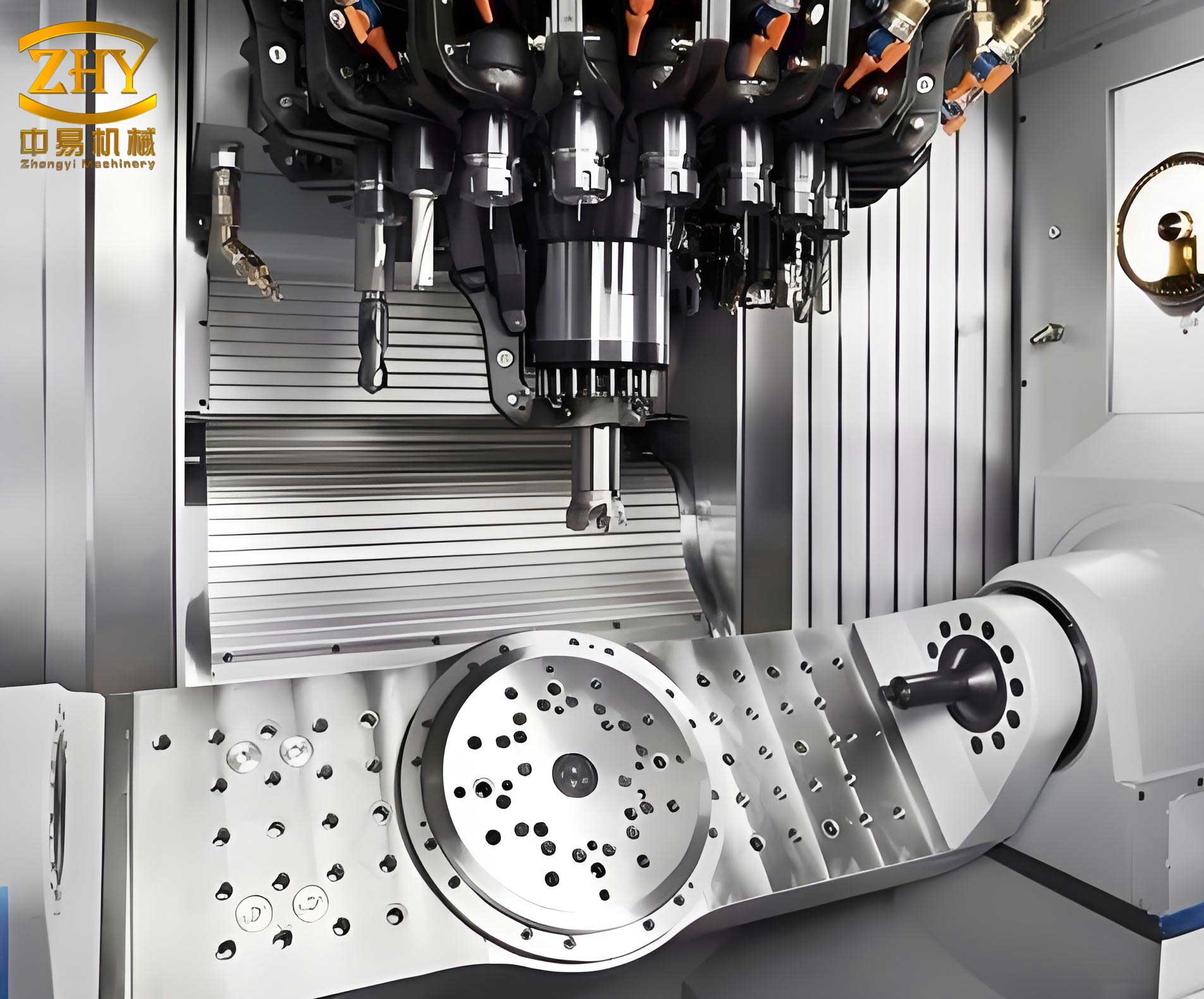
To enhance wear resistance, several material strategies have been developed for machine tool castings. Alloying gray cast iron is a common approach. Copper alloy cast iron, for example, improves fluidity, reduces shrinkage, and stabilizes pearlite. Adding 1-2% Cu with 0.25-0.5% Cr can increase tensile strength by 10-35% and wear resistance by 0.5 to 1 times. The effect can be modeled as:
$$ \Delta v_w = k \cdot [Cu] \cdot [Cr] $$
where \( \Delta v_w \) is the reduction in wear rate, and \( k \) is a constant. Titanium alloy cast iron, utilizing natural alloy pig iron with Ti, Cu, Ni, and Cr, offers cost-effective solutions for machine tool castings. Boron alloy cast iron, with 0.02-0.08% B, incorporates hard phosphorous-boron eutectics, reducing wear to 50-76% of ordinary cast iron. However, it may accelerate wear of mating parts due to abrasive hard phases, necessitating further study for machine tool castings applications.
Composite additives, blending carbide-forming elements (e.g., Cr, Mn, Mo) with graphitizers (Si, Ca), enhance pearlite dispersion and microhardness while preventing free cementite and reducing residual stresses. For machine tool castings, such additives can improve wear resistance by 40-70%. Bainitic cast iron, alloyed with Ni and Mo, achieves as-cast bainitic structures with superior wear resistance; under lubricated conditions, its wear is one-third to one-half that of ordinary gray cast iron, outperforming even hardened cast iron at 45 HRC.
Ductile iron is another candidate for machine tool castings, with spheroidal graphite offering larger average spacing than flake graphite. Pearlitic ductile iron (e.g., grade 60-2) exhibits the best wear resistance due to high matrix microhardness. To obtain as-cast pearlite, alloying with Cu or Mo is required. The wear rate can be correlated with graphite shape and matrix hardness:
$$ v_w = \alpha \cdot \frac{1}{S_{g, \text{sphere}}} + \beta \cdot H_m $$
where \( \alpha \) and \( \beta \) are coefficients, and \( S_{g, \text{sphere}} \) is the spacing in spheroidal graphite.
Synthetic cast iron, produced from steel scrap in induction furnaces with carbon addition, offers superior quality for machine tool castings. It allows optimal carbon-silicon ratios, improving casting and service properties. Wear resistance of synthetic cast iron is 50-70% higher than cupola-melted cast iron, equivalent to low-alloy varieties. The eutectic degree \( S_c \) and silicon-to-carbon ratio influence graphite length and pearlite microhardness:
$$ S_c = \frac{C}{4.26 – 0.31 \cdot Si} $$
where \( C \) and \( Si \) are percentages. For heavy machine tool castings, \( S_c \) of 0.80-0.82 with 3.0-3.2% C is recommended, potentially enhanced with 0.5-1.0% Cu.
Forced cooling within molds is a processing technique for heavy machine tool castings. It controls cooling during the eutectoid transformation range (850-650°C) to achieve desired microstructure. A system with hollow “soft” chills delivers moist compressed air, maintaining a cooling rate of 1-3°C/min depending on thickness factor \( R_H \), defined as:
$$ R_H = \frac{V}{A} $$
where \( V \) is casting volume and \( A \) is cooling surface area. For \( R_H < 350 \) cm, cooling rates of 2-3°C/min are suitable; for \( R_H > 350 \) cm, rates of 1-2°C/min apply. This method yields high and uniform hardness (around 200 HB), fine pearlite (interlamellar spacing 0.3 μm, microhardness 200-300), and graphite spacing of 60-70 μm. It also reduces thermal gradients, minimizing casting stresses and cracking in machine tool castings, which further enhances wear resistance as per recent studies:
$$ \sigma_r \propto \Delta T \quad \text{and} \quad v_w \propto \sigma_r $$
where \( \sigma_r \) is residual stress and \( \Delta T \) is temperature gradient.
To summarize the factors and measures, I present the following tables and formulas. Table 1 compares various alloy gray cast irons used in machine tool castings, highlighting compositions, properties, and wear improvement.
| Type | Composition (%) | Properties | Wear Improvement |
|---|---|---|---|
| Copper Alloy | C: 3.0-3.3, Si: 1.5-2.0, Cu: 0.5-2.6, Cr: 0.2-0.5 | HB: 225-255, tensile increase 10-35% | 0.5-1x |
| Titanium Alloy | C: 3.0-3.3, Ti: 0.1-0.2, Cu: 0.4-0.6, Cr: 0.3-0.4 | HB: 230, good uniformity | Moderate |
| Boron Alloy | C: 3.0-3.3, B: 0.02-0.04, Ti: 0.02-0.07 | HB: 197-226 | 1.6-3x |
| Composite Additive | Cr: 0.2-0.3, Si: 1.5-2.0 with graphitizers | HB: 185-210, stress reduction | 40-70% |
Table 2 outlines bainitic cast iron compositions and wear performance relative to ordinary gray cast iron, emphasizing its suitability for machine tool castings under different friction conditions.
| Condition | Bainite (%) | Pearlite (%) | Relative Wear |
|---|---|---|---|
| A (lubricated, low abrasives) | 50-60 | 15-20 | 0.33-0.5 |
| B (severe abrasives) | 70-75 | 3-5 | 0.5 |
| C (vs. hardened cast iron) | 85-95 | 0-5 | Superior |
The wear rate can be mathematically expressed as a function of multiple variables for machine tool castings:
$$ v_w = k_1 \cdot e^{-k_2 \cdot S_g} + k_3 \cdot \frac{1}{H_m} + k_4 \cdot [\text{alloy}] $$
where \( k_1, k_2, k_3, k_4 \) are constants, and \( [\text{alloy}] \) represents alloying element concentration. This formula encapsulates the interplay between graphite spacing, matrix microhardness, and alloy content in determining wear resistance.
In conclusion, enhancing the wear resistance of machine tool guideways involves a multifaceted approach centered on material composition and processing techniques for machine tool castings. Key strategies include alloying with elements like copper, titanium, and boron; employing ductile or synthetic cast iron; and implementing controlled cooling methods. Microstructural optimization, particularly graphite morphology and pearlite refinement, is critical. The integration of these measures ensures improved performance and longevity of machine tool castings, contributing to precision machining. Future research should explore advanced alloys and real-time monitoring of wear processes to further innovate in this field.