
In industrial applications, the degradation of materials due to combined erosion and corrosion, often referred to as erosion-corrosion, is a critical issue that leads to significant economic losses and resource wastage. This phenomenon is prevalent in sectors such as petroleum, chemical, mining, metallurgy, hydraulics, and power generation, where components like pumps, valves, pipelines, and slurry handling equipment are exposed to corrosive fluids containing solid particles. The synergy between mechanical wear from particle impact and electrochemical corrosion accelerates material loss, making it essential to understand the underlying mechanisms for developing more durable materials. Among various materials, white cast iron, particularly chromium-containing varieties, has garnered attention due to its inherent wear resistance from hard carbides embedded in the matrix. In this study, we systematically investigate the interaction between erosion and corrosion of chromium white cast iron in a liquid-solid two-phase fluid, employing weight loss methods and electrochemical techniques to quantify the synergistic effects. Our focus is on elucidating how chromium content influences the erosion-corrosion behavior, with the aim of providing theoretical insights for optimizing the use of white cast iron in harsh environments.
White cast iron is a type of cast iron characterized by a microstructure consisting of hard carbides, such as cementite or alloy carbides, dispersed in a metallic matrix. This structure imparts excellent abrasion resistance, making white cast iron suitable for applications involving severe wear. The addition of chromium enhances both corrosion and wear resistance by forming chromium carbides and improving the stability of the matrix. In erosion-corrosion scenarios, the performance of white cast iron depends on the balance between its mechanical properties and electrochemical behavior. The interaction between erosion and corrosion is not merely additive; rather, it involves complex synergies where corrosion can accelerate material removal by erosion, and erosion can exacerbate corrosion by damaging protective layers or exposing fresh surfaces. This interplay is often described by the following equation:
$$W_t = W_e + W_c + \Delta W_{ec}$$
where \(W_t\) is the total weight loss rate, \(W_e\) is the pure erosion weight loss rate (due to mechanical action alone), \(W_c\) is the pure corrosion weight loss rate (due to electrochemical action alone), and \(\Delta W_{ec}\) is the synergistic weight loss rate from erosion-corrosion interaction. This interaction can be further decomposed into components where corrosion enhances erosion (\(\Delta W_e\)) and erosion enhances corrosion (\(\Delta W_c\)), such that:
$$\Delta W_{ec} = \Delta W_e + \Delta W_c$$
Understanding these components is crucial for predicting material performance and designing alloys with improved resistance. In this context, we explore how varying chromium content in white cast iron affects these parameters, using experimental data to derive insights into the dominant failure mechanisms.
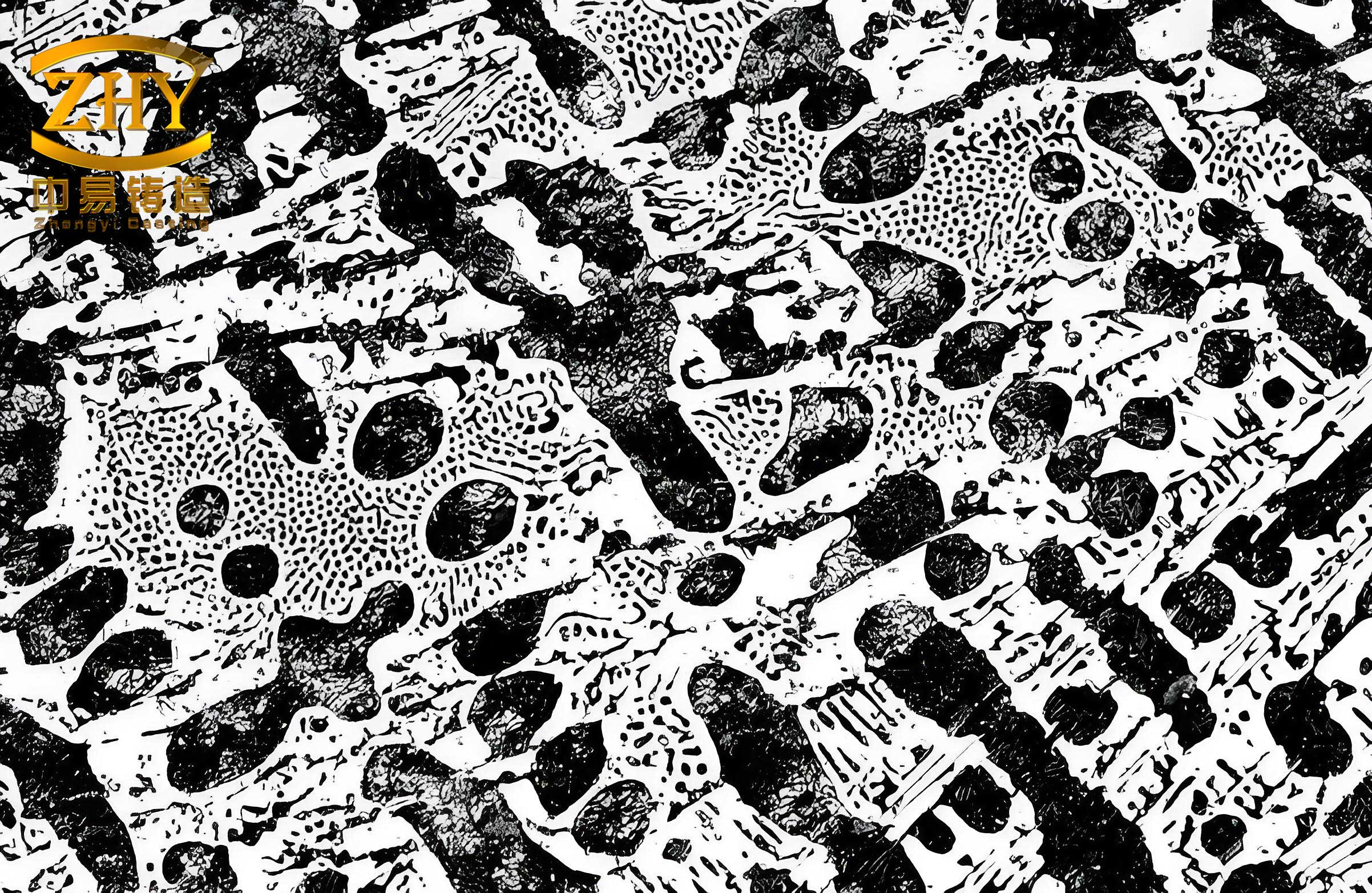
The microstructure of white cast iron, as shown in the image above, typically features a network of hard carbides within a matrix, which can be tailored through alloying elements like chromium. This composite-like structure contributes to its durability under abrasive conditions. However, in corrosive environments, the potential difference between carbides and the matrix can lead to galvanic corrosion, exacerbating material loss. Our study aims to quantify this effect in a controlled liquid-solid two-phase flow, simulating real-world conditions such as those found in slurry transport systems. By analyzing weight loss rates and electrochemical responses, we seek to establish correlations between chromium content, microstructure, and erosion-corrosion resistance, thereby advancing the application of white cast iron in demanding industrial settings.
To conduct this investigation, we designed three types of chromium white cast iron with identical carbon content but varying chromium levels. The compositions are detailed in Table 1, which summarizes the chemical makeup and key parameters such as the chromium-to-carbon ratio. These alloys were heat-treated to achieve a martensitic matrix, ensuring consistency in mechanical properties. The choice of chromium content ranges from low to high, allowing us to observe trends in erosion-corrosion behavior as the alloy becomes more corrosion-resistant due to increased chromium in the matrix.
| Material Designation | C (wt%) | Cr (wt%) | Si (wt%) | Mn (wt%) | S (wt%) | Crm (wt%) | Cr/C Ratio |
|---|---|---|---|---|---|---|---|
| 3Cr White Cast Iron | 2.51 | 2.98 | 0.99 | 0.45 | 0.030 | 2.02 | 1.19 |
| 15Cr White Cast Iron | 2.50 | 14.11 | 0.86 | 0.34 | 0.034 | 9.38 | 5.64 |
| 24Cr White Cast Iron | 2.56 | 23.07 | 0.96 | 0.38 | 0.031 | 14.50 | 9.01 |
Note: Crm represents the chromium content in the matrix of the white cast iron, calculated based on alloy composition and carbide formation. This parameter is critical as it directly influences the corrosion resistance of the matrix, which plays a key role in erosion-corrosion interactions. The Cr/C ratio indicates the propensity for carbide formation, with higher ratios typically leading to more chromium-rich carbides and improved wear resistance.
The experimental setup involved a customized liquid-solid two-phase flow erosion-corrosion test rig, developed in collaboration with industrial partners. This apparatus consists of several systems: a tribological system for simulating erosion-corrosion conditions, a mechanical drive system, an electrochemical measurement system, a temperature control system, and a sample mounting system. The test rig allows for simultaneous weight loss measurements and electrochemical monitoring under dynamic conditions. Samples of white cast iron, machined into cylindrical shapes, were mounted on a polytetrafluoroethylene disk and exposed to a slurry composed of 5% H2SO4 and 15% quartz sand (0.2 mm particle size). The test conditions were maintained at a temperature of 25°C, a linear velocity of 5 m/s, an impingement angle of 0° (representing parallel flow to minimize pure erosion effects), and a pH of 1.5. The dynamic erosion time was set to 2 hours, while static corrosion tests were conducted over 24 hours to establish baseline corrosion rates. Electrochemical measurements were performed using a potentiostatic method with a three-electrode configuration, including a saturated calomel reference electrode and a platinum counter electrode, to track corrosion behavior in real-time.
The methodology for assessing erosion-corrosion interaction follows established protocols, where we measure various weight loss components separately. Specifically, the total weight loss rate \(W_t\) was determined from dynamic tests in the slurry. The pure erosion weight loss rate \(W_e\) was obtained under cathodic protection conditions to suppress corrosion, thereby isolating mechanical erosion. The pure corrosion weight loss rate \(W_c\) was derived from static immersion tests in the same acidic medium without solid particles. The corrosion component under dynamic conditions \(W_c’\) was estimated electrochemically by integrating corrosion current densities over time. From these measurements, the synergistic components were calculated using the equations mentioned earlier. This approach ensures a comprehensive analysis of how erosion and corrosion interact in white cast iron, providing insights into the contribution of each process to overall material degradation.
Our results reveal significant trends in the erosion-corrosion behavior of chromium white cast iron. As shown in Table 2, the weight loss rates for different chromium contents demonstrate that increasing chromium substantially reduces both the total weight loss rate and the synergistic interaction component. This underscores the beneficial role of chromium in enhancing the durability of white cast iron under combined erosion-corrosion conditions. The data are summarized below, along with calculated percentages to illustrate the relative contributions of each component.
| Material | \(W_t\) (mg/cm²·h) | \(W_e\) (mg/cm²·h) | \(W_c\) (mg/cm²·h) | \(\Delta W_{ec}\) (mg/cm²·h) | \(\Delta W_e\) (mg/cm²·h) | \(\Delta W_c\) (mg/cm²·h) |
|---|---|---|---|---|---|---|
| 3Cr White Cast Iron | 45.2 | 0.8 | 16.5 | 27.9 | 18.4 | 9.5 |
| 15Cr White Cast Iron | 22.7 | 0.7 | 6.3 | 15.7 | 11.2 | 4.5 |
| 24Cr White Cast Iron | 12.4 | 0.6 | 3.1 | 8.7 | 6.5 | 2.2 |
From this table, it is evident that the pure corrosion weight loss rate \(W_c\) is approximately 20 times higher than the pure erosion weight loss rate \(W_e\) across all alloys, highlighting the dominance of corrosion in this acidic slurry environment. Moreover, the synergistic interaction \(\Delta W_{ec}\) accounts for about 70% of the total weight loss rate \(W_t\), indicating that erosion and corrosion do not act independently but rather amplify each other. Within this interaction, the component \(\Delta W_e\), representing corrosion-accelerated erosion, constitutes over 50% of \(W_t\) for higher chromium white cast iron, suggesting that corrosion-induced weakening of the material surface facilitates greater material removal by solid particle impact. This aligns with the notion that the failure mechanism of white cast iron under these conditions is primarily characterized by corrosion accelerating erosion.
To further analyze these trends, we can express the weight loss rates as functions of chromium content. For instance, the total weight loss rate \(W_t\) decreases exponentially with increasing chromium, which can be modeled by an equation such as:
$$W_t = A \cdot e^{-k \cdot \text{Cr}} + B$$
where \(A\), \(k\), and \(B\) are constants derived from regression analysis of the experimental data. Similarly, the synergistic component \(\Delta W_{ec}\) shows a proportional relationship with the corrosion rate, emphasizing the interplay between electrochemical and mechanical factors. The electrochemical behavior of white cast iron was also monitored through polarization curves, which revealed that higher chromium content shifts the corrosion potential to more noble values and reduces corrosion current density, thereby improving corrosion resistance. This is consistent with the formation of a more stable passive layer on the matrix, which mitigates both pure corrosion and its synergistic effects with erosion.
The microstructural aspects of white cast iron play a crucial role in these observations. In chromium white cast iron, the matrix chromium content (Crm) increases with overall chromium addition, leading to enhanced corrosion resistance of the metallic phase. However, the hard carbides, while providing wear resistance, can act as cathodic sites relative to the matrix, promoting galvanic corrosion. This galvanic effect is quantified through electrochemical measurements, showing that the potential difference between carbides and matrix decreases with higher chromium, reducing the driving force for corrosion. Additionally, the distribution and morphology of carbides influence erosion resistance; finer and more uniform carbide networks tend to better withstand particle impact. Our analysis indicates that optimizing both matrix composition and carbide characteristics is key to improving the erosion-corrosion performance of white cast iron.
In terms of practical implications, these findings suggest that while white cast iron with low chromium content may suffer severe material loss in corrosive slurries, high-chromium variants exhibit significantly better performance. For example, in applications such as slurry pumps or mining equipment, where acidic conditions combine with abrasive particles, selecting white cast iron with chromium content above 15% could extend service life. However, it is important to note that even high-chromium white cast iron may not be suitable for extremely corrosive environments, as the pure corrosion component remains substantial. Alternative materials or protective coatings might be necessary in such cases. Nevertheless, the insights from this study provide a foundation for alloy design, where balancing chromium content with other elements like carbon and molybdenum could yield white cast iron with tailored erosion-corrosion resistance.
To contextualize our results, we compare them with existing literature on erosion-corrosion of metals. Previous studies on carbon steels and stainless steels have reported similar synergistic effects, but white cast iron presents unique challenges due to its heterogeneous microstructure. The high hardness of white cast iron, often exceeding HRC 50, makes it resistant to pure erosion, but the galvanic corrosion between carbides and matrix can exacerbate overall degradation. Our data show that for white cast iron, the synergy is more pronounced than in some homogeneous alloys, underscoring the need for specialized approaches in material selection and maintenance. For instance, in industries like hydraulic fracturing or chemical processing, where both erosion and corrosion are prevalent, regular monitoring and material testing based on our findings could prevent premature failures.
Future research directions could involve extending this study to other alloying elements, such as nickel or molybdenum, in white cast iron to further enhance corrosion resistance. Additionally, investigating the effects of slurry parameters like particle size, concentration, and flow velocity would provide a more comprehensive understanding of erosion-corrosion mechanisms. Advanced characterization techniques, such as in situ microscopy or computational modeling, could also elucidate the micro-scale processes involved in material removal. From a theoretical perspective, developing predictive models that integrate electrochemical kinetics with mechanical wear laws would be valuable for designing next-generation white cast iron alloys. Our work lays the groundwork for such endeavors by quantifying the interaction components and highlighting the critical role of chromium.
In conclusion, our systematic investigation into the erosion-corrosion interaction of chromium white cast iron in a liquid-solid two-phase fluid demonstrates that increasing chromium content markedly reduces both the synergistic weight loss rate and the total material degradation. The dominance of corrosion in this environment, with pure corrosion rates being 20 times higher than pure erosion rates, underscores the electrochemical sensitivity of white cast iron. The synergistic interaction accounts for approximately 70% of total weight loss, primarily driven by corrosion accelerating erosion. Therefore, while white cast iron offers excellent wear resistance, its application in strongly corrosive slurries may be limited unless high chromium levels are employed. These insights contribute to the broader understanding of erosion-corrosion phenomena and inform the selection and development of white cast iron for industrial use, ultimately promoting more sustainable and efficient material solutions in harsh operating conditions.