
In my years of experience working with nodular cast iron, particularly for demanding applications like wind power components, I have encountered numerous challenges in stabilizing the production of thick-section castings. Wind turbine parts such as hubs and bases are critical nodular cast iron elements that must withstand harsh environments—low temperatures, cyclic loading, and corrosive conditions—while maintaining high integrity and performance. This article delves into the technical nuances of producing these large, heavy-section nodular cast iron castings, focusing on methodologies to achieve consistent quality and meet stringent specifications for mechanical properties, including low-temperature impact toughness.
The production of thick-section wind power nodular cast iron castings, often exceeding 100 mm in wall thickness and weighing several tons, presents unique difficulties. The slow cooling rates inherent in such massive sections lead to prolonged solidification times, which can result in graphitic degeneration, elemental segregation, and the formation of undesirable microstructural features. These issues compromise the mechanical properties, especially elongation and impact toughness at sub-zero temperatures, which are paramount for wind energy applications. Through systematic control of every stage—from raw material selection to final processing—I have identified key strategies to mitigate these challenges and ensure reliable production of high-performance nodular cast iron.
Production Challenges in Thick-Section Nodular Cast Iron
Thick-section nodular cast iron castings are prone to several metallurgical and processing issues. The primary concerns include:
- Graphite Degeneration: Slow cooling promotes the growth of coarse graphite nodules, reduces nodule count, and leads to distorted graphite forms such as vermicular, exploded, or chunky graphite. This deterioration directly affects ductility and toughness.
- Elemental Segregation: During solidification, elements like manganese, phosphorus, and silicon tend to segregate at grain boundaries or last-to-freeze zones, forming carbides, phosphides, or other brittle phases that impair mechanical properties.
- Nodularizing and Inoculation Fade: The extended liquidus-to-solidus interval increases the likelihood of magnesium and inoculant fading, resulting in poor nodularity and reduced graphite nucleation efficiency.
- Shrinkage and Porosity: The high thermal mass leads to inadequate feeding if not properly addressed through gating and risering design, causing internal defects.
- Microstructural Heterogeneity: Variations in microstructure across the section—from surface to core—can lead to inconsistent properties, making it difficult to meet specification requirements uniformly.
Addressing these challenges requires a holistic approach, integrating careful material science principles with practical foundry techniques.
Technical Control Points for Stable Production
1. Raw Material Selection
The foundation of quality nodular cast iron lies in the purity and consistency of raw materials. For wind power grades, I insist on using high-purity pig iron and steel scrap to minimize detrimental elements.
| Element | Pig Iron (max, wt%) | Steel Scrap (max, wt%) | Remarks |
|---|---|---|---|
| P | 0.04 | 0.03 | Minimize to avoid phosphide embrittlement |
| S | 0.025 | 0.025 | Control for effective nodularization |
| Mn | 0.10 | 0.30 | Lower for better low-temperature toughness |
| Ti | 0.030 | 0.02 | Avoid excessive titanium carbides |
| Trace Elements (Sb, Pb, Bi, etc.) | Sum < 0.06 | Sum < 0.05 | Prevent interference with graphite formation |
| N | – | Low (< 80 ppm) | Reduce nitrogen-induced porosity |
Pig iron should be sourced from reliable suppliers with low baseline levels of trace elements. Steel scrap must be clean, non-rusted, and free from coatings to avoid introducing oxides or harmful impurities. The cumulative effect of trace elements can be quantified using an interference factor, often expressed as:
$$ \text{Interference Factor} = \sum k_i \cdot C_i $$
where \( k_i \) is the potency coefficient for element \( i \), and \( C_i \) is its concentration. For stable nodular cast iron production, this factor should be kept below a critical threshold, typically around 0.1.
2. Chemical Composition Design
Balancing the chemical composition is crucial for achieving the desired microstructure and properties in nodular cast iron. Key elements must be controlled within narrow windows.
| Element | QT400-18AL (wt%) | QT350-22AL (wt%) | Influence on Properties |
|---|---|---|---|
| C | 3.60–3.90 | 3.60–3.85 | Enhances fluidity, graphite formation; high levels cause floating graphite |
| Si | 1.9–2.2 | 1.8–2.0 | Promotes ferrite, solid solution strengthening; increases brittle transition temperature |
| Mn | ≤0.25 | ≤0.15 | Segregates, forms carbides; raises brittle transition temperature significantly |
| P | ≤0.04 | ≤0.04 | Forms brittle phosphides; strictly limited |
| S | 0.005–0.015 | 0.005–0.012 | Necessary for nucleation but consumes nodularizing agents |
| Mgres | 0.030–0.050 | 0.030–0.045 | Essential for graphite spheroidization; excess reduces toughness |
| REres | 0.010–0.015 | 0.008–0.012 | Assists nodularization, combats trace elements; excess promotes chunky graphite |
The carbon equivalent (CE) is a critical parameter to avoid casting defects and ensure proper graphite structure. It is calculated as:
$$ \text{CE} = \%C + \frac{\%Si + \%P}{3} $$
For thick-section nodular cast iron, I target a CE near the eutectic point, typically between 4.3 and 4.5, to balance fluidity and minimize shrinkage.
Silicon’s role is particularly sensitive in nodular cast iron. Its effect on the ductile-to-brittle transition temperature (\( T_{db} \)) can be approximated by:
$$ \Delta T_{db} = \alpha \cdot \Delta \text{Si} $$
where \( \alpha \) is approximately 5.5–6.0 °C per weight percent silicon increase. Hence, for low-temperature applications, silicon is kept at the lower end of the range.
Manganese’s impact is even more pronounced; each 0.1% increase in Mn raises \( T_{db} \) by about 10–12 °C. Therefore, stringent control is necessary, especially for QT350-22AL nodular cast iron.
3. Melting and Process Control
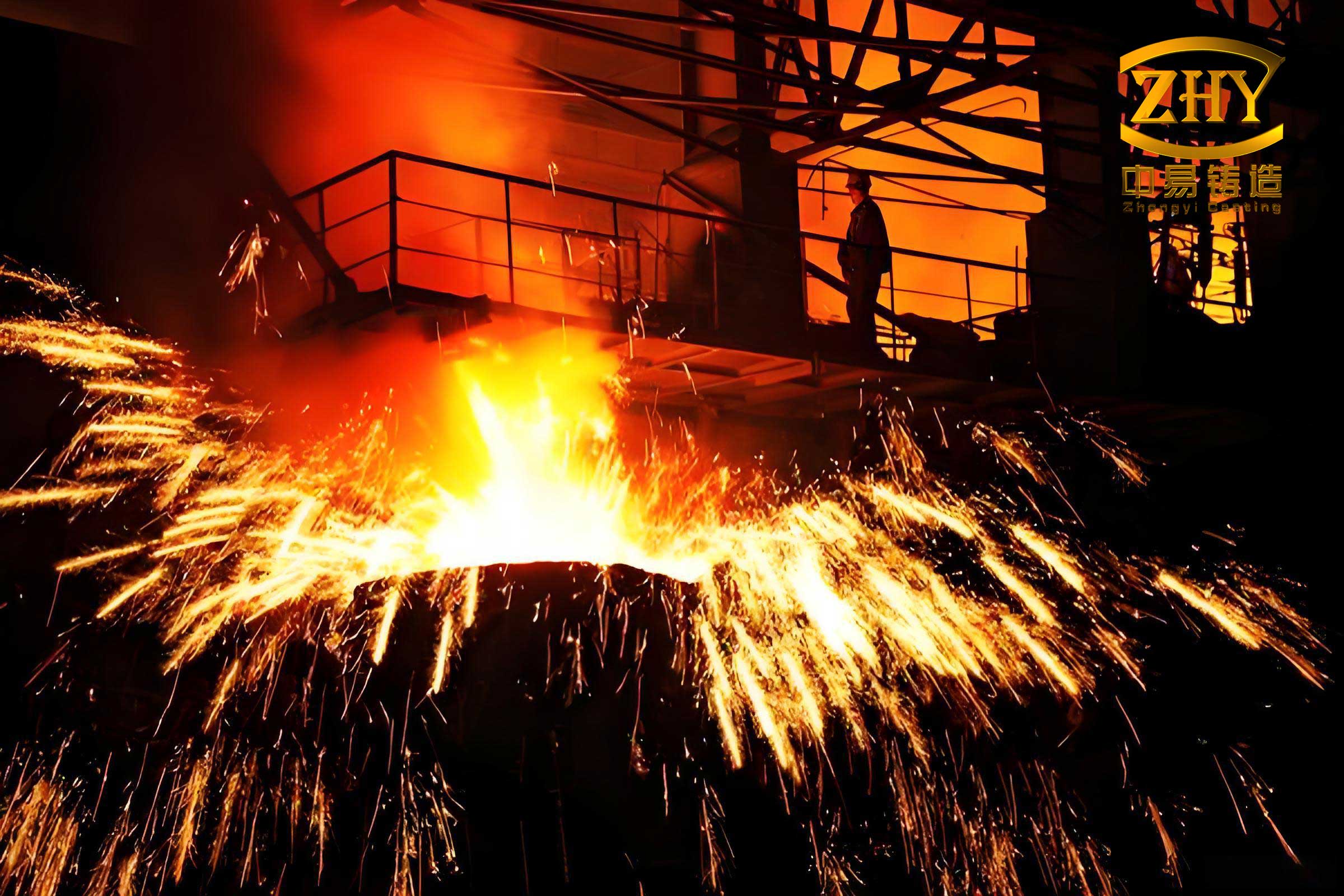
Melting practices for nodular cast iron must ensure consistent temperature, composition, and low oxidation. I prefer using medium-frequency induction furnaces for their stirring action and precise temperature control. The melting temperature should be maintained between 1500–1550 °C to achieve good homogeneity while avoiding excessive superheat that can lead to gas pickup.
Prior to treatment, the base iron should be desulfurized if necessary, aiming for a sulfur content in the range of 0.005–0.015%. Too low sulfur (<0.005%) can reduce nucleation sites, impairing inoculation effectiveness. The relationship between sulfur content and required magnesium addition for effective nodularization can be expressed as:
$$ \%\text{Mg}_{\text{add}} = a \cdot \%S_{\text{initial}} + b $$
where \( a \) and \( b \) are constants dependent on the treatment method; typically, \( a \approx 0.76 \) and \( b \approx 0.025 \) for magnesium-ferrosilicon alloys.
4. Nodularizing and Inoculation Treatments
The choice of nodularizing and inoculating agents is pivotal for achieving high nodularity and fine graphite distribution in nodular cast iron. For thick sections, I recommend using magnesium-based nodularizers with low rare-earth (RE) content to minimize the risk of chunky graphite. A typical composition might be Mg 5–7%, Si 45–50%, RE 0.5–1.5%, with the balance being iron and calcium.
Inoculation is performed both during treatment (primary inoculation) and post-treatment (late inoculation) to enhance nucleation. Effective inoculants for nodular cast iron include ferrosilicon alloys containing elements like Ca, Ba, Al, and Sr. The inoculation efficiency can be modeled by:
$$ N = N_0 \cdot e^{-k t} $$
where \( N \) is the active nucleus count, \( N_0 \) is the initial nucleus count, \( k \) is the fade rate constant, and \( t \) is time after inoculation. For thick-section nodular cast iron, fade is accelerated due to long holding times, necessitating multiple inoculation points or use of fade-resistant inoculants.
Treatment methods such as sandwich technique in ladle or flow-through systems are employed. The residual magnesium and rare-earth levels should be monitored closely; I aim for Mgres of 0.030–0.050% and REres of 0.010–0.015% to ensure good nodularity without excessive carbide formation.
5. Control of Alloying and Trace Elements
Trace elements, even in minute quantities, can significantly influence the microstructure and properties of nodular cast iron. Elements like Sb, Bi, Sn, and As can either be detrimental or beneficial depending on their concentration and interaction with RE.
Antimony (Sb), when added in controlled amounts (0.002–0.005%), can refine graphite structure and increase nodule count by adsorbing at the graphite/liquid interface and forming compounds that act as nuclei. However, excess Sb leads to graphite distortion. The interplay between Sb and Ce can be described by the ratio:
$$ \text{Sb/Ce ratio} \approx 1.2 \text{ to } 1.5 $$
Maintaining this ratio helps optimize graphite morphology in nodular cast iron.
Bismuth (Bi) has similar effects; it can be used as an inoculant enhancer in amounts up to 0.001% to prevent degenerate graphite in heavy sections.
The combined effect of trace elements on nodularity can be assessed using empirical formulas like:
$$ \text{Nodularity Score} = 100 – \beta \cdot (\%\text{Ti} + \%\text{Sb} + \%\text{Pb} + \cdots) $$
where \( \beta \) is a factor derived from historical data. For premium nodular cast iron, this score should exceed 90%.
6. Pretreatment and Modification Techniques
Pretreatment of the base iron before nodularization is a powerful tool to improve the quality of nodular cast iron. Techniques include pre-inoculation with graphite-based additives or silicon carbide to increase nucleation sites. This step reduces the required magnesium addition and enhances graphite nodule count.
Another effective method is the addition of small amounts of elements like Sb or Bi as modifiers. As shown in practice, adding 0.003% Sb to a 2 MW hub casting improved nodularity from 93.4% to 98% and increased ferrite fraction while eliminating chunky graphite. The mechanism involves the formation of stable compounds that serve as long-lasting nuclei, mitigating fade effects in thick sections.
The benefit of pretreatment on nodule count (\( N_v \)) can be quantified as:
$$ N_v = N_{v0} + \gamma \cdot C_{\text{pretreat}} $$
where \( N_{v0} \) is the baseline nodule count, \( \gamma \) is a efficiency coefficient, and \( C_{\text{pretreat}} \) is the concentration of pretreatment agent.
7. Process Design and Solidification Control
Gating and risering design for thick-section nodular cast iron must account for the long freezing range and high shrinkage propensity. I use modulus-based methods to design feeders, ensuring adequate feed metal to compensate for solidification contraction. The modulus \( M \) is defined as:
$$ M = \frac{V}{A} $$
where \( V \) is volume and \( A \) is cooling surface area. Feeders should have a modulus about 1.2 times that of the casting section to ensure directional solidification.
Chills and cooling ribs are often employed to accelerate cooling in critical areas, reducing segregation and promoting finer microstructure. Simulation software is invaluable for predicting solidification patterns, hot spots, and potential defect locations in nodular cast iron castings.
The solidification time \( t_s \) for a thick section can be estimated using Chvorinov’s rule:
$$ t_s = B \cdot \left( \frac{V}{A} \right)^n $$
where \( B \) and \( n \) are constants dependent on the mold material and casting conditions. For nodular cast iron in sand molds, \( n \) is typically around 2.
8. On-Site Process Monitoring and Quality Assurance
Consistent production of high-quality nodular cast iron requires rigorous in-process controls. Key parameters to monitor include:
- Melting temperature and holding time.
- Chemical composition via optical emission spectrometry.
- Treatment temperatures and reaction kinetics.
- Cooling rates in molds, especially for thick sections.
Non-destructive testing (NDT) methods such as ultrasonic testing (UT) and magnetic particle inspection (MT) are mandatory for wind power nodular cast iron components to detect internal and surface defects. Mechanical testing from attached test blocks (e.g., 70 mm thickness) provides data on tensile strength, elongation, and impact toughness at low temperatures (-20 °C or -40 °C).
The relationship between silicon content and mechanical properties in such test blocks can be modeled linearly for practical ranges:
$$ \sigma_b = \sigma_{b0} + m \cdot \%\text{Si} $$
$$ A_{KV} = A_{KV0} – n \cdot \%\text{Si} $$
where \( \sigma_b \) is tensile strength, \( A_{KV} \) is impact energy, and \( m \), \( n \) are positive coefficients derived from regression analysis of production data.
Conclusion
Stable production of thick-section wind power nodular cast iron castings is a complex endeavor that demands meticulous attention to detail across all stages of the manufacturing process. From selecting high-purity raw materials to implementing precise chemical controls, advanced treatment methods, and robust process design, each step contributes to the final quality of the nodular cast iron. Key takeaways include the necessity of keeping silicon and manganese low to preserve low-temperature toughness, optimizing magnesium and rare-earth residuals, utilizing pretreatment or micro-additions like antimony to enhance graphite nucleation, and employing solidification modeling to prevent defects. Through these integrated approaches, foundries can consistently produce nodular cast iron components that meet the rigorous standards of the wind energy industry, ensuring reliability and longevity in service. The continuous refinement of these techniques will further advance the capabilities of nodular cast iron in demanding applications.