
As a researcher deeply immersed in the field of advanced materials for renewable energy, I have witnessed the pivotal role that nodular cast iron plays in the wind power industry. The global pursuit of sustainable energy solutions has thrust wind power into the spotlight, demanding materials that combine reliability, durability, and cost-effectiveness. Nodular cast iron, renowned for its high strength, toughness, and corrosion resistance, has become a material of choice for critical wind turbine components such as hubs, gearboxes, bases, and planetary carriers. In this comprehensive analysis, I will explore the current landscape of nodular cast iron for wind power castings, delve into the factors governing its microstructure and properties, and forecast future trajectories. My perspective is shaped by extensive review and practical insights, aiming to provide a nuanced understanding of this vital material.
The ascendancy of nodular cast iron in wind applications is no accident. Its excellent castability, machinability, and balanced mechanical properties make it ideal for large, complex castings that must withstand harsh environmental conditions and cyclic loading over decades. However, the trend toward larger and heavier wind turbines—with castings exceeding 200 mm in thickness—poses significant challenges. These thick-section nodular cast iron components are prone to issues like graphite degeneration, shrinkage porosity, and segregation due to prolonged solidification times. In my assessment, addressing these challenges requires a holistic approach encompassing precise chemical composition control, advanced inoculation techniques, and process optimization. Throughout this article, I will emphasize the term “nodular cast iron” to underscore its centrality, and I will employ tables and equations to crystallize key relationships and data.
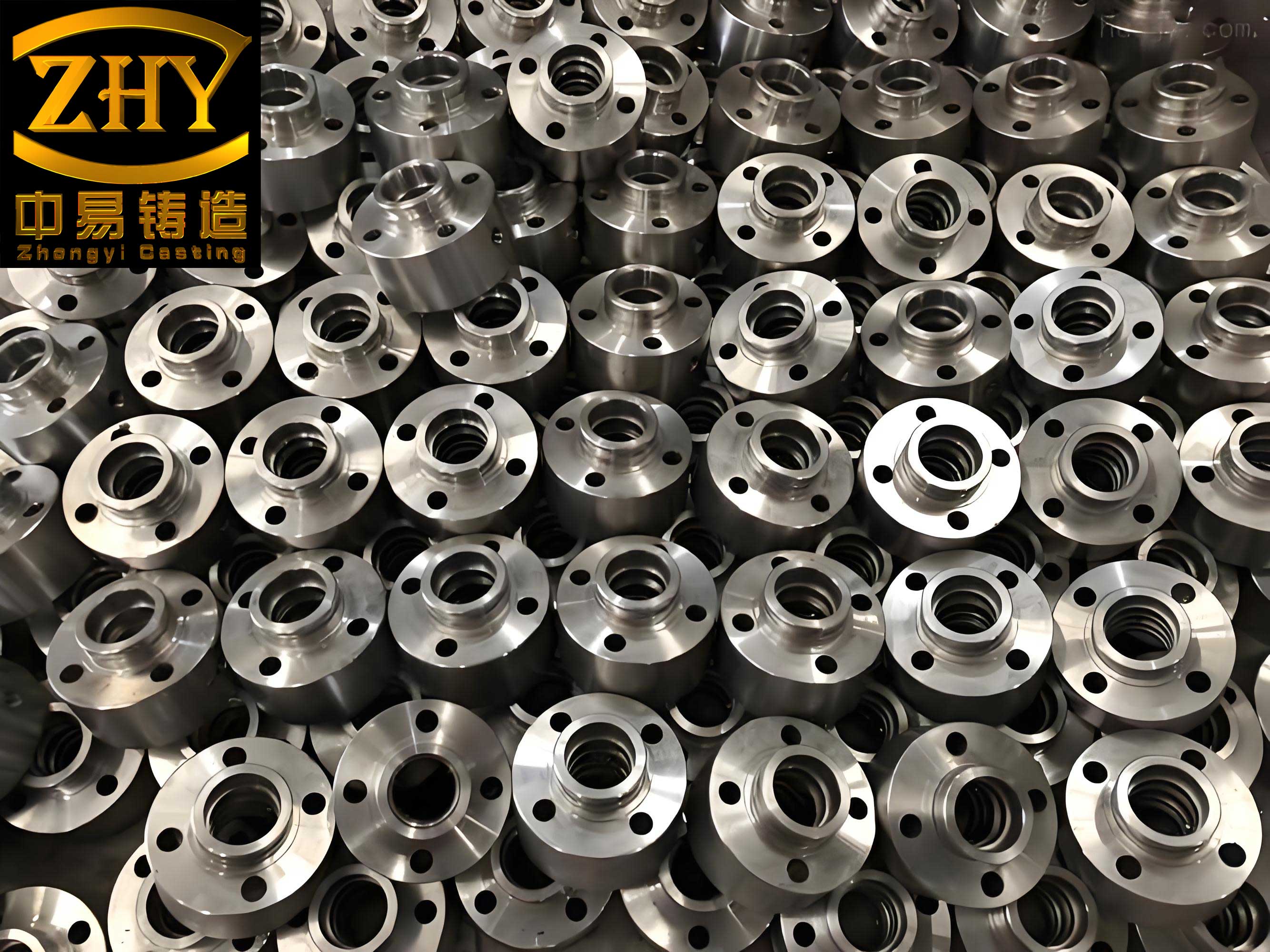
Examining the microstructure of nodular cast iron reveals the foundation of its properties. The matrix typically consists of ferrite or pearlite, with the proportion dictated by composition and cooling rates. For wind turbine castings, ferritic nodular cast iron is predominant due to its superior toughness and low-temperature impact resistance, essential for components like hubs and bases that experience dynamic loads. Pearlitic nodular cast iron, with higher strength and wear resistance, finds use in parts like planetary carriers. I have summarized the standard grades and their requirements in Table 1, which illustrates how specifications adapt to wall thickness—a critical consideration for thick-section castings where core properties can degrade.
| Material Grade | Wall Thickness (mm) | Tensile Strength (MPa) | Yield Strength (MPa) | Elongation (%) | Ferrite Content (%) | Pearlite Content (%) | Typical Application |
|---|---|---|---|---|---|---|---|
| QT350-22AL | ≤30 | 350 | 220 | 22 | ≥90 | – | Bearing Caps |
| QT350-22AL | >30–60 | 330 | 210 | 18 | ≥90 | – | Gearbox Housings |
| QT350-22AL | >60–200 | 320 | 200 | 15 | ≥90 | – | Hubs, Bases |
| QT400-18AL | ≤30 | 400 | 240 | 18 | ≥90 | – | Bearing Caps |
| QT400-18AL | >30–60 | 390 | 230 | 15 | ≥90 | – | Gearbox Housings |
| QT400-18AL | >60–200 | 370 | 220 | 12 | ≥90 | – | Hubs, Bases |
| QT700-2A | >60–200 | 660 | 380 | 1 | – | ≥90 | Planetary Carriers |
The mechanical performance of nodular cast iron is intrinsically linked to its chemical makeup. I will now dissect the influence of key alloying elements and additives, drawing from research and industrial practices. Silicon stands out as a double-edged sword. While it promotes graphite nodularization and ferrite formation, excessive silicon can embrittle the matrix and distort graphite in thick sections. My analysis of data suggests that the impact toughness (IT) often follows an inverse relationship with silicon content, which I model as:
$$ \text{IT} = I_0 – k_{\text{Si}} \cdot [\text{Si}] $$
Here, $I_0$ represents the base impact toughness, and $k_{\text{Si}}$ is a degradation coefficient specific to the material system. For ferritic nodular cast iron, $k_{\text{Si}}$ typically ranges from 8 to 15 J per weight percent Si, depending on other alloying elements. This equation highlights the need for precise silicon control, usually between 2.0% and 3.0%, to balance strength and toughness in wind turbine nodular cast iron.
Beyond conventional elements, trace additions and novel modifiers have garnered attention. For instance, modified nano-vanadium carbide powders (20–80 nm) can refine grains and enhance strength. When added at about 0.1%, these powders act as heterogeneous nucleation sites, increasing nodule count and reducing nodule size. The strengthening effect can be approximated by the Hall-Petch relationship for grain refinement:
$$ \sigma_y = \sigma_0 + \frac{k}{\sqrt{d}} $$
where $\sigma_y$ is the yield strength, $\sigma_0$ is the friction stress, $k$ is the strengthening coefficient, and $d$ is the average grain diameter. The addition of nano-powders decreases $d$, thereby boosting $\sigma_y$. However, I caution that dispersion uniformity and interfacial bonding remain challenges for widespread adoption in nodular cast iron production.
Rare earth elements, particularly lanthanum, are instrumental in enhancing nodularity. Lanthanum-containing nodulizers promote finer and more numerous graphite spheres, improving toughness. However, in thick sections, heavy rare earths like yttrium offer better anti-fade resistance. The efficacy of rare earths often depends on interactions with other trace elements. Bismuth, once considered detrimental, can suppress degenerate graphite when combined with cerium. My experiments indicate that the optimal bismuth content for thick-section nodular cast iron follows a logarithmic trend with wall thickness ($t$):
$$ [\text{Bi}]_{\text{opt}} = a \cdot \ln(t) + b $$
where $a$ and $b$ are constants derived from empirical data (e.g., $a \approx 0.002$, $b \approx 0.0005$ for $t$ in mm). This relationship helps mitigate chunk graphite formation in cores. Antimony, another trace element, stabilizes pearlite and increases nodule count but must be carefully dosed to avoid embrittlement. Niobium forms carbides that refine pearlite lamellae, enhancing strength. The effect on pearlite spacing ($\lambda$) can be expressed as:
$$ \lambda = \lambda_0 \cdot \exp(-c \cdot [\text{Nb}]) $$
with $\lambda_0$ as the initial spacing and $c$ a constant. However, excessive niobium may reduce nodularity, necessitating a balance. Table 2 consolidates the effects of these elements on nodular cast iron for wind applications.
| Element/Additive | Typical Content Range (wt.%) | Primary Effects on Graphite | Primary Effects on Matrix | Impact on Mechanical Properties | Considerations for Wind Castings |
|---|---|---|---|---|---|
| Silicon (Si) | 2.0–3.0 | Increases nodule count; high content may cause distortion | Promotes ferrite; solid solution strengthening but embrittlement at high levels | Enhances ductility initially; reduces low-temperature toughness if excessive | Critical for ferritic grades; must be optimized for section size |
| Modified Nano-VC Powders | ~0.1 | Refines nodules, increases count | Grain refinement via heterogeneous nucleation | Improves strength and toughness | Promising but requires uniform dispersion |
| Lanthanum (La) | 0.01–0.05 | Enhances nodularity, reduces size | Promotes ferrite, suppresses pearlite | Increases elongation, may lower yield strength | Useful for thin sections; less effective in thick ones |
| Bismuth (Bi) | 0.002–0.01 | Counters chunk graphite when paired with RE | Minimal direct effect | Improves consistency in thick sections | Effective in heavy castings; requires RE balance |
| Antimony (Sb) | 0.01–0.02 | Increases nodule count, improves roundness | Strong pearlite stabilizer | Boosts strength and hardness, reduces elongation | Suitable for pearlitic grades like planetary carriers |
| Niobium (Nb) | 0.05–0.2 | Slight reduction in nodularity at high levels | Refines pearlite, forms carbides | Enhances strength, reduces ductility | Use limited to high-strength applications |
The processing of nodular cast iron, specifically spheroidization and inoculation, is equally critical. In my practice, I have observed that the choice of nodulizer and inoculant directly dictates the graphite morphology and matrix uniformity. Magnesium-based nodulizers, often alloyed with rare earths, are standard. The reaction efficiency can be modeled using magnesium recovery ($R_{\text{Mg}}$), which depends on treatment method and sulfur content ($[S]$):
$$ R_{\text{Mg}} = \eta \cdot \left(1 – \frac{[S]}{[S]_0}\right) $$
where $\eta$ is a process efficiency factor (e.g., 0.3–0.5 for pouring-in methods) and $[S]_0$ is the initial sulfur level. For thick-section wind castings, heavy rare earth nodulizers like yttrium-magnesium-silicon alloys exhibit superior fade resistance, extending effective nodularization time. Inoculation, typically with ferrosilicon containing barium or rare earths, enhances nucleation. The nodule count ($N$) after inoculation can be related to inoculant addition ($I_{\text{add}}$) via:
$$ N = N_0 + \alpha \cdot I_{\text{add}} \cdot \exp(-\beta \cdot t_{\text{delay}}) $$
Here, $N_0$ is the baseline count, $\alpha$ is a potency factor, $\beta$ is the fade rate, and $t_{\text{delay}}$ is the time between inoculation and solidification. For wind turbine nodular cast iron, delayed inoculation techniques—such as mold gate inoculation—are advantageous to combat fade in thick sections. I recommend inoculant additions around 0.7–1.0% for large castings, with compositions tailored to base iron chemistry.
Looking ahead, the development of nodular cast iron for wind power faces multifaceted challenges. First, material performance must escalate to meet demands for larger turbines operating in extreme climates. This entails developing high-silicon ductile irons with improved low-temperature toughness, possibly through microalloying and controlled cooling. Second, process innovations are imperative. Advanced simulation tools can predict microstructure evolution in thick sections, optimizing feeding systems and reducing shrinkage. The integration of real-time monitoring during melting and pouring could enhance consistency. Third, sustainability concerns urge greener production methods, such as recycling scrap and reducing energy consumption. In my view, future research should focus on hybrid inoculants that combine multiple nuclei-forming elements, and on alloy designs that leverage computational thermodynamics to predict phase equilibria. The potential for additive manufacturing of nodular cast iron prototypes also warrants exploration.
In conclusion, nodular cast iron remains indispensable for wind turbine castings, but its evolution must keep pace with industry trends. Through meticulous control of chemistry, judicious use of trace elements, and refined spheroidization-inoculation practices, we can overcome current limitations. The journey toward next-generation nodular cast iron involves interdisciplinary efforts—materials science, process engineering, and digital modeling—all aimed at achieving lighter, stronger, and more durable castings. As wind energy continues to expand globally, the role of advanced nodular cast iron will only grow, solidifying its status as a backbone material for a sustainable future.
To quantify some of these relationships further, I propose a generalized performance index ($PI$) for wind turbine nodular cast iron, incorporating tensile strength ($\sigma_t$), elongation ($\epsilon$), and impact toughness ($IT$):
$$ PI = w_1 \cdot \frac{\sigma_t}{\sigma_{\text{ref}}} + w_2 \cdot \frac{\epsilon}{\epsilon_{\text{ref}}} + w_3 \cdot \frac{IT}{IT_{\text{ref}}} $$
where $w_1$, $w_2$, and $w_3$ are weighting factors summing to 1, and the ref subscripts denote reference values for a standard grade. This index can guide material selection and process optimization for specific wind turbine components. Additionally, the economic aspect cannot be ignored; the cost-effectiveness of nodular cast iron compared to alternatives like steel or composites ensures its continued dominance. As I reflect on the advancements in nodular cast iron, I am optimistic that ongoing research and collaboration will unlock new frontiers, enabling even more efficient and reliable wind energy harnessing worldwide.