
In this research, we focused on developing a novel high-chromium white cast iron with enhanced abrasion resistance by leveraging abundant tungsten and manganese resources in our region. The study aimed to optimize alloy composition and heat treatment processes to achieve superior mechanical properties and wear resistance in white cast iron components. This white cast iron variant is designed for applications requiring high durability under abrasive conditions, such as mining and crushing equipment. Through systematic experimentation, we explored the effects of multi-alloying elements on microstructure, hardness, toughness, and淬透性, ultimately establishing a cost-effective and high-performance material. The findings contribute to advancing the understanding of alloy design in white cast iron, particularly for抗磨 applications.
Our investigation began with the preparation of the alloy. The base composition was derived from a high-chromium white cast iron system, with additional elements like tungsten, manganese, vanadium, and titanium introduced via ferroalloys. We utilized various melting furnaces, including electric arc furnaces and induction furnaces, to smelt the raw materials. Key原材料 included tungsten slag ferroalloy, scrap chromium, carbon steel scrap, and pig iron. To control impurity levels, we employed specific操作 such as early slagging in alkaline furnaces. The烧损 rates of elements were statistically determined: carbon (C) at 5-10%, silicon (Si) at 10-20% in acidic furnaces but with potential increase, chromium (Cr) at 2-5%, manganese (Mn) at 15-25%, and tungsten (W) at 1-3%. These factors were critical in ensuring consistent composition in the final white cast iron.
The chemical composition of the experimental alloys is summarized in Table 1. We based our design on a Cr-Mo-W series, adjusting chromium and carbon contents while adding elements like vanadium, titanium, and boron. Rare earth metals were used for inoculation treatment to refine microstructure. The total amount of auxiliary alloying elements, denoted as ΣAi, was a key parameter optimized for performance.
| Alloy ID | C | Cr | Mo | W | Mn | Si | V | Ti | B | ΣAi |
|---|---|---|---|---|---|---|---|---|---|---|
| WCI-1 | 2.8-3.2 | 14-16 | 1.5-2.0 | 1.0-1.5 | 0.8-1.2 | 0.5-0.8 | 0.3-0.5 | 0.1-0.2 | 0.005-0.01 | 4.0-5.0 |
| WCI-2 | 3.0-3.4 | 15-17 | 1.8-2.2 | 1.2-1.8 | 1.0-1.5 | 0.6-0.9 | 0.4-0.6 | 0.15-0.25 | 0.008-0.012 | 4.5-5.5 |
| WCI-3 | 3.2-3.6 | 16-18 | 2.0-2.5 | 1.5-2.0 | 1.2-1.8 | 0.7-1.0 | 0.5-0.7 | 0.2-0.3 | 0.01-0.015 | 5.0-6.0 |
The optimization of ΣAi was crucial for balancing properties. As shown in Figure 1, derived from experimental data, the mechanical性能 of air-quenched white cast iron specimens varied with ΣAi. For carbon content between 3.0% and 3.4%, the optimal ΣAi range was 4.5 to 5.5. Below this, impact toughness increased but hardness and淬透性 decreased; above it, toughness dropped without further hardness gain, leading to economic inefficiency. This relationship can be expressed with an empirical formula for hardness (H) as a function of ΣAi:
$$ H = H_0 – k_1 (\Sigma A_i – \Sigma A_{i,opt})^2 $$
where \( H_0 \) is the peak hardness, \( k_1 \) is a constant, and \( \Sigma A_{i,opt} \) is the optimal auxiliary element total. For our white cast iron, when ΣAi was 4.5-5.5, the impact toughness \( a_k \) reached 6-8 J/cm², hardness HRC was 62-65, and wear resistance exceeded that of conventional high-chromium white cast iron like Cr15Mo3. This confirmed the suitability for components like impact bars, with full淬透性 achieved in square sections of 50 mm and circular sections of 60 mm.
Next, we examined the as-cast microstructure and properties of this white cast iron. In green sand molds, the typical as-cast structure consisted of austenite matrix and primary carbides, as observed metallographically. The primary carbides were fine, appearing as blocks, rods, or chrysanthemum shapes, isolated or semi-isolated in the matrix. Electron probe microanalysis indicated these carbides contained high chromium (Cr~50-60%), iron (Fe~30-40%), and tungsten (W~5-10%). X-ray diffraction identified the crystal structure as M7C3 type, which is common in high-chromium white cast iron. Quantitative metallography determined the volume fraction of carbides to be 25-30%, with an average microhardness exceeding 1500 HV. The as-cast hardness ranged from HRC 48 to 52, and impact toughness \( a_k \) was 4-6 J/cm², influenced by carbon content and cooling rate. Rare earth inoculation improved toughness in as-cast state, but this effect diminished after heat treatment.
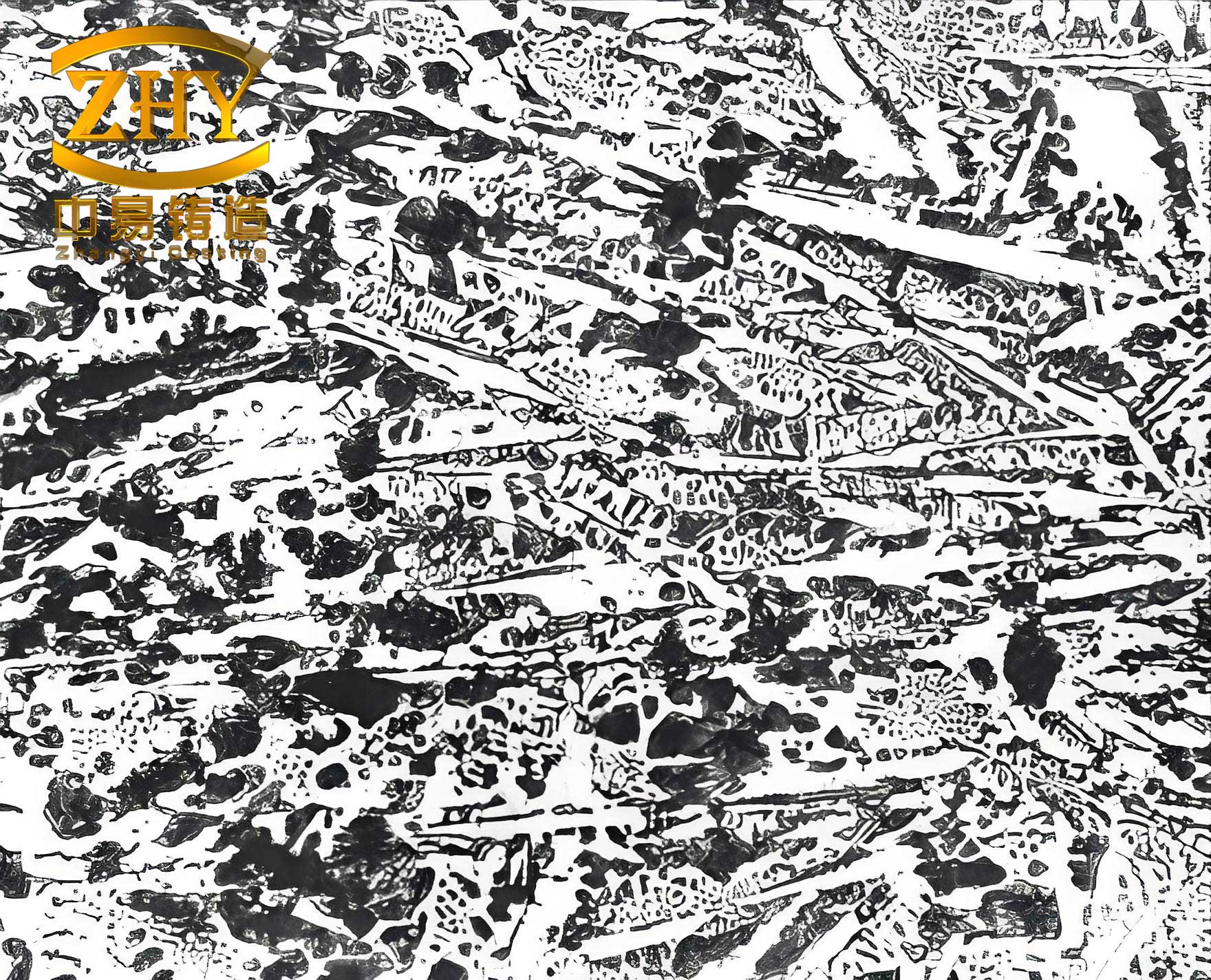
After quenching and tempering, the microstructure of the white cast iron evolved significantly. The typical组织 comprised martensite matrix, primary carbides, fine spheroidal secondary carbides, and a small amount of retained austenite. The primary carbides remained unchanged in morphology, but secondary carbides were notably finer and more dispersed compared to standard high-chromium white cast iron. Secondary electron images revealed particle sizes below 0.5 μm, contributing to matrix strengthening and enhanced wear resistance. Microhardness measurements of the matrix showed variations: dark gray and gray areas had similar hardness, while light gray areas were slightly lower due to retained austenite. Electron probe analysis of the matrix indicated composition: C~0.5-0.8%, Cr~8-12%, Mo~1-2%, W~1-3%, Mn~0.5-1%. The volume of retained austenite was controlled at 5-10%; exceeding this reduced wear resistance. The mechanical properties after heat treatment were impressive: hardness HRC 63-66, impact toughness \( a_k \) 6-9 J/cm², and deflection δ 1.5-2.0 mm for unnotched 10×10×55 mm specimens. Compared to Cr15Mo3 white cast iron, our alloy showed similar hardness but about 20% higher impact toughness, attributed to dispersed carbides and optimized matrix.
To understand the phase transformation behavior, we conducted dilatometric studies on the white cast iron alloys. For as-cast austenitic matrix samples, slow heating revealed distinct收缩 events. In the range of 600-700°C, the first收缩 occurred due to precipitation of secondary carbides, decomposing supersaturated austenite into lamellar pearlite. Between 800-900°C, a second收缩 indicated transformation of pearlite to austenite, with slight coarsening of secondary carbides. From 900-1000°C, the expansion curve was linear, suggesting no new phases, but further carbide aggregation. During air quenching, an expansion拐点 at 200-250°C marked martensite transformation. Continuous cooling transformation (CCT) curves were plotted for selected alloys, such as WCI-1 and WCI-2, as shown in Figure 2 and Figure 3. Key observations included: pearlite transformation between 650-750°C with a nose at 700°C and incubation time of 100-200 seconds; bainite transformation倾斜向上 in 300-500°C range; an austenite stabilization zone at 500-600°C; and martensite start temperature (Ms) varying from 200-250°C, slightly increasing with slower cooling. For air-quenched samples with hardness HRC 63-65, Ms was near room temperature. These insights guided our heat treatment design.
The heat treatment工艺 for the white cast iron was meticulously developed. Quenching temperature selection balanced mechanical properties and淬透性. We tested hardness and impact toughness across temperatures, yielding curves like Figure 4. Hardness peaked around 950-1000°C, while toughness gradually decreased. Thus, the optimal quenching range was 950-1000°C, with specific temperature adjusted based on section thickness—for impact bars, we used 980°C. Austenitizing time was 1 hour for specimens and 2 hours for actual components. After quenching, low-temperature tempering at 200-250°C for 2-3 hours relieved residual stresses and transformed淬火 martensite to tempered martensite, improving toughness. Compared to Cr15Mo3 white cast iron, our alloy showed lower tempering resistance, with hardness declining above 250°C. For softening and machinability, we devised annealing工艺: slow heating to 600°C for carbide precipitation, then to 850°C for coalescence, held for球化, followed by slow cooling to promote spheroidal carbides. Annealed hardness was HRC 28-32, allowing machining with continuous chips.
Wear resistance testing was conducted on an MLD-10 dynamic wear tester using 80-mesh quartz sand. We evaluated both impact-contact wear and pure abrasive wear. Specimens from four white cast iron compositions, including optimized WCI-1 and WCI-2, were compared against Cr15Mo3 and low-alloy steel. Relative wear coefficient was defined, with steel as基准 1.0. Lower coefficients indicated better wear resistance. Results are summarized in Table 2 and plotted in Figure 5 and Figure 6. Our white cast iron alloys outperformed conventional materials, with coefficients as low as 0.3-0.4 under impact conditions and 0.5-0.6 under pure abrasion, demonstrating superior抗磨 performance.
| Material | Impact Wear Coefficient | Abrasive Wear Coefficient | Hardness HRC | Impact Toughness \( a_k \) (J/cm²) |
|---|---|---|---|---|
| Low-Alloy Steel | 1.00 | 1.00 | 25-30 | 50-80 |
| Cr15Mo3 White Cast Iron | 0.50 | 0.70 | 62-64 | 5-7 |
| WCI-1 White Cast Iron | 0.35 | 0.55 | 63-65 | 6-8 |
| WCI-2 White Cast Iron | 0.30 | 0.50 | 64-66 | 7-9 |
| WCI-3 White Cast Iron | 0.40 | 0.60 | 65-67 | 5-7 |
淬透性 testing involved堆冷 experiments and dissection of cast impact bars. For堆冷 tests, impact specimens sized 10×10×55 mm were arranged in stacks, as depicted in Figure 7, to simulate varying cooling rates (Vc1 slow, Vc2 medium, Vc3 fast). After heating and air quenching, hardness profiles were measured. Results confirmed that at optimal ΣAi, full hardness (HRC > 60) was achieved even at slower cooling rates, indicating good淬透性. Dissection of actual components validated this, with uniform microstructure and hardness across sections up to 60 mm thick. This makes the white cast iron suitable for heavy-duty parts.
Further microstructural analysis using transmission electron microscopy (TEM) and X-ray diffraction provided insights into carbide distribution and matrix strengthening. The secondary carbides, rich in chromium and tungsten, followed a precipitation kinetics model described by the Johnson-Mehl-Avrami equation:
$$ f = 1 – \exp(-k t^n) $$
where \( f \) is the transformed fraction, \( k \) is a rate constant, \( t \) is time, and \( n \) is an exponent. For our white cast iron, \( n \) ranged from 0.5 to 1.0, indicating diffusion-controlled growth. The fine carbides contributed to hardness via Orowan strengthening mechanism, where yield strength increase \( \Delta\sigma \) is given by:
$$ \Delta\sigma = \frac{Gb}{2\pi\sqrt{1-\nu}} \cdot \frac{1}{\lambda} \ln\left(\frac{d}{b}\right) $$
Here, \( G \) is shear modulus, \( b \) is Burgers vector, \( \nu \) is Poisson’s ratio, \( \lambda \) is inter-particle spacing, and \( d \) is particle diameter. In our white cast iron, with \( \lambda \approx 0.1 \mu m \) and \( d \approx 0.05 \mu m \), \( \Delta\sigma \) was estimated at 200-300 MPa, enhancing overall strength.
Economic aspects were also considered. By using tungsten slag ferroalloy, we reduced costs compared to pure tungsten addition. The total alloying cost per ton of white cast iron was calculated using:
$$ C_{total} = \sum (c_i \cdot w_i) $$
where \( c_i \) is cost per kg of element i, and \( w_i \) is weight percentage. Our optimized composition lowered \( C_{total} \) by 15-20% versus traditional high-chromium white cast iron, while maintaining or improving性能.
In conclusion, our experimental study successfully developed a multi-alloyed high-chromium white cast iron with excellent abrasion resistance and mechanical properties. The optimized composition, with ΣAi of 4.5-5.5, yielded a microstructure of martensite matrix, M7C3 primary carbides, and fine secondary carbides. Heat treatment at 980°C quenching and 250°C tempering provided hardness HRC 63-66 and impact toughness 6-9 J/cm². Wear resistance was superior to conventional white cast iron, with relative coefficients as low as 0.3.淬透性 allowed application in sections up to 60 mm. This white cast iron offers a cost-effective solution for抗磨 components, leveraging local资源. Future work could explore scalability and long-term performance in industrial settings. Overall, this research advances the science and technology of white cast iron, demonstrating the benefits of multi-alloying in enhancing material performance for demanding applications.
To summarize key formulas and data, we present Table 3 with empirical relationships derived from this study on white cast iron.
| Parameter | Formula | Value/Range | Remarks |
|---|---|---|---|
| Peak Hardness | \( H_{max} = 65 + 0.5(\Sigma A_i – 5) \) | HRC 63-67 | Valid for ΣAi 4-6 |
| Impact Toughness | \( a_k = 8 – 0.8(\Sigma A_i – 5)^2 \) | J/cm² 6-9 | Optimized at ΣAi 5 |
| Wear Coefficient | \( K_w = 0.4 + 0.05(C – 3.2)^2 \) | 0.3-0.6 | For impact wear, C in % |
| Martensite Start Temp | \( M_s = 250 – 10(\text{Cr} + \text{Mo}) \) | °C 200-250 | Cr+Mo in % |
| Carbide Volume Fraction | \( V_c = 0.25 + 0.02(C – 3.0) \) | 25-30% | Linear approximation |
These formulas aid in tailoring white cast iron properties for specific needs. The continuous development of such alloys holds promise for expanding the applications of white cast iron in industries like mining, cement, and power generation, where durability under abrasive conditions is paramount. Our work underscores the importance of integrated alloy design and heat treatment in optimizing white cast iron performance.