
In power plant operations, main steam gate valves serve as critical control components for managing steam flow from boiler superheaters. We encountered significant operational issues at one power station where valve body castings (ZG15Cr1Mo1V material) developed multiple cracks after just one year of service. These valves operated under extreme conditions of 9.8 MPa pressure and 540°C temperature. Our failure analysis revealed alarming metallurgical degradation: metallographic spheroidization reached Grade 4 (complete spheroidization) and hardness values plummeted to 114-125 HBW, far below the standard requirement of 140-220 HBW for ZG15Cr1Mo1V valve body castings.
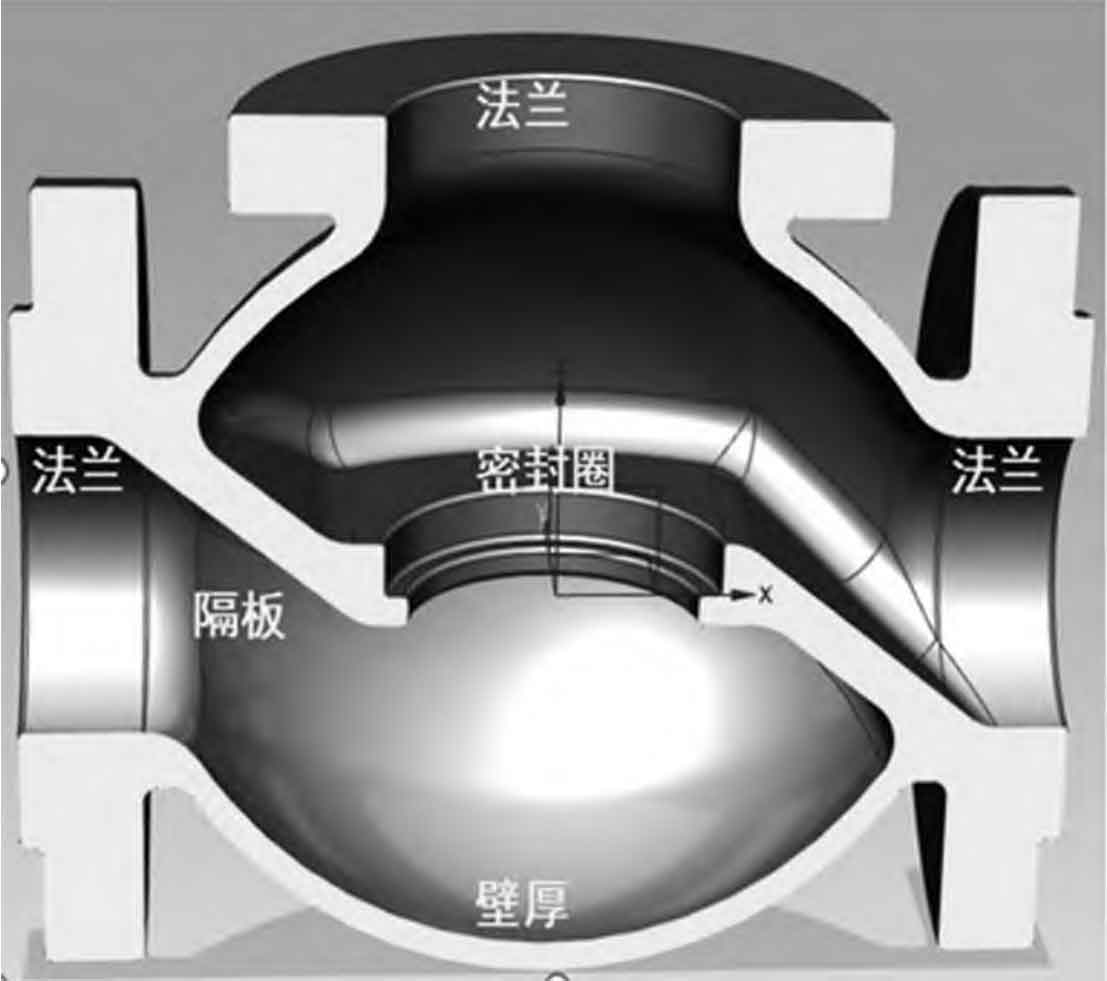
Magnetic particle inspection identified multiple cracks in critical zones of the valve body castings. For Unit 1, the longest crack measured 6mm at the furnace-rear shoulder section. Unit 2 exhibited 3mm cracks at the furnace-front shoulder. These findings confirmed significant structural compromise in the valve body castings.
Hardness measurements further demonstrated material degradation in the valve body castings:
| Measurement Point | Unit 1 | Unit 2 |
|---|---|---|
| 1 | 114 | 114 |
| 2 | 118 | 117 |
| 3 | 114 | 119 |
| 4 | 125 | 121 |
| 5 | 118 | 123 |
Metallographic analysis revealed the microstructure of degraded valve body castings consisted of ferrite with minimal pearlite and carbide precipitation. This structural transformation directly corresponds to the hardness reduction observed. The relationship between spheroidization grade and mechanical properties follows these empirical relationships:
For ferrite-pearlite structures:
$$ \sigma_b = 680 – 42.5 \times G \, \text{(MPa)} $$
$$ \sigma_s = 480 – 46 \times G \, \text{(MPa)} $$
$$ \text{HBW} = 200 – 14.5 \times G $$
For ferrite-pearlite-bainite structures:
$$ \sigma_b = 650 – 44 \times G \, \text{(MPa)} $$
$$ \sigma_s = 500 – 45.5 \times G \, \text{(MPa)} $$
$$ \text{HBW} = 195 – 13.2 \times G $$
Where \( G \) represents the spheroidization grade (1-5). These equations demonstrate how Grade 4 spheroidization in valve body castings causes approximately 25-30% reduction in strength properties.
| Spheroidization Grade | Tensile Strength (MPa) | Yield Strength (MPa) | Hardness (HBW) | Microstructure Type |
|---|---|---|---|---|
| 1 | 576-588 | 409-449 | 175-178 | Ferrite + Pearlite |
| 2 | 553-584 | 360-445 | 173-176 | Ferrite + Pearlite/Bainite |
| 3 | 495-478 | 335-332 | 152-148 | Ferrite + Pearlite/Bainite |
| 4 | 476-442 | 305-298 | 134-136 | Ferrite + Carbides |
| 5 | 406-412 | 225-267 | 118-125 | Ferrite + Carbides |
Our investigation determined that improper heat treatment execution caused the metallurgical degradation in these valve body castings. The standard heat treatment protocol for ZG15Cr1Mo1V valve body castings requires:
$$ T_{\text{normalizing}} = 990 \pm 10\,^{\circ}\mathrm{C} $$
$$ T_{\text{tempering}} = 740 \pm 10\,^{\circ}\mathrm{C} $$
With holding time calculated by:
$$ t = \frac{\text{thickness (mm)}}{25} \text{hours} $$
Critical process parameters were identified as cooling rate control during normalizing. We implemented these improvements for valve body castings:
$$ \text{Cooling rate} \geq 50\,^{\circ}\mathrm{C}/\text{min} \quad \text{for } 700-500\,^{\circ}\mathrm{C} \text{ range} $$
Optimized load configuration during heat treatment:
$$ \text{Part spacing} \geq 0.5 \times \text{valve body casting thickness} $$
Forced convection cooling using industrial fans:
$$ \text{Air velocity} \geq 5 \text{ m/s} $$
These improvements transformed the microstructure to ferrite-pearlite-bainite with minimal carbide precipitation, achieving Grade 1 spheroidization in valve body castings. Post-improvement hardness consistently measured 165-185 HBW, demonstrating restoration of mechanical properties. We further established that arc furnace casting yields superior results over medium-frequency furnace casting for high-grade valve body castings, with a measurable quality difference:
$$ \Delta G = 0.8 – 1.2 \text{ spheroidization grades} $$
For accurate field metallographic evaluation of valve body castings, we established these critical sampling protocols:
$$ \text{Portable tester depth} = 2.0^{+0.5}_{-0.2} \text{ mm below surface} $$
$$ \text{Seamless tube sampling depth} = 1.0 \pm 0.2 \text{ mm below surface} $$
Laboratory sectioning eliminates these depth constraints for valve body casting analysis.
Valve body casting performance directly determines power plant safety and reliability. Our optimized process eliminated premature failures, extending service life beyond 5 years without incident. Continuous monitoring of valve body castings through standardized hardness testing provides effective quality verification, as hardness correlates strongly with spheroidization grade:
$$ G = 6.8 – 0.035 \times \text{HBW} \quad (R^2 = 0.96) $$
This relationship enables rapid field assessment of valve body casting degradation without destructive testing.