
In the field of heavy machinery, high manganese steel casting plays a critical role in manufacturing durable components such as track pads for large excavators. These track pads are essential for supporting and propelling the machine, directly interacting with harsh environments including soil, rocks, and abrasive materials. Given the severe operational conditions, including high impact loads and cyclic stresses, the integrity of high manganese steel casting is paramount to prevent premature failures. This article investigates the fracture mechanisms in high manganese steel track pads through comprehensive analysis and proposes effective control measures to enhance their service life. We focus on the material’s behavior under stress, emphasizing the importance of microstructure control in high manganese steel casting.
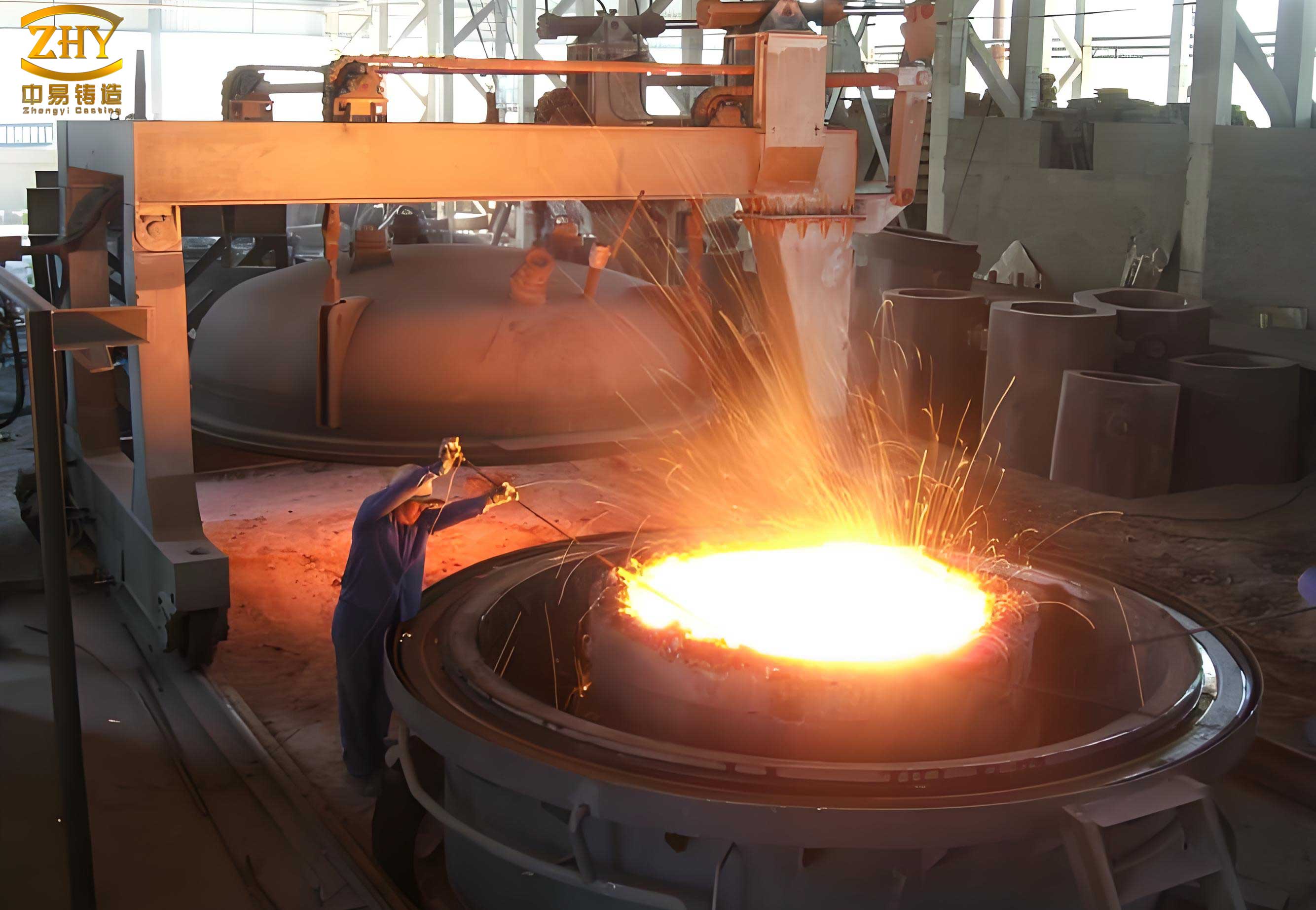
The performance of high manganese steel casting in track pads is influenced by factors such as chemical composition, heat treatment, and casting defects. In this study, we employed various analytical techniques to examine a fractured track pad, aiming to identify the root causes of abnormal failure. The use of high manganese steel casting ensures high toughness and work-hardening capabilities, but improper processing can lead to brittleness and fatigue cracks. We begin by outlining the methodologies used in our analysis, followed by detailed results and discussions on improving high manganese steel casting practices.
Methodology for Failure Analysis
To understand the fracture behavior in high manganese steel casting, we conducted a series of tests on a failed track pad sample. The methods included macroscopic fracture observation, chemical composition analysis, radiographic testing, metallographic examination, and energy-dispersive X-ray spectroscopy (EDS). These approaches allowed us to assess the material’s properties and identify defects in the high manganese steel casting process. For instance, the chemical composition was analyzed using emission spectroscopy, while microstructure was examined through optical and scanning electron microscopy. The integration of these techniques provides a holistic view of the failure mechanisms in high manganese steel casting components.
In macroscopic observation, the fracture surface exhibited beach marks indicative of fatigue failure, with cracks originating from the pin hole inner surface. This aligns with typical fatigue fracture patterns in high manganese steel casting under cyclic loading. Chemical analysis revealed deviations in element concentrations, particularly molybdenum, which is crucial for suppressing carbide precipitation. The formula for calculating the carbide volume fraction can be expressed as: $$V_c = \frac{C_{\text{total}} – C_{\text{sol}}}{C_{\text{carbide}} – C_{\text{sol}}} \times 100\%$$ where \(V_c\) is the volume fraction of carbides, \(C_{\text{total}}\) is the total carbon content, \(C_{\text{sol}}\) is the soluble carbon in austenite, and \(C_{\text{carbide}}\) is the carbon content in carbides. This highlights the importance of composition control in high manganese steel casting.
| Element | Measured Value | Standard Range |
|---|---|---|
| C | 0.91 | 0.70-1.30 |
| Mn | 12.33 | 11.5-14.0 |
| P | 0.014 | ≤0.07 |
| Mo | 0.77 | 0.9-1.2 |
| Si | 0.7 | ≤1.0 |
| S | 0.008 | ≤0.03 |
Radiographic testing confirmed the absence of major casting defects like shrinkage pores or inclusions, indicating that the high manganese steel casting process was generally sound. However, metallographic analysis revealed microstructural issues, such as the presence of twins, deformation martensite, and secondary intergranular cracks. The EDS analysis further identified phosphorus eutectic and carbide aggregations at grain boundaries, which are common pitfalls in high manganese steel casting. The kinetics of carbide precipitation can be modeled using the Avrami equation: $$X = 1 – \exp(-kt^n)$$ where \(X\) is the transformed fraction, \(k\) is the rate constant, \(t\) is time, and \(n\) is the Avrami exponent. This equation helps in understanding the transformation behavior during heat treatment of high manganese steel casting.
Results and Microstructural Analysis
The examination of the high manganese steel casting sample showed that the fracture initiated at the pin hole due to stress concentration, propagating outward in a fatigue manner. The microstructure consisted of an austenitic matrix with numerous twins, which is typical for high manganese steel casting after solution treatment. However, we observed deformation-induced martensite and intergranular cracks, suggesting embrittlement. The presence of carbides and phosphorus eutectic at grain boundaries was confirmed through EDS, as summarized in the table below. These findings underscore the critical role of microstructure in the performance of high manganese steel casting under load.
| Region | C | O | Si | P | Mo | Mn | Fe |
|---|---|---|---|---|---|---|---|
| EDS1 (Matrix) | 17.22 | 9.73 | 1.07 | 0.14 | 1.24 | 12.21 | 57.66 |
| EDS2 (Phosphorus Eutectic) | 17.32 | 7.71 | 0.95 | 3.57 | 5.86 | 18.13 | 44.32 |
| EDS3 (Flake Carbide) | 20.26 | 12.95 | 1.37 | 1.32 | 1.7 | 11.25 | 50.6 |
| EDS4 (Spheroidal Carbide) | 37.97 | 8.52 | 2.29 | 1.28 | 15.51 | 5.6 | 27.15 |
The data indicates that phosphorus segregation and carbide formation are key issues in high manganese steel casting. The phosphorus eutectic, with high P and Mn content, forms low-melting-point phases that weaken grain boundaries. Carbides, rich in C and Mo, contribute to brittleness. The stress intensity factor for crack growth in high manganese steel casting can be described by: $$K_I = \sigma \sqrt{\pi a}$$ where \(K_I\) is the stress intensity factor, \(\sigma\) is the applied stress, and \(a\) is the crack length. This formula explains how microcracks in high manganese steel casting can propagate under cyclic loads, leading to fatigue failure.
Furthermore, the cooling rate during heat treatment significantly affects carbide precipitation in high manganese steel casting. Slow cooling, as in thick sections like pin ears, promotes网状 carbide networks. The relationship between cooling rate and carbide size can be approximated by: $$d = k \cdot T^{-1/2}$$ where \(d\) is the carbide size, \(k\) is a material constant, and \(T\) is the cooling time. Optimizing this parameter is essential for high-quality high manganese steel casting.
Discussion on Fracture Mechanisms and Control Measures
Based on our analysis, the abnormal fracture in high manganese steel track pads is primarily due to intergranular embrittlement caused by phosphorus eutectic and carbide networks. This embrittlement reduces the material’s fatigue resistance, leading to crack initiation and propagation under operational stresses. In high manganese steel casting, phosphorus enters mainly through raw materials like ferromanganese, and its low solubility in austenite results in grain boundary segregation. To mitigate this, we propose several control strategies for high manganese steel casting processes.
First, strict control of phosphorus content is vital. By using high-purity raw materials and implementing dephosphorization techniques, the formation of phosphorus eutectic in high manganese steel casting can be minimized. Additionally, microalloying with elements like titanium or vanadium can refine grains and reduce phosphorus segregation. The effectiveness of dephosphorization can be evaluated using the distribution ratio: $$L_P = \frac{[P]_{\text{slag}}}{[P]_{\text{metal}}}$$ where \(L_P\) is the phosphorus distribution ratio, and higher values indicate better removal. This is crucial for improving high manganese steel casting quality.
Second, enhancing heat treatment processes is essential for high manganese steel casting. Water quenching should be optimized by reducing the time from furnace to water and maintaining low water temperatures to increase cooling rates. This suppresses carbide precipitation and prevents网状 formations. The quenching rate can be calculated as: $$Q = \frac{T_i – T_f}{t}$$ where \(Q\) is the quenching rate, \(T_i\) is the initial temperature, \(T_f\) is the final temperature, and \(t\) is time. Faster quenching improves the toughness of high manganese steel casting by retaining a homogeneous austenitic structure.
Third, adjusting molybdenum content in high manganese steel casting can improve strength and inhibit flake carbide formation. Molybdenum promotes the formation of spheroidal carbides, which are less detrimental than flake types. The optimal Mo content can be determined based on the carbon equivalent formula: $$CE = C + \frac{Mn}{6} + \frac{Mo}{3}$$ where CE is the carbon equivalent. Higher Mo levels in high manganese steel casting enhance hardenability and reduce brittleness, as shown in our EDS results where spheroidal carbides had higher Mo content.
Moreover, numerical modeling of stress distribution in high manganese steel casting components can aid in design improvements. Finite element analysis (FEA) can simulate load conditions and identify high-stress areas prone to cracking. The von Mises stress criterion is often used: $$\sigma_v = \sqrt{\frac{(\sigma_1 – \sigma_2)^2 + (\sigma_2 – \sigma_3)^2 + (\sigma_3 – \sigma_1)^2}{2}}$$ where \(\sigma_v\) is the equivalent stress, and \(\sigma_1, \sigma_2, \sigma_3\) are principal stresses. Applying this to high manganese steel casting designs helps in reinforcing critical sections and extending service life.
Conclusion
In summary, the fracture of high manganese steel track pads in large excavators is attributed to intergranular brittleness from phosphorus eutectic and carbide networks. Through detailed analysis, we have identified that improvements in high manganese steel casting processes, such as controlling phosphorus levels, optimizing heat treatment, and adjusting molybdenum content, can significantly enhance durability. The implementation of these measures ensures that high manganese steel casting components meet the demanding requirements of heavy machinery applications, reducing the risk of premature failures and economic losses. Future work should focus on advanced alloy design and real-time monitoring during high manganese steel casting to further improve performance and reliability.