
Abstract
In the steel casting manufacturing industry, flash polishing plays a crucial role in determining the surface quality and aesthetics of the workpiece. Traditional manual polishing methods pose issues of safety and low efficiency, prompting manufacturing plants to seek more intelligent and efficient polishing solutions. With the rapid development of industrial intelligence, the integration of vision detection technology and industrial robotics provides a new approach to addressing these issues. Based on actual production scenarios involving steel castings, this research designs a polishing work plan that utilizes point cloud processing to obtain the pose information of the steel castings and extract flash polishing path points. Combined with a three-dimensional curve generation algorithm, the polishing path points are interpolated in real-time to generate polishing trajectories, guiding the robot to follow the generated trajectory for polishing movements. This solution can accomplish high-precision, high-efficiency flash polishing tasks.
1. Introduction
1.1 Background and Research Significance
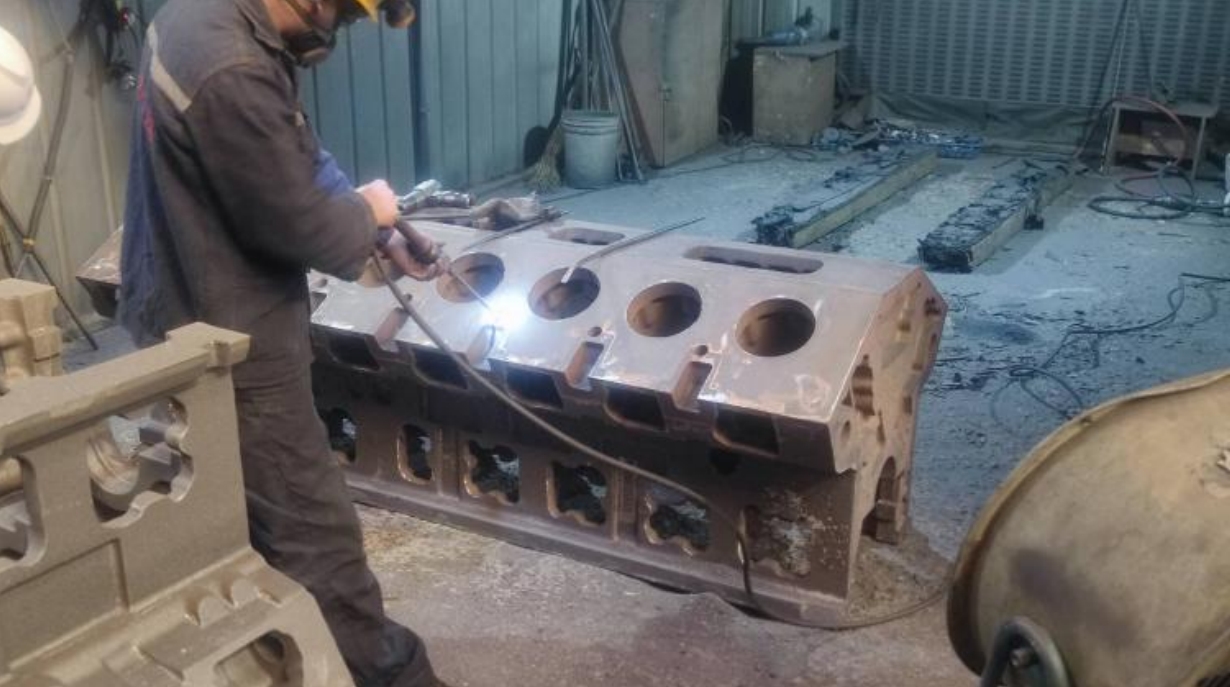
The manufacturing of steel castings involves multiple processes, with flash polishing being a crucial step that affects the final quality and appearance of the workpiece. Traditional manual polishing exposes workers to high dust and risk environments, adversely impacting their health. Additionally, manual polishing is labor-intensive and inefficient. In response to these issues, various companies have gradually incorporated robotic processing technology into polishing operations. Robotic processing technology integrates sensor technology, computer vision, human-computer interaction, and mechanics, enabling high-precision, high-efficiency, and flexible processing operations in the polishing field, thereby improving production efficiency and product quality.
1.2 Domestic and International Research Status
1.2.1 Research Status of Flash Detection for Steel Castings Based on Point Cloud Processing
With continuous improvements in three-dimensional imaging technology, acquiring point cloud data for various objects has become more convenient and efficient. Compared to traditional 2D images, point cloud data offers a sense of realism and depth, contains rich information, is not affected by illumination and texture, and has strong extensibility and wide application. Object detection based on point cloud data has become a research hotspot, attracting numerous scholars who have achieved remarkable results.
Table 1: Summary of Research on Flash Detection Based on Point Cloud Processing
| Author | Method | Key Contributions |
|---|---|---|
| Hao Wen et al. | Point cloud-based object recognition | Analyzed advantages and disadvantages of various methods and challenges in extracting feature points from large-scale point cloud data |
| Philipp et al. | Alignment strategy combining projection of specific areas and point data | Achieved robust alignment of sheet metal parts through the Iterative Closest Point (ICP) algorithm |
| Jiangtao Zhang et al. | Point cloud registration algorithm based on bidirectional threshold screening | Obtained precise pose of workpieces, smoothed workpiece point clouds using Moving Least Squares (MLS), and set flash polishing paths using NURBS surface models |
| Yaonan Li et al. | Real-time structured light 3D scanner | Obtained point cloud data of castings, identified defect areas on castings with arbitrary surfaces, performed surface fitting, generated grinding paths, and built an automatic grinding test system integrating a 3D scanner and robotic arm |
1.2.2 Research Status of Robot Polishing Trajectory Technology
In the field of robot automatic polishing, researchers have explored various trajectory planning and control methods to improve polishing efficiency and quality. Techniques such as polynomial fitting, spline interpolation, and machine learning algorithms have been applied to generate smooth and continuous polishing paths.
2. Steel Casting Polishing Process and Scheme Design
2.1 Introduction
To address the challenges in flash detection and automated polishing of steel castings and meet manufacturing plants’ demands for automatic flash detection and robotic polishing, this research conducted a study on flash detection and robotic polishing path planning technologies for steel castings.
2.2 Steel Casting Flash Polishing Process
2.2.1 Introduction to Steel Casting Polishing Scenarios
Steel castings are characterized by large size and complex shapes, with the areas requiring polishing widely distributed on their surfaces and interiors.
2.2.2 Analysis of Steel Casting Flash Characteristics
The flash on steel castings is mainly formed due to material overflow during the casting process, resulting in uneven surfaces that require polishing to achieve the desired quality.
2.2.3 Polishing Workflow
The polishing process includes point cloud acquisition, point cloud preprocessing, flash detection, grinding path point extraction, robot trajectory planning, and polishing execution.
2.3 Design of Steel Casting Simulation Polishing System
A simulation system for steel casting flash polishing was established to verify and optimize key technologies such as robot motion planning and collision detection in a virtual environment.
3. Detection of Flash Regions on Steel Castings
3.1 Introduction
Accurate detection of flash regions is crucial for subsequent polishing path planning. This section introduces point cloud preprocessing, flash edge extraction, and downsampling methods.
3.2 Point Cloud Preprocessing
Point cloud preprocessing includes filtering and improved feature point extraction to remove noise and irrelevant information, enhancing the accuracy of flash detection.
Table 2: Point Cloud Preprocessing Methods
| Method | Description |
|---|---|
| Point cloud filtering | Removes noise and outliers from the point cloud |
| Improved feature point extraction | Enhances the extraction of feature points related to flash edges |
3.3 Pose Acquisition of Steel Castings
To obtain the precise pose of steel castings, a point cloud registration method combining Principal Component Analysis (PCA) and normal vector constraints was adopted.
3.4 Extraction of Grinding Path Point Sets for Steel Casting Flash
3.4.1 Flash Edge Extraction Based on Alpha Shapes Method
The alpha shapes method was used to extract the contours of flash edges based on the geometric characteristics of point cloud data.
3.4.2 Improved Voxel Grid Centroid Neighborhood Downsampling Algorithm
To reduce the complexity of point cloud data and improve its expression accuracy, an improved voxel grid centroid neighborhood downsampling algorithm was employed.
Table 3: Extraction of Grinding Path Point Sets
| Method | Description |
|---|---|
| Alpha shapes | Extracts flash edge contours |
| Improved voxel grid downsampling | Reduces data complexity and improves accuracy |
4. Robot Polishing Path Planning
4.1 Introduction
Robot polishing path planning involves determining the optimal trajectory for the robot to follow during the polishing process. This section introduces trajectory planning methods and curve fitting techniques.
4.2 Analysis of Six-Axis Robot Trajectory Planning
Six-axis robots offer high flexibility and precision in polishing tasks. However, trajectory planning in joint space can be computationally complex.
4.3 Design and Analysis of Curve Fitting Methods
Initially, polynomial fitting and cubic spline interpolation were considered for generating polishing paths. However, polynomial fitting curves may not pass through all points, and cubic spline interpolation curves may lack smoothness.
Table 4: Comparison of Curve Fitting Methods
| Method | Advantages | Disadvantages |
|---|---|---|
| Polynomial fitting | Simple calculation | May not pass through all points |
| Cubic spline interpolation | Smooth curves | Insufficient smoothness in some cases |
To address these issues, a fifth-order non-uniform spline interpolation algorithm based on inverse calculation of control points was adopted. This method generates continuous and smooth polishing paths that pass through all points.
5. Simulation Experiments and Verification
5.1 Introduction
Simulation experiments were conducted to verify the effectiveness of the proposed flash detection and grinding path planning methods.
5.2 Simulation Setup
The simulation system included a robot control cabinet, polishing robot, operating console, and models of steel castings to be polished.
5.3 Experimental Results and Analysis
Point cloud segmentation was used to extract flash regions, and boundary points were obtained. The fifth-order non-uniform spline interpolation algorithm was applied to generate polishing paths. The results showed that the generated paths were continuous, smooth, and accurately passed through all points.
6. Conclusion and Future Work
6.1 Conclusion
This research addressed the demand for automatic flash polishing of steel castings by manufacturing plants. A simulation polishing system was designed based on the characteristics and polishing requirements of steel casting flashes. Point cloud processing was utilized to obtain precise poses and extract polishing path points. A fifth-order non-uniform spline interpolation algorithm was adopted to generate continuous and smooth polishing paths. Experimental results validated the effectiveness of the proposed methods.
6.2 Future Work
This research focused on flash detection and robotic trajectory planning for the surfaces of steel castings. However, there are still some limitations. Future research could explore methods for detecting and segmenting flashes inside steel castings and improve the robustness and efficiency of the point cloud processing system.