
In my extensive research on metallic materials for mechanical engineering, I have focused on white cast iron, a widely used alloy known for its high hardness and wear resistance. White cast iron exhibits tensile and bending strengths comparable to steel, along with a similar elastic modulus. However, it suffers from casting defects such as porosity and shrinkage cavities, as well as a microstructure comprising ledeburite and networked carbides that embrittle the matrix, leading to low impact toughness. Traditionally, scholars have sought to enhance the toughness of white cast iron through high-alloying or heat treatment methods. Yet, high-alloying approaches are often impractical in resource-constrained environments where elements like chromium and nickel are scarce. Therefore, based on experimental investigations, I propose hot pressure processing as an alternative method. This article delves into the forgeability of white cast iron and examines the microstructural and property changes post-forging, aiming to broaden its applications through thermomechanical processing.
White cast iron is characterized by its high carbon content, typically above 2.14%, which forms cementite (Fe3C) rather than graphite, resulting in a hard, brittle material. The as-cast microstructure consists of pearlite, ledeburite, and secondary cementite, which contribute to its wear resistance but limit ductility. My experiments involved studying the hot forging behavior to overcome these limitations. A key finding is that white cast iron, long deemed unforgeable, can indeed be forged under specific temperature, strain, and stress conditions, revealing a promising hot-working potential.
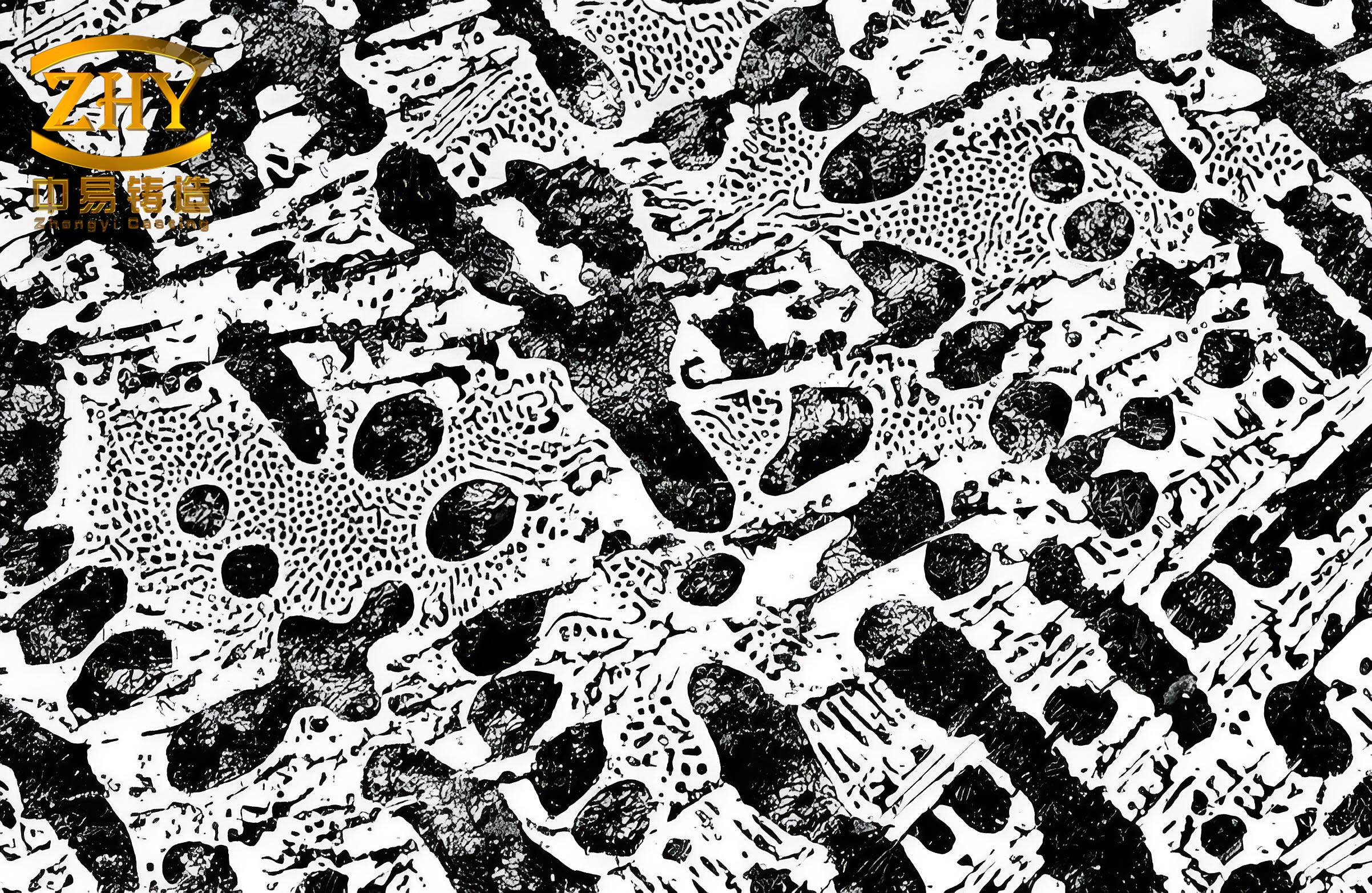
The forgeability of white cast iron is highly temperature-dependent. In my tests, I used white cast iron with the chemical composition shown in Table 1. The specimens were sand-cast round bars, with a room-temperature microstructure of pearlite-ledeburite-secondary cementite. I conducted hot compression tests at various temperatures to assess plasticity, deriving a temperature-plasticity curve as illustrated in Figure 1. The curve delineates four distinct stages:
- Below 800°C: Plasticity is extremely low, causing immediate cracking upon forging, making deformation impractical.
- 800–900°C: Plasticity increases sharply as the pearlite matrix transforms to austenite and secondary cementite begins dissolving into the matrix. However, plasticity remains moderate, with compression cracks appearing as shear cracks at 45° to the axis.
- 900–1100°C: This interval exhibits high plasticity, peaking around 1050°C. Here, the matrix fully transforms to ductile austenite, more secondary cementite dissolves, and phenomena like cementite spheroidization and aggregation occur. Cracks during upsetting manifest as lateral surface cracks, indicating optimal forgeability.
- Above 1100°C: Plasticity drops drastically due to overheating, leading to center forging cracks, thus limiting the usable range.
Hence, the optimal forging temperature range for white cast iron is 900–1100°C, narrower than that of steel. This necessitates precise thermal control during processing.
| C | Si | Mn | P | S | Cr | Fe |
|---|---|---|---|---|---|---|
| 3.2–3.6 | 0.5–1.0 | 0.5–1.0 | <0.1 | <0.05 | 0.2–0.5 | Balance |
The heating protocol is critical due to white cast iron’s low thermal conductivity. To prevent thermal stress-induced cracking, I recommend charging the furnace at around 600°C for soaking, then heating to 900°C with additional holding, followed by rapid heating to 1100°C. The holding time at the start-forging temperature should be minimal, just sufficient to heat the billet through. Forging on flat anvils can induce longitudinal cracks due to tensile stresses, and heavy blows may cause cross-shaped cracks. Therefore, a light-heavy-light forging sequence is advisable. In contrast, die forging or shaped-anvil forging places the billet under compressive stress, mitigating cracking risks.
Post-forging, white cast iron undergoes significant microstructural evolution. Casting defects like shrinkage pores and cracks are welded or compacted under high temperature and triaxial compressive stress, enhancing density. Plastic deformation and recrystallization break down the coarse, dendritic as-cast austenite grains, refining them into fine, equiaxed grains. This refinement follows the Hall-Petch relationship, where yield strength increases with decreasing grain size:
$$ \sigma_y = \sigma_0 + \frac{k_y}{\sqrt{d}} $$
Here, $\sigma_y$ is the yield strength, $\sigma_0$ is the friction stress, $k_y$ is the strengthening coefficient, and $d$ is the average grain diameter. For white cast iron, grain refinement improves toughness without compromising hardness.
Moreover, the networked carbides that embrittle the matrix are fragmented into fine, granular cementite particles uniformly dispersed in the matrix. Deformation increases dislocation density in the matrix, promoting nucleation and diffusion of carbides along grain boundaries, leading to a homogeneous dispersion. This microstructural change is evident in scanning electron microscopy (SEM) images of impact fracture surfaces, where the forged state shows a dimpled morphology indicative of ductile fracture, contrasting with the brittle cleavage in the as-cast state.
The mechanical properties of forged white cast iron are influenced by forging ratio and cooling methods. I tested over 500 specimens under varying conditions, with key results summarized in Figure 2 and Table 2. The forging ratio, defined as the initial cross-sectional area divided by the final area, plays a pivotal role. At ratios below 2, casting defects are not fully eliminated, and carbides retain a networked distribution. At a ratio of 2, carbides become uniformly granular, optimizing properties. Exceeding a ratio of 3 can cause cracking due to excessive deformation. Impact toughness peaks at a forging ratio around 2, reaching up to 6 J/cm² (6 kg·m/cm²) after oil quenching, a sixfold increase over the as-cast value of ~1 J/cm². Hardness, however, remains largely unaffected, staying at high levels suitable for wear applications.
| Forging Ratio | Cooling Method | Impact Toughness (J/cm²) | Hardness (HRC) | Carbide Morphology |
|---|---|---|---|---|
| 1.5 | Air Cooled | 2.5 | 55–58 | Partly Networked |
| 2.0 | Air Cooled | 4.0 | 56–59 | Granular, Uniform |
| 2.0 | Oil Quenched | 6.0 | 57–60 | Granular, Uniform |
| 2.0 | 400°C Isothermal, 60 min | 5.0 | 55–58 | Granular, Uniform |
| 3.0 | Air Cooled | 3.5 | 56–59 | Over-deformation Cracks |
The cooling method also affects toughness. Air cooling, oil quenching, and isothermal treatment all enhance impact toughness compared to the as-cast state, with oil quenching yielding the highest values. The hardness of white cast iron remains high post-forging, typically HRC 55–60, due to the retained cementite and matrix strengthening. This balance of toughness and hardness is crucial for applications like grinding balls, where both wear resistance and impact resistance are needed.
To quantify the property improvements, I model the strengthening mechanisms in forged white cast iron. The overall yield strength can be expressed as a sum of contributions from the matrix, grain boundaries, and dispersed carbides:
$$ \sigma_{total} = \sigma_{matrix} + \sigma_{gb} + \sigma_{particles} $$
where $\sigma_{matrix}$ is the strength of the austenitic or pearlitic matrix, $\sigma_{gb}$ is the grain boundary strengthening (from Hall-Petch), and $\sigma_{particles}$ is the dispersion strengthening from cementite particles. For particle strengthening, the Orowan mechanism applies:
$$ \sigma_{particles} = \frac{0.8 G b}{\lambda} $$
Here, $G$ is the shear modulus, $b$ is the Burgers vector, and $\lambda$ is the interparticle spacing. Forging reduces $\lambda$ by fragmenting carbides, thereby increasing strength. Additionally, the increased dislocation density from deformation enhances work hardening, described by:
$$ \sigma = \sigma_0 + K \epsilon^n $$
where $\sigma$ is the flow stress, $\epsilon$ is the strain, $K$ is the strength coefficient, and $n$ is the work-hardening exponent. In white cast iron, forging elevates $K$ and $n$, improving load-bearing capacity.
A practical application of forged white cast iron is in grinding balls for ball mills. Current materials include high-chromium white cast iron cast balls (containing 15–20% Cr), high-manganese steel balls, carbon steel rolled balls, and forged steel balls. However, these often face issues like poor wear resistance, peeling, or high consumption of alloying elements. My trials involved producing forged white cast iron balls with a composition similar to Table 1, using sand-cast billets of diameters 60 mm, 80 mm, and 100 mm. These were die-forged into balls of corresponding sizes, then air-cooled and tempered. In comparative tests with 100 mm balls, after 500 hours of operation, the forged white cast iron balls showed a wear loss of 0.5 kg per ball, whereas high-chromium cast balls exhibited 1.2 kg per ball. The breakage rate of forged balls was below 0.5%, significantly lower than that of cast alternatives. This not only reduces ball consumption and downtime but also minimizes iron powder contamination in ground products.
The economic benefits are substantial. High-chromium white cast iron cast balls cost $1500–2000 per ton, steel cast balls $1000–1500 per ton, while forged white cast iron balls are $800–1200 per ton. If produced via cupola melting and casting of billets, costs could drop below $1000 per ton. Thus, forged white cast iron balls offer superior technical and economic performance, leveraging local resources without relying on scarce alloys.
In conclusion, my research demonstrates that white cast iron possesses favorable hot-forging工艺性 when processed within the 900–1100°C window. Forging refines the microstructure, eliminates defects, and enhances toughness while maintaining high hardness. The forging ratio should be optimized around 2, with cooling methods tailored to desired toughness levels. This approach expands the applicability of white cast iron beyond traditional cast components, offering a cost-effective solution for wear-resistant parts. Future work could explore alloy design to further widen the forging window or integrate thermomechanical processing with subsequent heat treatments for tailored properties. The versatility of white cast iron, once considered brittle and unforgeable, is now unlocked through controlled hot deformation, paving the way for innovative applications in harsh environments.