
In my extensive experience within the foundry industry, the persistent defect of surface flow lines, or “veins,” on stainless steel investment castings presents a significant challenge to achieving high-quality surface finish. This defect manifests as shallow, linear depressions, typically 0.05 to 1.00 mm in depth, often tracing a flow-like pattern across the casting’s surface. It is particularly prevalent on the external surfaces of thicker sections, large flat planes, and large spherical or cylindrical contours, while rarely appearing on internal surfaces. Understanding the root cause of this phenomenon is not merely academic; it is crucial for implementing effective corrective actions on the production floor. Through systematic observation and analysis, I have concluded that the primary mechanism is fundamentally tied to gas pressure dynamics within the mold shell, a direct consequence of the specific characteristics of the investment casting process.
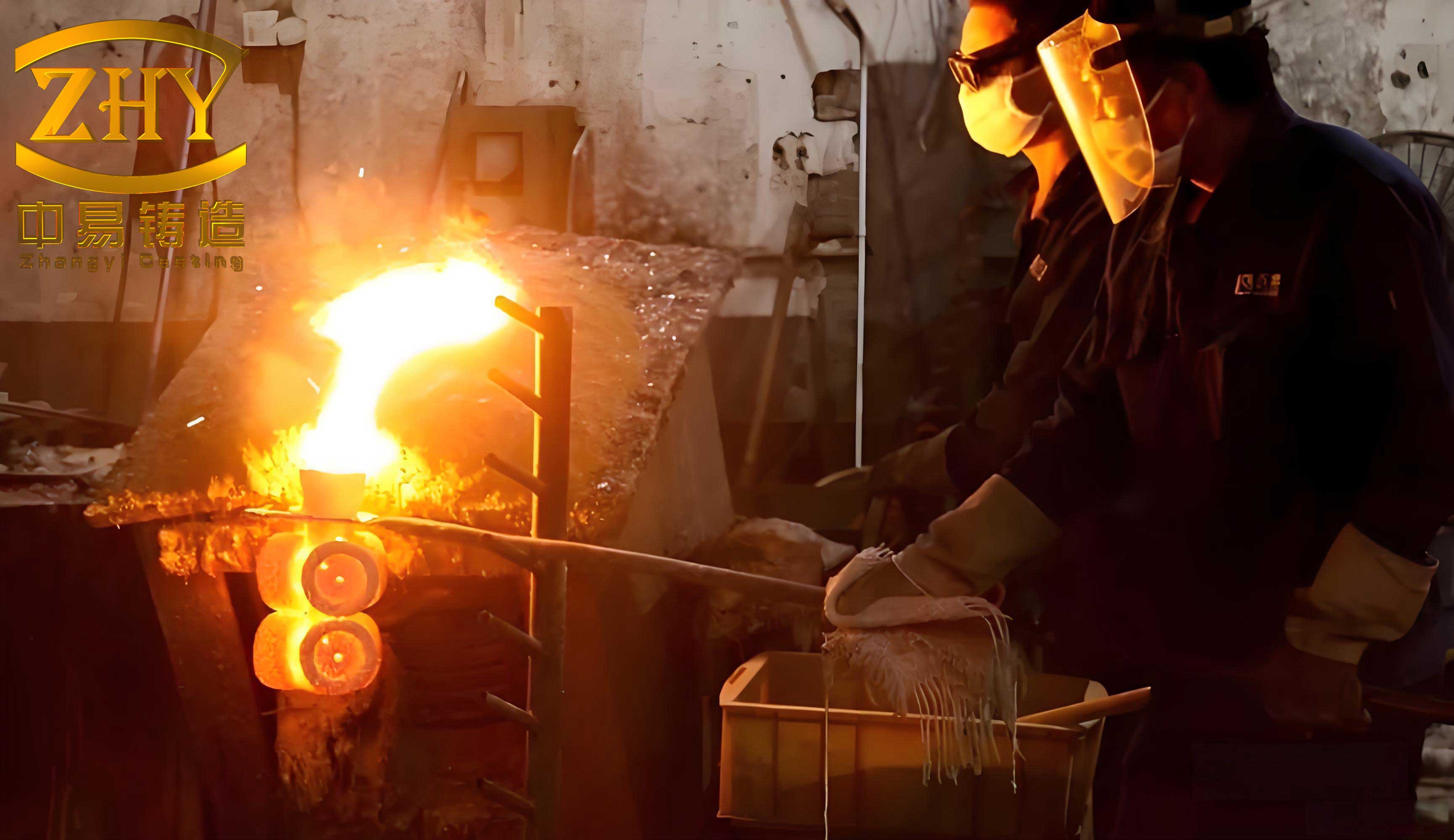
The investment casting process, while excellent for achieving complex geometries, involves a sequence of steps where the integrity of the ceramic shell is paramount. A critical stage is dewaxing, where the wax pattern is removed from the fired ceramic mold, typically using an autoclave with high-pressure steam. It is during this phase that the initial flaw is introduced. The rapid heating causes the wax to expand and the residual moisture within the shell’s inner layers to vaporize explosively. This combined action can generate a network of micro-cracks on the interior surface of the shell. These cracks are often invisible to the naked eye but become the precursors to the flow line defect. This is a key differentiator from other casting methods; the formation of the mold cavity itself can introduce critical defects.
During the subsequent pouring of molten stainless steel, the mold cavity contains air and gases from the burning of any residual pattern material. As the metal front advances, it pressurizes these gases. A shell with high permeability would allow these gases to escape through the ceramic wall. However, shells made with silica sol binders, common for high-quality surface finish, often exhibit lower permeability. Consequently, the pressurized gas seeks the path of least resistance, which is often the pre-existing micro-cracks in the shell’s inner layer. The gas is forced into these fine fissures. Once trapped, the intense heat from the molten metal, which can be in excess of 1500°C, causes this gas to expand rapidly according to the ideal gas law. The pressure within the confined crack space rises dramatically.
The formation of the flow line is essentially a pressure-balance failure at the metal-shell interface. The molten metal exerts a pressure on the crack orifice, comprised primarily of metallostatic pressure and a component from surface tension. The trapped and expanding gas, however, develops a counter-pressure. When the gas pressure ($P_{gas}$) exceeds the opposing pressure from the liquid metal ($P_{metal}$), it acts as a pneumatic piston, pushing the still-liquid surface of the casting inward, causing it to recede and solidify in that recessed position. This creates the characteristic linear depression. The governing pressure balance at the moment of recession can be expressed as:
$$
P_{gas} > P_{metal} = P_{atm} + \rho g h + \frac{2\sigma \cos\theta}{r}
$$
where $P_{atm}$ is atmospheric pressure, $\rho g h$ is the metallostatic head pressure, $\sigma$ is the molten steel’s surface tension, $\theta$ is the contact angle, and $r$ is the radius of curvature at the meniscus of the depression. The final morphology of the flow line is defined by the point where solidification arrests this recession, locking in the gas-pressure signature.
In some cases, where the shell crack is wider or more substantial, molten metal may partially infiltrate the crack before the gas pressure builds, resulting in a thin fin or “flash” on the casting. The gas is then channeled to a narrower section of the same crack, where it builds pressure and creates a flow line adjacent to the flash. This scenario visually links the two defects, confirming they originate from the same shell imperfection but different local crack geometries. The primary reasons for surface flow line formation are summarized in the table below.
| Stage | Mechanism | Consequence |
|---|---|---|
| Shell Dewaxing | Thermal shock and steam pressure from vaporizing moisture create micro-cracks on the shell’s inner surface. | Creation of gas-entrapment pathways within the mold wall. |
| Mold Pouring | Gases in the mold cavity are pressurized by advancing molten metal and infiltrate the pre-existing micro-cracks. | Trapped gas within the shell matrix. |
| Metal Solidification | Trapped gas is heated and expands rapidly. Gas pressure exceeds local metal pressure. | Gas counter-pressure displaces liquid metal, forming a surface depression that solidifies as a flow line. |
| Shell Characteristic | Low permeability of silica sol shells prevents efficient venting of trapped gas. | Gas pressure cannot readily dissipate, amplifying its displacing effect. |
Therefore, mitigation strategies must be twofold: first, to prevent the formation of the micro-cracks during dewaxing, and second, to manage the pressure of any gas that does become trapped. My approach involves a holistic review of the entire investment casting process chain, from pattern assembly to final pouring.
1. Preventing Shell Inner Surface Cracking: The goal is to minimize the stress on the shell during dewaxing. The “dewaxing index,” a concept relating wax volume to escape area, is a useful parameter. A lower index reduces stress.
$$
\text{Dewaxing Index} \propto \frac{V_{wax}}{S_{escape}}
$$
We optimize this by designing gating systems with appropriately sized ingates and by potentially adding auxiliary wax escape channels. Furthermore, the shell’s properties are critical. A shell that is too weak or too impermeable will crack. We aim for a shell with good thermal conductivity and enhanced permeability in the primary layers. This allows heat to transfer quickly to melt the wax surface, which can then weep into the shell’s porous face coat, creating a buffer layer before the bulk wax expands. Key measures include:
- Using slightly coarser refractory flour and stucco for the prime coat to increase intrinsic permeability.
- Ensuring excellent drying of the secondary and backup coats. While the prime coat must not be over-dried, subsequent layers that are well-dried draw moisture out of the prime coat, increasing its overall strength and resistance to steam shock. The relationship between shell strength and drying rate is paramount.
- Controlling the dewaxing autoclave cycle: Rapid loading and immediate pressurization to 0.7-0.8 MPa ensure the wax surface melts quickly. A slow depressurization prevents differential pressure from bloating and cracking the shell.
- Selecting a pattern wax with lower melting point, lower viscosity, and lower solid contraction to reduce expansion forces.
2. Managing Intruded Gas Pressure: Even with best practices, some risk remains. Therefore, we must minimize the pressure build-up ($P_{gas}$) from any gas that does enter a crack. From the ideal gas law, the pressure increase factor ($K_p$) can be derived:
$$
P_1 V_1 = n_1 R T_1 \quad \text{(Before pour)}
$$
$$
P_2 V_2 = n_2 R T_2 \quad \text{(After gas intrusion)}
$$
Assuming the crack volume is constant ($V_1 = V_2$), we get:
$$
\frac{P_2}{P_1} = \frac{n_2 T_2}{n_1 T_1}
$$
Defining $K_p = P_2/P_1$ (pressure growth factor) and $K_n = n_2/n_1$ (gas entrapment ratio), the relationship is:
$$
K_p = K_n \cdot \frac{T_2}{T_1}
$$
This equation is instrumental. To reduce $K_p$, we must minimize $K_n$ and the ratio $T_2/T_1$.
- Minimize $K_n$ (Gas Entrapment): This is achieved by maximizing shell permeability to allow gas to escape from the crack into the atmosphere. Beyond prime coat adjustments, we incorporate venting aids into backup coats, such as adding a small percentage of carbonaceous materials (graphite powder, carbon sand) that burn out during mold preheat, leaving interconnected pores.
- Minimize $T_2/T_1$: We aim to lower the final gas temperature ($T_2$) and raise the initial shell temperature ($T_1$). $T_2$ is approximated by the pouring temperature. Therefore, reducing the metal pouring temperature within the bounds of fluidity requirements directly reduces $T_2$. Conversely, increasing the mold preheat temperature ($T_1$) before pouring is equally critical. A hot shell reduces the thermal shock to the trapped gas and increases the denominator in the ratio, effectively dampening the pressure spike.
The interplay of these factors is complex. For instance, a higher mold preheat improves metal flow (allowing for lower pour temperature) and reduces thermal stress on the shell. It is a synergistic optimization. The table below consolidates the primary mitigation strategies derived from this analysis.
| Objective | Specific Action | Mechanism & Effect |
|---|---|---|
| Prevent Shell Cracking | Optimize gating to lower dewaxing index. | Reduces stress from wax expansion during autoclaving. |
| Use coarser prime coat materials & ensure proper drying of backup layers. | Increases shell permeability and strength to withstand dewaxing stresses. | |
| Control dewaxing cycle: fast ramp to high pressure, slow depressurization. | Promotes rapid surface wax melt and prevents shell bloating. | |
| Select low-melt, low-shrinkage pattern wax. | Minimizes expansion forces exerted on the shell. | |
| Manage Gas Pressure | Enhance overall shell permeability (e.g., with burnout additives). | Lowers $K_n$ by providing escape paths for trapped gas. |
| Increase mold preheat temperature ($T_1$). | Lowers the $T_2/T_1$ ratio, reducing $K_p$. | |
| Decrease metal pouring temperature ($T_2$). | Lowers the $T_2/T_1$ ratio, reducing $K_p$. |
Implementing these measures requires a disciplined, controlled approach to every variable. To facilitate process control, I recommend establishing and monitoring key parameters, as outlined below.
| Process Parameter | Target Direction | Control Method & Justification |
|---|---|---|
| Prime Coat Viscosity / Slurry Weight | Lower (within spec) | Regular measurement with flow cup & density cup. A lower density promotes a slightly more porous, permeable layer. |
| Secondary/Backup Coat Drying | Thorough & Complete | Monitor drying environment (temp, humidity, airflow). Well-dried backup coats strengthen the entire shell structure. |
| Dewaxing Index | Minimize | CAD simulation and practical trials to optimize gating geometry and pattern cluster size. |
| Dewaxing Pressure Ramp Rate | Maximize (to set point) | Use an autoclave with a pre-charged steam accumulator to ensure near-instantaneous pressure rise upon cycle start. |
| Mold Preheat Temperature ($T_1$) | Increase | Calibrated furnace profiling. Aim for the highest temperature compatible with metal chemistry and shell type (often > 900°C for stainless). |
| Metal Pouring Temperature ($T_2$) | Decrease | Pyrometer control. Pour at the lowest temperature that ensures complete filling of thin sections. |
| Shell Permeability | Increase | Standard permeability test on sample shells. Use of burnout additives in backup coats. |
In conclusion, the formation of surface flow lines in stainless steel investment castings is not an enigmatic defect but a predictable outcome of gas dynamics within a compromised shell. The vulnerability is created during the dewaxing stage of the investment casting process, where thermal-mechanical stresses induce micro-cracking. The defect is realized during pouring when gases are forced into these cracks and expand. The fundamental mitigation principle lies in manipulating the pressure balance equation, $P_{gas} > P_{metal}$, by preventing the crack formation and, failing that, by minimizing the $K_p$ factor through shell and thermal management. Success demands a systems-engineering view of the entire investment casting process, where shell engineering, process control, and thermal management are inextricably linked. By rigorously applying the principles and controls discussed—focusing on shell integrity, permeability, and the critical temperatures $T_1$ and $T_2$—this persistent and quality-diminishing defect can be effectively eliminated, leading to stainless steel castings with the pristine surface finish demanded by high-technology industries.