
In the production of critical industrial components, the casting of large, thin-walled shell structures presents a significant set of challenges. As a foundry engineer directly involved in process development, I have encountered and addressed numerous issues related to defect formation, dimensional accuracy, and mechanical integrity. One particularly demanding project involved the manufacture of a large T-branched housing, a component whose failure during pressure testing led to a comprehensive re-evaluation and optimization of our standard foundry practices. This shell casting, weighing approximately 1455 kg and specified in HT 250 grey iron, was characterized by its complex geometry, relatively thin walls, and a stringent requirement to pass a hydraulic pressure test without leakage. The recurring problem of sporadic leakage, necessitating costly repairs or leading to outright scrap, demanded a methodical investigation and a fundamental redesign of the casting process.
The initial step was a thorough root-cause analysis of the leakage failures. The traditional process employed for these shell castings utilized a single, monolithic core to form the extensive internal cavity of the housing. The assembly sequence required placing the drag, then the cope, and finally lowering this large, heavy core into the mold cavity from above. This sequence was inherently problematic.
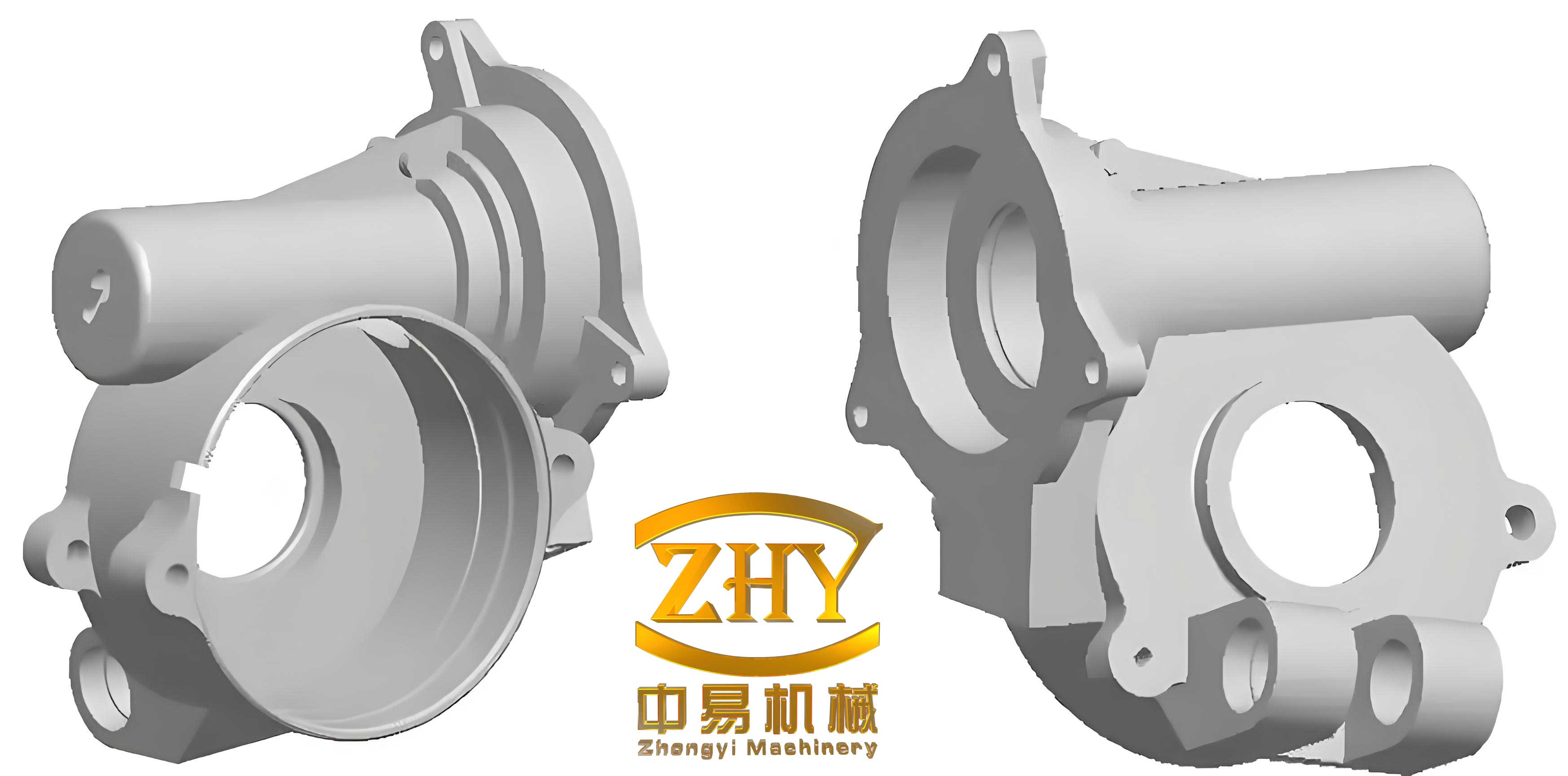
The act of maneuvering and setting the core, often with crane assistance, frequently caused damage to the fragile core prints or seats within the mold. For thin-walled shell castings, any dislodged sand fragments or eroded mold material becomes a critical issue. Unlike thicker sections where inclusions might be trapped harmlessly, the narrow flow channels and rapid solidification fronts in thin walls readily encapsulate such particles. The compromised core seats and the inability to thoroughly clean the deep, intricate mold cavity before closing resulted in non-metallic inclusions—primarily sand—being trapped within the casting wall. These inclusions created direct paths for fluid penetration during pressure testing. The randomness of the leak locations was a clear indicator of a stochastic process like sand erosion or inclusion entrapment, rather than a systematic shrinkage defect.
Furthermore, the original horizontal pouring orientation, while convenient for molding, was suboptimal for feeding. HT 250 grey iron has a significant volumetric shrinkage (approximately 1-2% for hypoeutectic compositions) during solidification. The long, flat profile of the housing in a horizontal position made it exceedingly difficult to establish an effective thermal gradient toward strategically placed feeders (risers). This likely contributed to dispersed micro-porosity, which could synergistically worsen leakage paths initiated by inclusions. The combination of these factors—core assembly damage and poor feeding—made the production of sound, pressure-tight shell castings unreliable.
The revised foundry methodology was built upon three core principles: ensuring mold cavity integrity, optimizing solidification control, and proactively managing dimensional variation. A comparative summary of the key changes is presented below:
| Process Aspect | Original Method | Optimized Method | Rationale & Impact |
|---|---|---|---|
| Core Assembly | Single, monolithic core lowered after cope placement. | Segmented core system (e.g., Core 1, Core 3). | Prevents core seat damage; allows thorough cleaning before final closure. |
| Pouring Orientation | Horizontal (flat). | Vertical (upright). | Enables directional solidification; simplifies placement of effective feeders at top. |
| Feeding Strategy | Ineffective, dispersed feeders. | Concentrated top feeders on upper flanges/massive sections. | Ensures liquid feed metal is available to compensate for shrinkage throughout solidification. |
| Dimensional Control | None specified. | Application of machining allowance (positive metal allowance) on flange faces. | Compensates for unpredictable dimensional variation across long casting spans. |
The most critical change was the abandonment of the monolithic core. The internal cavity was instead formed using a segmented core design. A primary core (let’s denote it Core 1) was designed to form a major portion of the internal passage. This core could be placed securely in the drag mold section. The drag was then closed with the cope mold section. Only after this was a second, smaller core (Core 3) introduced through an opening in the cope to complete the internal geometry. This sequential assembly eliminated the damaging “lowering-in” maneuver, preserved the integrity of the core seats, and most importantly, allowed for a final visual inspection and cleaning of the entire mold cavity before the final core segment was set and the pouring basin sealed. This single change drastically reduced the primary source of sand inclusions in the finished shell castings.
The second pillar of the optimization was the shift to a vertical pouring orientation. This decision was driven by solidification science. The goal is to achieve directional solidification, where the regions farthest from the feeder solidify first, and the feeder itself solidifies last. This ensures a continuous supply of liquid metal to feed the shrinkage porosity that forms during the phase change from liquid to solid. For a tall, T-branched shell casting poured vertically, the thermal gradient can be effectively managed. The lower sections, in contact with the cooler drag mold, begin to solidify first. Feeders are placed on the top flanges of the casting, which become the hottest spots, acting as reservoirs of liquid metal. The feeding distance, a critical parameter for soundness, is vastly improved in this configuration compared to a horizontal layout.
The required feeder size can be estimated using the modulus method, where the feeder’s solidification time must exceed that of the casting section it is intended to feed. The modulus (M) is the ratio of volume (V) to cooling surface area (A_s): $$M = \frac{V}{A_s}$$. For a cylindrical feeder, the modulus is approximately $$M_{feeder} \approx \frac{d}{6}$$ for a side-fed feeder, where d is the diameter (assuming height/diameter ratio ~1). The feeder must be designed so that $$M_{feeder} > k \cdot M_{casting}$$, where k is a safety factor (typically 1.1 to 1.2) accounting for interface effects. For the critical upper junction of our T-branched shell casting, we calculated the modulus of the hot spot and designed feeders accordingly to ensure adequate feeding pressure and time.
The third key improvement was the explicit addition of a positive machining allowance, or pattern allowance, on the mounting flanges. Large shell castings, especially in grey iron, are subject to unpredictable dimensional variation due to mold wall movement, core shift, and non-uniform cooling stresses. By adding extra material (e.g., 3-5 mm) to the flange faces in the pattern equipment, we ensured that subsequent machining operations could clean up all surfaces and achieve the final part dimensions with 100% reliability, regardless of minor casting distortions. This is a crucial but often overlooked aspect of process design for large, dimensionally sensitive components.
While the core assembly and solidification control were the primary fixes for the leakage defect, the overall quality philosophy for producing high-integrity shell castings extends to every aspect of metal handling and pouring. The principles applied to ductile iron in the referenced context are equally vital for high-quality grey iron castings. Rigorous control of pouring temperature is paramount. Too low a temperature increases viscosity, leading to mistuns and poor filling of thin sections, while excessively high temperatures can promote mold erosion (reintroducing the sand inclusion problem) and coarse microstructures. We maintain a stringent minimum pouring temperature of 1300°C for such medium-to-thin walled shell castings to ensure fluidity without excessive thermal attack.
For ductile iron shell castings, the treatment and pouring windows are even more critical. The fade of nodularizing and inoculating effects is time-dependent. Therefore, a strict rule is enforced: a 500 kg ladle must be emptied within 7 minutes. The kinetics of fade can be conceptually related to a first-order decay of active nuclei or magnesium in solution. While the exact model is complex, the practical rule ensures consistency. The relationship between holding time and achievable nodule count or mechanical properties is non-linear and precipitous after a critical point.
Metal cleanliness is another universal requirement. For shell castings where any inclusion can be a leak path or a stress concentrator, filtering the molten metal is a highly effective strategy. We employ high-temperature ceramic foam filters with a specific geometry (e.g., 1.5 x 1.5 mm cell size, 55% porosity) in the gating system. The filtration mechanism involves both cake filtration and depth filtration. The efficiency of inclusion removal can be modeled by considering the pressure drop across the filter (using the Darcy-Forchheimer equation for flow through porous media) and the Stokes law settling behavior of inclusions. The filter dramatically reduces the burden of secondary oxidation slag and eroded sand particles that enter the mold cavity, directly contributing to the pressure-tightness of the final shell castings.
Finally, a robust traceability system is implemented. Each ladle of metal is treated as a unique batch. The last casting poured from a batch, or a separately cast “keel block” from the same ladle, is used for destructive mechanical and metallographic testing. This sample is linked unequivocally to the production shell castings from that batch, allowing for definitive quality verification and creating a feedback loop for process control. The mechanical properties (tensile strength, yield strength, elongation) and microstructure (graphite morphology, matrix) are recorded and tracked.
The outcomes of this comprehensive process optimization were immediately evident and sustained. The revised methodology for these large T-branched shell castings eliminated the sporadic leakage defect entirely. Hydraulic pressure testing, which was previously a source of uncertainty and cost overruns, became a routine verification step passed consistently. Radiographic and ultrasonic inspection confirmed a dramatic reduction in both macro-inclusions and shrinkage porosity. The microstructure of the HT 250 shell castings was denser and more uniform, directly translating to more predictable and improved mechanical properties.
The theoretical underpinnings of this success are clear. By controlling the mold filling and solidification dynamics through orientation and feeding design, we manage the fundamental thermal parameters. The thermal gradient (G) and solidification rate (R) determine the microstructure and soundness. The product G*R influences grain size and dendrite arm spacing, while the ratio G/R governs the mode of solidification (planar, cellular, dendritic). For a sound, leak-tight shell casting, we aim for a sufficiently high G to promote directional solidification and minimize mushy zone extent, thereby reducing interdendritic shrinkage. The vertical pouring setup, combined with strategic chilling if necessary, promotes this favorable condition. The Niyama criterion, often used for predicting shrinkage porosity in steel castings, provides a analogous conceptual framework: porosity is likely in regions where the thermal gradient divided by the square root of the cooling rate falls below a critical threshold: $$ \frac{G}{\sqrt{\dot{T}}} < \text{critical value}$$. Our optimized process ensures that critical sections of the shell casting remain above this threshold.
In conclusion, the production of high-integrity, large shell castings is a multidisciplinary challenge that requires synergy between practical mold engineering, precise melt control, and applied solidification theory. The failure of the initial process for the T-branched housing was a lesson in how a single logistical flaw in core assembly can compromise an entire manufacturing stream. The solution was not a single trick but a system-wide recalibration: redesigning the core for assembly integrity, reorienting the casting for controlled solidification, implementing rigorous metal cleaning and pouring protocols, and building in allowances for dimensional variation. This holistic approach ensures that every shell casting produced is not only geometrically accurate but also intrinsically sound, capable of performing reliably under demanding service conditions. The principles established here—mold cavity integrity, directional solidification, and proactive process control—form a robust foundation for the manufacture of a wide variety of complex, thin-walled shell castings across different alloys and industries.