
In the field of internal combustion engines, piston rings play a critical role in sealing, heat transfer, and support functions. The advent of nodular cast iron for piston rings represents a significant leap forward in manufacturing history, offering superior wear resistance, elasticity, and thermal stability compared to traditional materials. However, the stable production of high-quality nodular cast iron piston rings remains a formidable challenge due to complexities in material composition and processing. Based on my extensive experience in foundry operations, I will elaborate on the casting technology for nodular cast iron piston rings, focusing on raw material control, spheroidization treatment, inoculation, and process optimization. This discussion aims to provide a comprehensive guide, incorporating tables and formulas to summarize key points, while emphasizing the repeated use of “nodular cast iron” to highlight its centrality in this context.
The production of nodular cast iron piston rings, particularly using the mono-block double-piece casting method, involves precise control over every stage of the process. This method, illustrated in the following image, involves machining the central shrinkage porosity and surface defects from cast blanks to achieve superior quality.
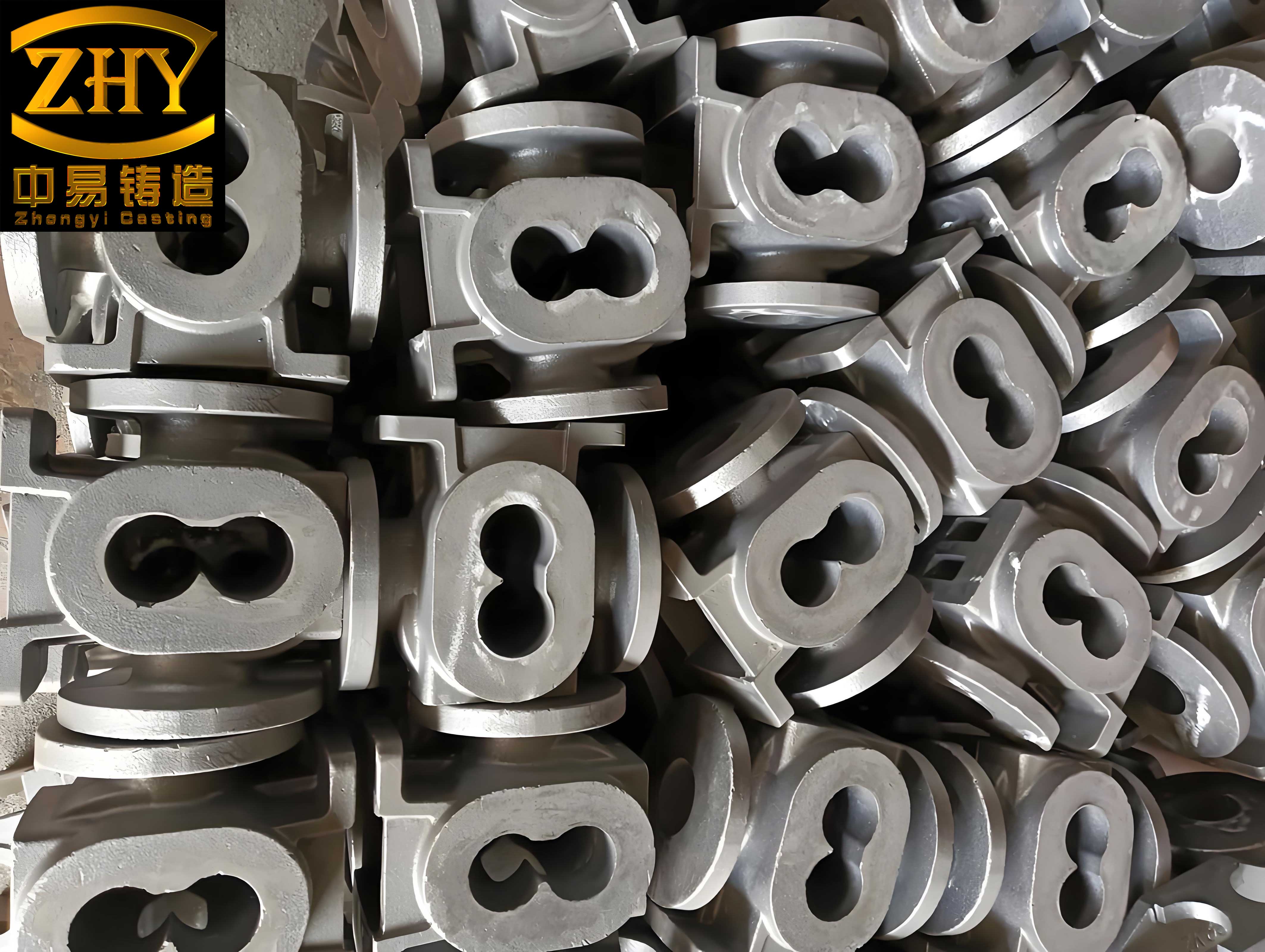
The success of this approach hinges on stringent raw material specifications and advanced foundry techniques. In many regions, including my operational context, the availability of high-purity pig iron is limited, necessitating adaptations to accommodate locally sourced materials with higher levels of manganese, phosphorus, and sulfur. This article delves into the technical strategies employed to overcome these hurdles, ensuring consistent production of nodular cast iron piston rings with desired microstructures and mechanical properties.
Raw Material Challenges and Control
The foundation of producing nodular cast iron lies in the quality of pig iron. Ideally, pig iron should have low levels of interfering elements such as manganese, phosphorus, and sulfur to facilitate effective graphite spheroidization. However, in practice, pig iron often contains elevated amounts: for instance, typical compositions include 3.8–4.3% carbon, 0.8–1.3% silicon, 0.2–0.5% manganese, phosphorus below 0.07%, and sulfur below 0.03%. These higher levels pose significant challenges for nodular cast iron production. Manganese, while manageable through subsequent heat treatments, can promote carbide formation if excessive, affecting the as-cast structure. Phosphorus, if above 0.1%, leads to phosphide eutectic at grain boundaries, degrading strength and toughness. Sulfur is particularly detrimental as it consumes magnesium during spheroidization, reducing treatment efficiency and increasing defects like slag inclusions and subsurface porosity.
To address this, I emphasize the use of rapid carbon-sulfur analyzers to monitor sulfur content in real-time, allowing for precise adjustments in spheroidizer additions. The target composition for pig iron in nodular cast iron piston ring production is optimized as follows: carbon at 3.8–4.2%, silicon at 0.8–0.9%, manganese at 0.2–0.4%, phosphorus at 0.04–0.06%, and sulfur kept below 0.026%. This adjustment, though not ideal, enables feasible production when coupled with tailored processing steps. The key is to balance these elements through careful melting and treatment practices, ensuring that the final nodular cast iron meets performance standards.
The impact of raw material variations can be summarized using a formula for the effective carbon equivalent (CE), which influences graphite formation and fluidity. For nodular cast iron, the carbon equivalent is calculated as:
$$ CE = \%C + \frac{1}{3}(\%Si + \%P) $$
In our case, with typical values, CE ranges from 4.2 to 4.5, indicating a near-eutectic composition that favors graphite precipitation and reduces shrinkage tendencies. Controlling CE within this range is crucial for producing sound castings of nodular cast iron.
Process Feasibility Analysis
Given the constraints of local pig iron, a detailed feasibility analysis was conducted to assess the viability of producing nodular cast iron piston rings. The analysis focused on compensating for high manganese, phosphorus, and sulfur levels through optimized spheroidization and inoculation. For example, the higher silicon content (0.4–0.6% above ideal) is manageable in medium-frequency induction furnaces, though it limits the reuse of returns. Manganese’s tendency to form carbides can be mitigated by post-casting annealing to achieve a ferritic matrix, but excessive carbides must be avoided during casting to maintain dimensional stability. Phosphorus levels, while acceptable below 0.07%, require monitoring to prevent eutectic formation. Sulfur, however, demands immediate attention due to its direct interference with magnesium during spheroidization.
Through iterative trials, I found that by employing specialized spheroidizers and inoculants, along with strict process controls, it is possible to produce high-quality nodular cast iron even with suboptimal raw materials. The success hinges on factors such as melting temperature, treatment timing, and cooling rates. For instance, maintaining a spheroidization temperature of 1500–1550°C and completing pouring within 10 minutes post-treatment are critical to preserving nodular graphite structures. This approach underscores the adaptability of nodular cast iron technology to local conditions, provided that compensatory measures are integrated into the workflow.
Spheroidization Treatment for Nodular Cast Iron
Spheroidization is the heart of producing nodular cast iron, where graphite is transformed into spherical shapes to enhance mechanical properties. In my practice, a customized spheroidizer is used, with a composition of 38–48% silicon, 5.0–6.5% magnesium, rare earths (RE) below 1.0%, and aluminum below 1.0%. This spheroidizer offers a balanced reaction compared to conventional alloys, ensuring adequate magnesium absorption while minimizing temperature drops and carbide formation. The addition rate of spheroidizer is determined by multiple factors, including the V/O ratio (volume-to-surface area ratio) of the piston ring and the sulfur content of the base iron.
The required spheroidizer addition can be expressed as:
$$ \text{Spheroidizer Addition} (\%) = \text{Mg Loss} + \text{Mg for Desulfurization} + \text{Residual Mg} $$
Where:
– Mg Loss accounts for vaporization and oxidation during treatment, typically constant under controlled conditions.
– Mg for Desulfurization is calculated based on the sulfur content: $$ \text{Mg for Desulfurization} \approx 0.76 \times (\%S_{\text{initial}} – \%S_{\text{target}}) $$, with target sulfur often below 0.018%.
– Residual Mg is essential for maintaining spheroidization, usually aimed at 0.03–0.05% in the final iron.
Empirical data from trials show the relationship between spheroidizer addition and nodular graphite formation. The table below summarizes key findings for a typical piston ring design:
| Spheroidizer Addition (%) | Nodularity Rate (%) | Graphite Count (nodules/cm²) | Remarks |
|---|---|---|---|
| 1.2 | 0 | — | Insufficient Mg, vermicular graphite observed |
| 1.4 | 80 | ~30,000 | Marginal, some carbides present |
| 1.6 | 100 | >40,000 | Optimal, spherical graphite with minimal defects |
| 1.8 | 100 | ~35,000 | Excessive Mg, increased carbides and shrinkage |
These results highlight that a spheroidizer addition of 1.6% is ideal for achieving over 80% nodularity and a graphite count exceeding 30,000 nodules/cm², which are benchmarks for high-quality nodular cast iron. The process involves using a pocket method for spheroidizer addition in ladles, with rapid pouring to minimize magnesium fade. This meticulous control ensures that the nodular cast iron exhibits consistent graphite morphology, essential for piston ring performance.
Inoculation Treatment in Nodular Cast Iron Production
Inoculation complements spheroidization by enhancing graphite nucleation, refining graphite spheres, and preventing chill formation in nodular cast iron. For piston rings, I employ a blended inoculant consisting of a strontium-based inoculant (S-type) and a magnesium-bearing inoculant (M-type). The S-type inoculant contains 73–78% silicon, 0.7–1.0% strontium, 0.6–1.0% calcium, and aluminum below 1.0%, while the M-type has 43–47% silicon, 1.0–1.5% magnesium, 0.6–0.9% calcium, and aluminum below 1.0%. This combination not only reduces undercooling but also stabilizes graphite spheroidization by providing additional nuclei and compensating for magnesium loss during late-stage solidification.
The effectiveness of inoculation is quantified by the graphite nodule count, which directly influences the as-cast matrix of nodular cast iron. The inoculation addition rate is critical: too little leads to coarse graphite and carbides, while too much causes graphite flotation and degradation. Based on experiments, the relationship between inoculant addition and graphite count is tabulated below:
| Inoculant Addition (%) | Graphite Count (nodules/cm²) | Observations |
|---|---|---|
| 0.2 | ~15,000 | Low count, graphite coarsening, carbides present |
| 0.3 | ~25,000 | Improved but below target |
| 0.4 | >40,000 | Optimal, fine spherical graphite, no carbides |
| 0.5 | >40,000 | Similar count but graphite blooming begins |
| 0.6 | >40,000 | Excessive, graphite flotation and silicon rise |
Thus, an inoculant addition of 0.4% is recommended for nodular cast iron piston rings. The inoculation is performed as a late addition during pouring, often via stream inoculation, to maximize nucleation efficiency. The mechanism can be described by the formula for nucleation rate (N):
$$ N = k \cdot \exp\left(-\frac{\Delta G^*}{kT}\right) $$
where \(\Delta G^*\) is the activation energy for graphite nucleation, reduced by inoculant particles. This treatment ensures that the nodular cast iron achieves a fully ferritic matrix after annealing, with graphite nodules uniformly dispersed, enhancing toughness and machinability.
Control of Carbon and Silicon in Base Iron for Nodular Cast Iron
Carbon and silicon are pivotal elements in nodular cast iron, influencing graphite formation, fluidity, and mechanical properties. Unlike in gray cast iron, high carbon content in nodular cast iron is beneficial as it promotes graphite nucleation and reduces shrinkage, provided it does not exceed the eutectic point to avoid graphite flotation. In my practice, carbon is controlled between 3.65% and 3.8%, depending on the V/O ratio of the piston ring. This range ensures adequate carbon equivalent for eutectic solidification, which enhances casting integrity and minimizes defects.
Silicon, a strong graphitizer, is carefully regulated to balance its effects. The total silicon content in nodular cast iron piston rings typically targets 2.4–2.8%, derived from both the base iron and additions from spheroidizers and inoculants. To achieve this, the base iron silicon is adjusted based on the V/O ratio, as shown in the table below:
| V/O Ratio Range | Base Iron Silicon Content (%) | Rationale |
|---|---|---|
| ≤1.80 | 1.9 | Higher cooling rate requires more silicon for graphitization |
| 1.81–2.50 | 1.7 | Moderate adjustment for balanced properties |
| 2.51–4.50 | 1.6 | Lower silicon to prevent excessive graphite in thicker sections | >4.50 | 1.1 | Minimal silicon to avoid carbide formation in slow cooling |
The carbon equivalent (CE) for nodular cast iron can be approximated as:
$$ CE = \%C + 0.3(\%Si + \%P) $$
For our compositions, CE values range from 4.0 to 4.3, ensuring good castability and graphite morphology. Excessive silicon from inoculants is avoided to prevent graphite blooming, which can degrade the spherical shape in nodular cast iron. This precise control underscores the importance of tailored chemistry for each piston ring design, leveraging the unique attributes of nodular cast iron for optimal performance.
Production Outcomes and Performance of Nodular Cast Iron Piston Rings
Implementing the above strategies has enabled successful production of nodular cast iron piston rings for various engines, such as those in passenger cars and commercial vehicles. The process utilizes medium-frequency induction furnaces or electric arc furnaces, with strict adherence to temperature and time controls. The resulting nodular cast iron exhibits excellent microstructural and mechanical properties, as summarized in the table below for a typical application:
| Property | Specification Requirement | Achieved Value in Production |
|---|---|---|
| Graphite Morphology | Spherical or near-spherical | Spherical with minimal vermicular graphite |
| Nodularity Rate (%) | ≥80 | ≥85 |
| Graphite Count (nodules/cm²) | >30,000 | >40,000 |
| Hardness (HRB) | 104–112 | 104–112 |
| Bending Strength (MPa) | ≥1300 | ≥1600 |
| Elastic Modulus (MPa) | ≥150,000 | ≥155,000 |
These results demonstrate that nodular cast iron piston rings produced under these conditions meet or exceed international standards. The high graphite count and nodularity ensure a ferritic matrix after annealing, providing superior wear resistance and elasticity. Over years of production, millions of nodular cast iron piston rings have been supplied with low rejection rates, validating the robustness of this technology. The key to this success lies in the integrated approach to raw material management, spheroidization, and inoculation, all tailored for nodular cast iron.
Conclusions on Nodular Cast Iron Piston Ring Casting
The production of high-quality nodular cast iron piston rings is achievable even with challenging raw materials, provided that a systematic approach is adopted. This involves selecting pig iron with minimized manganese, phosphorus, and sulfur, though compromises can be managed through process adjustments. Critical steps include precise spheroidization using customized magnesium-based alloys, effective inoculation with blended agents, and tight control over carbon and silicon contents. The V/O ratio of the piston ring must guide these parameters to ensure optimal cooling and graphite formation.
Formulas such as those for spheroidizer addition and carbon equivalent are indispensable tools for process optimization. Moreover, rapid analytical techniques like carbon-sulfur analysis enable real-time adjustments, enhancing consistency in nodular cast iron production. Post-casting annealing is often necessary to achieve a fully ferritic matrix and improve machinability, but the as-cast structure must already exhibit high nodularity and graphite count to minimize downstream issues.
In summary, the foundry technology for nodular cast iron piston rings hinges on a balance of material science and practical engineering. By emphasizing repeated control measures and leveraging advanced treatments, manufacturers can overcome local material limitations to produce durable and reliable components. The enduring success of nodular cast iron in this application underscores its versatility and performance, making it a cornerstone of modern piston ring manufacturing. Future advancements may focus on further refining inoculation methods or exploring alternative spheroidizers, but the core principles outlined here will remain vital for producing superior nodular cast iron.