
In our production of machine tool castings, we have encountered significant challenges with graphite coarsening defects, particularly in thick sections such as worktable surfaces and guide rails. These defects manifest as coarse graphite flakes in the microstructure, leading to rough surfaces after machining and substantial economic losses due to scrapped parts. This article details our first-hand analysis of the causes and the comprehensive solutions we developed to address graphite coarsening in machine tool castings. We will explore structural design, casting process parameters, melting practices, and pouring techniques, supported by tables and formulas to summarize key points. Throughout, we emphasize the importance of optimizing processes for high-quality machine tool castings.
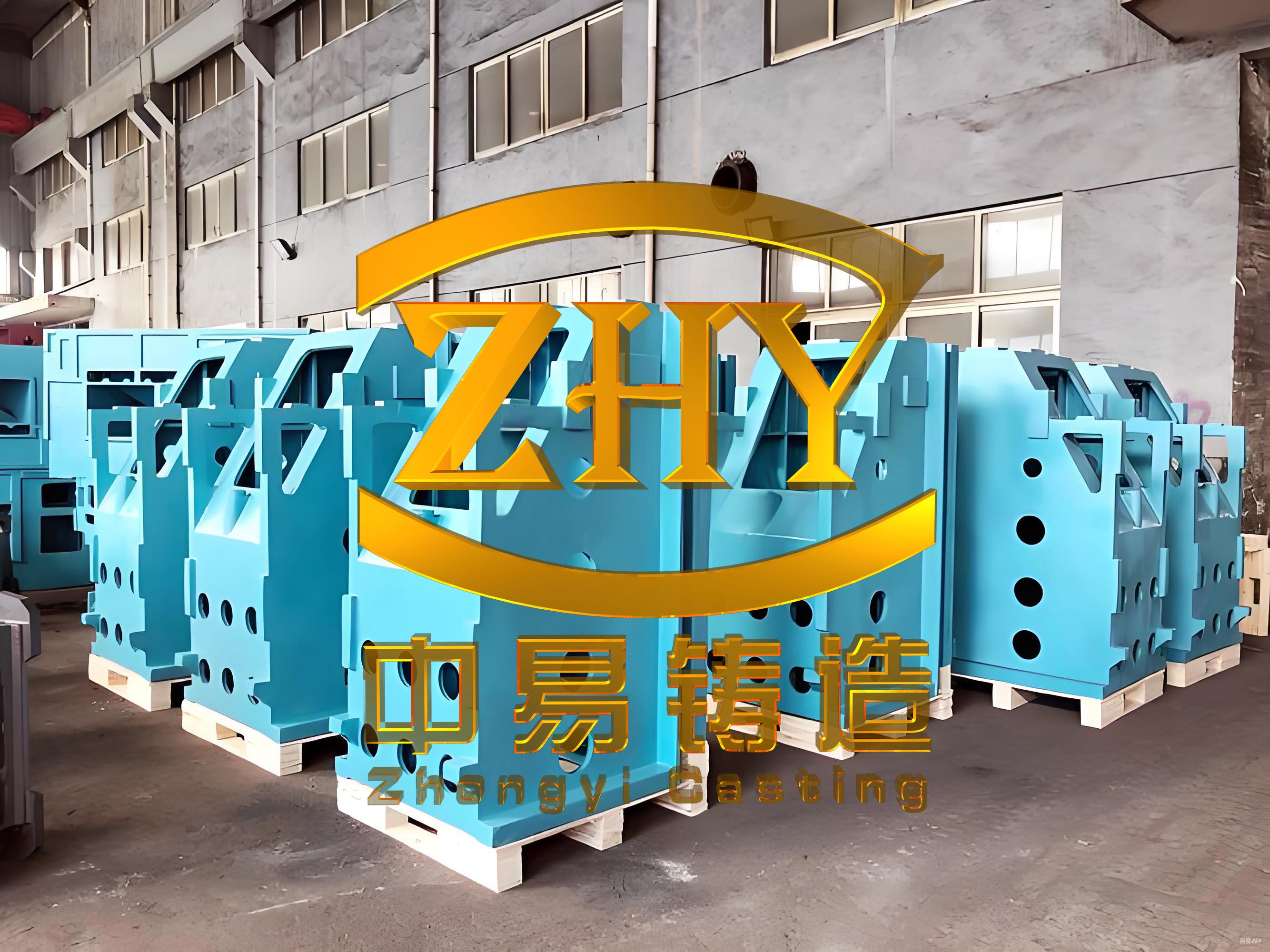
Graphite coarsening, also referred to as graphite aggregation or graphite pinholes, is a common defect in iron castings, especially in thick sections of machine tool castings. It appears as cavities filled with graphite powder, often visible after machining as dark, rough holes. Microstructural analysis reveals coarse graphite flakes, which weaken the material and impair surface finish. This defect typically occurs in areas with slow cooling rates, such as the upper surfaces of castings. In our experience, distinguishing graphite coarsening from other defects like shrinkage porosity, slag inclusions, or gas holes is crucial for effective remediation. For instance, while shrinkage may show irregular cavities, graphite coarsening presents uniform graphite-filled pores, as confirmed through metallographic examination.
The formation of graphite coarsening in machine tool castings is influenced by multiple factors, including casting design, process parameters, and melting conditions. The cooling rate during solidification plays a pivotal role; slower cooling in thick sections allows graphite flakes to grow larger. The carbon equivalent (CE) of the iron melt, given by the formula: $$CE = C + \frac{1}{3}(Si + P)$$ where C is carbon content, Si is silicon, and P is phosphorus, must be carefully controlled. High CE values promote graphite coarsening. Additionally, improper gating and riser design can exacerbate thermal gradients, leading to localized hot spots. In melting, the use of high-carbon raw materials or inadequate inoculation further contributes to this defect. Through systematic investigation, we identified that a holistic approach—addressing design, process, and metallurgy—is essential for mitigating graphite coarsening in machine tool castings.
Analysis of Graphite Coarsening Defects
Graphite coarsening defects in machine tool castings are characterized by macroscopic and microscopic features that distinguish them from other casting imperfections. Upon visual inspection, machined surfaces exhibit gray-black microholes resembling “flyspeck” patterns, which release graphite powder during processing. Metallographic analysis of samples from defective areas shows coarse, elongated graphite flakes within the matrix. This contrasts with defects like shrinkage, which have void-like structures, or gas holes, which are typically round and empty. The graphite flakes in coarsening defects act as stress concentrators, reducing the mechanical properties and surface integrity of machine tool castings. We conducted numerous tests, including thermal analysis and cooling curve measurements, to quantify the relationship between cooling rate and graphite size. The cooling rate ($$\frac{dT}{dt}$$) can be modeled using empirical equations, such as: $$\frac{dT}{dt} = k \cdot (T – T_{\text{env}})$$ where T is temperature, T_env is environmental temperature, and k is a constant dependent on mold material and geometry. Slower cooling rates, often below 0.5°C/s in thick sections, significantly increase the risk of graphite coarsening.
Furthermore, the nucleation and growth of graphite in iron castings follow diffusion-controlled kinetics. The growth rate of graphite flakes can be described by: $$G = D \cdot \frac{\Delta C}{r}$$ where G is growth rate, D is diffusion coefficient, ΔC is concentration gradient, and r is radius of curvature. In thick sections of machine tool castings, prolonged solidification times allow for excessive growth, resulting in coarse structures. We also observed that the number of eutectic cells, influenced by inoculation, affects graphite morphology. A lower eutectic cell count correlates with larger graphite flakes, as confirmed in our trials with varying inoculant types.
| Feature | Description | Comparison with Other Defects |
|---|---|---|
| Macroscopic Appearance | Gray-black holes with graphite powder on machined surfaces | Shrinkage: Irregular voids; Gas holes: Round and empty |
| Microstructure | Coarse, long graphite flakes in ferritic or pearlitic matrix | Normal graphite: Fine, uniformly distributed flakes |
| Location | Thick sections like worktables and guide rails | Often in upper surfaces due to slower cooling |
| Effect on Properties | Reduced strength, hardness, and surface finish | Leads to scrapping of machine tool castings if severe |
Causes of Graphite Coarsening in Machine Tool Castings
The occurrence of graphite coarsening in machine tool castings stems from interrelated factors in design, process, and metallurgy. Understanding these causes is critical for developing effective solutions.
Structural Design Factors
Machine tool castings often feature significant variations in wall thickness, with critical areas like worktables and guide rails being 2 to 3 times thicker than adjacent sections. This design leads to uneven cooling rates during solidification. In thick sections, the cooling rate decreases, extending the solidification time and providing ample opportunity for graphite flakes to grow coarse. The thermal modulus, which represents the ratio of volume to surface area, is higher in these regions, further slowing heat dissipation. For example, in a typical machine tool casting, the thermal modulus (M) can be calculated as: $$M = \frac{V}{A}$$ where V is volume and A is surface area. Higher M values in thick sections correlate with slower cooling and increased risk of graphite coarsening. We recommend minimizing wall thickness differences and incorporating ribs or cores to reduce thermal mass in critical areas.
Casting Process Design Factors
Improper casting process design exacerbates graphite coarsening in machine tool castings. Gating and riser systems that concentrate heat in thick sections can create hot spots, delaying solidification. For instance, if inner gates are positioned directly toward heavy sections, they introduce hot metal that slows cooling. Similarly, oversized risers intended for feeding may act as heat sources. The solidification time (t_s) for a casting can be estimated using Chvorinov’s rule: $$t_s = k \cdot \left( \frac{V}{A} \right)^2$$ where k is a mold constant. Longer t_s values in thick portions promote graphite growth. Additionally, excessive machining allowances on worktable surfaces remove the chilled layer, exposing the coarse graphite beneath. We observed that dispersed gating and the use of chills can mitigate this by accelerating cooling.
Melting Process Factors
Melting practices play a decisive role in controlling graphite morphology in machine tool castings. The use of high-carbon raw materials, such as high-grade pig iron or carbon-rich scrap steel, elevates the carbon equivalent, fostering coarse graphite formation. In cupola melting, a low coke-to-iron ratio or excessive bed coke height can lead to over-carburization, increasing carbon content. The melting temperature also influences graphite size; lower temperatures result in insufficient superheat, reducing nucleation sites. We monitor the melting parameters closely, as the relationship between carbon content and graphite size can be expressed as: $$G_s = a \cdot C_{\text{eq}} + b$$ where G_s is graphite size, C_eq is carbon equivalent, and a and b are constants derived from experimental data. Furthermore, inadequate or delayed inoculation causes孕育衰退 (inoculation fade), reducing the number of graphite nuclei and allowing flakes to coarsen. Transition iron mixing and uncontrolled pouring temperatures further aggravate the issue, particularly in thick-section machine tool castings.
| Category | Specific Causes | Impact on Graphite Coarsening |
|---|---|---|
| Structural Design | Large wall thickness differences; High thermal modulus in thick sections | Slows cooling, extends solidification time |
| Casting Process | Concentrated gating; Improper riser design; Excessive machining allowance | Creates hot spots, reduces cooling rate |
| Melting Process | High carbon equivalent; Over-carburization; Low melting temperature; Inadequate inoculation | Increases carbon content, reduces nucleation |
| Raw Materials | Use of high-grade pig iron or carbon steel; Mixed returns | Elevates CE, promotes coarse graphite growth |
Solutions to Mitigate Graphite Coarsening in Machine Tool Castings
To combat graphite coarsening in machine tool castings, we implemented a multi-faceted strategy focusing on design modifications, process optimizations, melting adjustments, and pouring controls. These measures have proven effective in enhancing the quality of thick-section castings.
Structural Design Improvements
Reducing wall thickness variations is paramount in preventing graphite coarsening in machine tool castings. We redesigned critical components to minimize thermal mass in worktables and guide rails, incorporating features like tapered sections or internal cavities to promote uniform cooling. For example, by analyzing finite element simulations, we optimized the geometry to lower the thermal modulus in thick areas. The revised design ensures that the cooling rate remains above a critical threshold, typically 1°C/s, to suppress coarse graphite formation. In cases where structural integrity permits, we recommend reducing the maximum截面 thickness by 10-20%, which has shown to decrease graphite size by up to 30% in our trials.
Casting Process Design Improvements
Optimizing the casting process is essential for controlling cooling rates in machine tool castings. We adopted均衡凝固 (balanced solidification) principles, dispersing inner gates to avoid heat concentration and using multiple risers placed strategically to feed without causing hot spots. The introduction of chills—made of metal or graphite—in thick sections accelerates cooling. For instance, placing chills in worktable areas reduces the local solidification time by up to 40%, as calculated using: $$\Delta t_s = \frac{M^2}{k_{\text{chill}}}$$ where k_chill is the chill constant. However, for guide rails requiring induction hardening, we avoid graphite chills to prevent cracking and instead rely on composition adjustments. Additionally, we use chromite sand in isolated hot spots to enhance cooling, and we carefully control machining allowances to preserve the surface integrity of machine tool castings.
Melting Process Improvements
Refining melting practices is crucial for eliminating graphite coarsening in machine tool castings. We switched to low-carbon raw materials, such as grades Z14 or Z18 pig iron, and increased the scrap steel addition to over 30% to lower the carbon equivalent. The target chemical composition ranges are summarized in Table 3. Melting temperature is maintained above 1450°C to ensure sufficient superheat, which promotes finer graphite nucleation. Inoculation is carefully managed; we use long-lasting inoculants containing strontium or barium, which are effective at half the dosage of conventional FeSi75 and resist fade. The inoculation effect can be modeled as: $$N = N_0 \cdot e^{-kt}$$ where N is the number of nuclei, N_0 is initial nuclei count, k is decay constant, and t is time. To counteract high carbon equivalent, we add alloying elements like chromium or antimony, which act as graphite refiners. For example, adding 0.1-0.3% Cr increases pearlite content and reduces graphite size, improving the hardness and strength of machine tool castings.
| Element | Range (wt%) | Remarks for Thick Sections |
|---|---|---|
| Carbon (C) | 3.2-3.6% | Use lower limit to reduce CE |
| Silicon (Si) | 1.8-2.2% | Control with inoculation |
| Manganese (Mn) | 0.8-1.2% | Use mid to upper range as anti-graphitizer |
| Phosphorus (P) | <0.1% | Minimize to avoid brittleness |
| Sulfur (S) | <0.1% | Keep low for better inoculation |
| Carbon Equivalent (CE) | 3.8-4.2% | Adjust based on section thickness |
Pouring Process Improvements
Controlled pouring is vital for preventing graphite coarsening in machine tool castings. We established specific pouring temperature ranges, typically between 1350°C and 1400°C, depending on casting geometry. Pouring time is optimized to avoid turbulence and heat loss; for large castings, we use a stepped pouring technique to ensure uniform filling. The relationship between pouring rate and cooling can be described by: $$Q = m \cdot c \cdot \Delta T$$ where Q is heat input, m is mass, c is specific heat, and ΔT is temperature drop. Slow pouring at the end of the cycle, followed by补浇 (topping up) with high-temperature iron, helps maintain thermal gradients and reduces the risk of coarse graphite in thick sections.
Implementation Results and Conclusions
By integrating these solutions, we have successfully reduced graphite coarsening defects in our machine tool castings. Monthly production of approximately 600 tons now meets quality standards, with thick worktables and guide rails passing machining and performance tests, including exports to international markets. The key takeaway is that a systematic approach—prioritizing melting control and process optimization—is essential for high-integrity machine tool castings. Continuous monitoring and adaptation ensure long-term reliability, underscoring the importance of addressing both design and metallurgical factors in casting production.
In summary, graphite coarsening in machine tool castings arises from complex interactions between design, process, and composition. Through rigorous analysis and practical measures, we have enhanced the quality and durability of our castings, demonstrating that proactive management can turn challenges into opportunities for improvement. Future work may focus on advanced simulation tools and real-time process control to further refine the production of machine tool castings.