
The production of high-performance components like railway frogs (crossings) represents a core competency for any specialized manganese steel casting foundry. These castings, renowned for their exceptional work-hardening capacity and toughness under severe impact, are indispensable in heavy-duty applications. However, the very properties that make high manganese steel desirable also introduce significant challenges during its thermal processing. For years, our manganese steel casting foundry struggled with a persistent and costly issue: the formation of cracks during the heat treatment, specifically the water-quenching (water toughening) process, of large railway frog castings. Rejection rates hovered around 15%, representing a substantial financial loss and a barrier to consistent quality. This article details our first-hand investigation into the root causes of this problem and the systematic development and validation of an improved heat treatment protocol that successfully eliminated thermal cracking.
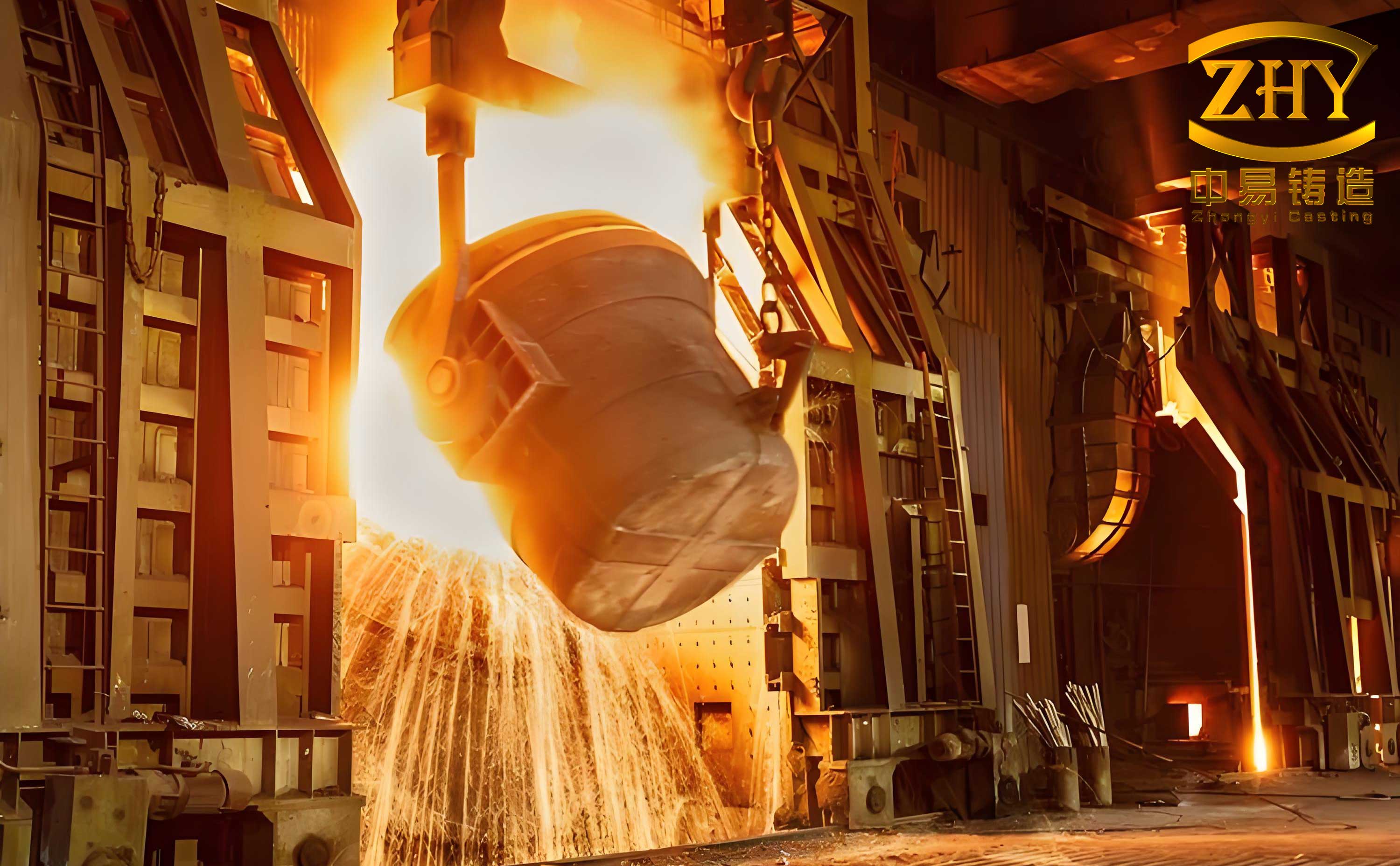
The standard heat treatment for austenitic manganese steel castings is water toughening. This involves heating the castings to a temperature between 1050°C and 1100°C to dissolve all carbides into a homogeneous austenitic solid solution, followed by rapid quenching in water. This produces the single-phase austenitic structure essential for achieving high toughness and the subsequent work-hardening behavior. The problem we observed was not related to the final microstructure, which upon metallographic examination was typically within specification (austenite with minimal, acceptable carbides). Instead, cracks were appearing, often at stress concentration points like section changes, and their occurrence correlated strongly with the castings’ position within the furnace—those near burners or at the top, where heating was most intense, were more susceptible.
This spatial pattern pointed directly to thermal stress as the primary culprit. The fundamental issue lies in the intrinsic thermophysical properties of high manganese steel compared to carbon steel. Austenitic manganese steel has exceptionally low thermal conductivity. This property is the key to understanding the crack genesis in a production manganese steel casting foundry environment.
The rate of heat conduction is governed by Fourier’s law. The one-dimensional form is:
$$ q = -k \frac{dT}{dx} $$
where \( q \) is the heat flux (W/m²), \( k \) is the thermal conductivity (W/m·K), and \( \frac{dT}{dx} \) is the temperature gradient. For a given heating rate and casting section thickness, a lower \( k \) results in a steeper temperature gradient \( \frac{dT}{dx} \) between the surface and the core of the casting.
The thermal stress (\( \sigma_{th} \)) generated due to this constraint can be approximated for a simple case by:
$$ \sigma_{th} \approx E \cdot \alpha \cdot \Delta T $$
where \( E \) is Young’s modulus, \( \alpha \) is the coefficient of thermal expansion, and \( \Delta T \) is the temperature difference between different regions of the casting. While high manganese steel has a high coefficient of thermal expansion (around \( 18 \times 10^{-6} /K \)), its critically low thermal conductivity (\( k \approx 13-15 W/m·K \) at room temperature, roughly one-quarter that of plain carbon steel) is the dominant factor. During heating, the surface heats rapidly while the core lags far behind, creating a massive \( \Delta T \). This differential expansion is constrained, generating significant tensile stresses in the cooler, weaker core. If the sum of these thermal stresses and any pre-existing residual stresses from the casting process exceeds the material’s yield or fracture strength at that temperature, cracking will initiate.
The following table contrasts the key properties that make heat treatment of manganese steel castings particularly sensitive:
| Material Property | High Manganese Steel (Austenitic) | Low/Medium Carbon Steel | Implication for Manganese Steel Casting Foundry |
|---|---|---|---|
| Thermal Conductivity (k) @ ~500°C | ~20 W/m·K | ~45-50 W/m·K | Much steeper temp. gradients, higher thermal stress. |
| Coefficient of Thermal Expansion (α) | ~18 × 10⁻⁶ /K | ~12 × 10⁻⁶ /K | Magnifies strain from temperature differences. |
| Yield Strength (at 400-600°C) | Relatively Low | Higher | Lower resistance to stress-induced deformation/cracking during heating. |
Our original production practices inadvertently exacerbated this inherent sensitivity. We operated mainly with two loading scenarios: “hot castings into a hot furnace” and “cold/cool castings into a cold furnace.” The former aimed for energy efficiency but created a critical flaw. Castings from different shakeout batches, with varying initial temperatures, were loaded into the same furnace. A casting at 50°C could be placed next to one at 250°C, yet the furnace might start heating from 400°C. The resulting large, non-uniform initial \( \Delta T \) between the furnace atmosphere, different castings, and within individual castings themselves was a recipe for disaster. Even the “cold start” process began heating from 200°C or 400°C at a relatively fast rate, not allowing sufficient time for temperature equalization. In essence, we were subjecting thermally sluggish castings to thermal shock during the heating stage.
A systematic analysis of crack patterns and furnace loading data confirmed this. The solution required a paradigm shift from a simple time-temperature recipe to a process controlled by thermal equilibrium and gentle thermal gradients. The improved protocol we developed is strictly governed by the initial temperature of the castings.
The two defined procedures are summarized in the table below:
| Process Designation | Initial Casting Temperature | Furnace Start Temperature | Critical Ramp-Up Rules | Objective |
|---|---|---|---|---|
| Process A (Cold Casting Process) | Ambient (≤ 50°C) | ≤ 50°C (Furnace at ambient) | 1. Soak/equalize for 1.0-1.5 hrs at ambient. 2. Heat from ambient to 650°C at ≤ 100°C/hr. |
Minimize initial gradient, allow core to follow surface. |
| Process B (Warm Casting Process) | ≤ 150°C | 150°C | 1. Soak/equalize for 1.0-1.5 hrs at 150°C. 2. Heat from 150°C to 650°C at ≤ 100°C/hr. |
Eliminate温差 between castings & furnace, control low-temp ramp. |
Both processes then follow: 650°C to 700°C at ~90°C/hr, 700°C to 1050°C at ~150°C/hr, soak, then water quench.
The core scientific principle behind this improvement is the management of the Biot number (\( Bi \)) during the initial heating phase. The Biot number is a dimensionless quantity that compares the internal thermal resistance of a body to the external convective/radiative resistance:
$$ Bi = \frac{h L_c}{k} $$
where \( h \) is the heat transfer coefficient, \( L_c \) is the characteristic length (volume/surface area), and \( k \) is the thermal conductivity. For high manganese steel with low \( k \), the Biot number is inherently high for typical casting dimensions, indicating that internal conduction resistance dominates (lumped capacitance analysis does not apply). This means temperature gradients within the casting are significant. By drastically reducing the initial furnace temperature and the heating rate below 650°C, we effectively reduce the driving potential for heat transfer (\( T_{furnace} – T_{casting} \)), thereby reducing the surface heat flux \( q \). From Fourier’s law, a lower \( q \) with a fixed \( k \) results in a smaller temperature gradient \( \frac{dT}{dx} \), which directly reduces the thermal stress \( \sigma_{th} \).
The mandatory equalization soak is crucial. It allows the temperature across a batch of castings and within each casting’s thick and thin sections to homogenize, eliminating “hot spots” and associated localized stresses before significant heating begins. This step is often neglected in generic heat treatment schedules but is paramount for a manganese steel casting foundry dealing with large, complex geometries.
The validation of this new protocol was unequivocal. We conducted a controlled production trial over 14 furnace charges. Twelve charges followed Process B (warm start, 132 castings), and two charges followed Process A (cold start, 22 castings). The result was a 0% crack rejection rate across all 154 castings. The correlation between crack formation and furnace position was broken. This wasn’t a statistical fluke; the subsequent full-scale adoption of this disciplined approach has permanently eliminated this specific failure mode in our production. The improvement in yield and cost savings for the manganese steel casting foundry have been substantial.
Beyond the practical solution, this experience underscores several critical lessons for heat-treating high manganese steel castings:
- Thermal Mass Management is Key: Treat the furnace charge as a single thermal mass. Minimize initial temperature variation within the load.
- Respect the Low-Temperature Region: The most dangerous period for crack formation is during heating from room temperature to about 650°C, where the steel’s strength is relatively low but thermal stresses can be very high. This region must be controlled with slow, deliberate heating.
- Process Discipline Overrides Convenience: The energy “savings” of hot charging are illusory if they lead to high scrap rates. A disciplined, slightly longer but controlled process is far more economical and reliable.
Looking forward, the principles established here could be further refined through modeling. Finite Element Analysis (FEA) can be used to simulate transient thermal and stress fields during heating. The governing heat transfer equation for transient analysis is:
$$ \rho C_p \frac{\partial T}{\partial t} = \nabla \cdot (k \nabla T) $$
where \( \rho \) is density and \( C_p \) is specific heat. Coupling this with a thermo-elasto-plastic stress model would allow a manganese steel casting foundry to virtually test heating rates for specific casting geometries, potentially optimizing cycle times without risk. Furthermore, the use of step heating or holding at intermediate temperatures (e.g., 300°C, 500°C) could be evaluated as a method to allow stress relaxation through creep mechanisms before proceeding, though this must be balanced against the risk of carbide precipitation.
In conclusion, the successful resolution of the cracking problem in high manganese steel railway frogs hinged on a fundamental understanding of the material’s poor thermal conductivity and a willingness to challenge entrenched, but flawed, production practices. The implemented solution—characterized by stringent control of the starting conditions, mandatory equalization, and severely restricted low-temperature heating rates—transformed our heat treatment from a source of loss into a pillar of reliability. This case study exemplifies the precise, science-based process control required to consistently master the challenging yet rewarding craft of high-integrity manganese steel casting foundry operations.