
In the context of escalating environmental concerns and energy crises, supercritical power generation technology has emerged as a pivotal solution due to its high efficiency and energy-saving capabilities. As a researcher in materials science and engineering, I have focused on the development and optimization of heat treatment processes for critical components, such as large steam turbine castings used in supercritical power plants. These components, often fabricated from advanced ferritic heat-resistant steels like ZG08Cr9W3Co3VNbNB, must endure extreme temperatures and pressures exceeding 600°C and 25 MPa. However, the inherent challenges associated with cast materials, including coarse grain structures, segregation, and residual stresses, often lead to significant heat treatment defects that compromise mechanical performance and service life. Heat treatment defects, such as uneven microstructures, mixed grain sizes, and reduced toughness, are prevalent in conventional methods, necessitating innovative approaches to refine grains and enhance properties. This article presents a comprehensive study on a novel heat treatment methodology designed to mitigate these heat treatment defects, thereby improving the overall mechanical performance of supercritical material castings.
The pursuit of cleaner fuel technologies worldwide has intensified research on materials capable of withstanding supercritical conditions. ZG08Cr9W3Co3VNbNB, a martensitic heat-resistant steel with high alloy content, is a prime candidate for such applications. Its chemical composition typically includes elements like chromium, tungsten, cobalt, vanadium, niobium, and boron, which contribute to high-temperature strength and creep resistance. However, the casting process often results in dendritic structures and chemical inhomogeneities, which, if not addressed through heat treatment, can lead to severe heat treatment defects such as brittle fracture and premature failure. Existing heat treatment practices, including multiple austenitization cycles, aim to refine grains but frequently cause mixed grain phenomena and increased production costs. These limitations underscore the urgency for developing optimized heat treatment sequences that minimize heat treatment defects while achieving uniform microstructures and superior mechanical properties. In this study, we propose a multi-step heat treatment protocol that effectively eliminates organizational heredity and refines grain size, thereby addressing common heat treatment defects in supercritical castings.
To understand the kinetics of grain growth and phase transformations during heat treatment, we consider fundamental equations. For instance, the grain growth kinetics can be described by the Beck equation: $$ d = k t^n $$ where \( d \) is the average grain diameter, \( t \) is the time, \( k \) is a temperature-dependent constant, and \( n \) is the growth exponent typically around 0.5 for ideal grain growth. In practice, alloying elements and precipitates impede grain boundary movement, modifying this relationship. Additionally, the diffusion-controlled phase transformations during heat treatment can be modeled using the Johnson-Mehl-Avrami-Kolmogorov (JMAK) equation: $$ f = 1 – \exp(-k t^n) $$ where \( f \) is the transformed fraction, \( k \) is a rate constant, and \( n \) is the Avrami exponent. These equations help in predicting microstructural evolution and identifying parameters that could lead to heat treatment defects if not controlled properly.
The chemical composition of the ZG08Cr9W3Co3VNbNB casting used in this study is detailed in Table 1. The material was melted in a vacuum induction furnace to minimize impurities, which are often sources of heat treatment defects like inclusions and porosity. Precise control of alloying elements is crucial, as deviations can exacerbate heat treatment defects during subsequent processing.
| Element | Content (wt.%) |
|---|---|
| C | 0.08 |
| Si | 0.33 |
| Mn | 0.54 |
| Cr | 8.8 |
| Nb | 0.05 |
| W | 2.9 |
| Co | 3.3 |
| V | 0.24 |
| B | 0.013 |
| N | 0.008 |
| Fe | Balance |
Conventional heat treatment methods for such castings often involve direct austenitization and tempering, but these can induce heat treatment defects such as coarse prior austenite grains and mixed grain structures. For example, repeated cycling between austenitization and cooling may refine grains but at the cost of introducing residual stresses and non-uniform transformations, which are classic heat treatment defects. To overcome these issues, our proposed methodology integrates four sequential steps: homogenization heat treatment, low-temperature annealing heat treatment, normalizing heat treatment, and tempering heat treatment. Each step is designed to progressively eliminate microstructural imperfections and reduce heat treatment defects.
The homogenization heat treatment aims to reduce chemical segregation, a common precursor to heat treatment defects. The casting is heated to 1140–1200°C and held for 10–14 hours to promote diffusion of alloying elements. The heating rates are controlled below 50°C/h to 800°C and then below 80°C/h to the target temperature to prevent thermal shock, which could cause cracking—a severe heat treatment defect. After holding, the casting is furnace-cooled to below 150°C to minimize thermal stresses. The diffusion process during homogenization can be described by Fick’s second law: $$ \frac{\partial C}{\partial t} = D \frac{\partial^2 C}{\partial x^2} $$ where \( C \) is concentration, \( t \) is time, \( D \) is the diffusion coefficient, and \( x \) is distance. By optimizing temperature and time, we reduce concentration gradients that lead to heat treatment defects like banding or preferential precipitation.
Following homogenization, a low-temperature annealing step is introduced at 650–850°C for 30–100 hours. This step facilitates the formation of a near-equilibrium ferrite and carbide structure, which helps in breaking the organizational heredity from the as-cast condition. Organizational heredity is a key contributor to heat treatment defects, as it perpetuates coarse grains through successive phase transformations. By annealing at intermediate temperatures, we promote recovery and precipitation processes that refine the microstructure. The kinetics of carbide precipitation during annealing can be expressed as: $$ r = \left( \frac{4 D t}{9} \right)^{1/3} $$ where \( r \) is the precipitate radius, \( D \) is the diffusion coefficient, and \( t \) is time. Controlled precipitation mitigates heat treatment defects by pinning grain boundaries and preventing excessive grain growth.
The normalizing heat treatment involves austenitization at 1100–1200°C, followed by forced air cooling to below 80°C. This step aims to transform the microstructure into a uniform austenite phase, which upon cooling forms fine martensite. The heating rate is carefully regulated to avoid overheating, which could cause grain coarsening—a typical heat treatment defect. The martensite start temperature \( M_s \) can be estimated using empirical formulas based on alloy composition: $$ M_s (°C) = 539 – 423C – 30.4Mn – 17.7Ni – 12.1Cr – 7.5Mo $$ where element symbols represent weight percentages. Controlling the cooling rate is critical to avoid quench cracking, another heat treatment defect associated with rapid temperature changes.
Finally, tempering is conducted at 710–760°C for 14–20 hours to relieve stresses and improve toughness. Tempering induces the precipitation of secondary carbides and recovery of dislocations, enhancing ductility without sacrificing strength. Inadequate tempering can lead to heat treatment defects such as tempered martensite embrittlement or insufficient stress relief. The tempering parameter, often described by the Hollomon-Jaffe equation, helps in optimizing this step: $$ P = T ( \log t + C ) $$ where \( P \) is the tempering parameter, \( T \) is temperature in Kelvin, \( t \) is time in hours, and \( C \) is a constant. By selecting appropriate tempering conditions, we minimize heat treatment defects and achieve a balanced microstructure.
To validate this methodology, we designed four experimental groups with varying parameters, as summarized in Table 2. Group 4 served as a control, omitting the low-temperature annealing step to highlight its importance in reducing heat treatment defects. Each group underwent the full sequence except for the specified variations, and we analyzed microstructures and mechanical properties to assess the impact on heat treatment defects.
| Step | Key Parameter | Group 1 | Group 2 | Group 3 | Group 4 (Control) |
|---|---|---|---|---|---|
| Homogenization | Temperature | 1140°C | 1160°C | 1180°C | 1140°C |
| Holding Time | 10 h | 12 h | 14 h | 10 h | |
| Heating Rate (to 800°C) | 50°C/h | 40°C/h | 30°C/h | 50°C/h | |
| Heating Rate (above 800°C) | 80°C/h | 70°C/h | 60°C/h | 80°C/h | |
| Low-Temperature Annealing | Temperature | 750°C | 700°C | 800°C | Not Applied |
| Holding Time | 60 h | 50 h | 80 h | — | |
| Normalizing | Austenitization Temperature | 1150°C | 1120°C | 1170°C | 1150°C |
| Holding Time | 5 h | 5 h | 5 h | 5 h | |
| Cooling Method | Forced Air | Forced Air | Forced Air | Forced Air | |
| Tempering | Temperature | 730°C | 720°C | 740°C | 730°C |
| Holding Time | 20 h | 14 h | 17 h | 20 h | |
| Cooling Rate | 50°C/h | 40°C/h | 30°C/h | 50°C/h |
Microstructural analysis revealed that Groups 1-3 exhibited uniform grain structures without mixed grains, indicating effective mitigation of heat treatment defects. In contrast, Group 4 showed coarse prior austenite grains, a direct consequence of omitting the annealing step, which exacerbated heat treatment defects like organizational heredity. The grain size refinement can be quantified using the Hall-Petch relationship, which relates yield strength to grain size: $$ \sigma_y = \sigma_0 + \frac{k_y}{\sqrt{d}} $$ where \( \sigma_y \) is yield strength, \( \sigma_0 \) is friction stress, \( k_y \) is a constant, and \( d \) is grain diameter. Finer grains in Groups 1-3 contributed to higher strength and toughness, reducing heat treatment defects associated with brittle behavior.
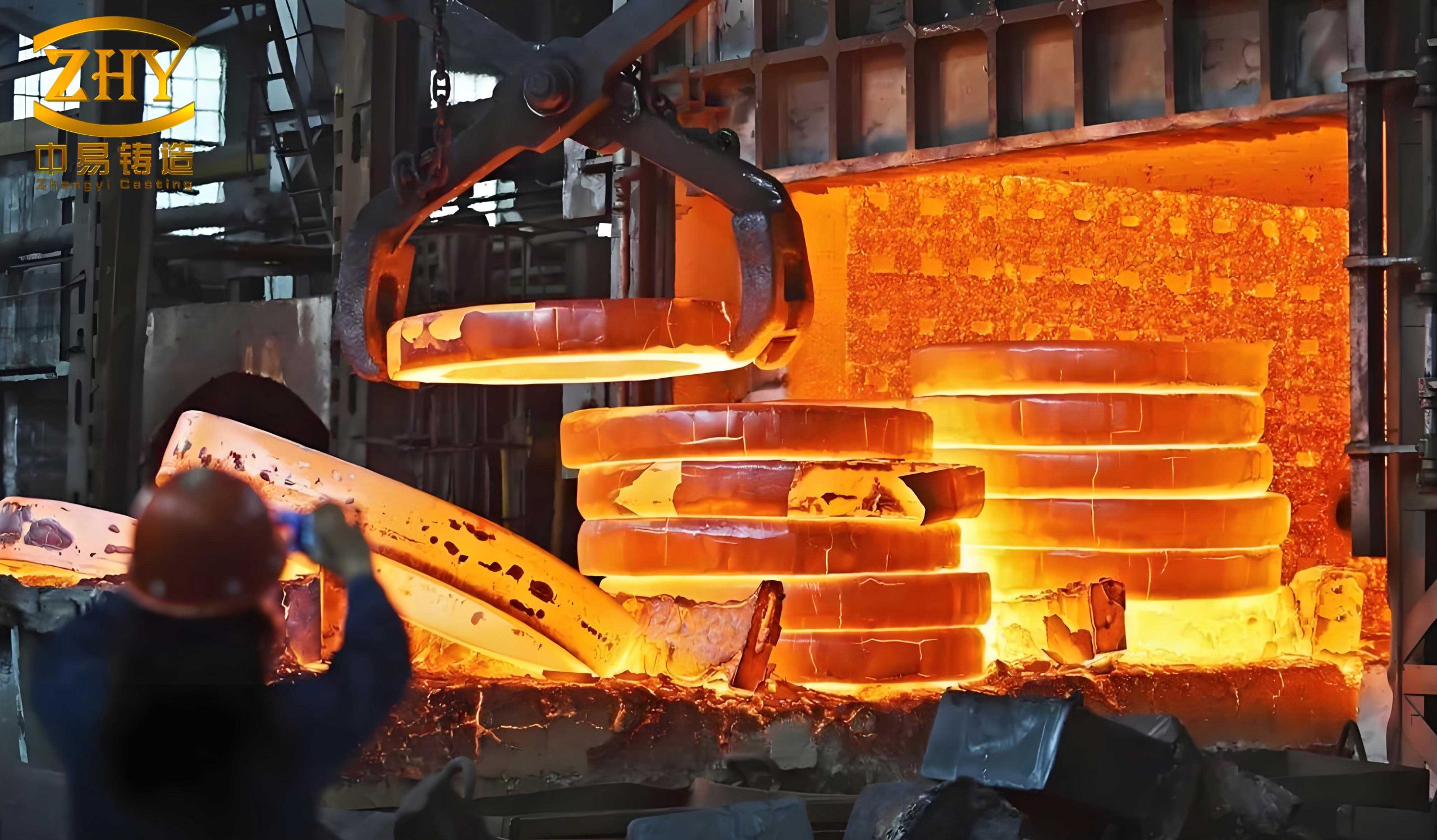
The image above illustrates common heat treatment defects, such as cracks and uneven microstructures, which we aimed to avoid through our optimized process. By integrating low-temperature annealing, we disrupted the inheritance of coarse structures, a critical factor in preventing heat treatment defects. The mechanical properties of the treated castings are summarized in Table 3, demonstrating significant improvements over the control group. Heat treatment defects like low toughness and poor creep resistance were markedly reduced, highlighting the efficacy of our approach.
| Property | Group 1 | Group 2 | Group 3 | Group 4 (Control) |
|---|---|---|---|---|
| Tensile Strength (MPa) | 838 | 767 | 796 | 750 |
| Yield Strength (MPa) | 692 | 618 | 611 | 600 |
| Elongation (%) | 18 | 17 | 16 | 15 |
| Reduction of Area (%) | 60 | 58 | 55 | 50 |
| Impact Energy at Room Temperature (J) | 47 | 32 | 35 | 27 |
| High-Temperature Creep Life at 650°C, 170 MPa (h) | 3810 | 3260 | 3430 | 1735 |
The data clearly show that Groups 1-3 achieved superior mechanical performance, with Group 1 exhibiting the best combination of strength, ductility, and creep resistance. The high-temperature creep life, in particular, was more than doubled compared to the control, indicating a substantial reduction in heat treatment defects related to long-term durability. Creep deformation can be modeled using Norton’s law: $$ \dot{\epsilon} = A \sigma^n \exp\left(-\frac{Q}{RT}\right) $$ where \( \dot{\epsilon} \) is creep strain rate, \( \sigma \) is stress, \( n \) is stress exponent, \( Q \) is activation energy, \( R \) is gas constant, and \( T \) is temperature. By refining grains and optimizing precipitates, our heat treatment lowers the creep rate, thereby extending component life and minimizing heat treatment defects under service conditions.
Further discussion on heat treatment defects involves the role of residual stresses. During casting and heat treatment, thermal gradients induce stresses that can lead to distortion or cracking—severe heat treatment defects. Our process incorporates controlled heating and cooling rates to mitigate these issues. The residual stress \( \sigma_r \) can be approximated using thermoelastic models: $$ \sigma_r = E \alpha \Delta T $$ where \( E \) is Young’s modulus, \( \alpha \) is thermal expansion coefficient, and \( \Delta T \) is temperature difference. By minimizing \( \Delta T \) through gradual steps, we reduce residual stresses and associated heat treatment defects.
Another aspect is the prevention of decarburization and oxidation, which are surface-related heat treatment defects that weaken the material. Our use of vacuum melting and controlled atmosphere during heat treatment helps in preserving surface integrity. The rate of oxidation can be described by the parabolic law: $$ x^2 = k_p t $$ where \( x \) is oxide thickness, \( k_p \) is parabolic rate constant, and \( t \) is time. By limiting exposure to high temperatures in oxidizing environments, we curb this heat treatment defect.
In conclusion, the proposed multi-step heat treatment methodology effectively addresses common heat treatment defects in supercritical ZG08Cr9W3Co3VNbNB castings. By integrating homogenization, low-temperature annealing, normalizing, and tempering, we achieve a fine, uniform grain structure without mixed grains, significantly enhancing tensile strength, yield strength, elongation, and creep resistance. The control group, lacking the annealing step, exhibited coarse grains and inferior properties, underscoring the importance of each stage in mitigating heat treatment defects. This approach not only improves mechanical performance but also reduces manufacturing costs and cycle times by avoiding repetitive treatments. Future work will focus on scaling up the process for industrial applications and further optimizing parameters to eliminate heat treatment defects in other advanced materials. Ultimately, tackling heat treatment defects is crucial for ensuring the reliability and efficiency of supercritical power plants, contributing to global energy sustainability.
To reinforce the findings, we can derive a comprehensive equation summarizing the effect of heat treatment on grain refinement. Combining the Beck equation with the Hall-Petch relationship, we get: $$ \sigma_y = \sigma_0 + \frac{k_y}{\sqrt{k t^n}} $$ This illustrates how controlling time and temperature during heat treatment directly influences strength by refining grains, thereby reducing heat treatment defects. Additionally, the total reduction in heat treatment defects can be quantified as a function of process parameters: $$ D_{defects} = f(T_1, t_1, T_2, t_2, T_3, t_3, T_4, t_4) $$ where \( D_{defects} \) represents the severity of heat treatment defects, and \( T_i \) and \( t_i \) are temperatures and times for each step. Our experimental data show that optimizing these variables minimizes \( D_{defects} \), leading to superior material performance.
In summary, this study highlights the critical role of tailored heat treatment in overcoming heat treatment defects in supercritical material castings. Through meticulous process design and validation, we have demonstrated a pathway to enhance the mechanical properties and service life of components essential for next-generation power generation. The continuous emphasis on heat treatment defects throughout this research underscores their pervasive impact and the need for innovative solutions in materials engineering.