
In the manufacturing industry, machine tool castings serve as the backbone of precision engineering, directly influencing the accuracy and reliability of machined components. The stability and performance of these machine tool castings are critical, as any residual stress release during service can lead to dimensional changes, compromising precision. To address this, we have developed a high carbon equivalent (CE) and high silicon to carbon ratio (Si/C) grey cast iron, specifically optimized for high-end machine tool castings. This material enhances mechanical properties, reduces residual stress, and improves microstructure uniformity, making it ideal for demanding applications in machine tool castings.
Our research focused on comparing three distinct material compositions for HT300 grey cast iron, commonly used in machine tool castings. The phases included: low CE with low Si/C, high CE with low Si/C, and high CE with high Si/C. Through extensive testing, we evaluated chemical compositions, mechanical properties, metallographic structures, and residual stresses. The results demonstrate that the high CE and high Si/C formulation, combined with alloying elements like Sn, Cr, and N, delivers superior performance for machine tool castings, including higher tensile strength, elastic modulus, and reduced sensitivity to section variations.
The chemical composition data for the three material types are summarized in Table 1. Key parameters such as carbon equivalent and silicon to carbon ratio were calculated to assess their impact on the properties of machine tool castings. The carbon equivalent is defined as: $$ CE = C + \frac{Si + P}{3} $$ where C, Si, and P represent the weight percentages of carbon, silicon, and phosphorus, respectively. This formula helps in predicting the casting behavior and graphite formation in grey cast iron used for machine tool castings.
| Material Type | Statistical Batches | C (%) | Si (%) | Mn (%) | P (%) | S (%) | Cu (%) | Cr (%) | Sn (%) | N (%) | CE (%) | Si/C Ratio |
|---|---|---|---|---|---|---|---|---|---|---|---|---|
| Low CE, Low Si/C HT300 | 40 | 3.64 | 1.66 | 0.85 | 0.03 | 0.08 | 0.50 | – | 0.02 | 0.0057 | 3.64 | 0.54 |
| High CE, Low Si/C HT300 | 100 | 3.85 | 1.85 | 0.87 | 0.03 | 0.07 | – | 0.04 | – | 0.0084 | 3.85 | 0.58 |
| High CE, High Si/C HT300 | 100 | 3.83 | 2.33 | 0.75 | 0.03 | 0.08 | – | 0.25 | 0.06 | 0.0087 | 3.83 | 0.77 |
Mechanical properties and metallurgical quality indicators were evaluated to determine the suitability of these materials for machine tool castings. Table 2 presents the average values for tensile strength, elastic modulus, hardness, and other parameters. The maturity (RG), hardening degree (HG), and quality index (Qi) are calculated using the following formulas: $$ RG = \frac{\text{Tensile Strength}}{100 – 1.2 \times \text{Hardness}} $$ $$ HG = \frac{\text{Hardness}}{\text{Tensile Strength}} \times 100 $$ $$ Qi = RG \times HG $$ These metrics help in assessing the overall quality and performance consistency of machine tool castings under varying conditions.
| Material Type | Statistical Batches | Tensile Strength (MPa) | Elastic Modulus (GPa) | Test Bar Hardness (HBW) | Guide Rail Hardness (HBW) | Machinability (m) | Eutectic Saturation (Sc) | Maturity (RG) | Hardening Degree (HG) | Quality Index (Qi) |
|---|---|---|---|---|---|---|---|---|---|---|
| Low CE, Low Si/C HT300 | 40 | 332.0 | 120.6 | 203.4 | 189.4 | 1.63 | 0.83 | 0.99 | 0.65 | 1.52 |
| High CE, Low Si/C HT300 | 100 | 342.4 | 122.5 | 213.5 | 186.4 | 1.60 | 0.89 | 1.18 | 0.79 | 1.49 |
| High CE, High Si/C HT300 | 100 | 369.9 | 132.5 | 223.8 | 205.8 | 1.63 | 0.88 | 1.22 | 0.80 | 1.52 |
Metallographic analysis revealed significant differences in graphite morphology and matrix structure among the three materials. The high CE and high Si/C formulation exhibited over 99% Type A graphite, with a size of 4-5 grades, and a pearlite volume fraction exceeding 98%. The graphite particles were shorter, thicker, and had blunt tips, which contribute to reduced stress concentration and improved mechanical properties in machine tool castings. The pearlite spacing was also finer, as measured in micrometers, enhancing the hardness and wear resistance essential for machine tool castings.
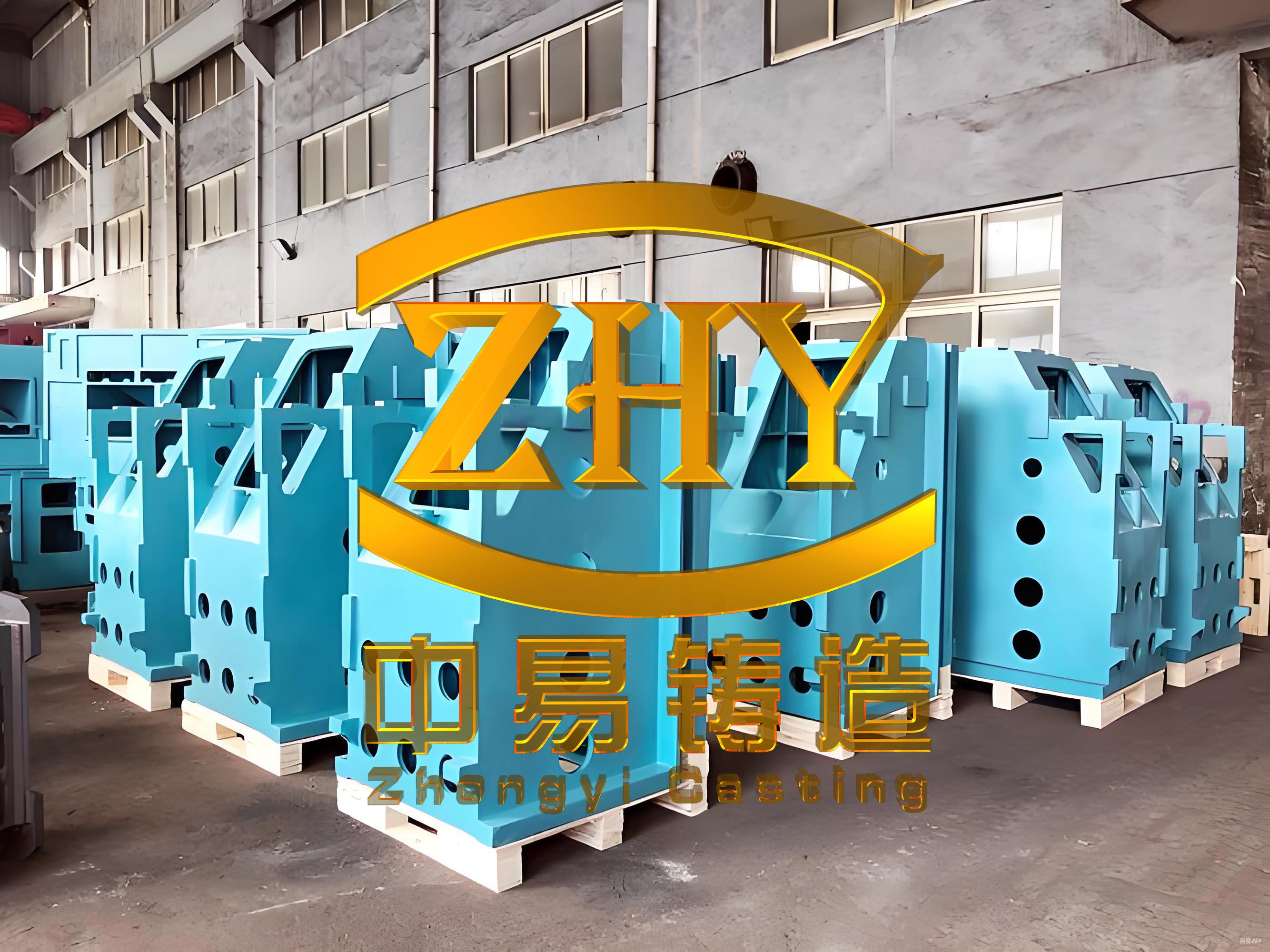
Residual stress measurements were conducted using a stress frame method to evaluate the internal stresses in cast machine tool castings. The stress frame dimensions and detection points were standardized, and results showed that the high CE and high Si/C material had lower residual stresses, with tensile stresses below 50 MPa and compressive stresses under 98 MPa. This reduction is crucial for minimizing dimensional instability in precision machine tool castings. The stress values are summarized in Table 3, highlighting the advantages of the high CE and high Si/C approach for producing low-stress machine tool castings.
| Material Type | Measurement Point | σ1 (MPa) | σ2 (MPa) | Tensile Strength (MPa) | Elastic Modulus (GPa) |
|---|---|---|---|---|---|
| Low CE, Low Si/C HT300 | Central Thick Bar | 32.4 | 17.2 | 332.0 | 120.6 |
| High CE, Low Si/C HT300 | Central Thick Bar | 20.2 | -6.7 | 342.4 | 122.5 |
| High CE, High Si/C HT300 | Central Thick Bar | 25.0 | 5.8 | 365.3 | 132.5 |
Based on these findings, we established performance indicators for high-end machine tool castings, as shown in Table 4. These include target ranges for carbon equivalent (3.80%-3.90%), silicon to carbon ratio (0.7-0.8), and alloying elements like Sn and Cr. The microstructure should consist of at least 90% Type A graphite, with pearlite volume fraction ≥98%, tensile strength ≥300 MPa, and elastic modulus ≥130 GPa. Additionally, residual stresses in the as-cast state must be controlled, with tensile stress ≤50 MPa and compressive stress ≤98 MPa, ensuring long-term stability for machine tool castings.
| Parameter | Target Value |
|---|---|
| Carbon Equivalent (CE, %) | 3.80-3.90 |
| Silicon to Carbon Ratio (Si/C) | 0.7-0.8 |
| Nitrogen (N, %) | 0.0080-0.0100 |
| Tin (Sn, %) | 0.04-0.06 |
| Copper (Cu, %) | 0-0.5 |
| Chromium (Cr, %) | 0-0.25 |
| Graphite Type (A, %) | ≥90 |
| Graphite Size (Grade) | 4-5 |
| Pearlite Volume Fraction (%) | ≥98 |
| Phosphide Eutectic + Cementite (%) | ≤1 |
| Tensile Strength (MPa) | ≥300 |
| Elastic Modulus (GPa) | ≥130 |
| Guide Rail Hardness (HBW) | 200±10 |
| Test Bar Hardness (HBW) | 220±10 |
| Machinability (m) | ≥1.0 |
| Maturity (RG) | ≥1.0 |
| Hardening Degree (HG) | ≤1.0 |
| Quality Index (Qi) | ≥1.0 |
| As-Cast Residual Stress (Tensile, MPa) | ≤50 |
| As-Cast Residual Stress (Compressive, MPa) | ≤98 |
To validate these results, we applied the high CE and high Si/C material to the production of a bed casting, a critical component in machine tool castings. The bed had dimensions of 1800 mm × 1000 mm × 900 mm and a weight of 1300 kg, with wall thicknesses ranging from 15 mm to 80 mm. Using furan resin sand molding and core-making processes, we melted the iron in a medium-frequency induction furnace, incorporating additives like graphitizing carburizer, metallurgical silicon carbide, and inoculants. The melting temperature was maintained between 1500°C and 1540°C, with pouring temperatures of 1360°C to 1390°C, and molds were opened below 280°C to minimize thermal stresses.
Chemical analysis of the molten iron from six batches confirmed consistency with the target composition, as detailed in Table 5. The carbon equivalent and silicon to carbon ratio were within the specified ranges, and alloying elements like Sn and N were controlled to optimize the microstructure and properties of the machine tool castings.
| Sample No. | CE (%) | Si/C Ratio | C (%) | Si (%) | Mn (%) | P (%) | S (%) | Sn (%) | N (%) |
|---|---|---|---|---|---|---|---|---|---|
| 1 | 3.80 | 0.79 | 3.00 | 2.37 | 0.785 | 0.034 | 0.083 | 0.070 | 0.0089 |
| 2 | 3.81 | 0.79 | 3.00 | 2.38 | 0.757 | 0.034 | 0.068 | 0.070 | 0.0086 |
| 3 | 3.82 | 0.77 | 3.03 | 2.33 | 0.764 | 0.037 | 0.077 | 0.070 | 0.0079 |
| 4 | 3.81 | 0.80 | 3.00 | 2.39 | 0.752 | 0.028 | 0.067 | 0.061 | 0.0090 |
| 5 | 3.83 | 0.76 | 3.05 | 2.31 | 0.771 | 0.036 | 0.083 | 0.056 | 0.0081 |
| 6 | 3.82 | 0.78 | 3.02 | 2.36 | 0.771 | 0.034 | 0.079 | 0.067 | 0.0076 |
Mechanical testing of single-cast test bars and hardness measurements on the bed guide rails demonstrated excellent performance, as shown in Table 6. Tensile strengths exceeded 350 MPa, elastic moduli were above 130 GPa, and hardness values were uniform, with variations within 10 HBW across the guide rails. This consistency is vital for the precision and durability of machine tool castings, ensuring minimal distortion during machining and service.
| Sample No. | Tensile Strength (MPa) | Test Bar Hardness (HBW) | Guide Rail Hardness (HBW) | Elastic Modulus (GPa) |
|---|---|---|---|---|
| 1 | 357 | 218 | 209, 210, 206 | 133 |
| 2 | 366 | 223 | 206, 202, 210 | 130 |
| 3 | 382 | 225 | 199, 205, 208 | 132 |
| 4 | 356 | 220 | 208, 205, 202 | 137 |
| 5 | 374 | 220 | 201, 198, 197 | 131 |
| 6 | 382 | 232 | 204, 209, 213 | 137 |
Metallographic examination of the bed guide rails confirmed a homogeneous structure with over 90% Type A graphite, sized at 4-5 grades, and pearlite content above 95%. The graphite was uniformly distributed without directionality, contributing to the low residual stresses and high dimensional stability required for machine tool castings. Hardness uniformity tests on four guide rails, each 1500 mm long, showed maximum variations of less than 10 HBW, indicating excellent consistency for machining operations in machine tool castings.
Residual stress measurements on the as-cast bed using the blind-hole method revealed tensile stresses below 50 MPa and compressive stresses under 98 MPa, as detailed in Table 7. These values align with the performance indicators, underscoring the effectiveness of the high CE and high Si/C material in reducing internal stresses in machine tool castings.
| Component | Measurement Point | ε1 (με) | ε2 (με) | ε3 (με) | σ1 (MPa) | σ2 (MPa) |
|---|---|---|---|---|---|---|
| Bed | 1 | 61 | -7 | -81 | 37.8 | -20.6 |
| Bed | 2 | 24 | -8 | 29 | -9.0 | -39.1 |
| Bed | 3 | 3 | -2 | -7 | 3.9 | -0.3 |
| Bed | 4 | 79 | 36 | -30 | 2.0 | -46.6 |
In conclusion, the high carbon equivalent and high silicon to carbon ratio grey iron, with CE of 3.80%-3.90% and Si/C of 0.7-0.8, demonstrates superior properties for machine tool castings. It achieves tensile strengths over 300 MPa, elastic moduli above 130 GPa, and controlled residual stresses, along with a refined microstructure of Type A graphite and high pearlite content. This material reduces section sensitivity and shrinkage tendencies, enhancing the precision and reliability of machine tool castings. While further validation with industry partners is ongoing, the current results highlight its potential for advancing high-end machine tool castings, ensuring improved performance and longevity in demanding applications.