
High manganese steel casting has been a cornerstone in the manufacturing of wear-resistant components for mining machinery since its invention in 1882. Its unique impact hardening characteristics make it indispensable for applications requiring durability under severe conditions. In our production facility, we specialize in engineering machinery wear-resistant castings, with a significant portion dedicated to high manganese steel casting. Over the years, we have focused on enhancing the performance of standard high manganese steel, such as ZGMn13, by incorporating alloying elements like chromium, nickel, molybdenum, titanium, and rare earth elements. These additions, combined with precise control over chemical composition, processing parameters, and heat treatment, have enabled us to refine the grain structure and improve the overall properties of high manganese steel casting. This article details our first-hand experiences and methodologies in optimizing high manganese steel casting for excavator components, emphasizing the use of tables and mathematical models to summarize key findings.
The foundation of high manganese steel casting lies in its chemical composition, which directly influences its mechanical properties and performance. Traditional high manganese steel, as outlined in early studies, typically contains carbon and manganese as primary elements, with strict limits on impurities like phosphorus and sulfur. However, in our practice, we have adopted a modified grade, ZGMn13Mo, which includes molybdenum to enhance carbide distribution, grain refinement, and elevated temperature performance. This improvement is particularly beneficial for welding properties and overall service life. Below, we present the chemical compositions and mechanical properties that guide our high manganese steel casting production.
| Element | C | Mn | P | Si | S |
|---|---|---|---|---|---|
| Content /% | 1.1–1.4 | 11–14 | ≤0.07 | 0.3–1.0 | ≤0.05 |
| Element | C | Mn | P | Si | Mo | S |
|---|---|---|---|---|---|---|
| Content /% | 1.05–1.2 | 12–14 | ≤0.06 | 0.30–0.80 | 0.80–1.20 | ≤0.03 |
| Material | Heat Treatment | Yield Strength ReL /MPa | Tensile Strength Rm /MPa | Elongation A /% | Reduction of Area Z /% | Impact Energy Cv (-40°C) /J | Brinell Hardness (HBW) |
|---|---|---|---|---|---|---|---|
| ZGMn13Mo | Water Quenching | ≥379 | ≥758 | ≥30 | ≥30 | ≥67 | 180–240 |
In high manganese steel casting, the casting process itself presents unique challenges due to the high manganese content, which can lead to issues like chemical burn-on and hot cracking. The fluidity and mold-filling capabilities are excellent, but these are offset by the reactivity of manganese oxides with silica in conventional molding sands. To address this, we have experimented with various molding materials. While options like magnesite, olivine, and alumina sands are effective, they are cost-prohibitive and difficult to recycle. Instead, we use silica sand coated with magnesite powder, which effectively prevents chemical burn-on in high manganese steel casting while maintaining economic feasibility. This approach has proven successful in our production of components such as track links, bucket lips, and wheel parts for excavators.
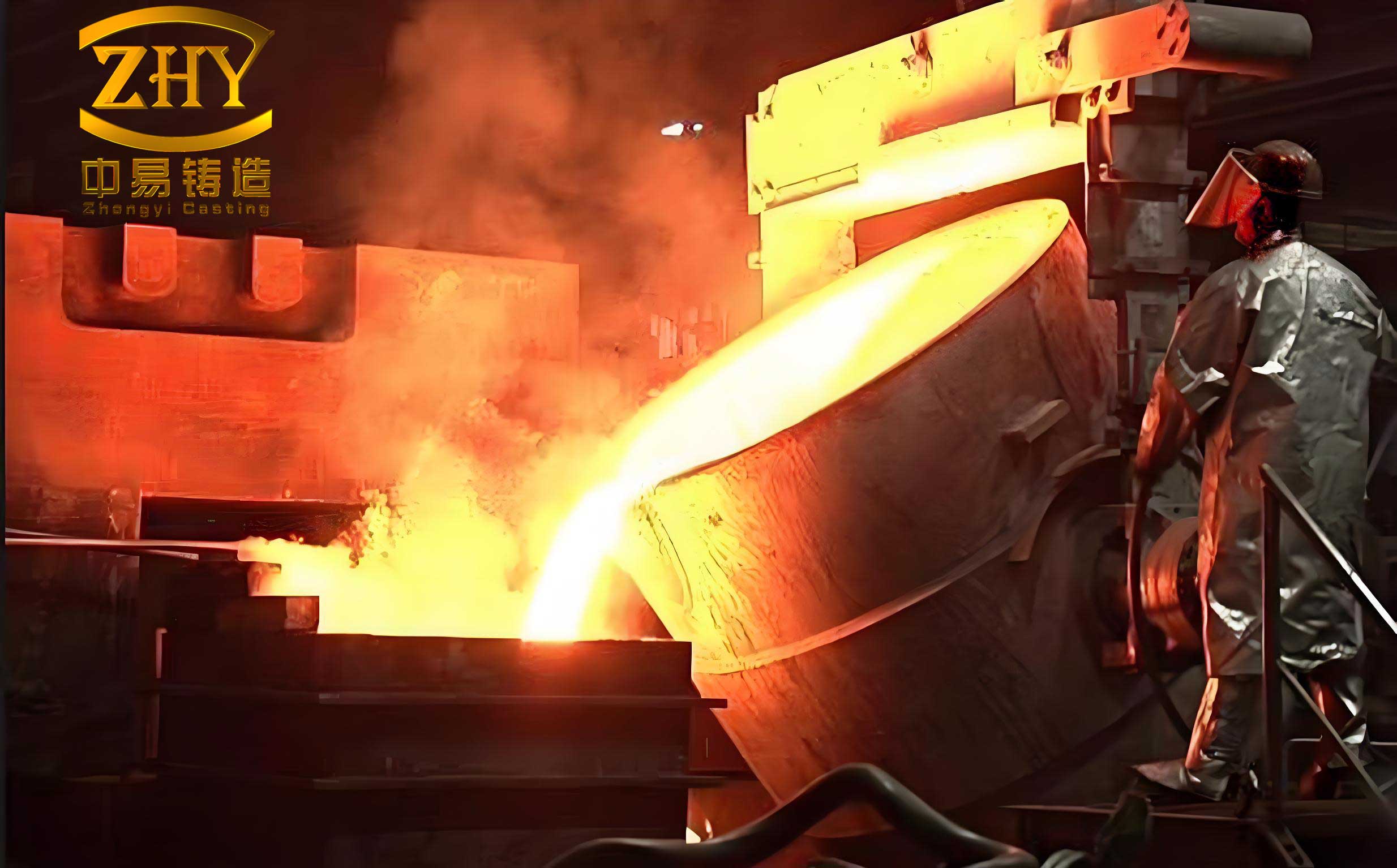
The microstructure of high manganese steel casting is inherently coarse in the as-cast state, with carbide networks at grain boundaries that impair mechanical properties. Thus, heat treatment is essential to achieve the desired austenitic structure and enhance performance. Our standard heat treatment for high manganese steel casting involves water quenching, but we have developed refined processes to further improve grain refinement and strength. The relationship between heat treatment parameters and mechanical properties can be modeled using kinetic equations. For instance, the austenitization process during heating can be described by the Avrami equation for phase transformation: $$ X(t) = 1 – \exp(-k t^n) $$ where \( X(t) \) is the fraction transformed, \( k \) is the rate constant, \( t \) is time, and \( n \) is the Avrami exponent. In high manganese steel casting, controlling this transformation is key to refining grain size.
One critical aspect of optimizing high manganese steel casting is microalloying with rare earth elements. We conducted experiments by adding rare earth silicide in varying amounts from 0.2% to 0.8% to the melt. The results showed that at 0.4% addition, the tensile strength peaked at 915 MPa, indicating significant grain refinement and purification of grain boundaries. This microalloying effect enhances the impact toughness and overall durability of high manganese steel casting. The relationship between rare earth content and tensile strength can be expressed as: $$ R_m = R_{m0} + \alpha \cdot \omega(RE) – \beta \cdot \omega(RE)^2 $$ where \( R_m \) is the tensile strength, \( R_{m0} \) is the base strength, \( \omega(RE) \) is the mass fraction of rare earth, and \( \alpha \) and \( \beta \) are constants derived from experimental data.
Another factor we optimized in high manganese steel casting is the pouring temperature. Higher pouring temperatures tend to coarsen the grain structure, reducing density and mechanical properties. We tested pouring temperatures from 1420°C to 1480°C and observed that lower temperatures resulted in finer grain sizes. For example, at 1420°C, the grain size was rated at level 3, whereas at 1480°C, it deteriorated to level 1. This inverse relationship can be quantified as: $$ G = G_0 + \gamma \cdot (T_p – T_{ref}) $$ where \( G \) is the grain size number, \( G_0 \) is the base grain size, \( T_p \) is the pouring temperature, \( T_{ref} \) is a reference temperature, and \( \gamma \) is a temperature coefficient. Controlling pouring temperature is therefore crucial for high-quality high manganese steel casting.
| Pouring Temperature /°C | Grain Size Number | Density /g·cm-3 |
|---|---|---|
| 1420 | 3 | 7.7800 |
| 1450 | 2 | 7.7503 |
| 1480 | 1 | 7.6209 |
Heat treatment plays a pivotal role in high manganese steel casting, as it transforms the coarse as-cast structure into a refined austenitic matrix. Our standard water quenching process involves heating to 1050–1100°C, holding, and then rapidly cooling in water. However, we introduced a modified heat treatment that includes an intermediate hold at 550–600°C to promote pearlitic transformation, followed by austenite re-crystallization. This process increases the number of nucleation sites, leading to finer grains. Additionally, we applied aging treatments after water quenching to precipitate carbides弥散ly, enhancing strength through dispersion hardening. The temperature-time profile for our improved heat treatment can be represented as: $$ T(t) = T_{\text{max}} \cdot \left(1 – \exp\left(-\frac{t}{\tau}\right)\right) + T_{\text{hold}} \cdot \exp\left(-\frac{t}{\tau}\right) $$ where \( T(t) \) is the temperature at time \( t \), \( T_{\text{max}} \) is the peak temperature, \( T_{\text{hold}} \) is the holding temperature, and \( \tau \) is the time constant.
| Heat Treatment Method | Tensile Strength Rm /MPa | Yield Strength Rp0.2 /MPa | Elongation A /% | Reduction of Area Z /% | Grain Size Number |
|---|---|---|---|---|---|
| Conventional Process | 865 | 420 | 44.0 | 38.0 | 2.5 |
| Improved Process | 900 | 430 | 44.5 | 35.0 | 3.5 |
| Improved Process + 350°C Aging | 930 | 465 | 60.5 | 42.0 | 3.5 |
| Improved Process + 400°C Aging | 910 | 460 | 44.5 | 38.0 | – |
To systematically optimize high manganese steel casting, we conducted a comprehensive orthogonal experiment focusing on three factors: rare earth addition, pouring temperature, and aging temperature. Each factor was tested at three levels, and we used an L9(3^4) orthogonal array to minimize the number of trials while capturing interactions. The goal was to maximize tensile strength, a key indicator of performance in high manganese steel casting. The factors and levels are summarized below.
| Factor | Level 1 | Level 2 | Level 3 |
|---|---|---|---|
| A: RE Addition /% | 0.2 | 0.4 | 0.6 |
| B: Pouring Temperature /°C | 1400 | 1440 | 1480 |
| C: Aging Temperature /°C | 300 | 350 | 400 |
The experimental design and results are presented in the following table, where we calculated the average tensile strength for each level and determined the range (R) to assess factor significance. The analysis revealed that aging temperature (Factor C) had the greatest impact, followed by rare earth addition (Factor A) and pouring temperature (Factor B).
| Experiment No. | A: RE Addition /% | B: Pouring Temperature /°C | C: Aging Temperature /°C | Empty Column | Tensile Strength Rm /MPa |
|---|---|---|---|---|---|
| 1 | 0.2 | 1400 | 300 | 1 | 860 |
| 2 | 0.2 | 1440 | 350 | 2 | 890 |
| 3 | 0.2 | 1480 | 400 | 3 | 845 |
| 4 | 0.4 | 1400 | 400 | 2 | 880 |
| 5 | 0.4 | 1440 | 300 | 3 | 870 |
| 6 | 0.4 | 1480 | 350 | 1 | 920 |
| 7 | 0.6 | 1400 | 350 | 3 | 890 |
| 8 | 0.6 | 1440 | 400 | 1 | 885 |
| 9 | 0.6 | 1480 | 300 | 2 | 850 |
| Factor | Level 1 Average Rm /MPa | Level 2 Average Rm /MPa | Level 3 Average Rm /MPa | Range R |
|---|---|---|---|---|
| A: RE Addition | 865 | 890 | 875 | 25 |
| B: Pouring Temperature | 876 | 881 | 871 | 10 |
| C: Aging Temperature | 860 | 900 | 870 | 40 |
The trend analysis from the orthogonal experiment indicated that the optimal combination for high manganese steel casting is 0.4% rare earth addition, a pouring temperature of 1400°C, and an aging temperature of 350°C. This combination yielded a tensile strength of 930 MPa, representing a significant improvement over conventional methods. The relationship between these factors and tensile strength can be modeled using a response surface equation: $$ R_m = \beta_0 + \beta_1 A + \beta_2 B + \beta_3 C + \beta_{12} A B + \beta_{13} A C + \beta_{23} B C + \beta_{11} A^2 + \beta_{22} B^2 + \beta_{33} C^2 $$ where \( A \), \( B \), and \( C \) are the coded factors for rare earth addition, pouring temperature, and aging temperature, respectively, and \( \beta \) coefficients are derived from regression analysis.
In production validation, implementing these optimized parameters for high manganese steel casting resulted in components with superior appearance, dimensional accuracy, and mechanical properties. The grain size was refined by more than two levels compared to previous methods, and impact energy at -40°C consistently exceeded 167 J. Service life increased by approximately 1.5 times, demonstrating the effectiveness of our approach. This success underscores the importance of integrated process control in high manganese steel casting, from alloy composition to heat treatment.
In conclusion, our efforts in high manganese steel casting have led to several key advancements. First, by using silica sand coated with magnesite powder, we effectively mitigated chemical burn-on while maintaining cost efficiency. Second, through systematic experimentation, we identified critical factors such as rare earth microalloying, controlled pouring temperature, and optimized heat treatment cycles that enhance grain refinement and strength. Third, the orthogonal experiment provided a robust framework for determining the optimal combination of parameters, resulting in high-performance high manganese steel casting with extended service life. These improvements not only ensure the quality of our castings but also contribute to the broader field of wear-resistant material engineering. Future work will focus on further refining these processes and exploring additional alloying elements to push the boundaries of high manganese steel casting performance.