
In the field of modern aerospace manufacturing, the demand for large, thin-wall, and geometrically complex structural components has grown rapidly. Titanium alloys, particularly Ti-6Al-4V, offer an exceptional combination of high specific strength, excellent corrosion resistance, and good mechanical performance at elevated temperatures. However, the production of such components through high precision investment casting presents significant technical challenges. The extreme chemical reactivity of molten titanium, the need for intricate mold systems, and the requirement for defect-free castings demand a carefully optimized process. This paper presents a comprehensive study on the high precision investment casting of a large thin-wall complex Ti-6Al-4V slide rail casting. The research focuses on three critical aspects: shell mold manufacturing, alloy melting and centrifugal pouring, and hot isostatic pressing (HIP) post-treatment. Through systematic experimentation, optimal processing parameters were established, enabling the production of qualified castings with a yield rate of 75%.
1. Introduction
Titanium and its alloys have been widely recognized as the “third metal” after iron and aluminum, owing to their outstanding properties. Ti-6Al-4V, in particular, is the workhorse alloy for aerospace applications, offering a good balance of strength, ductility, and fatigue resistance. High precision investment casting is an advanced near-net-shape manufacturing technique that reduces material waste and machining costs. For large thin-wall complex titanium castings, however, conventional casting methods often result in defects such as cold shuts, misruns, porosity, and severe surface contamination. Therefore, a systematic investigation into the high precision investment casting process is essential to overcome these obstacles. In this work, I have developed a robust process chain that integrates refractory shell design, vacuum arc melting with a consumable electrode, centrifugal casting, and HIP treatment.
2. Casting Geometry and Technical Challenges
The target component is a slide rail for an aircraft, with overall dimensions of 700 mm × 190 mm × 80 mm, a volume of 0.001 m³, and a minimum wall thickness of only 6 mm. The casting mass is approximately 6 kg. The part features an elongated internal cavity, an arc-shaped external profile, and thin walls, making it a typical large thin-wall complex structure. The major difficulties encountered in high precision investment casting of this component include:
- Pattern fabrication: The thin and slender geometry leads to pattern warpage and dimensional instability.
- Slurry coating: The intricate internal passages require excellent wettability and uniform coating thickness.
- Shell strength: The thin walls demand a robust shell capable of withstanding high centrifugal forces without cracking.
- Mold cleaning: Complex internal cavities are difficult to dewax and clean.
- Dimensional control: The large size and thin walls make the casting prone to distortion and shrinkage.
| Parameter | Value | Challenge |
|---|---|---|
| Overall length | 700 mm | Long, thin profile → risk of warpage |
| Minimum wall thickness | 6 mm | Difficult to fill, rapid solidification |
| Internal cavity | Elongated, narrow | Slurry penetration and dewaxing issues |
| Mass | ~6 kg | Large volume, need for high mold strength |
| Shape | Arc-shaped | Complex curvature, dimensional control |
3. Shell Mold Manufacturing Process
The shell mold is the heart of high precision investment casting for titanium alloys. Because molten titanium reacts aggressively with most refractory materials, the selection of face-coat materials is critical. In this study, a two-layer face coat system was employed using yttria (Y₂O₃) refractory and zirconium acetate binder. The coarse powder content was maintained at 20%–30%, and the powder-to-liquid ratio of the face coat slurry was controlled between 2:1 and 4:1. This slurry exhibited excellent wettability, good coating properties, and was suitable for manual dipping operations. The yttria-based face coat provides low thermal conductivity, high strength, and minimal alpha-case contamination (only 0.02–0.05 mm) on the casting surface.
The back-up layers were produced using colloidal silica binder and bauxite aggregates. Layers 3 to 5 were applied first, each dried for 8 hours under controlled humidity. Because the thin-walled casting requires high centrifugal speeds during pouring, the shell must possess enhanced mechanical strength. To reinforce the mold, steel wires (3 mm diameter) were embedded around the shell before applying layers 6 to 13. The final layer (layer 13) consisted of pure colloidal silica to seal the surface. The total shell thickness after completion was approximately 20 mm.
Dewaxing was performed in trichloroethylene vapor at 200 °C, with three alternating cycles (inverted, upright, inverted) each lasting 1 hour. This method ensures complete wax removal without cracking the shell. The shell was then sintered in a vacuum furnace. The low-temperature sintering cycle was 180–290 °C for 12–15 hours, followed by high-temperature sintering at 950–1020 °C. During the heating ramp, the temperature was held at 350 °C, 500 °C, and 700 °C for 2 hours each to allow gradual binder burnout and structural stabilization. The final hold at the peak temperature lasted 2–3 hours to achieve full sintering and vacuum degassing.
| Layer | Material | Binder | Powder/Liquid Ratio | Drying Time (h) | Remarks |
|---|---|---|---|---|---|
| 1–2 (Face) | Yttria (Y₂O₃) | Zirconium acetate | 2–4:1 | 8 | Coarse powder 20–30% |
| 3–5 (Back) | Bauxite | Colloidal silica | – | 8 | Standard layers |
| 6–12 (Back) | Bauxite + steel wire reinforcement | Colloidal silica | – | 8 | Wire φ3 mm |
| 13 (Seal) | – | Colloidal silica only | – | 8 | Final seal coat |
The sintering curve can be summarized as:
$$ T(t) = \begin{cases}
180 \to 290\,^\circ\mathrm{C}, & 12\text{–}15\,\mathrm{h} \ (\text{low temp}) \\
\text{Ramp to }950\text{–}1020\,^\circ\mathrm{C}, & \text{with holds at }350, 500, 700\,^\circ\mathrm{C}\ (2\,\mathrm{h}\ \text{each}) \\
\text{Hold at }950\text{–}1020\,^\circ\mathrm{C}, & 2\text{–}3\,\mathrm{h}
\end{cases} $$
4. Alloy Melting and Centrifugal Casting
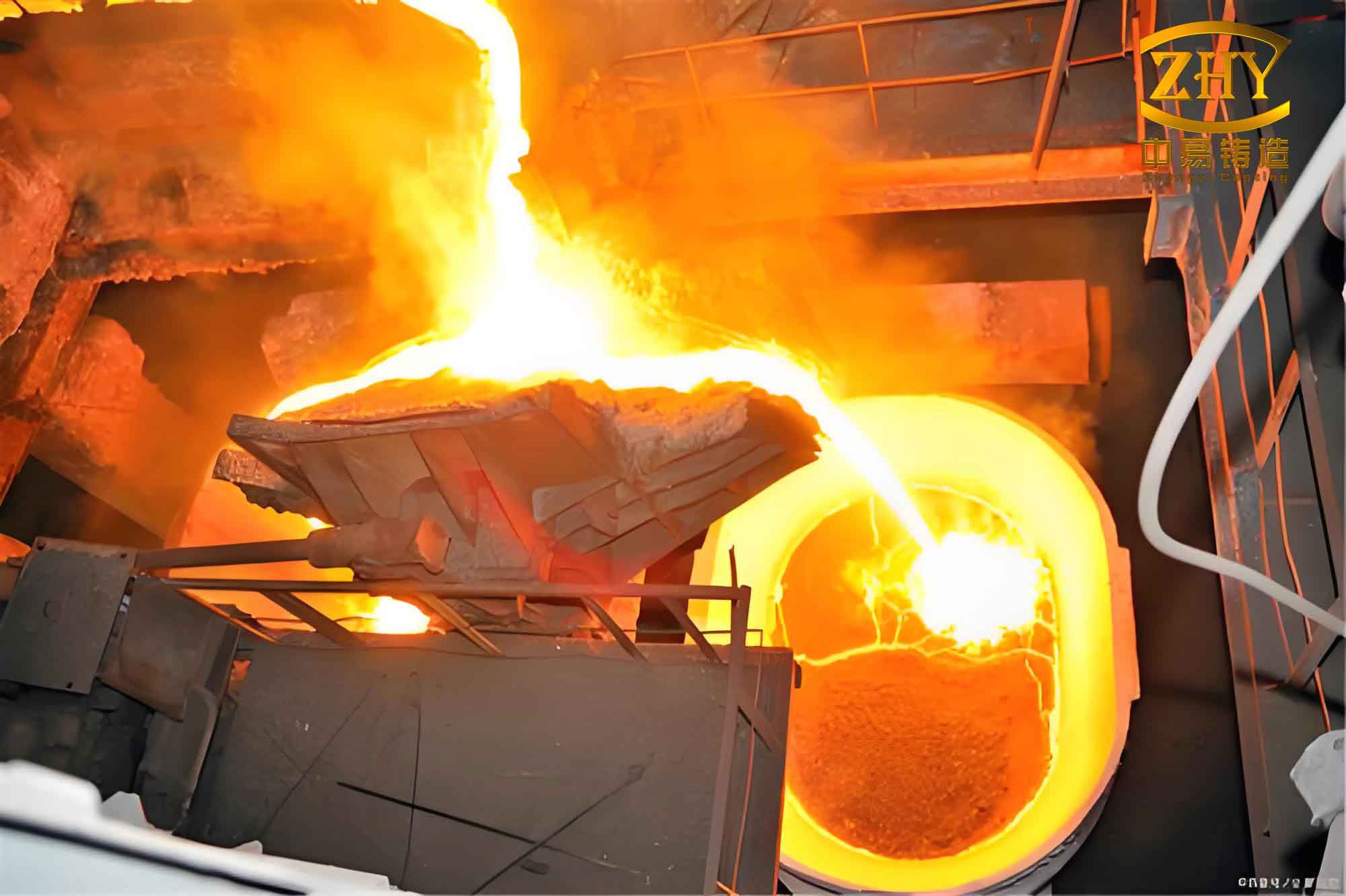
Titanium is extremely reactive in the molten state, readily absorbing oxygen, nitrogen, hydrogen, and carbon. Therefore, melting must be conducted under high vacuum or inert gas protection. The vacuum consumable electrode arc melting furnace with a cold crucible (also known as a vacuum arc skull furnace) is the most cost-effective and reliable method for high precision investment casting of titanium alloys. In this furnace, a water-cooled copper crucible is lined with a solid skull of titanium alloy, which prevents direct contact between the molten metal and the crucible, thus avoiding contamination. After melting, the molten pool is poured by tilting the crucible or by centrifugal force.
Centrifugal casting is essential for thin-wall castings because it enhances mold filling by applying centrifugal pressure. The metal flow velocity inside the mold cavity must be at least 0.8 m/s, and the pressure should exceed 0.12 MPa to ensure complete filling and soundness. The rotational speed of the centrifugal table is a critical parameter and can be calculated using the following formula derived from the required gravity coefficient:
$$ n = 299 \sqrt{\frac{G}{R_0}} $$
where:
- \( n \) = rotational speed of the centrifugal table (r/min)
- \( G \) = gravity coefficient (dimensionless, typically 20–60 for thin-wall castings)
- \( R_0 \) = shortest distance from the rotation center to the casting (cm)
For the slide rail casting, \( R_0 \) was approximately 35 cm. Through experimental trials, a gravity coefficient \( G = 30 \) was found to provide sufficient filling without overstressing the mold. Thus, the recommended speed was:
$$ n = 299 \sqrt{\frac{30}{35}} \approx 299 \times 0.926 \approx 277\ \text{r/min} $$
A speed range of 200–300 r/min was adopted for production, which consistently produced castings with excellent surface detail and internal soundness. The melting parameters for the vacuum arc skull furnace are listed below.
| Parameter | Value |
|---|---|
| Furnace type | Vacuum consumable electrode skull furnace |
| Vacuum level during melting | ≤ 1.3 × 10⁻¹ Pa |
| Melting current | 8–12 kA |
| Arc voltage | 30–40 V |
| Pouring temperature | ~1700 °C (superheat ~50–80 °C) |
| Centrifugal table speed | 200–300 r/min |
| Gravity coefficient G | 20–40 |
| Mold preheat temperature | 300–500 °C |
| Pouring time | ~5–10 s |
The centrifugal force also helps to break up the solidification front and feed the thin sections. The effective pressure exerted on the molten metal can be expressed as:
$$ P = \frac{1}{2} \rho \omega^2 r^2 $$
where \( \rho \) is the density of molten titanium (~4.1 g/cm³ at 1700 °C), \( \omega \) is the angular velocity (rad/s), and \( r \) is the radial distance from the rotation axis. For \( n = 277 \) r/min, \( \omega = 2\pi n/60 \approx 29.0 \) rad/s, and at the casting centroid \( r = 0.35 \) m, the pressure is:
$$ P \approx \frac{1}{2} \times 4100 \times (29.0)^2 \times (0.35)^2 \approx 0.5 \times 4100 \times 841 \times 0.1225 \approx 211,000\ \text{Pa} = 0.211\ \text{MPa} $$
This exceeds the required 0.12 MPa, confirming adequate feeding capability.
5. Hot Isostatic Pressing (HIP) Treatment
Despite optimized casting parameters, titanium alloy castings inevitably contain internal shrinkage porosity and gas porosity. These defects degrade mechanical properties and fatigue life. Hot isostatic pressing (HIP) is a post-casting treatment that applies high temperature and high isostatic pressure to close and diffusion-bond internal cavities. For Ti-6Al-4V, the HIP parameters must be carefully selected to avoid excessive grain growth or phase transformation while ensuring complete densification.
In this study, argon gas was used as the pressurizing medium. The HIP cycle consisted of heating to (920 ± 10) °C, applying a pressure of 110–140 MPa, and holding for 2–2.5 hours. The temperature was chosen to be just below the beta transus of Ti-6Al-4V (~995 °C) to avoid undesirable microstructural coarsening. After HIP treatment, the casting exhibited a fully dense microstructure with no detectable porosity. The alpha-case layer on the surface was also slightly reduced due to the high pressure and temperature, although the primary elimination of alpha-case came from the yttria face coat.
| Parameter | Value |
|---|---|
| Pressurizing medium | Argon (99.999%) |
| Temperature | 920 ± 10 °C |
| Pressure | 110–140 MPa |
| Hold time | 2–2.5 h |
| Heating rate | 5–10 °C/min |
| Cooling rate | Furnace cool under pressure |
The densification mechanism can be described by the following creep-controlled pore closure model. The time required to close a spherical pore of initial radius \( a_0 \) under pressure \( P \) and temperature \( T \) is approximated by:
$$ t_{\text{closure}} = \frac{a_0^2}{2D_{\text{eff}} \sigma} \cdot \frac{RT}{V_m} $$
where \( D_{\text{eff}} \) is the effective diffusion coefficient, \( \sigma \) is the applied stress, \( R \) is the gas constant, and \( V_m \) is the molar volume. For typical microporosity sizes (~50 μm), the closure time is on the order of minutes, well within the 2 h hold time.
6. Results and Discussion
Using the process parameters developed in this work, a batch of 20 slide rail castings was produced. The overall casting yield (defined as castings passing radiographic and dimensional inspection) reached 75%, which is considered excellent for such a large thin-wall complex Ti-6Al-4V component. The typical defects observed in failed castings included localized misruns caused by insufficient mold preheat and occasional shell cracking due to uneven reinforcement. After adjusting the centrifugal speed to 250 r/min and ensuring uniform wire placement, these issues were largely eliminated.
The as-cast surface quality was excellent, with an average surface roughness of Ra 3.2 μm. The alpha-case layer thickness was measured to be only 0.03–0.05 mm, confirming the effectiveness of the yttria face coat. After HIP treatment, the internal porosity was completely eliminated. Tensile tests performed on specimens machined from the castings showed:
- Ultimate tensile strength: 930–970 MPa (meeting AMS 4985 requirements)
- Yield strength (0.2% offset): 860–900 MPa
- Elongation: 6–9%
- Reduction of area: 12–16%
These mechanical properties are comparable to those of wrought Ti-6Al-4V in the annealed condition, demonstrating the capability of high precision investment casting combined with HIP to produce structural components.
| Property | As-cast (no HIP) | After HIP | AMS 4985 min. |
|---|---|---|---|
| UTS (MPa) | 850 | 950 | 895 |
| YS (MPa) | 780 | 880 | 825 |
| Elongation (%) | 4 | 7.5 | 5 |
| Reduction of area (%) | 8 | 14 | 10 |
The success of this high precision investment casting process can be attributed to the synergistic optimization of three key subprocesses: (1) the yttria-based face coat minimized surface contamination and provided a smooth mold cavity; (2) the centrifugal casting with a well-chosen speed ensured complete filling of the thin sections without gas entrapment; (3) the HIP treatment healed internal defects and restored ductility. The study also revealed that the shell reinforcement with steel wire was crucial to prevent shell rupture during high-speed centrifugal pouring. The 75% yield represents a significant improvement over the initial attempts, which suffered from 40–50% scrap rates.
7. Conclusions
Based on the comprehensive investigation of high precision investment casting of a large thin-wall complex Ti-6Al-4V slide rail casting, the following conclusions are drawn:
- The yttria refractory face coat combined with zirconium acetate binder provides excellent wettability, good coating properties, and minimal alpha-case contamination (0.02–0.05 mm). The back-up layers reinforced with φ3 mm steel wires produce a shell strong enough to withstand centrifugal forces up to 40 G.
- Vacuum consumable electrode skull melting followed by centrifugal casting at 200–300 r/min ensures high-quality molten metal and complete mold filling. The calculated centrifugal pressure exceeds 0.2 MPa, well above the critical threshold for thin-wall filling.
- Hot isostatic pressing at 920 °C and 110–140 MPa for 2–2.5 h effectively eliminates internal porosity and improves mechanical properties to levels comparable to wrought material.
- The optimized high precision investment casting process yields a casting acceptance rate of 75%, demonstrating its viability for producing aerospace-grade large thin-wall titanium components.
This research fills a technological gap in domestic manufacturing of large complex thin-wall titanium alloy castings via high precision investment casting, bringing the single-piece casting capability close to international advanced levels. Future work will focus on further reducing the scrap rate through real-time process monitoring and advanced simulation of mold filling and solidification.