
In the field of ductile iron castings, achieving a balance between high tensile strength, yield strength, elongation, and machinability has always been a challenge. Traditional grades like QT500-7 and QT600-3, which contain 30% to 60% pearlite in their matrix, often exhibit low yield strength and elongation, along with non-uniform hardness that impairs machining performance. To address these issues, we focused on leveraging silicon’s solid solution strengthening effect to develop fully ferritic matrix ductile iron castings with enhanced mechanical properties. This research explores the production of QT500-14 and QT600-10 ductile iron castings, which meet the specifications of EN 1563:2012, through optimized chemical composition and melting processes. The key innovation lies in utilizing high silicon content to achieve solid solution strengthening, thereby improving the overall performance of ductile iron castings without compromising ductility.
Solid solution strengthening involves the dissolution of solute atoms into the matrix, causing lattice distortion that increases resistance to dislocation movement. This results in higher strength and hardness, though it may reduce toughness and plasticity if not controlled properly. In ductile iron castings, silicon serves as an effective solid solution strengthener. The relationship between silicon content and tensile strength can be expressed as: $$ R_m = k \cdot [Si] + C $$ where \( R_m \) is the tensile strength, \( [Si] \) is the silicon content, \( k \) is a constant, and \( C \) is a base strength value. Similarly, the elongation decreases with increasing silicon, as shown by: $$ A = A_0 – m \cdot [Si] $$ where \( A \) is elongation, \( A_0 \) is the base elongation, and \( m \) is a coefficient. By carefully controlling silicon within 3.3% to 4.3%, we aimed to maximize strength while maintaining sufficient elongation for ductile iron castings.
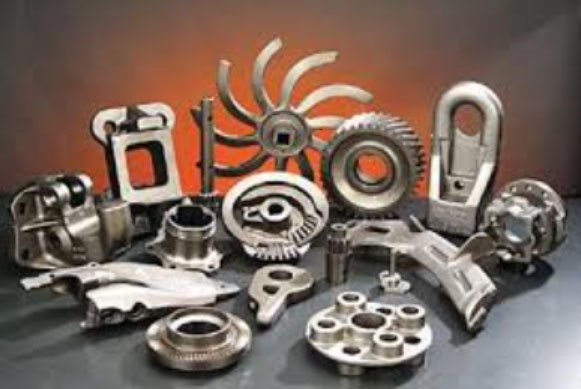
The chemical composition for these high silicon ductile iron castings was meticulously selected based on extensive experimentation and theoretical principles. Carbon equivalent (CE) plays a critical role in fluidity and shrinkage behavior. For optimal fluidity, CE is maintained between 4.45% and 4.55%, calculated as: $$ CE = \%C + \frac{\%Si}{3} + \frac{\%P}{3} $$ Silicon content is controlled between 3.3% and 4.3% to avoid excessive brittleness, while manganese is kept below 0.2% to prevent pearlite formation and segregation. Phosphorus and copper are minimized to below 0.04% and 0.1%, respectively, to reduce harmful effects like phosphide eutectics and pearlite promotion. Sulfur is controlled between 0.006% and 0.012% to ensure good nodulization, and magnesium is maintained at 0.045% to 0.065% to counteract silicon-induced graphite degeneration. The table below summarizes the target chemical composition for producing high-performance ductile iron castings.
| Element | Range (%) | Role in Ductile Iron Castings |
|---|---|---|
| Carbon (C) | 3.0 – 3.5 | Influences fluidity and graphite formation |
| Silicon (Si) | 3.3 – 4.3 | Solid solution strengthening, promotes ferrite |
| Manganese (Mn) | < 0.2 | Minimizes pearlite formation and segregation |
| Phosphorus (P) | < 0.04 | Reduces phosphide eutectics and brittleness |
| Copper (Cu) | < 0.1 | Prevents pearlite formation in ferritic matrix |
| Sulfur (S) | 0.006 – 0.012 | Essential for nodulization, controlled to avoid defects |
| Magnesium (Mg) | 0.045 – 0.065 | Ensures spherical graphite morphology |
Melting and processing techniques are crucial for achieving the desired properties in ductile iron castings. We used high-purity raw materials, including premium pig iron, steel scrap, and returns, to minimize impurity levels. The charge composition was optimized as follows: 30-50% pig iron, 10-30% steel scrap, and 30-50% returns. This blend ensures a consistent base for producing high-quality ductile iron castings. The melting process involved controlled temperatures to avoid overheating, with tapping temperatures carefully monitored to facilitate effective treatment. For nodulization, we employed FeSiMg alloy (4-6% Mg, 40-45% Si) via the sandwich method, with additions of 0.9-1.2% to counteract high silicon’s impact on graphite shape. Inoculation was performed using BaSi inoculant (70-75% Si, 4-6% Ba) at 0.8-1.0% to enhance graphite nucleation and uniformity. The overall process can be described by the kinetic equation for nodulization: $$ \frac{d[Mg]}{dt} = -k \cdot [S] $$ where \( [Mg] \) is magnesium content, \( [S] \) is sulfur content, and \( k \) is a rate constant, highlighting the importance of sulfur control in ductile iron castings.
Extensive trials were conducted in three phases to refine the process for ductile iron castings. Initially, low silicon content and poor nodularity led to subpar mechanical properties. By increasing silicon and adjusting magnesium levels, we improved tensile strength and elongation. In the final phase, we cast single test bars of Y25, U40, and U70 sizes to evaluate mechanical properties and microstructure. The results demonstrated that QT500-14 and QT600-10 ductile iron castings consistently met EN 1563:2012 requirements. Below are tables summarizing the experimental data for QT600-10 and QT500-14 ductile iron castings, showing tensile strength (Rm), yield strength (Rp0.2), elongation (A), nodularity, and ferrite content.
| Trial | C (%) | Si (%) | Nodularity (%) | Rm (MPa) | Rp0.2 (MPa) | A (%) | Ferrite (%) |
|---|---|---|---|---|---|---|---|
| 1 | 3.18 | 3.95 | 91 | 617 | 500 | 19 | >95 |
| 2 | 3.11 | 3.89 | 93 | 612 | 499 | 17 | >95 |
| 3 | 3.15 | 3.94 | 95 | 610 | 493 | 18 | >95 |
| 4 | 3.17 | 3.98 | 89 | 619 | 491 | 15 | >95 |
| 5 | 3.09 | 4.10 | 97 | 628 | 510 | 16 | >95 |
| Trial | C (%) | Si (%) | Nodularity (%) | Rm (MPa) | Rp0.2 (MPa) | A (%) | Ferrite (%) |
|---|---|---|---|---|---|---|---|
| 1 | 3.18 | 3.95 | 92 | 597 | 490 | 15 | >95 |
| 2 | 3.11 | 3.89 | 90 | 594 | 482 | 16 | >95 |
| 3 | 3.15 | 3.94 | 91 | 588 | 485 | 13 | >95 |
| 4 | 3.17 | 3.98 | 91 | 601 | 493 | 14 | >95 |
| 5 | 3.09 | 4.10 | 90 | 611 | 502 | 17 | >95 |
| Trial | C (%) | Si (%) | Nodularity (%) | Rm (MPa) | Rp0.2 (MPa) | A (%) | Ferrite (%) |
|---|---|---|---|---|---|---|---|
| 1 | 3.18 | 3.95 | 92 | 589 | 487 | 16 | >95 |
| 2 | 3.11 | 3.89 | 93 | 590 | 485 | 14 | >95 |
| 3 | 3.15 | 3.94 | 94 | 580 | 483 | 12 | >95 |
| 4 | 3.17 | 3.98 | 90 | 579 | 481 | 13 | >95 |
| 5 | 3.09 | 4.10 | 93 | 586 | 493 | 15 | >95 |
| Trial | C (%) | Si (%) | Nodularity (%) | Rm (MPa) | Rp0.2 (MPa) | A (%) | Ferrite (%) |
|---|---|---|---|---|---|---|---|
| 1 | 3.23 | 3.65 | 93 | 542 | 450 | 15 | >95 |
| 2 | 3.19 | 3.71 | 95 | 551 | 452 | 16 | >95 |
| 3 | 3.24 | 3.64 | 95 | 536 | 459 | 17 | >95 |
| 4 | 3.30 | 3.68 | 90 | 521 | 443 | 15 | >95 |
| 5 | 3.25 | 3.75 | 91 | 549 | 451 | 14 | >95 |
| Trial | C (%) | Si (%) | Nodularity (%) | Rm (MPa) | Rp0.2 (MPa) | A (%) | Ferrite (%) |
|---|---|---|---|---|---|---|---|
| 1 | 3.23 | 3.65 | 91 | 533 | 448 | 15 | >95 |
| 2 | 3.19 | 3.71 | 92 | 546 | 453 | 17 | >95 |
| 3 | 3.24 | 3.64 | 90 | 535 | 455 | 15 | >95 |
| 4 | 3.30 | 3.68 | 95 | 522 | 443 | 16 | >95 |
| 5 | 3.25 | 3.75 | 96 | 541 | 441 | 15 | >95 |
| Trial | C (%) | Si (%) | Nodularity (%) | Rm (MPa) | Rp0.2 (MPa) | A (%) | Ferrite (%) |
|---|---|---|---|---|---|---|---|
| 1 | 3.23 | 3.65 | 90 | 529 | 438 | 14 | >95 |
| 2 | 3.19 | 3.71 | 91 | 537 | 446 | 15 | >95 |
| 3 | 3.24 | 3.64 | 92 | 525 | 437 | 15 | >95 |
| 4 | 3.30 | 3.68 | 99 | 520 | 433 | 14 | >95 |
| 5 | 3.25 | 3.75 | 87 | 530 | 441 | 15 | >95 |
Microstructural analysis revealed a fully ferritic matrix with nodularity exceeding 85%, confirming the effectiveness of the high silicon approach in ductile iron castings. The graphite morphology was predominantly spherical, with minimal degeneracy, as achieved through controlled magnesium additions. The relationship between silicon content and mechanical properties can be further described by the empirical formula: $$ R_m = 500 + 30 \cdot ([Si] – 3.0) $$ for QT500-14, and $$ R_m = 600 + 25 \cdot ([Si] – 3.5) $$ for QT600-10, illustrating how silicon enhances tensile strength in these ductile iron castings.
High silicon ductile iron castings offer several advantages over traditional alloys. Compared to copper or tin-alloyed ductile iron castings with mixed ferritic-pearlitic matrices, the high silicon variants provide superior tensile strength, yield strength, and elongation. This allows for weight reduction in thick-section ductile iron castings, lowering production costs. Moreover, the uniform hardness distribution improves machinability, extending tool life and reducing machining expenses. The narrow hardness range in these ductile iron castings stems from the fully ferritic matrix, which minimizes tool wear. Additionally, the high silicon content permits the use of more steel scrap in charges, reducing material costs without compromising performance. However, there are limitations: the production window for QT600-10 is narrow, requiring strict silicon control below 4.3%; surface treatments like quenching are not feasible due to high silicon; and weldability is poor, restricting repair options.
The application prospects for high silicon ductile iron castings are promising, particularly in elevated temperature environments. Impact toughness tests on V-notched specimens from QT500-14 ductile iron castings showed that impact energy increases with temperature, as summarized in the table below. This makes them suitable for high-temperature applications, where they can replace mixed-matrix grades like QT600-3 and QT500-7. However, caution is advised for low-temperature use due to reduced impact resistance.
| Test Bar Type | Temperature (°C) | Impact Energy (J) – Sample 1 | Impact Energy (J) – Sample 2 | Impact Energy (J) – Sample 3 | Average Impact Energy (J) |
|---|---|---|---|---|---|
| Y25 | -20 | 4 | 4 | 4 | 4 |
| Y25 | 20 | 5 | 5 | 5 | 5 |
| Y25 | 140 | 19 | 20 | 21 | 20 |
| Y25 | 180 | 20 | 21 | 22 | 21 |
| Ductile Iron Casting Grade | Test Bar Type | Impact Energy at -20°C (J) | Impact Energy at 20°C (J) | Impact Energy at 140°C (J) | Impact Energy at 180°C (J) |
|---|---|---|---|---|---|
| QT600-10 | Y25 | 3 | 4 | 18 | 20 |
| QT500-14 | Y25 | 4 | 5 | 20 | 21 |
| QT500-7 | Y25 | 4 | 5 | 18 | 20 |
| QT450-18 | Y25 | 7 | 17 | 22 | 24 |
| QT450-10 | Y25 | 6 | 7 | 18 | 22 |
| QT400-18 | Y25 | 8 | 18 | 22 | 23 |
In conclusion, the development of QT500-14 and QT600-10 ductile iron castings through high silicon solid solution strengthening represents a significant advancement. By employing FeSiMg nodulizers and BaSi inoculants, we achieved mechanical properties and microstructures that comply with EN 1563:2012 standards. These ductile iron castings are ideal for high-temperature applications but should be avoided in low-temperature settings due to inferior impact resistance. Future work could focus on expanding the application range and improving weldability for broader adoption of high silicon ductile iron castings.