
In my extensive experience with advanced foundry practices, the production of high-strength shell castings using ZL205A aluminum alloy represents a significant technical challenge due to the alloy’s inherent casting complexities. These shell castings are critical components in aerospace and high-performance applications, demanding exceptional mechanical properties, lightweight design, and dimensional stability under severe operational conditions. As a Class I casting per stringent standards, these shell castings must be entirely free from defects such as porosity, inclusions, shrinkage, and cracks, with rigorous X-ray inspection to exclude any segregation anomalies. The ZL205A alloy, a domestically developed high-purity Al-Cu system alloy, offers remarkable post-heat-treatment strength, hardness, ductility, machinability, and surface treatment capabilities. However, its poor castability, characterized by a wide solidification range and mushy freezing behavior, predisposes it to shrinkage porosity, hot tearing, and other defects if the casting process is not meticulously engineered. This article, from my firsthand perspective, delves into the铸造工艺要点 for such shell castings, analyzing structural nuances and performance requirements to present a novel and practical工艺 approach, emphasizing the repeated importance of optimizing processes for reliable shell castings.
The工艺特性 of ZL205A alloy are foundational to designing an effective casting process for shell castings. Its chemical composition and mechanical properties are summarized in Table 1. The alloy’s broad crystallization temperature range leads to pasty solidification, hindering directional solidification and increasing sensitivity to section thickness, which can result in dispersed microporosity and hot cracks in shell castings. To counteract this, several measures are imperative in the工艺 for shell castings. First, enhancing chilling at the bottom and lateral hot spots of the shell castings is crucial to establish a steep thermal gradient, promoting bottom-up directional solidification. This can be achieved by strategically placing chills and designing oversized risers to improve thermal distribution and metallostatic pressure for effective feeding. Second, at locations with thicker sections or uneven wall thickness—common in complex shell castings—the use of chills or other cooling aids is essential to accelerate local solidification, refine microstructure, and ensure denseness. Combining chills with risers at these hot spots guarantees integrity in shell castings. Third, the gating system for such shell castings typically employs an open design, often combining bottom and slot gating to ensure smooth, rapid mold filling while fostering favorable solidification conditions for high-quality shell castings.
| Element | Content (wt%) | Element | Content (wt%) |
|---|---|---|---|
| Cu | 4.6–5.3 | Fe | ≤0.15 |
| Mn | 0.3–0.5 | Si | ≤0.06 |
| Ti | 0.15–0.35 | Mg | ≤0.05 |
| Zr | 0.05–0.20 | Zn | ≤0.1 |
| B | 0.005–0.06 | Al | Balance |
| Cd | 0.15–0.25 | ||
| V | 0.05–0.30 |
| Casting Method | Condition | Tensile Strength σ_b (MPa) | Elongation δ_5 (%) | Brinell Hardness (HBS) |
|---|---|---|---|---|
| S | T5 | 440 | 7 | 120 |
| S | T6 | 490 | 3 | 140 |
| S | T7 | 470 | 2 | 130 |
The structural characteristics of the shell castings profoundly influence the工艺 design. The shell castings are conical回转体 structures with significant external dimensions: large-end diameter of approximately 578 mm, small-end diameter of 252 mm, and height of 238 mm, requiring strict dimensional and angular tolerances. Wall thickness is non-uniform, with a nominal thickness of 30 mm and maximum thickness reaching 70 mm, particularly at the upper port, creating abrupt transitions that pose feeding challenges. Both end faces serve as assembly surfaces, demanding high mechanical performance. These features necessitate a工艺 that ensures dimensional accuracy while meeting the冶金 quality requirements of ZL205A alloy for robust shell castings. To achieve uniform properties and consistent microstructure across the shell castings, a vertical pouring orientation is adopted. This promotes symmetrical solidification on both sides, enhancing homogeneity in成分, organization, and performance—a critical aspect for shell castings under impact loads. The larger end is positioned upward to facilitate riser placement and better feeding dynamics. Contoured chills are employed at the bottom and thick sections to encapsulate hot spots, accelerating cooling and mitigating shrinkage defects in shell castings. Given the complexity and size, the entire mold is constructed from cores to simplify pattern removal in manual molding. The cores for forming the internal cavity of the shell castings are made as hollow monolithic units using chromite sand, which provides additional chilling effect, reduces wall thickness sensitivity, ensures dimensional stability, improves venting, and simplifies assembly—key advantages for producing precise shell castings.
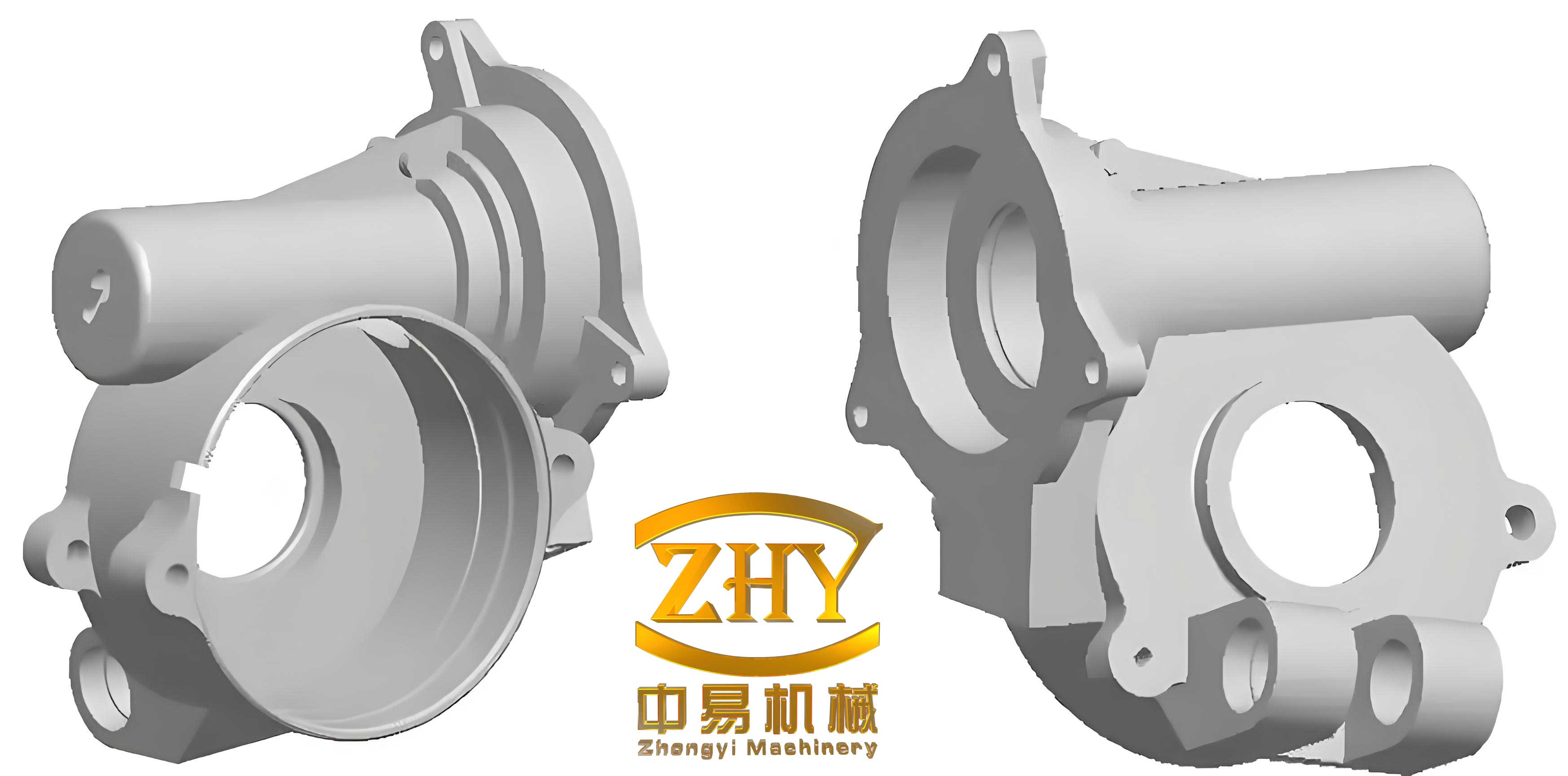
The gating system design is pivotal for achieving defect-free shell castings. For ZL205A alloy, prone to oxidation and with wide freezing range, an open gating system combining bottom and slot gates is utilized to minimize turbulence, prevent二次氧化夹渣, and ensure adequate filling capacity. The typical gating system structure for shell castings includes sprue, runner, ingate, and vertical sleeve with slot. The cross-sectional area ratios are set as F_sprue : F_runner : F_ingate = 1 : 4 : 5. The choke area, F_sprue, is calculated using the empirical formula:
$$ F_{\text{sprue}} = 0.11 \times G $$
where F_sprue is in cm² and G is the casting weight in kg. For a shell casting with G = 40 kg, F_sprue = 4.4 cm². In practice, custom-made片状干型直浇道 with dimensions 2 mm × 8 mm × 40 mm are used—two pieces, giving an actual F_sprue = 0.8 × 4.0 × 2.0 = 6.4 cm². Consequently, F_runner = 25.6 cm² and F_ingate = 32 cm², distributed as per design. A double-runner system enhances flow stabilization and slag trapping. Runner and ingate cross-sections are trapezoidal, with ingates tapered to a minimum thickness of 0.8–1.0 times the local wall thickness to control filling speed. Ceramic filters with porosity ≥75% are placed at the sprue-runner junction to effectively remove inclusions while maintaining metal flow, crucial for clean shell castings. Metal is introduced via ingates and vertical sleeve slots. The slot gates originate at thick sections, directly feeding into risers with constricted profiles, maximizing the sleeve’s feeding effect on adjacent walls and raising riser temperature for improved补缩. Slot dimensions are determined as:
$$ a = (0.8 \sim 1.5) \times \delta_{\text{casting}} $$
$$ b = 15 \sim 35 \text{ mm} $$
$$ D = (4 \sim 6) \times a $$
where a is slot width, b is slot height, D is sleeve diameter, and δ_casting is the local wall thickness. Risers are positioned atop the shell castings, with heights set at 170 mm to ensure adequate feeding pressure and thermal mass for sound shell castings.
Heat treatment is essential to unlock the full potential of ZL205A alloy in shell castings. For T5 condition, a multi-stage heating process is employed to prevent overheating and ensure consistent properties in shell castings. The parameters are: Solution treatment: Charge at ≤300°C, then 530 ± 5°C (hold 0.5 h) + 535 ± 5°C (hold 1 h) + 538 ± 5°C (hold 18 h), followed by water quenching at 40–60°C. Aging: 155 ± 5°C (hold 9 h) + air cooling. This careful ramp-up avoids exceeding critical temperatures, safeguarding against incipient melting and ensuring high strength and hardness in the final shell castings. The precision required underscores the sensitivity of ZL205A alloy, necessitating tight furnace control for reliable shell castings.
From my involvement in试制, the implemented工艺 for shell castings has yielded excellent results. Initial production runs of shell castings showed no visible external defects. Non-destructive testing, including X-ray inspection, confirmed internal soundness without segregation or porosity in the shell castings. Mechanical properties met or exceeded specifications, with tensile strength, elongation, and hardness values aligning with T5 requirements. Dimensional accuracy was maintained within tolerances, validating the core design and chilling strategy. These outcomes demonstrate that the工艺 design—integrating optimized gating, chilling, and risering—effectively addresses ZL205A’s casting challenges, producing high-integrity shell castings. The success highlights the importance of a holistic approach, balancing alloy characteristics with geometric constraints for superior shell castings.
To further elaborate on the工艺要点 for shell castings, it is beneficial to explore the underlying metallurgical principles. The solidification behavior of ZL205A alloy can be modeled using the Fourier heat conduction equation, which governs thermal dynamics during casting of shell castings:
$$ \frac{\partial T}{\partial t} = \alpha \nabla^2 T $$
where T is temperature, t is time, and α is thermal diffusivity. For shell castings, ensuring directional solidification requires manipulating boundary conditions through chills. The effectiveness of chills can be quantified by the Chvorinov’s rule, modified for complex geometries like shell castings:
$$ t_s = B \left( \frac{V}{A} \right)^n $$
where t_s is solidification time, V is volume, A is surface area, B is a mold constant, and n is an exponent (typically ~2). By applying chills to thick sections of shell castings, the local V/A ratio decreases, shortening t_s and promoting faster solidification to avoid shrinkage. Additionally, the feeding requirement for shell castings can be assessed using the Niyama criterion, a predictive tool for microporosity:
$$ G / \sqrt{\dot{T}} \geq C $$
where G is temperature gradient, \dot{T} is cooling rate, and C is a critical value. Optimizing工艺 parameters for shell castings aims to maximize G and \dot{T} at critical locations, ensuring soundness. The gating design also involves fluid flow considerations. The Bernoulli equation can approximate metal flow in gating systems for shell castings:
$$ P + \frac{1}{2} \rho v^2 + \rho g h = \text{constant} $$
where P is pressure, ρ is density, v is velocity, g is gravity, and h is height. Designing open systems with proper ratios minimizes velocity variations, reducing turbulence and oxide formation in shell castings. Furthermore, the slot gating mechanism in shell castings enhances feeding by creating a continuous liquid path; the pressure head in the sleeve can be expressed as:
$$ P_{\text{feeding}} = \rho g H_{\text{riser}} $$
where H_riser is riser height. Increasing H_riser, as done in these shell castings, boosts feeding pressure to overcome interdendritic resistance during pasty solidification.
In terms of microstructure control for shell castings, ZL205A alloy relies on precipitate strengthening. The main strengthening phases include θ’ (Al₂Cu) and T (Al₂₀Cu₂Mn₃). The formation kinetics can be described by the Avrami equation for phase transformation during aging of shell castings:
$$ f = 1 – \exp(-k t^n) $$
where f is fraction transformed, k is rate constant, t is time, and n is exponent. The multi-step aging used for these shell castings optimizes precipitate nucleation and growth, ensuring peak hardness and strength. Table 2 summarizes key process parameters for producing high-quality shell castings, integrating the discussed aspects.
| Process Aspect | Parameter | Value/Range | Rationale for Shell Castings |
|---|---|---|---|
| Pouring Orientation | Vertical, large-end up | N/A | Promotes symmetrical solidification and better riser placement for shell castings. |
| Chill Design | Contoured chills at hot spots | Material: Copper or Iron | Accelerates cooling, reduces shrinkage in thick sections of shell castings. |
| Core Material | Chromite sand | Hollow monolithic design | Provides chilling, dimensional stability, and venting for complex shell castings. |
| Gating Ratio | F_sprue : F_runner : F_ingate | 1 : 4 : 5 | Ensures open flow, minimizes turbulence in shell castings. |
| Sprue Area | Calculated via F_sprue = 0.11G | ~6.4 cm² (for 40 kg) | Provides adequate metal delivery for shell castings. |
| Slot Gate Dimensions | Width a, Height b, Sleeve D | a = (0.8–1.5)δ; b = 15–35 mm; D = (4–6)a | Enhances feeding efficiency for localized thick areas in shell castings. |
| Riser Height | Top risers | 170 mm | Increases feeding pressure and thermal mass for shell castings. |
| Filter Usage | Ceramic filter at sprue-runner | Porosity ≥75% | Removes inclusions, improves metal cleanliness for shell castings. |
| Solution Treatment | Temperature steps | 530°C → 535°C → 538°C | Prevents overheating, ensures solute homogenization in shell castings. |
| Aging Treatment | Temperature and time | 155°C for 9 h | Optimizes precipitate formation for strength in shell castings. |
Moreover, the economic and operational aspects of producing shell castings warrant discussion. The use of chromite sand cores, while more expensive than silica sand, proves cost-effective for shell castings due to reduced scrap rates and improved performance. The energy consumption during heat treatment for shell castings can be optimized by employing controlled atmosphere furnaces, with savings modeled via:
$$ E = \int_{0}^{t} P(T) \, dt $$
where E is energy, P is power as a function of temperature T, and t is time. Implementing such efficiencies is vital for sustainable production of shell castings. Quality control measures for shell castings include statistical process control (SPC) to monitor dimensional variances. The process capability index C_pk can be used:
$$ C_{pk} = \min \left( \frac{\text{USL} – \mu}{3\sigma}, \frac{\mu – \text{LSL}}{3\sigma} \right) $$
where USL and LSL are specification limits, μ is mean, and σ is standard deviation. Maintaining high C_pk ensures consistent quality in shell castings. Additionally, non-destructive testing techniques like ultrasonic inspection complement X-rays for comprehensive evaluation of shell castings, detecting subsurface flaws that could compromise integrity.
In conclusion, the successful production of high-strength ZL205A aluminum alloy shell castings hinges on a meticulously crafted工艺 that addresses alloy-specific challenges through strategic design. From my perspective, key takeaways include: adopting a vertical pouring orientation for uniformity, integrating chills and chromite sand cores to manage solidification, designing open gating with slot feeders to enhance feeding, and executing precise multi-stage heat treatment. The repeated emphasis on shell castings throughout this discussion underscores their centrality in advancing lightweight, high-performance components. Future work may explore additive manufacturing of cores for even more complex shell castings or alloy modifications to further improve castability. By adhering to these工艺要点, foundries can reliably produce defect-free shell castings that meet rigorous aerospace standards, contributing to technological progress. The journey of optimizing shell castings is continuous, driven by innovation and deep process understanding.