
In the competitive landscape of power generation, optimizing the cost-performance ratio of steam turbines is paramount. A significant avenue for achieving this lies in the material selection for large structural components, such as cylinders and casings. For decades, **spheroidal graphite cast iron** has been a mainstay for components operating at lower temperatures due to its excellent combination of mechanical properties, castability, and significantly lower cost compared to cast steels. My focus, as a developer in this field, is to systematically expand the operational temperature envelope of **ferritic spheroidal graphite cast iron**. The goal is to enable its application in increasingly hotter sections of the turbine, thereby replacing more expensive Cr-Mo cast steels without compromising component integrity or service life. This article synthesizes the underlying metallurgical principles, categorizes advanced alloys based on their thermal capability, and presents a detailed analysis for promoting **spheroidal graphite cast iron** in high-temperature service.
The foundational advantage of **spheroidal graphite cast iron** over other cast iron forms is its microstructure. The graphite exists as discrete spheroids within a metallic matrix, which drastically reduces the stress-concentrating effect of graphite flakes found in gray iron. This results in a material with superior tensile strength, toughness, and fatigue resistance. The matrix structure itself can be tailored through alloying and heat treatment to be ferritic, pearlitic, bainitic, or martensitic. For elevated temperature applications, the ferritic matrix is unequivocally the preferred choice. Its body-centered cubic structure offers better thermal stability compared to pearlite, which tends to decompose into ferrite and carbides. Bainitic and martensitic matrices, while strong at room temperature, offer lower toughness and are inherently unstable at high temperatures. Austenitic grades, rich in nickel, are cost-prohibitive for large structural parts and are typically reserved for special applications. Therefore, the development path centers on enhancing the high-temperature strength and oxidation resistance of the ferritic matrix through strategic alloying.
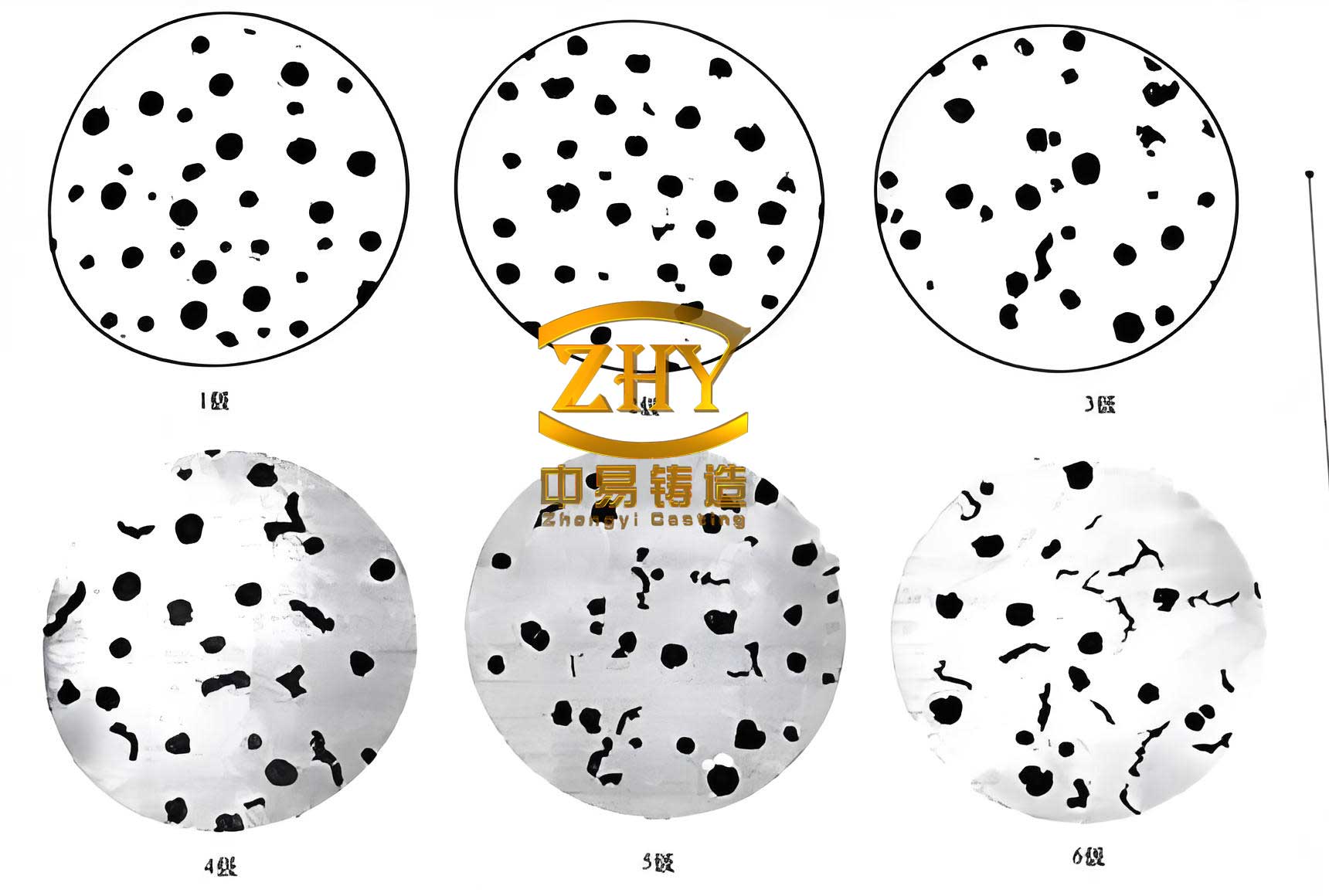
The performance of **spheroidal graphite cast iron** at elevated temperatures is governed by the synergistic and sometimes antagonistic effects of alloying elements. A deep understanding of these effects is crucial for rational alloy design.
Silicon (Si): Silicon is a potent ferrite stabilizer and solid solution strengthener. It raises the eutectoid temperature, promoting a fully ferritic matrix even at moderately elevated silicon levels, which is desirable for thermal stability. Its influence on room temperature tensile properties is pronounced, as shown in empirical relationships derived from extensive testing. The ultimate tensile strength ($R_m$) and yield strength ($R_{p0.2}$) can be correlated to silicon content ($C_{Si}$ in wt.%) through approximations like:
$$ R_m(20^\circ C) \approx 250 + 50 \times C_{Si} \quad \text{(MPa)} $$
$$ R_{p0.2}(20^\circ C) \approx 200 + 35 \times C_{Si} \quad \text{(MPa)} $$
Conversely, elongation ($A$) generally decreases:
$$ A(20^\circ C) \approx 25 – 5 \times C_{Si} \quad \text{(%)} $$
Furthermore, silicon promotes the formation of a protective, adherent silicon oxide (SiO2) layer on the surface at high temperatures, significantly improving oxidation resistance. The parabolic rate constant for oxidation ($k_p$) can be empirically observed to decrease with increasing silicon content.
Molybdenum (Mo): Molybdenum is a key element for high-temperature strengthening. It is a strong carbide former (forming stable M6C type carbides) and provides solid solution strengthening. Its primary benefit is in dramatically improving creep resistance and reducing the rate of over-aging of the ferritic matrix. However, molybdenum also promotes pearlite formation and can reduce toughness if added in excess. Data suggests an optimum plateau for room temperature properties around 0.5 wt.%. The effect on yield strength can be modeled for low alloy contents as:
$$ \Delta R_{p0.2}(20^\circ C) \approx 80 \times C_{Mo} \quad \text{(MPa per wt.%)} $$
where $C_{Mo}$ is the molybdenum content. Its effectiveness in raising the stress rupture strength is its most critical attribute.
Cobalt (Co): Cobalt is a unique alloying element that dissolves completely in the ferrite, providing solid solution strengthening without forming carbides or interfering with graphite morphology. This is particularly advantageous as it avoids the embrittlement associated with excessive carbide formation. Studies show that above approximately 3 wt.%, cobalt’s strengthening effect saturates, but it continues to contribute to microstructural stability at very high temperatures. Its effect on room temperature strength is moderate but positive for ductility, following a trend like:
$$ A(20^\circ C) \approx 15 + 3 \times C_{Co} \quad \text{(%) for } C_{Co} \leq 3\text{wt.%} $$
Niobium (Nb): Niobium is a potent microalloying element. It forms very fine, stable MC-type carbonitride precipitates (e.g., Nb(C,N)) that provide dispersion strengthening. These precipitates pin grain boundaries and dislocations, significantly retarding deformation and recovery processes during creep. The volume fraction of precipitates ($V_f$) is related to niobium content and can be estimated for stoichiometric NbC formation as:
$$ V_f \approx \frac{(C_{Nb} / A_{Nb}) \cdot \rho_{Fe}}{(1 / A_{NbC}) \cdot \rho_{NbC}} $$
where $C_{Nb}$ is weight fraction, $A$ is atomic/molecular weight, and $\rho$ is density. This precipitation strengthening mechanism is highly effective at temperatures up to about 600°C.
The interplay of these elements allows for the design of specific classes of **ferritic spheroidal graphite cast iron**. Based on target operating temperature, we can define four distinct categories, as summarized in the table below.
| Classification | Typical Designation | Key Alloying Features | Target Max Service Temp. | Primary Strengthening Mechanism(s) |
|---|---|---|---|---|
| Conventional Ferritic SGI | QT400-15A / Grade 400-18 | Low Si (<2.8%), No deliberate Mo/Nb/Co | 350°C | Ferritic matrix, Solid solution (Si) |
| Enhanced Ferritic SGI | QT400Si / QT400Mo | High Si (~4%) OR Low Mo (~0.3%) | 400°C | Solid solution (High Si), Carbide (Mo) |
| Advanced Ferritic SGI | QT400SiMo | High Si (~3.5-4%) + Mo (~0.5%) | 450°C | Solid solution + Carbide stability |
| Super Ferritic SGI | QT400SiMoCoNb | Si + Mo + Co (~2%) + Nb (~0.1%) | >500°C | Solid solution + Carbide + Precipitation |
1. Conventional Ferritic Spheroidal Graphite Cast Iron
This class, exemplified by standards like ASTM A395 (Grade 60-40-18) or EN-GJS-400-15, represents the workhorse material for temperatures at or below 350°C. Its chemistry is relatively simple, and the mechanical properties are well-established and guaranteed by international standards. The table below provides a comparative overview of key standard requirements, demonstrating the global consensus on this material’s baseline capabilities. Components such as low-pressure inner cylinders, low-pressure diaphragm carriers, and bearing housings have been successfully manufactured from this grade for decades by foundries worldwide. The focus here is on consistent production, achieving high nodularity and a fully ferritic matrix to ensure the required toughness and machinability.
| Standard | Grade | Tensile Strength, min (MPa) | Yield Strength, min (MPa) | Elongation, min (%) |
|---|---|---|---|---|
| ISO 1083 | 400-12 | 400 | 250 | 12 |
| ASTM A395 | 60-40-18 | 414 | 276 | 18 |
| EN 1563 | EN-GJS-400-15 | 400 | 250 | 15 |
2. Enhanced Ferritic Spheroidal Graphite Cast Iron
To push the service temperature to the 400°C regime, two primary alloying strategies are employed, leading to sub-classes like QT400Si or QT400Mo. The high-silicon approach leverages silicon’s solid solution strengthening and oxidation resistance. When silicon content is raised to approximately 4 wt.%, the room temperature tensile strength can exceed 450 MPa, with a yield strength above 300 MPa. More importantly, the strength retention at 400°C is significantly improved. The oxidation resistance follows a logarithmic improvement law, where the weight gain per unit area ($\Delta W/A$) after time $t$ is reduced:
$$ (\Delta W/A)^2 = k’_p \cdot t $$
where the parabolic rate constant $k’_p$ is lower for high-Si alloys compared to conventional grades. The alternative approach, adding about 0.3 wt.% molybdenum, provides strengthening through the formation of stable carbides, which help maintain strength at temperature. This class is suitable for components like intermediate-pressure casings in sub-critical units or other parts where the design is not governed by long-term creep but by short-term yield strength and oxidation.
3. Advanced Ferritic Spheroidal Graphite Cast Iron
For applications in the 450°C range, such as casings for high-efficiency, high-temperature turbines, a combination of silicon and molybdenum is essential. The QT400SiMo grade represents this category. The silicon ensures a stable, oxidation-resistant ferritic matrix, while molybdenum (typically around 0.5 wt.%) provides the necessary creep and rupture strength. The high-temperature performance of this **spheroidal graphite cast iron** is characterized by creep and stress-rupture testing. The Larson-Miller parameter (LMP) is often used to correlate time-to-rupture ($t_r$), stress ($\sigma$), and temperature ($T$ in Kelvin):
$$ \text{LMP} = T \cdot (C + \log_{10} t_r) $$
where $C$ is a material constant, typically around 20 for many ferrous alloys. Data for QT400SiMo suggests that its 100,000-hour rupture strength at 450°C is well above 100 MPa. Its 1% creep limit strength in the same timeframe is above 80 MPa. This makes it a technically and economically viable alternative to lower-grade cast steels for certain high-temperature casings, with successful application records in modern power plants.
4. Super Ferritic Spheroidal Graphite Cast Iron
This represents the frontier of **spheroidal graphite cast iron** development, aiming for service temperatures exceeding 500°C, directly competing with grades like G15Cr2Mo1 cast steel. The alloy design incorporates a multi-pronged strengthening strategy: high silicon and molybdenum for matrix stability and carbide formation, cobalt for enhanced solid solution strengthening without embrittlement, and niobium for precipitation hardening. The creep resistance of this super alloy is dramatically improved. The stress rupture data can be modeled by a power-law creep relationship, where the minimum creep rate ($\dot{\epsilon}_s$) is related to stress and temperature:
$$ \dot{\epsilon}_s = A \cdot \sigma^n \cdot \exp\left(-\frac{Q_c}{RT}\right) $$
Here, $A$ is a constant, $n$ is the stress exponent (higher for stronger alloys), $Q_c$ is the apparent activation energy for creep, $R$ is the gas constant, and $T$ is absolute temperature. For the QT400SiMoCoNb grade, the value of $n$ is significantly increased compared to conventional SGI, indicating a greater resistance to applied stress. Research indicates a 100,000-hour rupture strength at 500°C exceeding 100 MPa. This performance level opens the possibility for using this advanced **spheroidal graphite cast iron** in the hottest sections of advanced ultra-supercritical (A-USC) steam turbine casings, offering potential cost savings and shorter lead times compared to forged or cast steel alternatives.
The following table provides a synthesized comparison of the expected mechanical properties at room temperature and key high-temperature performance indicators for the four classes of **spheroidal graphite cast iron**.
| Material Class | Rm (20°C) MPa | Rp0.2 (20°C) MPa | A (20°C) % | Rp0.2 (400°C) MPa | σr(105h, T) MPa |
|---|---|---|---|---|---|
| Conventional (QT400) | 400-450 | 250-300 | 15-20 | ~180-200 | Not Applicable |
| Enhanced (QT400Si) | 450-500 | 300-350 | 10-15 | ~220-250 | N/A (Non-creep design) |
| Advanced (QT400SiMo) | 420-480 | 300-340 | 10-15 | ~240-270 | >100 @ 450°C |
| Super (QT400SiMoCoNb) | 450-500 | 320-380 | 8-12 | ~260-300 | >100 @ 500°C |
Note: σr(105h, T) denotes the stress rupture strength for 100,000 hours at temperature T.
In conclusion, the systematic development of **ferritic spheroidal graphite cast iron** presents a clear pathway for cost-effective material solutions in steam turbines across a widening temperature spectrum. The conventional grade remains the optimal choice for components below 350°C. The enhanced grades, through targeted silicon or molybdenum additions, reliably extend the application window to 400°C. The advanced SiMo grade has already transitioned from research to successful industrial application for 450°C service, demonstrating excellent performance. The frontier lies with the super alloyed grades incorporating cobalt and niobium, which show remarkable potential for temperatures above 500°C. To fully realize this potential, continued collaborative research between turbine manufacturers, foundries, and material institutes is essential. Focus must be placed on long-term property validation, the development of robust welding and repair procedures for these highly alloyed cast irons, and the production of thick-section castings to prove manufacturability. By advancing these high-performance grades of **spheroidal graphite cast iron**, the power generation industry can achieve significant reductions in capital expenditure and component lead time for future high-efficiency, high-temperature steam turbines.