
As a researcher engaged in advancing wear-resistant materials, I have extensively explored the potential of high-chromium white cast iron. This alloy is recognized as an excellent metallic wear-resistant material, and in recent years, its adoption has grown across various industries. However, the inherent poor plasticity of high-chromium white cast iron has long posed significant challenges for deformation processes, hindering the development of economically viable production methods. To address this, my work has focused on developing a high-temperature thermo-mechanical treatment (HTMT) process, specifically for products like grinding balls, aiming to enhance toughness and strength while optimizing production simplicity and energy efficiency.
The core innovation lies in combining casting with subsequent high-temperature deformation. We replace the conventional concept of a single “deformation amount” with a “total deformation accumulation” achieved through repeated forging actions. This approach, which we term “cast-forming followed by high-temperature thermo-mechanical treatment,” has proven to be a groundbreaking method. It allows for the production of high-quality white cast iron components with superior and stable properties, adaptable to various levels of automation and requiring relatively modest investment.
Chemical Composition Design for Thermo-Mechanically Treated White Cast Iron
The HTMT process itself enables more effective utilization of alloying elements. Therefore, the chemical composition can be optimized to conserve costly metals without compromising quality. The design philosophy centers on achieving a hard, wear-resistant matrix with sufficient toughness after deformation. A typical composition range is summarized in Table 1.
| Element | Range | Primary Role & Rationale |
|---|---|---|
| Carbon (C) | 2.5 – 3.5 | Ensures high hardness, which is the primary determinant of abrasion resistance in a tough matrix. Content may decrease slightly with increasing section size. |
| Chromium (Cr) | 12 – 18 | Forms M7C3 carbides, providing wear resistance. Lower levels than some traditional compositions are sufficient here, reducing cost while maintaining hardness. Peak hardness is often observed around 15% Cr. |
| Molybdenum (Mo) | 0.5 – 1.5 | Suppresses temper embrittlement and significantly improves forgeability of the white cast iron at high temperatures. |
| Nickel (Ni) | 0 – 1.0 | Enhances toughness and hardenability. Can be omitted to control cost, as the HTMT process itself ensures adequate properties. |
| Copper (Cu) | < 0.8 | Improves hardenability, especially for larger sections. Must be kept below 0.8% to avoid intergranular precipitation causing “red shortness” during forging. |
| Silicon (Si) | 0.8 – 1.8 | Increases wear and fatigue resistance, reducing spalling. Contrary to some beliefs, in high-carbon, multi-alloy white cast iron with Mo, Si can effectively improve hardenability within this range. |
| Rare Earth (RE) | 0.1 – 0.3 (residual) | Added via ferro-silicon rare earth alloy during tapping to modify inclusions and improve castability. |
The balance is iron. The critical relationship for carbide type can be expressed by the chromium-to-carbon ratio, which we maintain to favor the formation of hard M7C3 carbides:
$$ \frac{\text{Cr}}{\text{C}} \approx 5 – 7 $$
This ratio, combined with the HTMT process, ensures a desirable microstructure. The hardenability depth (DI) can be approximated for this multi-alloy white cast iron using a modified Grossmann approach, though the deformation effect adds complexity:
$$ D_I \propto \sum (k_i \cdot X_i) $$
where $k_i$ are potency factors and $X_i$ are the concentrations of alloying elements like Cr, Mo, and Si.
Foundry Practices: Melting, Casting, and Cleaning
The initial step involves producing high-quality cast blanks. The melting and casting procedures for this white cast iron are standard, with no extraordinary requirements. However, the goal is to obtain sound castings with minimal defects like shrinkage porosity or hot tears, as these can affect subsequent forging. The metal is melted in a suitable furnace and poured into molds to form the near-net-shape blanks, such as grinding ball preforms.
A crucial aspect is cleaning. The castings should be shaken out at an appropriate temperature, and all adhering sand must be thoroughly removed. Excessive sand remains can become compacted onto the surface during forging, leading to surface irregularities and potentially hindering quenching effectiveness. The gating system should be designed to leave a residual sprue of minimal length (e.g., <15 mm), simplifying its removal compared to traditional grinding-intensive methods.
To enhance energy efficiency, the cleaned cast blanks can be directly charged into the heating furnace while still warm, utilizing the residual heat to reduce the heating time required for the subsequent thermo-mechanical treatment of the white cast iron.
The High-Temperature Thermo-Mechanical Treatment (HTMT) Process
This is the core of the methodology, transforming the brittle cast structure into a refined, high-performance material. The process flow can be summarized as: Heating → Forging/Deformation → Controlled Cooling (Quenching) → Tempering.
Heating and Austenitization
The cast blanks are heated slowly to the austenitization temperature. In a cold furnace, a heating rate of 15–20 °C per minute is recommended to avoid thermal shock. The target austenitizing temperature ($T_A$) and time ($t_A$) are critical parameters:
$$ T_A = 1050 – 1150 \, ^\circ\text{C} $$
$$ t_A = 30 – 60 \, \text{minutes (after reaching } T_A \text{)} $$
This high austenitizing temperature promotes chemical homogenization and improves hardenability without causing excessive austenite grain growth in this alloy system. The microstructure at this stage consists of austenite and primary carbides.
Die Design for Forging White Cast Iron
Forging high-chromium white cast iron requires careful die design to minimize tensile stresses that can cause cracking. The principle is to use a die that facilitates repeated, controlled deformation rather than a single large stroke. The die is not necessarily fully enclosed, and its dimensions are slightly different from the final product to manage the “per-stroke deformation” and accumulate the “total deformation.” A schematic concept is shown in the description below.
The upper and lower dies are shaped to apply compressive forces that work the material progressively. For a grinding ball, the die cavity might be slightly oval or have features that redistribute metal, ensuring that deformation is imposed on all sections of the preform, including the sprue area, which is forged flat first to prevent die locking.
The Deformation Forging Process
Once uniformly heated, the blank is transferred to the forging equipment (e.g., an air hammer or press). The forging sequence involves:
1. Light Preliminary Blows: To allow the white cast iron blank to acclimate to the forging state.
2. Heavy Deformation Blows: This is the key phase where the “total deformation accumulation” is achieved. The per-stroke deformation ($\epsilon_{\text{single}}$) is controlled by the hammer force and die geometry. We aim for:
$$ \epsilon_{\text{single}} \approx 5 – 15\% $$
The cumulative total deformation ($\epsilon_{\text{total}}$) is targeted to be:
$$ \epsilon_{\text{total}} = \sum \epsilon_{\text{single}} \approx 40 – 80\% $$
This total strain is more critical than a single reduction. It effectively breaks down the as-cast dendritic structure, closes micro-porosity, and modifies carbide morphology.
3. Light Finishing Blows: To achieve the final dimensional accuracy and surface finish.
The optimal forging temperature range ($T_F$) is:
$$ T_F = 950 – 1050 \, ^\circ\text{C} $$
The process must be completed above a critical finish-forging/quenching temperature ($T_Q$):
$$ T_Q \geq 900 \, ^\circ\text{C} $$
In practice, the finish-forging temperature is often higher, which is beneficial as it corresponds to the quenching temperature and promotes higher hardenability and subsequent secondary hardening.
The improvement in crack propagation resistance is remarkable. Destructive tests show that forged white cast iron balls withstand significantly more impact blows than as-cast ones. Analysis of fractured specimens reveals that cracks change direction abruptly when encountering the deformed layer, indicating enhanced toughness and a barrier to crack growth. The relationship between fracture toughness ($K_{IC}$) and total deformation can be conceptually modeled as:
$$ K_{IC} (\epsilon_{\text{total}}) \approx K_{IC}(0) + \alpha \cdot \epsilon_{\text{total}}^{\beta} $$
where $\alpha$ and $\beta$ are positive constants specific to the white cast iron composition.
Controlled Cooling (Quenching) and Self-Tempering
Immediately after the final forging blow, the component is transferred to an “air-cooling conveyor” for quenching. This utilizes the retained heat from forging. The conveyor design is simple, often a sloped trough made of angle iron, allowing parts to cool uniformly in air. The cooling rate ($\dot{T}_{\text{cool}}$) on the conveyor is designed to achieve a martensitic transformation for this white cast iron:
$$ \dot{T}_{\text{cool}} \approx 30 – 100 \, ^\circ\text{C/min} \quad \text{in the range of } 900 \text{ to } 300\, ^\circ\text{C} $$
When the part temperature reaches approximately 250–300 °C, it is dropped into an insulated pit for “self-tempering.” This stage allows the core heat to temper the newly formed martensite, relieving stresses. The temperature evolution during self-tempering ($T_{\text{ST}}(t)$) can be approximated by a cooling law:
$$ T_{\text{ST}}(t) = T_{\text{entry}} \cdot e^{-k t} $$
where $T_{\text{entry}}$ is the entry temperature (~250-300°C), $k$ is a constant dependent on insulation, and $t$ is time. The part remains until its temperature falls below 150 °C.
Secondary Tempering
For large sections or components in severe service, a secondary tempering is essential to fully relieve transformation stresses, reduce retained austenite, and induce secondary hardening. The secondary tempering temperature ($T_{T2}$) and time ($t_{T2}$) are:
$$ T_{T2} = 450 – 520 \, ^\circ\text{C} $$
$$ t_{T2} = 90 – 180 \, \text{minutes} $$
Heating to this temperature can be rapid (e.g., 50 °C/min) due to the already enhanced toughness of the white cast iron. This treatment further increases hardness via precipitation hardening from the martensitic matrix.
Microstructural Evolution and Property Enhancement
The HTMT process fundamentally alters the microstructure of high-chromium white cast iron. The changes are summarized in Table 2 and supported by metallurgical principles.
| Aspect | As-Cast State | After HTMT | Mechanism & Consequence |
|---|---|---|---|
| Matrix Grain Structure | Coarse columnar/dendritic | Refined, equiaxed grains | Dynamic recrystallization and grain refinement during hot deformation increase toughness. |
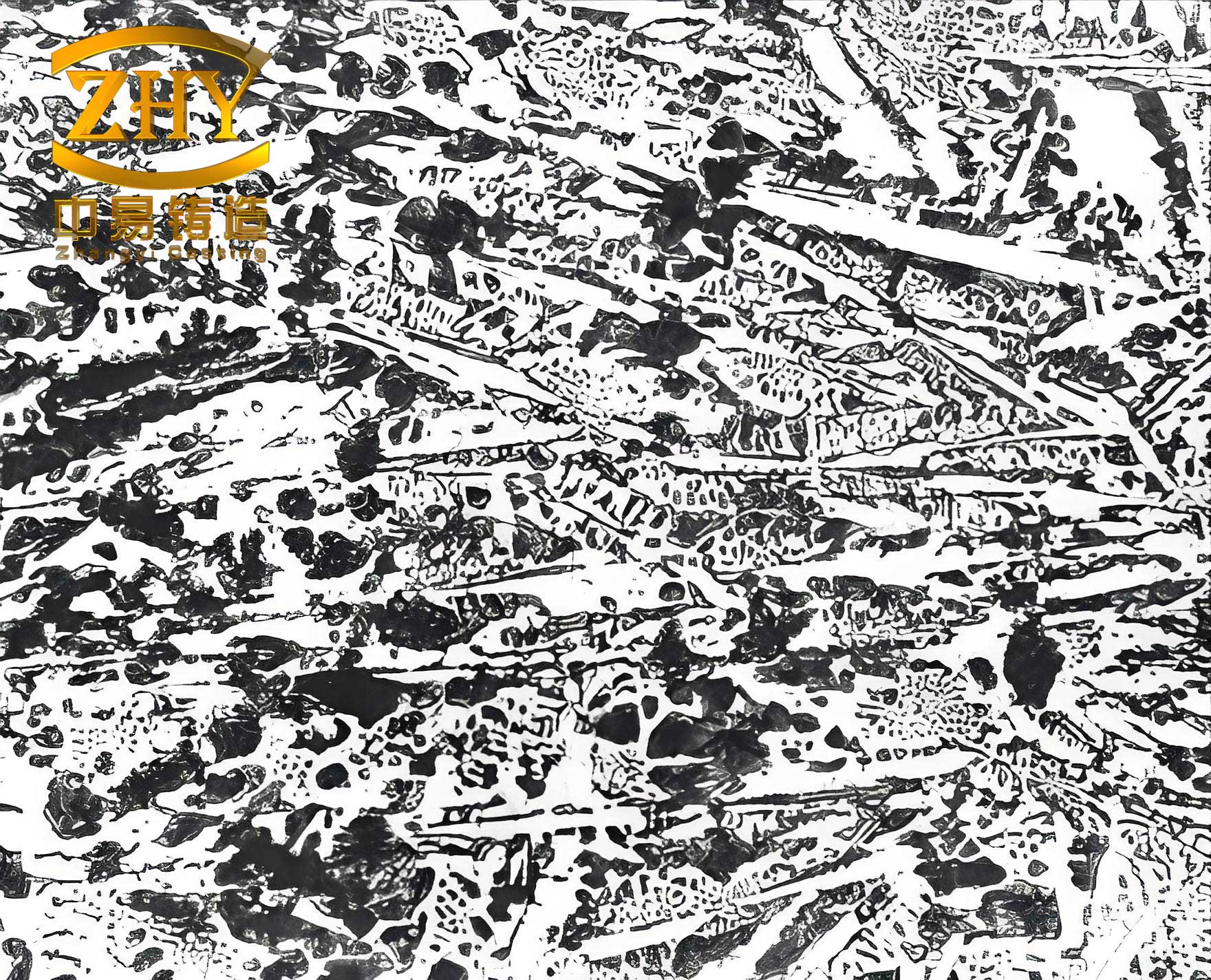
| Carbide Morphology | Large, interconnected eutectic carbides, often continuous | Fragmented, more isolated, and rounded carbides | Mechanical breaking and spheroidization during forging. Improves crack propagation resistance and binding force at matrix/carbide interfaces. |
| Defects | Micro-shrinkage, porosity | Porosity closed or reduced | Plastic flow under compressive stress welds internal voids, increasing density and strength. |
| Residual Austenite | Significant amounts possible | Greatly reduced | Deformation enhances transformation kinetics during cooling; secondary tempering further decomposes austenite. |
| Hardness Profile | May vary from surface to core | Uniform high hardness (HRC 60-65+) | Improved hardenability from deformation and alloy element utilization; self-tempering and secondary tempering optimize hardness. |
| Impact Toughness | Low (e.g., 3-5 J for unnotched Charpy) | High (≥ 8 J, up to ~12 J for unnotched Charpy) | Combined effect of grain refinement, carbide modification, and defect healing. |
The relationship between hardness (H) and wear resistance (W) in this toughened white cast iron can be described by a modified Archard-type equation, where toughness (K) also plays a role:
$$ W \propto \frac{H^n}{K^m} $$
where for abrasive wear, $n$ is often >1, and $m$ is a small positive exponent, indicating that high hardness dominates but adequate toughness is necessary to prevent brittle fracture. The HTMT process maximizes both H and K for white cast iron.
The strengthening mechanisms include work hardening, grain boundary strengthening (Hall-Petch), and dispersion strengthening from carbides. The yield strength ($\sigma_y$) can be expressed as a sum:
$$ \sigma_y = \sigma_0 + \sigma_{\text{HP}} + \sigma_{\text{WH}} + \sigma_{\text{DS}} $$
where:
– $\sigma_0$ is the lattice friction stress.
– $\sigma_{\text{HP}} = k_y \cdot d^{-1/2}$ is the Hall-Petch contribution from refined grain size $d$.
– $\sigma_{\text{WH}}$ is the contribution from work hardening (dislocation density $\rho$): $\sigma_{\text{WH}} = \alpha G b \sqrt{\rho}$.
– $\sigma_{\text{DS}}$ is dispersion strengthening from carbides.
The process parameters significantly influence the final properties. We can model the optimal combination using response surface methodology. Key variables are Austenitizing Temperature ($T_A$), Total Deformation ($\epsilon_{\text{total}}$), and Tempering Temperature ($T_{T2}$). The goal function for a grinding ball might be a weighted combination of Hardness (H) and Toughness (T):
$$ \text{Performance Index } (PI) = w_1 \cdot H(T_A, \epsilon_{\text{total}}, T_{T2}) + w_2 \cdot T(T_A, \epsilon_{\text{total}}, T_{T2}) $$
where $w_1$ and $w_2$ are weights based on application needs. Experimental data for the white cast iron composition in Table 1 typically shows a broad optimum where PI is maximized.
Energy and Economic Considerations
The HTMT process for white cast iron is notably energy-efficient compared to conventional heat treatments that involve separate high-temperature austenitizing, quenching, and tempering cycles. The key savings arise from using the casting heat and the deformation heat. The total specific energy consumption ($E_{\text{total}}$) can be approximated as:
$$ E_{\text{total}} = E_{\text{melting}} + E_{\text{heating to } T_A} + E_{\text{forging}} + E_{\text{tempering}} $$
Since the casting is forged directly after austenitization, and quenching is via air cooling, $E_{\text{total}}$ is lower than processes involving re-heating or liquid quenching. The furnace used can be a simple coal-fired reverberatory furnace, which is low-cost to build and operate. For a production rate of 2000-3000 tons per year of forged white cast iron balls, the furnace investment is minimal.
The material yield is high because the process is near-net-shape, and the deformation helps heal minor casting defects, reducing scrap rates. The ability to use slightly lower alloy content (e.g., less Cr, Ni) without sacrificing performance further reduces raw material cost, making high-performance white cast iron more accessible.
Conclusions and Prospects
In conclusion, the high-temperature thermo-mechanical treatment developed for high-chromium white cast iron represents a significant advancement. The process successfully overcomes the historical challenge of poor plasticity in white cast iron by employing a cast-forming and controlled forging strategy. The repeated deformation accumulates sufficient total strain to refine the microstructure, modify harmful carbide networks, and heal casting defects, resulting in a dramatic improvement in toughness while maintaining or even enhancing hardness and strength.
The technical advantages are clear: the process is simple, adaptable to different production scales, energy-efficient, and yields products with high and consistent quality. The method unlocks the full potential of alloying elements in white cast iron, allowing for cost-effective compositions. This approach has the potential to broaden the application of high-chromium white cast iron in demanding wear environments and facilitate its entry into international markets as a premium, reliably manufactured product. The underlying principles of using thermal and mechanical energy synergistically can be extended to other cast iron systems, paving the way for further innovations in metal processing.