
The systematic study of wear-resistant materials spans over a century, evolving through various stages of research, development, and refinement of production processes for materials such as Hadfield manganese steel, alloy steels, Ni-hard cast iron, and low/high chromium white cast irons. In recent decades, significant achievements and economic benefits have been realized in the systematic research and application of these materials. Among wear-resistant components, grinding balls for ball mills and semi-autogenous grinding (SAG) mills constitute a substantial portion. The evolution in their production technology, equipment, and quality control has substantially reduced the consumption and cost of these consumable parts for end-users.
Today, the grinding ball market serves critical industries like mineral processing (non-ferrous and ferrous), cement, and thermal power generation. The dominant materials have historically been cast iron balls, primarily low-chromium and high-chromium white cast irons. However, the trend towards larger mill diameters and more demanding operational conditions has exposed the limitations of traditional materials, driving the need for more advanced, cost-effective, and reliable solutions. This is where nodular cast iron, or ductile iron, has emerged as a formidable contender, offering a unique combination of properties derived from its distinct microstructure.
- Comprehensive Analysis of Grinding Ball Materials
The selection of grinding ball material is a critical decision impacting milling efficiency, operational cost (grinding media consumption), and maintenance frequency (related to breakage). The following table provides a detailed comparison of the predominant grinding ball materials used industrially.
| Material Type | Key Alloying Elements (wt.%) | Typical Heat Treatment | Surface Hardness (HRC) | Impact Toughness (J/cm²) | Cost & Resource Consideration | Primary Limitations |
|---|---|---|---|---|---|---|
| Low-Chromium White Cast Iron | Cr: 1-3%, C: 2.8-3.6 | As-cast or low-temp stress relief | ≥ 45 | ≥ 2 | Low cost, but consumes scarce Cr. | Low hardness, poor toughness, high wear loss, prone to deformation & breakage. |
| High-Chromium White Cast Iron | Cr: 10-13%, C: 2.4-3.2 | Oil/quench + Temper | ≥ 56 | ≥ 3 | High cost due to high Cr content; Cr is a strategic, largely imported resource. | Moderate toughness still insufficient for large SAG mills; high alloy cost. |
| Austempered Ductile Iron (ADI/CADI) | C, Si, Mn, + Mo, Cu, Ni (for hardenability) | Salt bath austempering | ≥ 56 | ≥ 10 | Very high cost due to expensive alloys (Mo, Cu) and complex heat treatment. | High production cost, environmental concerns with salt baths, equipment intensity. |
| Si-Mn Alloyed Nodular Cast Iron | C: 3.1-3.8, Si: 2.0-3.2, Mn: 1.4-2.5 | Water-based/polymer quench + Temper | ≥ 50 | ≥ 10 | Low cost (uses cheap Si, Mn), environmentally friendly process. | Requires precise control of chemistry, nodularity, and heat treatment. |
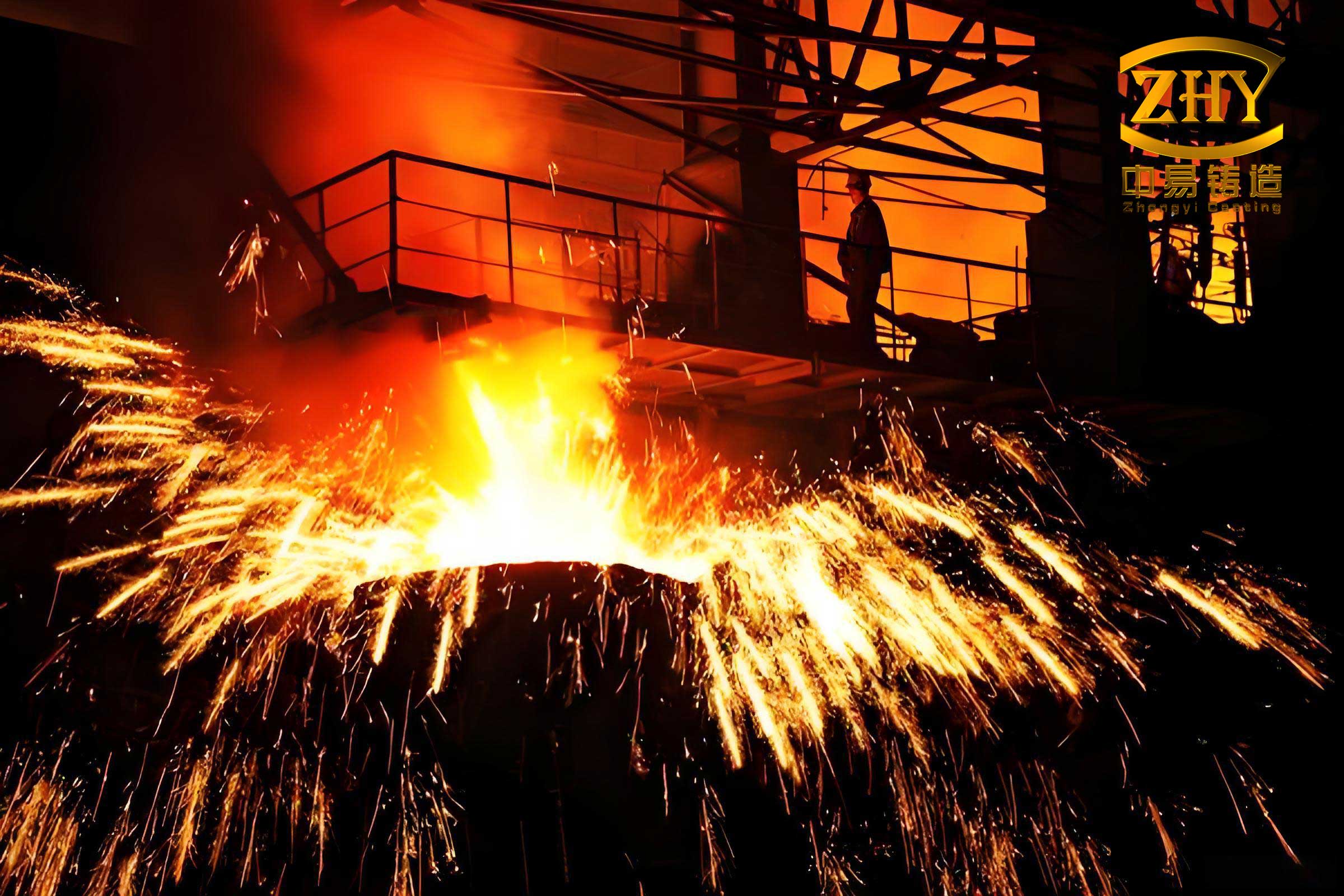
As evident, nodular cast iron variants, particularly the Si-Mn alloyed type, position themselves favorably by offering a superior toughness-to-hardness ratio at a competitive cost, while avoiding dependence on critical alloying elements. The spherical graphite nodules in nodular cast iron are key to its performance, acting as crack arresters and stress concentrator relievers. The following figure illustrates the typical microstructure of a high-quality nodular cast iron casting, highlighting the well-formed, discrete graphite spheroids within the metallic matrix.
- Material Design of Si-Mn Alloyed Nodular Cast Iron for Grinding Balls
The development of Si-Mn alloyed nodular cast iron focuses on replacing expensive hardenability enhancers like Molybdenum (Mo) and Copper (Cu) with more economical elements while maintaining or improving performance. The chemical composition is meticulously balanced, as shown in the target range below:
$$C: 3.1-3.8\\%,\\quad Si: 2.0-3.2\\%,\\quad Mn: 1.4-2.5\\%,\\quad P \\leq 0.04\\%,\\quad S \\leq 0.03\\%,\\quad \\text{Mg}_{res} \\geq 0.04\\%$$
The roles of the key alloying elements are:
- Manganese (Mn): A relatively cheap austenite stabilizer. It shifts the Continuous Cooling Transformation (CCT) curve to the right, increasing hardenability and promoting the formation of bainite or martensite upon quenching. However, Mn is a carbide promoter and can segregate, potentially harming toughness if not balanced.
- Silicon (Si): A strong graphitizer and ferrite stabilizer. Its primary function in this alloy is to counterbalance the carbide-forming tendency of Mn. A high Si content suppresses the formation of deleterious carbides, improves the stability of the austenite during heat treatment, and enhances the matrix strength. The Si/Mn ratio is a critical parameter for optimizing the final microstructure and properties of the nodular cast iron grinding ball.
The hardenability, a crucial factor for through-hardening large-diameter balls, can be empirically related to composition. A simplified approach considers the ideal critical diameter ($$D_I$$), which can be estimated using multiplicative factors. For nodular cast iron, the base hardenability is significantly influenced by the combined effect of Si and Mn. A modified Grossmann approach, while more complex for cast irons, underscores that the hardenability contribution of Mn is potentiated by the presence of Si in the matrix. The effective hardenability, ensuring a martensitic or bainitic structure from surface to center, is achieved when the actual cooling rate at the ball’s core exceeds the critical cooling rate for pearlite formation. This is governed by the heat transfer equation and the material’s CCT diagram.
The key to success lies not just in chemistry but in achieving excellent nodularity (spheroidal graphite shape, Type I). High nodularity grade (I-II) ensures the graphite particles effectively blunt propagating cracks, contributing to the high impact toughness that distinguishes nodular cast iron from its white iron counterparts. The number and size of nodules (nodule count) are also critical, optimized through effective inoculation and spheroidization practices.
- Heat Treatment Technology for Si-Mn Nodular Cast Iron Grinding Balls
Heat treatment is the transformative step that tailors the matrix microstructure of the nodular cast iron grinding ball, dictating its final hardness and toughness. The process typically involves three stages: Austenitizing, Quenching, and Tempering.
4.1 Austenitizing:
The as-cast balls are heated to a temperature within the austenite phase field ($$\\gamma$$-region), typically between 870°C and 930°C. The heating curve must include a slow ramp through the lower temperatures to avoid thermal stress, followed by a sufficient holding time (1.5-3 hours) at the austenitizing temperature to ensure complete dissolution of carbides and homogeneous carbon distribution in the austenite. The holding time $$t_h$$ can be approximated as a function of ball radius R: $$t_h \\propto k \\cdot R^n$$, where k and n are constants dependent on furnace and material characteristics.
4.2 Quenching and the Role of Water-Based Polymer Media:
After austenitizing, the balls are rapidly transferred to the quenching medium. The choice of quenchant is paramount. The ideal quenchant should exhibit high cooling speed in the high-temperature range (above ~600°C) to avoid the nose of the CCT curve and prevent pearlite formation, but a slow cooling speed in the low-temperature martensitic transformation range (below ~300°C) to minimize thermal stress and distortion.
- Water: Too severe, causing high risk of cracking during martensite formation.
- Oil: Too slow in the high-temperature range, risking pearlite formation in large sections.
- Water-Based Polymer Solution: This modern quenchant offers an adjustable cooling curve. The polymer forms a reversible film on the hot surface, which governs the cooling rate. By controlling the concentration and temperature of the solution, the cooling profile can be tuned. Typical cooling data for an optimized polymer quenchant is shown below:
| Cooling Characteristic | Value |
|---|---|
| Maximum Cooling Rate | 146 °C/s |
| Temperature at Max Rate | 689 °C |
| Cooling Rate at 300°C | 31.88 °C/s |
| Time to cool from 800°C to 600°C | 2.37 s |
| Time to cool from 800°C to 400°C | 5.2 s |
| Time to cool from 800°C to 200°C | 13.01 s |
This profile ensures rapid bypass of the pearlite region and a more controlled martensite transformation, making it ideally suited for nodular cast iron.
4.3 Tempering:
The quenched balls, containing a hard but brittle martensitic matrix with retained austenite, must be tempered immediately. Tempering is conducted typically between 200°C and 260°C for 2-4 hours. This process relieves internal stresses, increases toughness, and promotes the transformation of some retained austenite to more stable phases. The final microstructure is a tempered martensitic/bainitic matrix with uniformly dispersed graphite nodules and a small amount of stable retained austenite.
- Performance Characteristics and Industrial Validation
The effectiveness of the Si-Mn alloyed nodular cast iron grinding ball is confirmed by its microstructure and mechanical properties. The target microstructure consists of a matrix of tempered martensite and bainite with a controlled amount of finely distributed carbides and retained austenite, all embedded with well-formed graphite spheroids. This structure provides a unique synergy: the hard matrix resists abrasive wear, while the graphite nodules and tough matrix provide exceptional resistance to impact and fatigue.
Performance data for a Φ100 mm ball is summarized below. Hardness was measured at five points: surface, four quarter-radius points, and center.
| Measurement Position | Hardness (HRC) |
|---|---|
| Surface (avg of 4 pts) | 52.84 |
| Quarter-Radius (avg) | 51.1 |
| Center | 51.3 |
| Overall Average Hardness | 51.1 – 52.84 |
| Average Impact Toughness | 15.08 – 17.63 J/cm² |
| Drop-Weight Test (Φ100 mm) | > 20,000 drops without fracture |
The minimal hardness gradient from surface to center (difference < 2 HRC) demonstrates excellent through-hardenability due to the effective Si-Mn alloying. The high and consistent impact toughness far exceeds that of high-chromium cast iron. Furthermore, during service, the surface undergoes work-hardening as the retained austenite transforms to martensite under impact, potentially raising the in-service surface hardness to ~58 HRC, enhancing wear resistance dynamically.
Industrial trials in large-diameter mills (e.g., 8.8m and 10.37m SAG mills) in major mining operations have demonstrated successful application. Key reported outcomes include stable processing throughput, normal operational power draw, acceptable breakage rates (~1%), and maintained product fineness. These results validate that nodular cast iron grinding balls can meet the rigorous demands of large-scale modern grinding circuits.
- Dedicated Heat Treatment Equipment for Production
To achieve the consistency required for high-performance nodular cast iron grinding balls, specialized automated heat treatment lines have been developed. These systems integrate several key units:
- Preheating & Basket Return System: Prepares and feeds balls into the line.
- Atmosphere-Controlled Heating Furnace: Often segmented into preheat and high-heat zones, with protective atmosphere to minimize oxidation and decarburization.
- Water-Based Polymer Quench Center: A controlled tank with agitation, temperature control, and concentration management for the polymer quenchant.
- Variable-Speed Mesh-Belt Tempering Furnace: Provides precise temperature control and uniform heating for the tempering process, eliminating the need for baskets and improving energy efficiency.
- Automated Control & Monitoring System: Integrates sensors for temperature (ball and medium), conveyor speed, and quenchant concentration, enabling closed-loop process control.
This integrated line ensures precise adherence to the thermal cycle, from controlled austenitizing to the critical quench and temper stages, enabling the reliable mass production of high-quality Si-Mn alloyed nodular cast iron grinding balls.
- Conclusion and Perspective
The evolution of grinding ball technology highlights the growing prominence of nodular cast iron as a superior engineering material for demanding comminution applications. Specifically, the Si-Mn alloyed variant of nodular cast iron addresses the critical market needs for high performance, cost-effectiveness, and environmental sustainability.
The key advantages are solidified in the following conclusions:
1. Superior Property Balance: Nodular cast iron grinding balls achieve a surface hardness comparable to high-chromium iron (HRC 50-55+) but with a dramatically higher impact toughness (≥10 J/cm²), leading to lower breakage rates and reduced operational risk in large mills.
2. Economic and Strategic Advantage: By utilizing inexpensive and abundant Si and Mn to replace costly and strategic elements like Mo, Cu, and high levels of Cr, the material cost of nodular cast iron grinding balls is significantly reduced, enhancing their lifecycle cost-effectiveness.
3. Inherent Microstructural Benefit: The spheroidal graphite morphology inherent to nodular cast iron is fundamental to its performance, providing intrinsic crack-blunting capability and stress relief, which directly translates to high fatigue resistance and toughness.
4. Advanced, Eco-Friendly Processing: The adoption of water-based polymer quenchants, coupled with precise automated heat treatment lines, provides a controllable and environmentally safer alternative to oil quenching or salt bath austempering, enabling the reliable production of high-performance nodular cast iron balls.
5. Proven Industrial Performance: Successful deployments in large-diameter SAG mills, some exceeding 10 meters, have empirically validated the suitability and reliability of nodular cast iron grinding balls for the most challenging grinding applications, marking a significant evolution in grinding media technology.
The trajectory of grinding media development points towards advanced ferrous alloys that maximize performance per unit cost. Nodular cast iron, particularly in its optimally alloyed and heat-treated forms, stands as a prime example of this evolution, offering a compelling combination of durability, safety, and economy for the global mining and cement industries.