
In my years of experience in marine engineering and propeller manufacturing, I have consistently observed that metal casting defects in ship propellers are a critical factor contributing to hull vibrations. These vibrations, often termed as “shaking” or “oscillation,” not only compromise passenger comfort but also lead to premature wear of propulsion components, structural deformation, and reduced operational efficiency. This article delves into the intricate relationship between metal casting defects and hull vibration, offering insights into the root causes, mechanisms, and mitigation strategies. I will present detailed analyses, supplemented with tables and formulas, to underscore the importance of precision in propeller production.
The propulsion system of a vessel is a complex assembly where the propeller plays a pivotal role. When a propeller is cast, machined, and installed correctly, the ship operates smoothly. However, the presence of metal casting defects—such as imbalances in blade weight, variations in blade length and thickness, and pitch errors—can induce severe hull vibrations. These vibrations manifest as dynamic forces that propagate through the shaft, stern tube, and hull structure, causing issues like early wear of stern bushings, hull distortion, and unstable engine operation. Therefore, understanding and addressing these metal casting defects is paramount for ensuring maritime safety and performance.
Metal casting defects in propellers arise from multiple sources during the foundry process. Below, I summarize the primary defects and their origins in a tabular format to provide a clear overview.
| Defect Type | Primary Causes | Impact on Propeller Geometry |
|---|---|---|
| Pitch Angle Inequality | Improper leveling of control基准面 (reference plane), non-vertical core轴 (core axis), displacement of pitch boards during molding (sinking, warping, or shifting). | Leads to uneven blade division angles and pitch angles, causing aerodynamic imbalance. |
| Blade Misalignment and Skew | Incorrect placement of the hub模 (hub mold), looseness in axis sleeves or scrapers controlling the hub and helical surface, distortion of pitch补偿板 (compensation boards). | Results in hub inclination, varying rake angles, and deviation of helical lines from designed surfaces. |
| Radial Reference Line Errors | Unequal angles between blade radial reference lines during drafting,歪斜 (skewing) of sectional arc lines (helical lines). | Alters blade profile, affecting导边 (leading edge),随边 (trailing edge), and maximum thickness regions. |
| Blade Weight Imbalance | Over-modification of the suction side during surface finishing, causing excessive material on some blades. | Creates静态和动态不平衡 (static and dynamic unbalance), leading to centrifugal forces. |
| Mold Shift During Compaction | Failure to secure blade patterns or wax-clay forms during ramming of the cope mold; displacement due to uneven ramming forces. | Causes blade mispositioning, altering螺距 (pitch) and blade orientation. |
| Mismatch in Mold Assembly | Inaccurate定位 (positioning) during mold closing, heavy ramming near trailing edges, and uneven tightening of bolts or wedges. | Leads to箱抬升 (mold lifting) or下沉 (sinking), introducing dimensional inaccuracies. |
| Metal Pouring Defects | Rapid flow velocity during pouring, sequential filling of blade cavities, differential thermal收缩 (shrinkage) – linear and volumetric. | Produces扭曲变形 (warping) in a “W” shape, with uneven pitch contraction across blades. |
| Restricted Contraction | Tightening bolts not released after solidification, preventing free收缩 (shrinkage). | Causes localized deformation; early shakeout exacerbates扭曲 (distortion). |
Each of these metal casting defects contributes to geometric inaccuracies that, when the propeller rotates, generate periodic forces. These forces excite the hull’s natural frequencies, leading to resonant vibrations. To quantify this, consider the basic vibration model for a propeller-induced hull response. The vibrational force \( F_v \) due to a metal casting defect can be expressed as:
$$ F_v = m \cdot e \cdot \omega^2 \cdot \sin(\omega t + \phi) $$
where \( m \) is the effective mass of the unbalanced blade segment, \( e \) is the偏心距 (eccentricity) caused by defects like weight imbalance or pitch error, \( \omega \) is the angular velocity of the propeller ( \( \omega = 2\pi n \), with \( n \) as rotational speed in Hz), \( t \) is time, and \( \phi \) is the phase angle. This force acts at the propeller frequency and its harmonics, potentially aligning with hull natural frequencies. The resultant vibration amplitude \( A \) can be estimated using a simplified damped harmonic oscillator model:
$$ A = \frac{F_v}{k \sqrt{(1 – r^2)^2 + (2\zeta r)^2}} $$
Here, \( k \) is the hull stiffness, \( r = \frac{\omega}{\omega_n} \) is the frequency ratio (\( \omega_n \) being the natural frequency of the hull segment), and \( \zeta \) is the damping ratio. Metal casting defects increase \( e \) and thus \( F_v \), amplifying \( A \) when \( r \approx 1 \) (resonance).
Beyond casting, other factors exacerbate vibrations. For instance, machining errors—like misaligned hub bore machining—can compound metal casting defects. If the hub’s small end face is not properly squared during boring, the axis may tilt, causing the propeller to rotate off-center. This adds to dynamic unbalance. Additionally, incidents like grounding or collision can damage blades, while loose keyways or bolts on the propeller shaft introduce further imbalance. Inaccurate measuring tools, such as pitch gauges or balancing instruments, may lead to erroneous corrections, worsening the situation.
To illustrate the cumulative effect of metal casting defects, I present a formula for the total vibrational excitation \( E_t \). Assuming defects are independent, we can sum their contributions:
$$ E_t = \sum_{i=1}^{n} \alpha_i \cdot d_i $$
where \( \alpha_i \) is a coefficient representing the sensitivity of vibration to defect type \( i \), and \( d_i \) is the magnitude of the defect (e.g., pitch error in millimeters, weight imbalance in kilograms). For example, pitch error \( d_p \) might contribute as:
$$ \alpha_p \cdot d_p = k_p \cdot \Delta P \cdot \rho \cdot A_b \cdot \omega^2 $$
with \( k_p \) as a proportionality constant, \( \Delta P \) as pitch deviation, \( \rho \) as fluid density, and \( A_b \) as blade area. This highlights how metal casting defects directly scale vibrational energy.
Eliminating these defects requires a holistic approach from design to inspection. In casting, precision is key. All pitch boards must be calibrated, with vertical gaps not exceeding 0.5 mm for small propellers and 1.0 mm for larger ones. For variable-pitch propellers, pattern errors should be kept below ±0.5%. Before pouring, predictive checks on pitch, blade angle, rake, and thickness are essential; any discrepancies must be corrected immediately. Patterns should be firmly fixed to prevent移位 (shifting). Mold assembly should employ three-point positioning—at the leading edge, blade tip, and trailing edge—with marks or pins for alignment. Ramming and bolt-tightening forces must be uniform.
During metal pouring, a balanced浇注系统 (gating system) is crucial. I recommend using top and bottom gating with a rain-style sprue to ensure simultaneous filling of all blade cavities. Pouring speed must be controlled to avoid turbulent flow; a gradual fill reduces dynamic pressure and differential shrinkage. After solidification, bolts should be loosened to allow free contraction, minimizing warping. These steps directly address metal casting defects at their source.
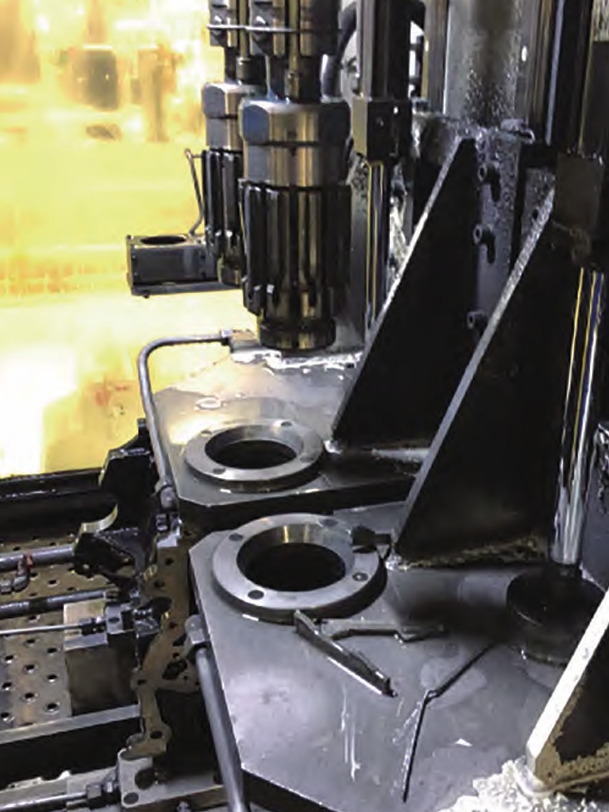
Post-casting, machining and balancing are vital. When boring the hub, the small end face must be verified with a vertical aligner; if skewed, corrections should be made by referencing the trailing edge vertical distance. For propellers already in service, vibration issues demand careful analysis. If pitch errors are identified, grinding the pressure side can rectify them. For weight imbalances, dynamic and static balancing tests determine the unbalance mass, followed by grinding—ensuring the blade’s hydrodynamic profile remains intact. This reduces涡旋阻力 (vortex resistance) and improves efficiency.
Moreover, operational measures can mitigate vibrations. Ships should carry spare blades for quick replacement if damage occurs. Installing mechanical dampers at the stern, using 4- or 5-bladed propellers, or opting for composite materials like plastics can reduce vibration and noise. Implementing a comprehensive technical management system for propellers, with records for each blade, fosters collaboration between design, foundry, and end-users. Open-water tests for standardized propellers are advisable to validate performance.
To encapsulate the strategies for addressing metal casting defects, I provide a table of corrective actions.
| Stage | Action | Expected Outcome |
|---|---|---|
| Design and Pattern Making | Use precision pitch boards; verify radial lines and angles; secure patterns. | Minimizes geometric errors at source. |
| Mold Preparation | Three-point定位 (positioning); uniform ramming; balanced bolt tightening. | Prevents mold shift and distortion. |
| Pouring and Solidification | Controlled pouring speed; simultaneous cavity filling; allow free contraction. | Reduces thermal stresses and warping. |
| Machining | Accurate hub boring; alignment checks with vertical instruments. | Ensures concentricity and balance. |
| Balancing and Finishing | Dynamic/static balancing; careful grinding of pressure/suction sides. | Eliminates residual unbalance. |
| Operational Maintenance | Regular inspection; use of dampers; spare blades; composite materials. | Reduces in-service vibration risks. |
The economic and safety implications are significant. Metal casting defects, if unchecked, lead to increased fuel consumption due to reduced propulsion efficiency, higher maintenance costs from component wear, and potential safety hazards. By adopting an integrated production approach—where design, casting, machining, and inspection are streamlined—we can achieve consistent quality. This “one-stop” production method reduces重复工序 (redundant processes), saves energy, and enhances overall效益 (benefit).
In conclusion, hull vibration stemming from propeller irregularities is a multifaceted issue, but metal casting defects are a predominant contributor. Through meticulous process control, advanced balancing techniques, and proactive maintenance, we can suppress these vibrations. The key lies in recognizing that each metal casting defect, whether minor pitch error or major weight imbalance, has a cumulative effect on dynamic performance. By prioritizing precision in foundry operations and fostering cross-disciplinary collaboration, the maritime industry can ensure smoother, safer, and more efficient voyages. Ultimately, combating metal casting defects is not just about technical fixes; it’s about cultivating a culture of excellence in propeller manufacturing.