
In the field of steel production, banded microstructure is a common defect that significantly impacts mechanical properties such as plasticity, impact toughness, and reduction of area. This issue is particularly pronounced in medium carbon high manganese steel casting, where elemental segregation during solidification leads to inhomogeneous structures. In this study, I focus on addressing banded microstructure through comprehensive optimization of material composition, casting processes, and rolling parameters. The goal is to enhance the uniformity of the solidification structure and reduce the conditions that foster band formation. High manganese steel casting involves complex interactions between alloying elements and thermal processes, making it essential to control these factors meticulously. Through systematic experimentation and analysis, I demonstrate how tailored approaches can mitigate banded microstructure, thereby improving the overall quality of the steel products. This research not only contributes to industrial practices but also provides insights into the fundamental mechanisms underlying segregation and phase transformation in high manganese steel casting.
The formation of banded microstructure can be categorized into primary and secondary types. Primary banding arises from segregation during the solidification of molten steel, while secondary banding develops during the rolling and cooling processes, resulting in layered structures aligned with the rolling direction. Both types introduce anisotropy and degrade material performance. In high manganese steel casting, elements like manganese and chromium are prone to segregation, which exacerbates banding. Therefore, my investigation begins with a detailed analysis of composition design to minimize these effects. By reducing the concentrations of elements that promote segregation, I aim to create a more homogeneous starting material for subsequent processing. This foundational step is critical for achieving consistent results in high manganese steel casting applications.
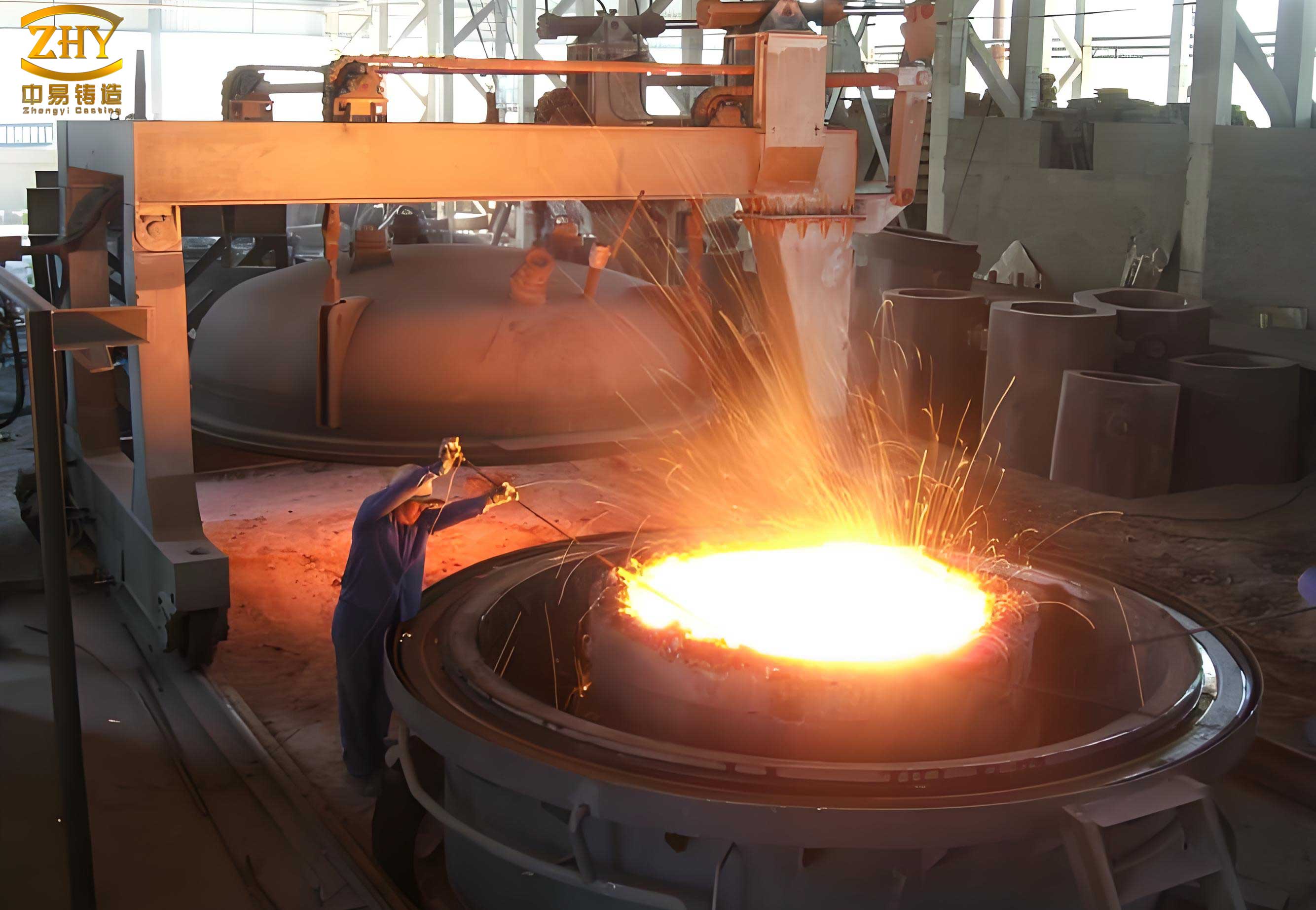
To understand the role of composition in high manganese steel casting, I first examine the chemical elements involved. The initial composition included higher levels of manganese and chromium, which are known to cause significant segregation. By optimizing the composition, I reduce these elements to lower levels, as shown in the following table. This adjustment helps in decreasing the propensity for banded microstructure formation. The table below summarizes the chemical compositions used in two different process routes, highlighting the reductions in key elements.
| Element | Process 1 | Process 2 |
|---|---|---|
| C | 0.40 | 0.40 |
| Si | 0.35 | 0.30 |
| Mn | 1.32 | 1.20 |
| Cr | 0.18 | 0.10 |
| V | 0.08 | 0.08 |
| Ti | 0.02 | 0.02 |
| O | 0.0011 | 0.0009 |
| N | 0.0135 | 0.0100 |
| P | 0.009 | 0.006 |
| S | 0.004 | 0.001 |
In high manganese steel casting, the solidification process plays a pivotal role in determining the final microstructure. I optimize the continuous casting parameters to enhance the homogeneity of the cast billet. Key parameters include casting speed, superheat, secondary cooling water flow, and electromagnetic stirring. By adjusting these factors, I promote a more uniform solidification structure with increased equiaxed crystal zone ratio and reduced center segregation. The following table outlines the casting parameters for two different processes, demonstrating how changes in these variables contribute to improved high manganese steel casting quality.
| Parameter | Process 1 | Process 2 |
|---|---|---|
| Casting Speed (m/min) | 0.95 | 0.80 |
| Superheat (°C) | 35 | 26 |
| Secondary Cooling Water Flow (L/kg) | 0.20 | 0.30 |
| Mold Electromagnetic Stirring (A) | 150 | 250 |
| Final Electromagnetic Stirring (A) | 50 | 300 |
| Pulse Magnetostrictive Oscillation (V) | 0 | 100 |
The optimization of casting parameters in high manganese steel casting is supported by theoretical models. For instance, the diffusion of elements during solidification can be described by Fick’s second law: $$ \frac{\partial C}{\partial t} = D \frac{\partial^2 C}{\partial x^2} $$ where \( C \) is the concentration, \( t \) is time, \( D \) is the diffusion coefficient, and \( x \) is the spatial coordinate. In high manganese steel casting, reducing segregation involves maximizing diffusion to homogenize the composition. The diffusion coefficient itself depends on temperature, as given by the Arrhenius equation: $$ D = D_0 \exp\left(-\frac{Q}{RT}\right) $$ where \( D_0 \) is the pre-exponential factor, \( Q \) is the activation energy, \( R \) is the gas constant, and \( T \) is the absolute temperature. By controlling the cooling rate and temperature gradients in high manganese steel casting, I can influence \( D \) and thereby reduce banding.
After casting, the billets undergo rolling processes, where further adjustments are made to mitigate banded microstructure. I implement two distinct rolling strategies: one with lower heating temperatures and shorter times, and another with higher heating temperatures and extended durations. The latter approach promotes elemental diffusion, leading to a more uniform austenite structure. Additionally, increasing the final rolling temperature enlarges the austenite grain size, which reduces the nucleation rate differences for ferrite across various regions. The table below compares the rolling parameters for the two processes, emphasizing the benefits of higher temperatures and longer times in high manganese steel casting.
| Parameter | Process 1 | Process 2 |
|---|---|---|
| Heating Section Temperature (°C) | 1245-1255 | 1295-1305 |
| Final Rolling Temperature (°C) | 900-910 | 800-820 |
| Total Heating Time (min) | 160 | 260 |
| High-Temperature Time (min) | 60 | 150 |
To evaluate the effectiveness of these optimizations, I analyze the transverse macrostructure of the cast billets. The low-magnification images reveal significant improvements in Process 2, with reduced center segregation and shrinkage porosity. The equiaxed crystal ratio increases from approximately 25.53% to 35.05%, indicating enhanced uniformity. This is crucial for high manganese steel casting, as a homogeneous structure provides a better foundation for rolling and reduces the risk of banded microstructure. The rating of macrostructure defects, based on standard guidelines, shows that Process 2 achieves superior results, as summarized in the following table.
| Defect Type | Process 1 (Grade) | Process 2 (Grade) |
|---|---|---|
| Center Porosity | 0.5 | 0.0 |
| Center Segregation | 0.5 | 0.0 |
| Shrinkage Cavity | 0.0 | 0.0 |
| Subsurface Cracking | 0.0 | 0.0 |
| Intermediate Cracking | 0.0 | 0.0 |
| Center Cracking | 0.0 | 0.0 |
Next, I examine the banded microstructure in the rolled products. Samples are taken from the center and mid-radius positions, and the banding is rated according to standard methods. Process 2 shows finer and less pronounced banding, with lower ratings compared to Process 1. This improvement is attributed to the combined effects of composition optimization, enhanced casting homogeneity, and adjusted rolling parameters. In high manganese steel casting, the reduction of banded microstructure directly translates to better mechanical properties. The table below provides a comparative rating of banded microstructure for the two processes.
| Location | Process 1 (Grade) | Process 2 (Grade) |
|---|---|---|
| Center | 4.0 | 2.5 |
| Mid-Radius | 3.0 | 2.0 |
The mechanisms behind these improvements can be explained through phase transformation kinetics. During rolling and cooling, the formation of ferrite and pearlite is influenced by the local composition. In high manganese steel casting, areas with higher manganese content have lower Ar3 temperatures, delaying ferrite nucleation. The difference in Ar3 temperatures between solute-rich and solute-lean regions drives banding. By increasing the cooling rate after rolling, I reduce the time for carbon diffusion, minimizing the banding effect. The relationship between cooling rate and phase transformation can be modeled using the Avrami equation for phase transformation: $$ X = 1 – \exp(-kt^n) $$ where \( X \) is the transformed fraction, \( k \) and \( n \) are constants, and \( t \) is time. In high manganese steel casting, controlling \( t \) through accelerated cooling helps achieve a more uniform microstructure.
Furthermore, the role of electromagnetic stirring and pulse magnetostrictive oscillation in high manganese steel casting cannot be overstated. These technologies promote grain refinement and homogenization by inducing fluid flow and nucleation sites. For example, increasing the electromagnetic stirring current enhances the fragmentation of dendrites, leading to a finer grain structure. This is particularly important in high manganese steel casting, where coarse grains can exacerbate segregation. The effectiveness of these methods is quantified through the increased equiaxed crystal ratio, which directly correlates with reduced banding in the final product.
In summary, my research demonstrates that a holistic approach to high manganese steel casting—encompassing composition design, casting process optimization, and rolling parameter adjustment—significantly improves the banded microstructure. By reducing segregation-prone elements, enhancing solidification homogeneity, and employing high-temperature rolling with extended heating times, I achieve a more uniform and superior-quality steel. This methodology not only addresses the immediate issue of banding but also sets a precedent for other high-performance steel productions. Future work could explore the integration of real-time monitoring and advanced simulation models to further optimize high manganese steel casting processes.
The implications of this study extend beyond industrial applications, contributing to the fundamental understanding of material science in high manganese steel casting. For instance, the diffusion processes involved in homogenization can be further analyzed using computational models that incorporate multi-component systems. Equations such as the multicomponent diffusion equation: $$ \frac{\partial C_i}{\partial t} = \sum_{j} D_{ij} \frac{\partial^2 C_j}{\partial x^2} $$ where \( C_i \) and \( C_j \) are concentrations of different elements, and \( D_{ij} \) are the inter-diffusion coefficients, can provide deeper insights. In high manganese steel casting, such models help predict segregation patterns and guide process adjustments.
Moreover, the thermal cycles during rolling and heat treatment play a critical role in microstructural evolution. The kinetics of recrystallization and grain growth can be described by equations like: $$ d^n = d_0^n + Kt \exp\left(-\frac{Q}{RT}\right) $$ where \( d \) is the grain size, \( d_0 \) is the initial grain size, \( n \) and \( K \) are constants, and \( Q \) is the activation energy. In high manganese steel casting, controlling these parameters ensures that the austenite grains remain large enough to minimize ferrite nucleation disparities, thereby reducing banding. This comprehensive approach underscores the importance of interdisciplinary strategies in advancing high manganese steel casting technologies.
In conclusion, the improvement of banded microstructure in medium carbon high manganese steel casting is achievable through systematic optimization of composition and processes. My findings highlight that reducing manganese and chromium contents, along with optimizing casting and rolling parameters, leads to significant enhancements in microstructural homogeneity. The use of electromagnetic stirring and pulse magnetostrictive oscillation further aids in achieving a uniform solidification structure. As a result, the banded microstructure is markedly improved, leading to better mechanical properties. This research underscores the critical role of integrated process control in high manganese steel casting and provides a framework for future innovations in the field.