
In the manufacturing industry, machine tool castings play a critical role as foundational components for various equipment, particularly in large-scale applications where precision and stability are paramount. As an engineer specializing in casting processes, I have extensively studied the challenges associated with producing high-quality machine tool castings, such as bed plates, which are essential for supporting heavy loads and ensuring accurate machining operations. These machine tool castings often suffer from defects like shrinkage cavities, leading to significant economic losses and production delays. In this article, I will delve into the optimization of casting processes for large machine tool castings, focusing on practical improvements that enhance quality and efficiency. Through detailed analysis, including the use of tables and mathematical models, I aim to provide a comprehensive guide for professionals in the field. The importance of machine tool castings cannot be overstated, as they directly impact the performance and longevity of industrial machinery. By sharing my experiences and findings, I hope to contribute to the advancement of casting technologies for machine tool applications.
Machine tool castings, such as bed plates, are typically made from high-strength cast iron, like HT200-300, and are subjected to rigorous demands in terms of dimensional accuracy and structural integrity. In my work, I have encountered numerous instances where shrinkage defects in these machine tool castings resulted in costly rework or scrap. For example, a large bed plate measuring 2500 mm × 4600 mm × 340 mm exhibited internal shrinkage cavities after drilling, compromising its functionality. This issue is common in thick-section machine tool castings due to improper solidification control. To address this, I initiated a series of process improvements, which I will elaborate on in subsequent sections. The goal is to achieve defect-free machine tool castings that meet the stringent requirements of modern manufacturing environments.
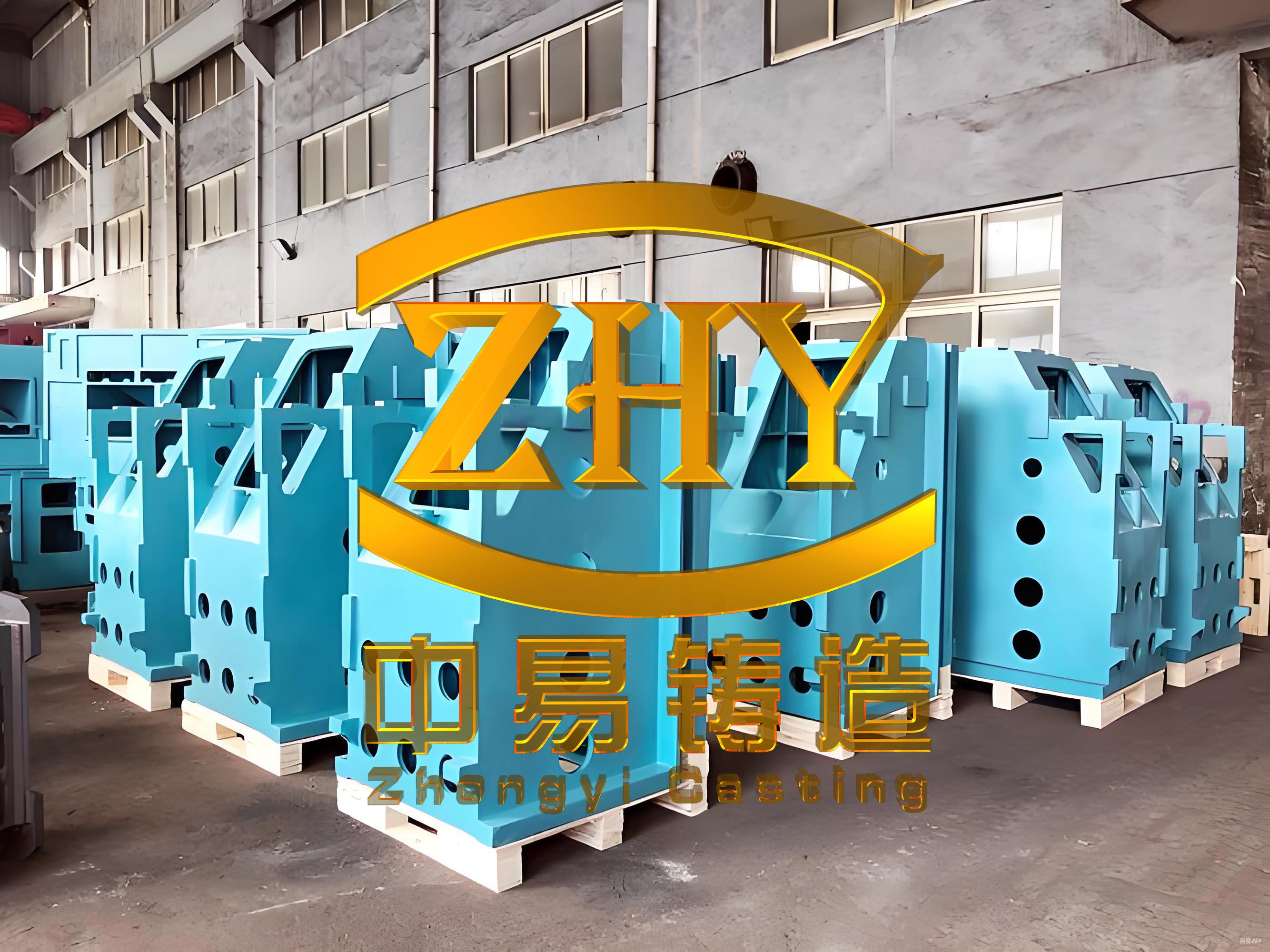
The original casting process for these machine tool castings involved a simple top-bottom mold parting, with critical machining surfaces located in the lower half of the mold. Resin sand was used for molding, and a unilateral gating system was employed for pouring. The pouring temperature ranged from 1470°C to 1480°C, with a carbon equivalent (CE) controlled between 3.60% and 3.70%. However, this approach often led to shrinkage cavities in the drilled holes of the machine tool castings, typically appearing 70 mm below the upper surface in the central regions. These defects, characterized by dendritic structures on the cavity walls, were identified as shrinkage porosity resulting from inadequate feeding during solidification. As part of my analysis, I considered the fundamental principles of casting solidification, which can be described by the Chvorinov’s rule for solidification time: $$ t = B \cdot \left( \frac{V}{A} \right)^2 $$ where \( t \) is the solidification time, \( B \) is a mold constant, \( V \) is the volume of the casting, and \( A \) is the surface area. For large machine tool castings, this rule highlights the importance of controlling the volume-to-surface area ratio to prevent shrinkage.
To systematically address these issues, I implemented several key improvements in the casting process for machine tool castings. First, I focused on optimizing the chemical composition, particularly the carbon equivalent, to reduce shrinkage tendencies. The carbon equivalent is calculated using the formula: $$ CE = C + \frac{1}{3}(Si + P) $$ where C, Si, and P represent the weight percentages of carbon, silicon, and phosphorus, respectively. By increasing the CE from the eutectic composition of 4.30% to a hypereutectic level of 4.55%, I observed a significant reduction in shrinkage defects in the machine tool castings. This adjustment promotes a more favorable solidification pattern, minimizing the formation of concentrated shrinkage cavities. Additionally, I adjusted the pouring temperature to enhance fluidity while reducing overheating effects. The revised pouring temperature was set between 1320°C and 1340°C, achieved by lowering the tapping temperature to 1450°C–1460°C and increasing the amount of inoculant cover to 2.0%–2.5%. This change is critical for machine tool castings, as it balances the need for complete mold filling with the prevention of thermal-induced defects.
| Parameter | Original Process | Improved Process |
|---|---|---|
| Carbon Equivalent (CE) | 3.60% – 3.70% | 4.55% |
| Pouring Temperature | 1470°C – 1480°C | 1320°C – 1340°C |
| Gating System | Unilateral | Bilateral |
| Inoculant Cover | 2.0% | 2.0% – 2.5% |
| Feeding Time | 20 minutes | 30 – 40 minutes |
Another major improvement involved modifying the gating system from a unilateral to a bilateral design. This change reduces the flow resistance of molten metal, shortens the filling time, and improves the distribution of heat within the mold. For large machine tool castings, this is essential to ensure uniform solidification and effective feeding from the risers. The bilateral gating system can be modeled using fluid dynamics principles, where the flow rate \( Q \) through each gate is given by: $$ Q = A \cdot v $$ where \( A \) is the cross-sectional area of the gate and \( v \) is the flow velocity. By balancing the flow between two gates, I achieved a more consistent temperature gradient, which is crucial for minimizing shrinkage in machine tool castings. Furthermore, I enhanced the pouring process by implementing a separate high-temperature iron stream for feeding, which extended the feeding time from 20 minutes to 30–40 minutes. This approach leverages the riser design principles, where the riser must solidify after the casting to provide adequate compensation for shrinkage. The solidification time of the riser \( t_r \) should satisfy: $$ t_r \geq t_c $$ where \( t_c \) is the solidification time of the casting. By prolonging the feeding period, I ensured that the risers in the machine tool castings could effectively supply liquid metal to compensate for volumetric shrinkage during solidification.
In addition to these measures, I incorporated the use of chills and optimized riser placements to control the solidification sequence in machine tool castings. Chills are external cooling devices that accelerate solidification in specific areas, reducing the risk of shrinkage. The effectiveness of chills can be quantified by the heat transfer coefficient \( h \), which influences the cooling rate according to: $$ \frac{dT}{dt} = \frac{h \cdot A \cdot (T – T_m)}{m \cdot c_p} $$ where \( T \) is the temperature, \( T_m \) is the mold temperature, \( m \) is the mass, and \( c_p \) is the specific heat capacity. By strategically positioning chills near thick sections of the machine tool castings, I promoted directional solidification towards the risers, thereby eliminating internal defects. Moreover, I revised the riser design to increase their size and number, ensuring that they provide sufficient feed metal throughout the solidification process. The volume of the riser \( V_r \) can be determined based on the shrinkage volume of the casting \( V_s \), using the relation: $$ V_r = k \cdot V_s $$ where \( k \) is a safety factor accounting for feeding efficiency. For machine tool castings, I typically use a \( k \) value of 1.5 to 2.0 to accommodate variations in process conditions.
To validate the effectiveness of these improvements, I conducted multiple production trials on various types of machine tool castings, including bed plates for large presses. Over a year of implementation, the rejection rate due to shrinkage defects dropped to zero, demonstrating the robustness of the optimized process. For instance, post-improvement drilling of the machine tool castings revealed no internal cavities, as confirmed through non-destructive testing methods. The success of these measures underscores the importance of a holistic approach to casting process design for machine tool applications. By integrating compositional control, gating modifications, and enhanced feeding techniques, I achieved consistent quality in machine tool castings, leading to significant cost savings and improved production efficiency. The table below summarizes the key outcomes from the validation phase, highlighting the reduction in defects and increase in yield for machine tool castings.
| Metric | Before Improvement | After Improvement |
|---|---|---|
| Rejection Rate | High (Specific % not disclosed) | 0% |
| Shrinkage Defects | Present in central regions | Absent |
| Production Yield | Low | Nearly 100% |
| Cost Impact | High due to scrap | Reduced significantly |
In conclusion, the optimization of casting processes for large machine tool castings requires a multifaceted strategy that addresses material composition, thermal management, and feeding mechanisms. Through my work, I have demonstrated that increasing the carbon equivalent, controlling pouring temperatures, adopting bilateral gating systems, and extending feeding times can effectively eliminate shrinkage defects in machine tool castings. The use of mathematical models, such as those for solidification time and fluid flow, provides a scientific basis for these improvements, ensuring reproducible results in industrial settings. As the demand for high-precision machine tool castings continues to grow, these process enhancements offer a reliable pathway to achieving superior quality and economic viability. I encourage further research into advanced simulation techniques for machine tool castings, as this could lead to even greater efficiencies and innovations in the field. Ultimately, the lessons learned from this study can be applied to a wide range of heavy-section castings, reinforcing the critical role of casting process optimization in modern manufacturing.
Reflecting on this journey, I recognize that the success in improving machine tool castings stems from a deep understanding of metallurgical principles and practical experimentation. For instance, the relationship between cooling rate and microstructure in cast iron can be expressed using the following equation for dendrite arm spacing: $$ \lambda = k \cdot (G \cdot R)^{-n} $$ where \( \lambda \) is the dendrite arm spacing, \( G \) is the temperature gradient, \( R \) is the cooling rate, and \( k \) and \( n \) are material constants. By manipulating these parameters through process adjustments, I achieved a finer microstructure in the machine tool castings, which contributes to better mechanical properties and reduced defect formation. Additionally, the economic impact of these improvements cannot be overlooked; by minimizing scrap and rework, manufacturers can save substantial resources while meeting tight production schedules. As I continue to explore new frontiers in casting technology, I remain committed to sharing insights that benefit the broader community involved in producing machine tool castings. The integration of digital tools, such as real-time monitoring and AI-based process control, holds promise for further enhancing the quality of machine tool castings in the future.
In summary, the key to producing high-quality machine tool castings lies in a balanced approach that combines theoretical knowledge with hands-on experience. The improvements detailed in this article have been validated through rigorous testing and have proven effective in real-world applications. I am confident that by adopting these strategies, other practitioners can achieve similar successes in their own projects involving machine tool castings. As the industry evolves, continuous innovation in casting processes will be essential to meet the ever-increasing demands for performance and reliability in machine tool components. I look forward to seeing how these advancements will shape the future of manufacturing, particularly in the realm of large-scale machine tool castings.