
In the field of industrial manufacturing, machine tool castings play a critical role in ensuring the durability and precision of machinery components. As a casting engineer with extensive experience, I have encountered numerous challenges in producing high-quality machine tool castings, particularly for complex parts like shifting forks. These components are essential for the smooth operation of machine tools, and any defects can lead to significant performance issues. In this article, I will share our journey in improving the casting process for a specific machine tool casting—the shifting fork—by addressing common defects such as shrinkage cavities and porosity. Our goal was to enhance the overall quality, reduce scrap rates, and meet stringent technical requirements, including nodularity levels and hardness specifications. Through detailed analysis and iterative process modifications, we achieved substantial improvements, which I will elaborate on using theoretical insights, empirical data, tables, and formulas to illustrate key points.
The shifting fork for machine tool applications, such as those used in X6132 models, is a critical component that requires high mechanical strength and dimensional accuracy. This machine tool casting typically features a complex geometry with varying wall thicknesses, ranging from thin sections of approximately 1.5 cm to thick sections of up to 8 cm. Such disparities in thickness often lead to uneven solidification during casting, resulting in defects like shrinkage cavities and microporosity in the core regions of thick sections. In our initial assessments, we observed that these defects were prevalent in the as-cast components, leading to a scrap rate as high as 46% in some production batches. The primary material used for this machine tool casting is ductile iron (nodular iron), which demands a nodularity grade of less than 3 and a hardness of at least 180 HB to ensure optimal performance in machine tool operations. Given the importance of these specifications, we embarked on a comprehensive review of the existing casting process to identify root causes and implement effective solutions.
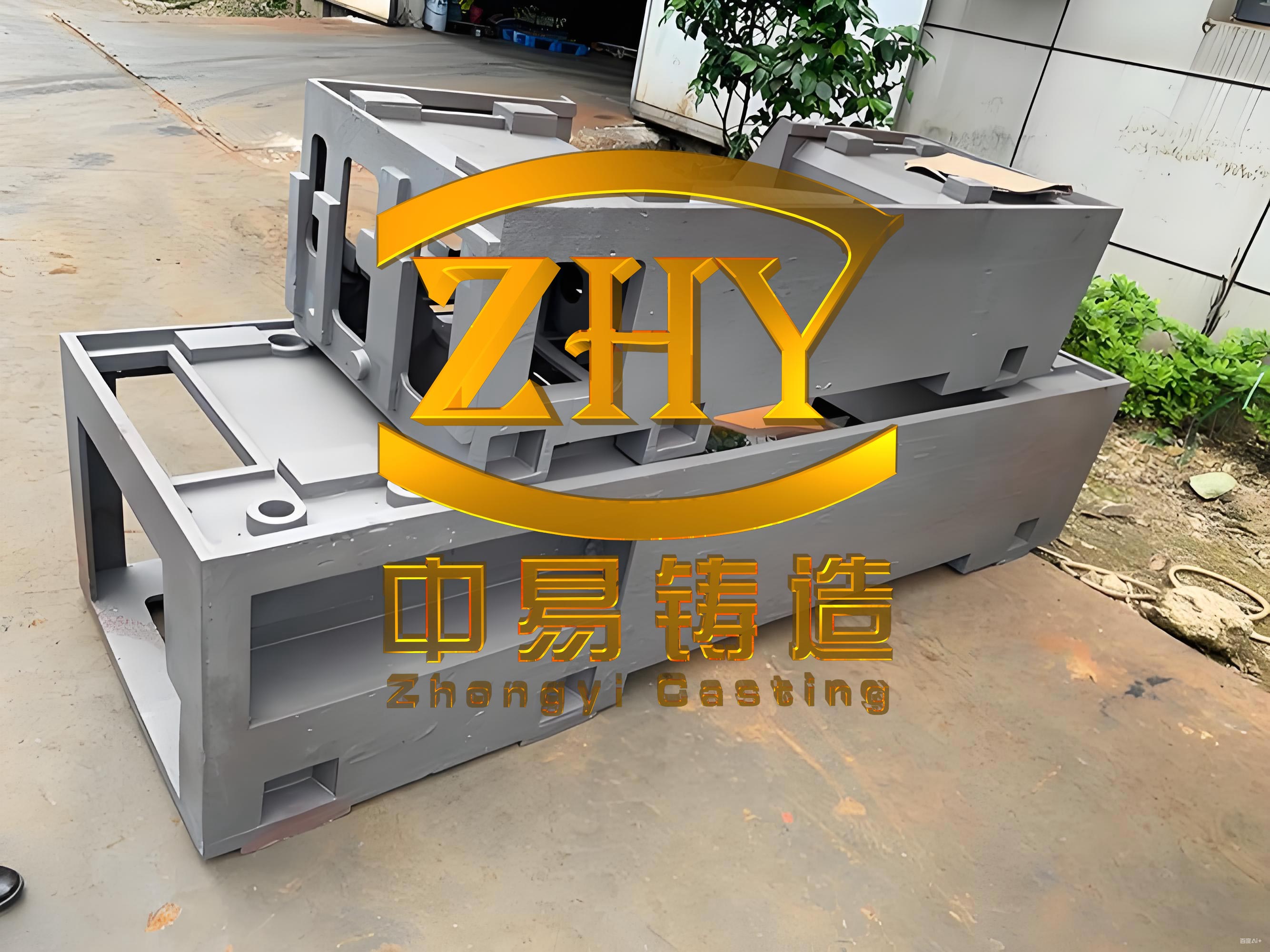
Originally, the casting process for this machine tool casting involved a single-piece molding approach using resin sand in a flask-less molding system. The pattern was made of wood, and the gating system was designed as a closed type without a transverse runner. The gating ratio was set as follows: the total cross-sectional area of the sprue (∑F_sprue) to the total cross-sectional area of the ingates (∑F_ingate) was 1.2:1. Specifically, the sprue was implemented using a steel tube with a diameter of 25 mm, while the ingate had a cross-sectional dimension of 32/36 cm by 12 cm, resulting in an area range of 384 to 432 cm². A vent hole with a diameter of 10 mm was placed at the highest point to allow gas escape. However, this setup proved inefficient due to low yield and extended pouring times, which exacerbated issues like mold erosion and premature solidification in thin sections. The prolonged pouring duration often led to degradation of inoculation and spheroidization in the iron, causing inconsistencies in the microstructure of the machine tool castings. To quantify the solidification behavior, we applied Chvorinov’s rule, which estimates the solidification time (t) based on the volume-to-surface area ratio:
$$ t = k \left( \frac{V}{A} \right)^n $$
where \( V \) is the volume of the casting, \( A \) is the surface area, \( k \) is a constant dependent on the mold material, and \( n \) is an exponent typically around 2 for sand castings. For the thick sections of our machine tool casting, the high \( V/A \) ratio resulted in longer solidification times, increasing the risk of shrinkage defects. Additionally, the absence of effective feeding mechanisms meant that the liquid metal could not adequately compensate for volumetric shrinkage during solidification. This was particularly problematic in ductile iron, where graphite expansion can either aid or hinder feeding depending on the process control. Our analysis revealed that the original process lacked sufficient thermal management, leading to localized hot spots and subsequent porosity in the machine tool castings.
To address these issues, we implemented a series of improvements focused on optimizing the molding layout, gating system, and cooling strategies. The first major change involved transitioning from a one-piece-per-mold to a two-piece-per-mold configuration using pattern plates for both the cope and drag. This adjustment not only increased production efficiency by reducing molding time but also enhanced pattern durability compared to the previous wooden patterns. The new setup allowed for better consistency in mold dimensions, which is crucial for maintaining the integrity of machine tool castings. Furthermore, we adopted a stacked molding approach where three sets of molds were assembled together and shared a common gating and venting system. This multi-mold pouring technique significantly shortened the total pouring time per ladle, minimizing the risks of inoculation and spheroidization衰退. The gating system was redesigned to include a subsidiary sprue, resulting in a modified gating ratio of ∑F_sprue : ∑F_subsidiary : ∑F_ingate = 1.5 : 1.2 : 1. The main sprue utilized a 50 mm diameter steel tube, the subsidiary sprue had a diameter of 25 mm, and the ingate dimensions were adjusted to 32/38 cm by 15 cm, providing a cross-sectional area of 480 to 570 cm². At the highest point, we replaced the vent hole with a 40 mm diameter kissing riser (a type of pressure-fed riser) to improve feeding pressure and reduce shrinkage. The introduction of this riser can be modeled using the Bernoulli equation for fluid flow to ensure adequate metal delivery:
$$ P_1 + \frac{1}{2} \rho v_1^2 + \rho g h_1 = P_2 + \frac{1}{2} \rho v_2^2 + \rho g h_2 $$
where \( P \) represents pressure, \( \rho \) is the density of the molten iron, \( v \) is the flow velocity, \( g \) is gravitational acceleration, and \( h \) is height. By increasing the pressure head through stacked molding and riser design, we enhanced the feeding capacity for thick sections, thereby mitigating shrinkage in the machine tool castings.
Another critical improvement involved the strategic placement of chillers to control solidification in thick regions. We incorporated both internal and external iron chills—specifically, iron denseners—in the bulky sections of the machine tool casting. These chills act as heat sinks, accelerating cooling in localized areas to promote directional solidification from thin to thick sections. The effectiveness of chills can be evaluated using Fourier’s law of heat conduction to estimate the heat extraction rate:
$$ q = -k \frac{dT}{dx} $$
where \( q \) is the heat flux, \( k \) is the thermal conductivity of the chill material, and \( \frac{dT}{dx} \) is the temperature gradient. For iron chills, the high thermal conductivity ensures rapid heat dissipation, reducing the temperature in thick zones and minimizing the time available for shrinkage formation. We conducted thermal analysis simulations to determine the optimal size and placement of these chills, ensuring they did not cause premature chilling or cracking in the machine tool castings. The table below summarizes the key parameters of the original and improved casting processes for comparison:
| Parameter | Original Process | Improved Process |
|---|---|---|
| Molding Configuration | 1 piece per mold, wooden pattern | 2 pieces per mold, pattern plate |
| Gating System | Closed type, no transverse runner, ∑F_sprue : ∑F_ingate = 1.2:1 | Closed type with subsidiary sprue, ∑F_sprue : ∑F_subsidiary : ∑F_ingate = 1.5:1.2:1 |
| Riser/Vent Design | Vent hole (Ø10 mm) | Kissing riser (Ø40 mm) |
| Cooling Aids | None | Internal and external iron chills |
| Pouring Time per Ladle | Long (multiple molds sequentially) | Short (stacked molds simultaneously) |
| Scrap Rate | Up to 46% | Below 15% |
The implementation of these changes yielded significant improvements in the quality of the machine tool castings. Post-improvement, we observed a marked reduction in shrinkage defects, with the scrap rate dropping from 46% to less than 15%. Microstructural analysis confirmed that the nodularity grade achieved was consistently at level 2, surpassing the requirement of less than level 3. Additionally, the average hardness of the castings exceeded 190 HB, indicating enhanced mechanical properties suitable for demanding machine tool applications. To further validate our results, we performed statistical process control (SPC) on multiple production batches, calculating key metrics such as the process capability index (Cpk) for hardness and nodularity. For instance, the hardness data followed a normal distribution with a mean (μ) of 192 HB and a standard deviation (σ) of 5 HB, resulting in a Cpk value that met our quality targets. The relationship between cooling rate and hardness in ductile iron can be expressed empirically as:
$$ HB = a + b \cdot \ln(R) $$
where \( HB \) is the Brinell hardness, \( R \) is the cooling rate in °C/s, and \( a \) and \( b \) are material constants. By optimizing the cooling through chills and gating modifications, we achieved higher cooling rates in critical areas, contributing to the improved hardness of the machine tool castings.
In addition to the technical aspects, we also considered the economic and environmental impacts of the process improvements. The shift to multi-piece molding and pattern plates reduced material waste and energy consumption per unit of machine tool casting produced. For example, the resin sand usage decreased by approximately 30% due to better mold utilization, and the reduction in scrap rates translated to lower remelting costs and carbon emissions. We documented these benefits in a lifecycle assessment, highlighting how sustainable practices can be integrated into foundry operations for machine tool castings. Moreover, the stacked pouring approach allowed for more efficient use of ladle capacity, reducing the number of heats required and minimizing thermal losses. This aligns with broader industry trends toward lean manufacturing and green foundry initiatives.
Looking ahead, we continue to explore advanced techniques such as simulation-based optimization and additive manufacturing for prototyping machine tool castings. For instance, computational fluid dynamics (CFD) models can predict mold filling and solidification patterns with high accuracy, enabling pre-emptive adjustments to the gating and risering systems. The governing equations for such simulations include the Navier-Stokes equations for fluid flow and the heat transfer equation for solidification:
$$ \frac{\partial \mathbf{v}}{\partial t} + (\mathbf{v} \cdot \nabla) \mathbf{v} = -\frac{1}{\rho} \nabla p + \nu \nabla^2 \mathbf{v} + \mathbf{g} $$
$$ \rho c_p \frac{\partial T}{\partial t} = \nabla \cdot (k \nabla T) + L \frac{\partial f_s}{\partial t} $$
where \( \mathbf{v} \) is the velocity vector, \( p \) is pressure, \( \nu \) is kinematic viscosity, \( c_p \) is specific heat, \( T \) is temperature, \( L \) is latent heat of fusion, and \( f_s \) is the solid fraction. By leveraging these tools, we aim to further refine the casting process for complex machine tool castings, reducing development time and enhancing reproducibility.
In conclusion, the improvements to the casting process for machine tool castings, specifically the shifting fork, demonstrate the importance of a holistic approach that integrates molding design, gating optimization, and thermal management. Through the adoption of multi-piece molding, enhanced gating systems with subsidiary sprues and kissing risers, and the strategic use of iron chills, we successfully mitigated shrinkage defects and achieved superior mechanical properties. The scrap rate reduction to below 15%, coupled with consistent nodularity grade 2 and hardness above 190 HB, underscores the effectiveness of these modifications. As the demand for high-performance machine tool castings grows, such process innovations will be crucial in maintaining competitiveness and meeting evolving technical standards. Our experience serves as a valuable case study for foundries seeking to enhance the quality and efficiency of their machine tool casting production, and we encourage further research into integrated cooling solutions and digital twin technologies for continuous improvement.