
In the production of wind turbine components, the internal quality of castings is critical for ensuring structural integrity and long-term performance. Our company faced significant challenges in manufacturing thick-walled ring-type castings, such as front and rear pressure covers for 4.2MW wind turbines, using QT400-18L ductile cast iron. These castings, corresponding to the European standard EN-GJS-400-18U-LT, required stringent non-destructive testing, including 100% penetration, magnetic particle, and ultrasonic inspections after machining. Initially, we encountered a high rejection rate due to localized shrinkage porosity and shrinkage cavity defects. This prompted a comprehensive review and improvement of our casting process for ductile cast iron components. The goal was to enhance yield, reduce costs, and achieve defect-free production of these critical wind power parts.
The material, QT400-18L ductile cast iron, is known for its high ductility and low-temperature impact resistance, making it ideal for wind energy applications. However, the thick sections of these castings, often exceeding 100 mm in wall thickness, exacerbate solidification issues. Ductile cast iron solidifies in a mushy manner, where graphite nodules form throughout the liquid metal, leading to a wide solidification range. This results in expansion from graphite precipitation, which can cause mold wall movement and subsequent shrinkage defects if not properly controlled. The formation of shrinkage porosity in ductile cast iron is influenced by liquid contraction, solidification shrinkage, and graphite expansion. The net volume change during solidification can be expressed as:
$$ V_{net} = V_{liquid} – V_{solid} + V_{graphite} $$
where $V_{liquid}$ is the volume decrease from liquid cooling, $V_{solid}$ is the contraction during phase change, and $V_{graphite}$ is the expansion due to graphite precipitation. For ductile cast iron, the expansion from graphite can compensate for shrinkage, but only if the mold is rigid enough to contain it and solidification is directional. Otherwise, internal porosity occurs. The carbon equivalent (CE) plays a key role, defined as:
$$ CE = \%C + \frac{1}{3}(\%Si + \%P) $$
A higher CE promotes graphite formation but must be balanced to avoid excessive shrinkage. Our initial process had a CE around 4.3-4.5, but adjustments were made to optimize graphite nucleation and growth.
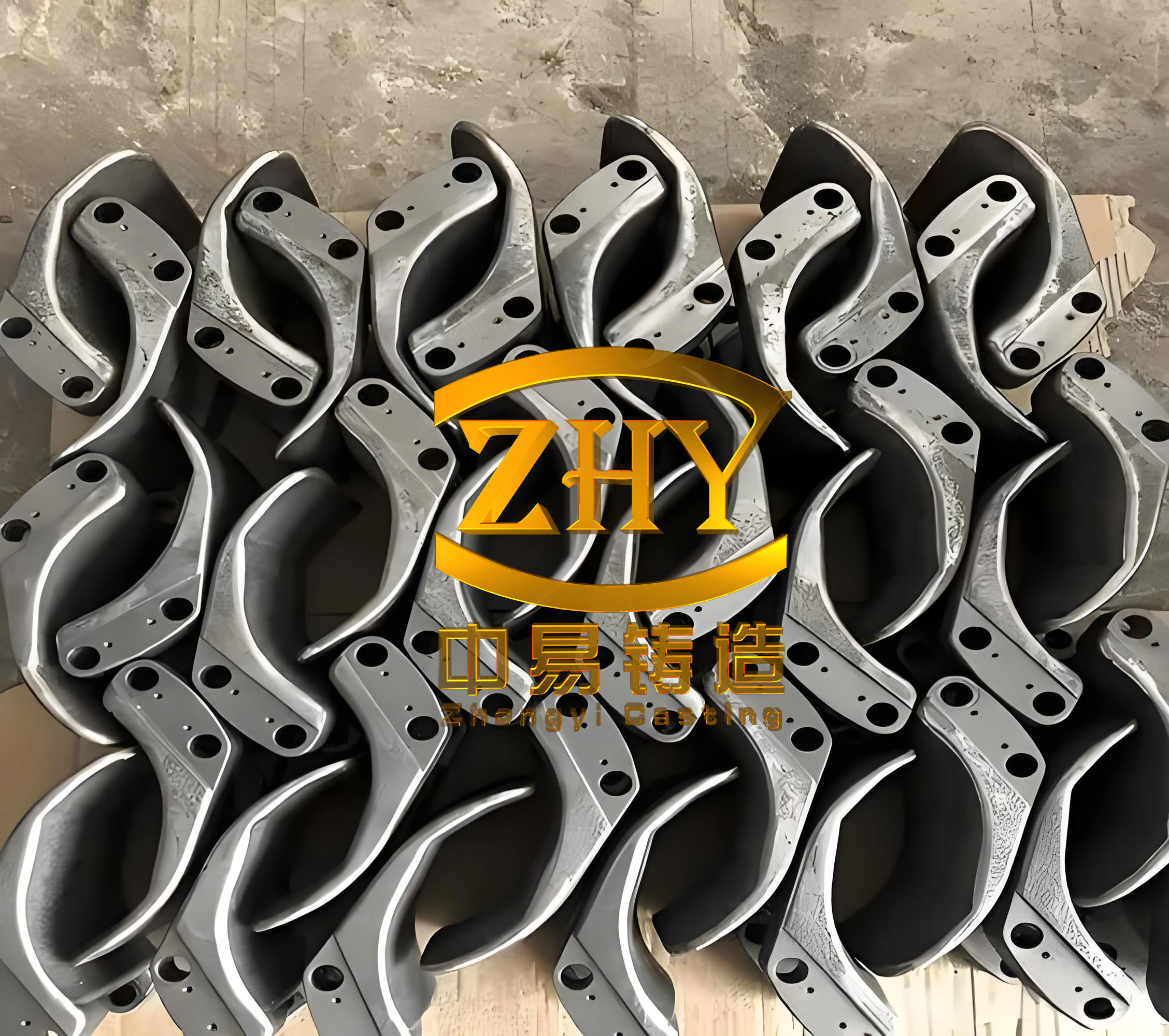
To address these issues, we implemented a multi-faceted process improvement strategy focused on enhancing cooling rates, mold rigidity, and metallurgical control. The core changes involved the use of chills, optimized gating, strict sand mold control, tailored coatings, baking procedures, refined melting practices, and precise pouring parameters. Each element aimed to shift the solidification behavior from mushy to directional, leveraging the self-expansion of graphite in ductile cast iron to achieve dense, sound castings. Below, we detail these improvements with supporting data and theoretical foundations.
Mechanism of Shrinkage Defects in Ductile Cast Iron
Ductile cast iron solidifies with a pasty or mushy morphology, where graphite spheroids nucleate and grow dispersed in the liquid-solid mixture. This leads to a continuous network of liquid pockets that shrink upon cooling, while graphite expansion exerts internal pressure. If the mold yields or cooling is uneven, cavities form. The solidification time $t_s$ for a thick section can be estimated using Chvorinov’s rule:
$$ t_s = k \left( \frac{V}{A} \right)^n $$
where $V$ is volume, $A$ is surface area, $k$ is a mold constant, and $n$ is an exponent (typically ~2). For our ring castings, the high $V/A$ ratio prolongs solidification, increasing shrinkage risk. Graphite expansion pressure $P_g$ can be modeled as:
$$ P_g = \frac{E_g \cdot \Delta V_g}{V_m} $$
where $E_g$ is the modulus of graphite, $\Delta V_g$ is the volume change from graphite precipitation, and $V_m$ is the mold cavity volume. To utilize this pressure for feeding, mold hardness must exceed $P_g$. Our resin sand molds initially had hardness around 75-80 units, insufficient to resist wall movement. We targeted hardness above 85 units to contain expansion.
Process Improvement Measures
We systematically revised our casting process for QT400-18L ductile cast iron, incorporating both traditional foundry wisdom and modern simulations. The following sections outline key changes.
1. Strategic Placement of Chills
Chills were employed to accelerate cooling in thick sections, promoting directional solidification. We designed three types of external chills made of HT200 gray iron, placed uniformly at the bottom, inner ring, and outer ring of the casting. This arrangement increases the chilling power of the mold, reduces the mushy zone, and enhances graphite nodule refinement. The chill dimensions and quantities are summarized in Table 1.
| Chill Type | Dimensions (mm) | Quantity | Location |
|---|---|---|---|
| Type 1 | Ø350 × 80 × 30 | 8 | Bottom |
| Type 2 | 250 × 150 × 40 | 4 | Inner Ring |
| Type 3 | 250 × 60 × 25 | 4 | Outer Ring |
The chill design followed empirical rules: chill volume should be 5-10% of the casting volume, and contact area optimized to avoid cracking. The cooling effect can be approximated by the heat extraction rate $Q$:
$$ Q = h \cdot A_c \cdot (T_m – T_c) $$
where $h$ is heat transfer coefficient, $A_c$ is chill area, $T_m$ is metal temperature, and $T_c$ is chill temperature. This forced cooling shifted solidification fronts, reducing isolated liquid pools.
2. Design of Special Pouring Cup
A proprietary pouring cup was developed to minimize turbulence and slag entrainment. The cup features a tapered design that maintains a full basin during pouring, reducing air contact and preventing oxide formation. The flow rate $F$ is controlled by the choke area $A_f$:
$$ F = C_d \cdot A_f \cdot \sqrt{2gH} $$
where $C_d$ is discharge coefficient, $g$ is gravity, and $H$ is metal head height. Our cup design ensures $C_d$ ~0.8, with $H$ adjusted to achieve a filling time of 45 seconds for the 800 kg casting. This gentle filling protects the resin sand mold from erosion and reduces gas pickup.
3. Control of Sand Mold and Core Hardness
Mold rigidity is crucial to withstand graphite expansion. We standardized ramming to achieve uniform hardness of 85-90 units measured with a sand hardness tester. The compression strength $\sigma_c$ of resin-bonded sand relates to hardness $H_s$ as:
$$ \sigma_c = k_s \cdot H_s^m $$
where $k_s$ and $m$ are material constants. Higher hardness reduces mold wall migration, allowing graphite expansion to compensate for shrinkage. Cores were similarly controlled, with hardness verified before assembly.
4. Selection and Application of Coatings
We switched from an FQ506 alcohol-based graphite coating to an FQ580 high-alumina coating for better refractoriness and anti-penetration properties. Coating parameters were optimized as per Table 2.
| Parameter | Specification |
|---|---|
| Coating Density | 1.5–1.6 g/cm³ |
| Coating Thickness | 0.2–0.3 mm |
| Application Method | Flow coating, 1 pass |
| Drying | Air drying or torch flashing |
The coating thickness $t_co$ influences heat transfer: thinner coatings promote faster cooling. The thermal resistance $R$ is given by:
$$ R = \frac{t_co}{\lambda_c} $$
where $\lambda_c$ is thermal conductivity. The high-alumina coating has lower $\lambda_c$, reducing heat loss but providing better surface finish.
5. Baking Procedures for Sand Molds
To reduce moisture and prevent gas holes, we implemented two baking methods. Both aim to eliminate volatile from resins and chill surfaces. Method 1: pre-heat chills with a gasoline torch to induce “sweating,” then assemble cores and bake the entire mold at 200°C for 1.5–2 hours using hot air, followed by natural cooling for 1.5–2 hours before pouring. Method 2: air-dry molds for over 24 hours, then torch chills for 20 minutes before assembly. The baking reduces water vapor pressure $P_w$:
$$ P_w = P_0 \cdot e^{-\frac{\Delta H}{RT}} $$
where $P_0$ is reference pressure, $\Delta H$ is enthalpy, $R$ is gas constant, and $T$ is temperature. Lower $P_w$ minimizes gas porosity in ductile cast iron.
6. Optimization of Melting and Treatment Process
The melting practice was revised to enhance graphite nucleation and reduce shrinkage tendency. Charge composition was adjusted to increase carbon content, eliminating steel scrap to raise CE. The charge makeup and alloy additions are in Table 3.
| Material | Amount (kg) | Particle Size (mm) | Purpose |
|---|---|---|---|
| South African Pig Iron | 1075 | < 33 | Base iron, high C |
| Nodularizer (ND-1Z) | 13.5 | 5–25 | Mg treatment for spheroidization |
| Inoculant 1 (FeSi) | 9 | 5–8 | Primary inoculation |
| Inoculant 2 (FeSi) | 2.5 | 1–3 | Late inoculation |
| 75% Ferrosilicon | 13 | 40 | Si adjustment |
Key steps: melting pig iron in medium-frequency furnace, adding ferrosilicon near melt completion, superheating to 1500°C, and transferring to a preheated ladle for nodularizing. The treatment uses a sandwich method with nodularizer covered by steel scrap and slag coagulant. Reaction time is ~90 seconds. Post-inoculation is done during tapping. The magnesium recovery $R_{Mg}$ is critical:
$$ R_{Mg} = \frac{Mg_{final} – Mg_{initial}}{Mg_{added}} \times 100\% $$
We target $R_{Mg}$ >40% to ensure sufficient nodule count. The final chemistry aims for: C 3.6–3.8%, Si 2.2–2.5%, Mg 0.04–0.06%, CE ~4.4–4.6. The nodule count $N$ per unit area relates to shrinkage resistance:
$$ N = k_n \cdot e^{-Q/RT} $$
where $k_n$ is a constant, $Q$ is activation energy, and $T$ is treatment temperature. Higher $N$ promotes uniform expansion.
7. Controlled Pouring Practices
Pouring parameters were tightened to avoid degradation of ductile cast iron properties. The window between treatment and pouring is limited to 15 minutes to prevent fade. Pouring temperature $T_p$ is maintained at 1330–1350°C, measured by infrared pyrometer. The cooling rate during pouring affects microstructure; we aim for a gradient that supports directional solidification. The temperature drop $\Delta T$ during transfer is modeled as:
$$ \Delta T = \frac{h_t \cdot A_t \cdot (T – T_{env}) \cdot t}{m \cdot C_p} $$
where $h_t$ is transfer coefficient, $A_t$ is surface area, $T_{env}$ is ambient temperature, $t$ is time, $m$ is mass, and $C_p$ is specific heat. Quick pouring within 45 seconds minimizes $\Delta T$.
Results and Discussion
After implementing these improvements, we produced over 50 sets of 4.2MW front and rear pressure covers in QT400-18L ductile cast iron. Non-destructive testing showed a dramatic reduction in shrinkage defects. The yield increased from ~70% to over 95%, meeting the stringent EN standards. Metallurgical analysis revealed finer graphite nodules (size 6-7 per ASTM A247) and pearlite content below 10%, ensuring mechanical properties: tensile strength >400 MPa, elongation >18%, and impact toughness >12 J at -20°C. The success underscores the importance of integrated process control for thick-section ductile iron castings.
The use of chills converted solidification from mushy to skin-forming, verified by thermal analysis. Mold hardness above 85 units contained expansion, as calculated from pressure models. The modified melting practice increased graphite nucleation sites, enhancing self-feeding. Overall, the synergy of these measures effectively harnessed the inherent properties of ductile cast iron to eliminate porosity.
Table 4 summarizes key before-and-after parameters.
| Aspect | Initial Process | Improved Process |
|---|---|---|
| Chill Usage | None | Three types, placed strategically |
| Mold Hardness | 75–80 units | 85–90 units |
| Carbon Equivalent | ~4.3 | ~4.5 |
| Pouring Temperature | 1300–1320°C | 1330–1350°C |
| Shrinkage Defect Rate | ~30% | < 5% |
| Nodule Count (per mm²) | 120–150 | 180–220 |
The economic impact was significant, reducing scrap and rework costs by approximately 40%. Moreover, the process robustness allows scaling to other wind power components like bearing housings and brake discs in ductile cast iron.
Conclusion
Through systematic process improvement, we have successfully mitigated shrinkage porosity and shrinkage cavity defects in QT400-18L wind power ductile iron castings. The combination of chills for enhanced cooling, a specialized pouring cup for calm filling, rigorous mold hardness control, optimized coatings, baking protocols, refined melting and treatment, and precise pouring parameters transformed the solidification behavior. This approach leveraged the graphite expansion characteristics of ductile cast iron to achieve sound, dense microstructures. The methodology not only boosted yield and cut costs but also provided a replicable framework for producing large, thick-walled ductile iron castings for demanding applications like wind turbines. Future work may involve simulation-driven optimization and advanced inoculation techniques to further push the boundaries of ductile cast iron performance.