
In the industrial manufacturing sector, planetary reducers are critical components widely used in metallurgy, mining, petroleum, chemical, and energy industries. As a key part of these reducers, the planetary carrier bears the highest external torque, and its structural design and manufacturing quality directly impact load distribution among planetary gears, as well as the overall承载 capacity, noise, and vibration of the transmission system. In our production experience, we encountered persistent casting defects, specifically gray spot defects on the轮辐 surfaces of planetary carrier castings, leading to significant losses and delays in delivery. This article details our comprehensive approach to analyzing and mitigating these casting defects, focusing on material science, process optimization, and quality control.
The planetary carrier is cast from ductile iron grade QT700-2A, with a single rough casting weight of 1300 kg. The material specifications require附铸试样 testing using D-type blocks, with microstructural demands including pearlite content ≥90%, spheroidization grade ≥2, graphite size ≥4, and phosphide and carbide contents ≤1%. Additionally, the sonic velocity in the本体 must exceed 5500 m/s (in normalized condition), and hardness should range from 235 to 275 HBW. Non-destructive testing such as ultrasonic testing (UT) and magnetic particle testing (MT) is applied to critical areas to meet internal standards. These stringent requirements underscore the importance of addressing any casting defects that could compromise mechanical properties.
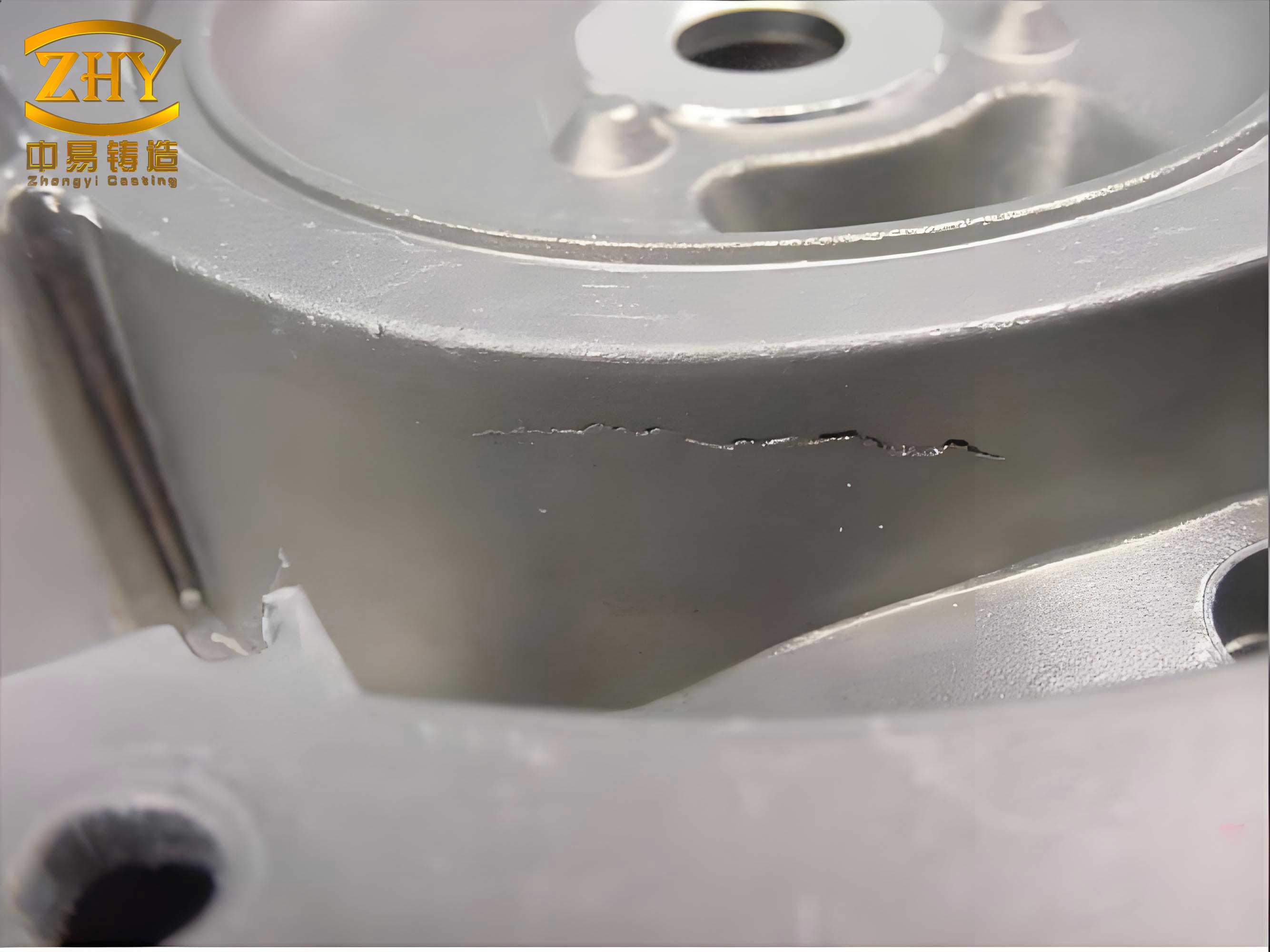
During machining, we observed gray spot defects dispersed on the machined surfaces of thick sections (approximately 100 mm wall thickness) of the planetary carrier. These casting defects manifested as uneven gray patches, often associated with localized porosity, severely reducing mechanical performance. Initial quality checks on附铸试样 from affected batches showed no abnormalities in mechanical properties or standard metallography, with spheroidization grade 2, graphite size 5, pearlite content 90%, and phosphide/carbide contents ≤1%. Sonic velocity measured 5560 m/s, and hardness ranged from 242 to 252 HBW, all within specifications. Chemical composition analysis via spectroscopy also revealed values within target ranges, consistent with defect-free castings. However, upon conducting detailed metallographic examination at the defect sites, we identified碎块状石墨 (chunky graphite) as the root cause. Comparative micrographs are shown below, highlighting the difference between defective and sound castings.
In defective castings, graphite appeared as碎块状 or degenerated forms, whereas sound castings exhibited well-formed spherical graphite. This碎块状石墨 is a畸变石墨常见 in heavy-section ductile iron castings or hot spots, where slow solidification and prolonged eutectic停留时间 promote graphite distortion. Macroscopically, this leads to gray spot casting defects. The formation mechanism involves a shift from divorced eutectic to共生 eutectic growth under low undercooling conditions. In this松散耦合 state, graphite and austenite grow with partial liquid zones or channels around graphite, allowing for分枝 and separation by austenite, resulting in large-angle branching rather than small-angle分叉 typical of spherical graphite. This phenomenon is influenced by factors such as composition, cooling rate, and graphite nucleation density.
To understand the context, our original production parameters involved melting in a 3-ton medium-frequency coreless induction furnace using Q10专用生铁 and scrap steel. Inoculation was performed via the冲入法 with Mg6RE3球化剂 (1.0–1.3% addition) and含Ba高效孕育剂 (0.5% addition, with 0.15%瞬时 addition). The tapping temperature was 1460–1490°C, and pouring temperature was 1350–1370°C. The target chemical composition before improvements is summarized in Table 1.
| C | Si | Mn | P | S | Cu | Mg | RE |
|---|---|---|---|---|---|---|---|
| 3.2–3.9 | 2.2–2.6 | 0.7–0.9 | <0.05 | <0.02 | 0.4–0.5 | 0.02–0.06 | 0.01–0.04 |
The presence of碎块状石墨 and associated casting defects necessitated a deep dive into preventive measures. Based on literature and industry practices, we identified three key strategies: controlling melt chemistry, accelerating cooling rates, and increasing graphite nodule count. First, reducing residual rare earth (RE) content is critical, as excessive RE (e.g., >0.02%) can destabilize the austenite shell and promote graphite degeneration. Second, lowering silicon content is advised, since high silicon (e.g., >2.6%) enhances graphitization and carbon diffusion, increasing graphite growth stress and austenite rupture risk. Third, elements like antimony (Sb) can inhibit碎块状石墨 when combined with RE, by cleansing oxygen from graphite/liquid interfaces. The optimal Sb range is 0.002–0.007%. Fourth, accelerating cooling via chills or悬浮浇注 can shorten solidification time, but for heavy sections, thermal mass limits effectiveness unless innovative methods are used. Fifth, increasing graphite nodule count to 60–70 nodules/mm² can prevent vermicular graphite formation, achievable through enhanced inoculation, higher carbon equivalent, or微量元素 additions.
From a theoretical perspective, the formation of casting defects like gray spots can be modeled using parameters such as cooling rate and composition. The solidification time \( t \) for a casting section can be approximated by Chvorinov’s rule:
$$ t = k \left( \frac{V}{A} \right)^2 $$
where \( V \) is volume, \( A \) is surface area, and \( k \) is a constant dependent on mold material and casting conditions. For heavy sections, \( V/A \) is large, leading to long \( t \) and increased risk of石墨畸变. The graphite nodule count \( N_g \) (nodules/mm²) relates to inoculation efficacy and undercooling, often expressed as:
$$ N_g = C_0 \cdot e^{-Q/RT} \cdot [\text{Inoculant}]^m $$
where \( C_0 \) is a constant, \( Q \) is activation energy, \( R \) is the gas constant, \( T \) is temperature, and \( m \) is an exponent for inoculant concentration. Higher \( N_g \) reduces the likelihood of casting defects. Additionally, the effect of silicon on graphitization can be described by:
$$ G_r = f([Si], [C], T) $$
where \( G_r \) is the graphite growth rate. Excessive silicon accelerates \( G_r \), contributing to缺陷 formation.
Guided by these principles, we implemented specific改进措施 to eliminate gray spot casting defects. First, we tightened raw material control by using high-purity pig iron and categorized scrap steel to minimize trace elements like lead, bismuth, and titanium that could exacerbate defects. Second, we adjusted melting and pouring temperatures: melting temperature was set to 1500–1550°C (with records of maximums to avoid遗传性 effects), and holding time was minimized to快熔快出. Pouring temperature was lowered to 1320–1340°C from 1350–1370°C, and球化 temperature adjusted to 1440–1480°C, aiming to reduce solidification time. Third, we refined the chemical composition as shown in Table 2.
| C | Si | Mn | P | S | Cu | Mg | RE | Sb |
|---|---|---|---|---|---|---|---|---|
| 3.2–3.9 | 2.1–2.4 | 0.4–0.5 | <0.05 | <0.02 | 0.6–0.8 | 0.02–0.06 | ≤0.02 | 0.002–0.005 |
Key changes included reducing silicon to curb graphitization, lowering manganese to minimize偏析负面影响, increasing copper to enhance pearlite formation and suppress defects, reducing rare earth content by switching to Mg6RE1球化剂, and adding antimony via Sb-containing inoculants. These adjustments targeted the冶金质量 factors influencing casting defects. Fourth, we optimized inoculation by using multiple stages and ensuring uniform distribution to boost graphite nodule count. The relationship between inoculation and nodule count can be summarized as:
$$ \Delta N_g = k_i \cdot [\text{Inoculant}] \cdot e^{-\lambda t} $$
where \( \Delta N_g \) is the increase in nodule count, \( k_i \) is an efficiency factor, and \( \lambda \) accounts for fading over time \( t \). By applying孕育剂 in smaller, more frequent doses, we maximized \( \Delta N_g \).
To validate these改进措施, we produced two trial planetary carrier castings under the new parameters. Metallographic inspection of these castings revealed no gray spot casting defects, with graphite appearing spherical and uniform. Subsequent testing of附铸试样 confirmed compliance with all mechanical and microstructural requirements. Encouraged by this, we scaled up to a batch of six castings, all of which passed quality checks without defects. Comparative micrographs before and after improvements are shown in Table 3, summarizing the outcomes.
| Parameter | Before Improvement (Defective) | After Improvement (Sound) |
|---|---|---|
| Graphite Form | Chunky/Degenerated | Spherical |
| Graphite Nodule Count (nodules/mm²) | ~40–50 | ~70–80 |
| Spheroidization Grade | 2 (but with degeneration) | 1–2 |
| Gray Spot Casting Defects | Present | Absent |
| Sonic Velocity (m/s) | 5560 | ≥5500 |
| Hardness (HBW) | 242–252 | 235–275 |
The increase in graphite nodule count aligns with the theoretical threshold of 60–70 nodules/mm² to prevent蠕虫状石墨, effectively eliminating casting defects. We also monitored cooling curves using thermocouples embedded in thick sections, deriving the cooling rate \( \frac{dT}{dt} \) during eutectic solidification. The improved process showed a higher \( \frac{dT}{dt} \), approximated by:
$$ \frac{dT}{dt} = \frac{T_p – T_e}{t_s} $$
where \( T_p \) is pouring temperature, \( T_e \) is eutectic temperature, and \( t_s \) is solidification time. By lowering \( T_p \) and optimizing mold design, we reduced \( t_s \), thereby mitigating conditions favorable for缺陷 formation.
Further analysis involved statistical quality control to assess the consistency of our改进措施. We tracked chemical composition variations using standard deviation \( \sigma \) for key elements like silicon and rare earths. The process capability index \( C_pk \) for critical parameters improved from below 1.0 to above 1.33, indicating better control over factors causing casting defects. This is calculated as:
$$ C_pk = \min \left( \frac{USL – \mu}{3\sigma}, \frac{\mu – LSL}{3\sigma} \right) $$
where \( USL \) and \( LSL \) are upper and lower specification limits, and \( \mu \) is the mean. For instance, for silicon content with a target of 2.1–2.4%, \( \mu \) stabilized at 2.25% with \( \sigma \) reduced from 0.15% to 0.05%, enhancing reproducibility.
The successful elimination of gray spot casting defects has enabled批量 production without quality issues, saving costs and ensuring timely deliveries. Our experience underscores the importance of a holistic approach combining material science, process engineering, and continuous monitoring. Casting defects like these are often multifactorial, requiring tailored solutions based on thorough analysis. In our case, controlling silicon and rare earth levels, adding antimony, and optimizing temperatures were pivotal. We continue to refine our methods, exploring advanced techniques such as computational simulation to predict defect formation and real-time process adjustment.
In conclusion, addressing casting defects in heavy-section ductile iron castings demands a deep understanding of metallurgical principles and practical constraints. Through systematic improvements in composition, cooling rates, and inoculation, we effectively eradicated gray spot defects in planetary carrier castings, enhancing product reliability and performance. This case study highlights how targeted interventions can resolve persistent casting defects, offering valuable insights for similar industrial applications. Future work will focus on further optimizing the process to prevent other types of casting defects and extending these strategies to other critical components.