
In my extensive experience with aluminum-silicon alloys, the ADC12 alloy stands out due to its exceptional casting properties, high strength, low thermal expansion, superior corrosion resistance, and excellent machinability. These attributes make it indispensable for manufacturing critical components such as carburetors, cylinder blocks, cylinder heads, shock absorber housings, engine gearboxes, and various machinery parts. With the rapid growth of the automotive and motorcycle industries, ADC12 is increasingly used for complex, high-precision parts like brake pump housings and shock absorber casings, which demand stringent mechanical performance. However, traditional heat treatment processes often introduce heat treatment defects such as uneven hardness, distortion, or excessive energy consumption, prompting the need for optimization. This article details my investigation into an improved heat treatment method that not only maintains mechanical properties but also mitigates common heat treatment defects, thereby enhancing production efficiency and cost-effectiveness.
The chemical composition of ADC12 aluminum-silicon alloy, as per standards, includes silicon (Si) for improved castability and wear resistance, copper (Cu) and magnesium (Mg) for precipitation strengthening, and manganese (Mn) to counteract the detrimental effects of iron (Fe) impurities. A typical composition is summarized in Table 1, highlighting the balance required to avoid heat treatment defects like reduced ductility or corrosion issues from excessive Cu or Mg.
| Element | Si | Cu | Mg | Zn | Fe | Mn | Ni | Sn | Al |
|---|---|---|---|---|---|---|---|---|---|
| JIS H2118 Range | 9.6-12.0 | 1.5-3.5 | <0.3 | <1.0 | <0.9 | <0.5 | <0.5 | <0.3 | Balance |
| Typical Factory | 10.5-12.0 | 1.8-3.5 | 0.4-0.5 | 0.2-0.3 | <0.4 | 0.3-0.5 | – | – | Balance |
Conventional production involves melting with 50% recycled scrap, followed by degassing at 720°C using a refining agent, modification at 720-730°C with strontium-based modifiers, and low-pressure die casting at 690-720°C. The as-cast microstructure, after modification but without heat treatment, consists of α-solid solution, silicon particles, CuAl2, Mg2Si, and AlFeMnSi phases. To achieve optimal properties, the standard T6 heat treatment is applied: solution treatment at 515±5°C for 8 hours, followed by water quenching and artificial aging at 155±5°C for 6 hours. While this yields good mechanical properties, it is energy-intensive and prone to heat treatment defects like distortion or incomplete solutionizing if not carefully controlled. The mechanical properties comparison with ZL108 alloy is shown in Table 2, where ADC12 exhibits superior strength and hardness.
| Alloy | Condition | σb (MPa) | δ (%) | Hardness (HB) |
|---|---|---|---|---|
| ADC12 (Standard) | As Cast | 225 | 1.6 | 39 |
| ADC12 (Typical) | T6 | 286.5 | 1.9 | 105 |
| ZL108 | T1 | 192 | – | 85 |
| ZL108 | T6 | 251 | – | 90 |
To address these challenges, I developed an improved heat treatment process, termed T6′, which replaces the conventional solution treatment with direct quenching from the as-cast state. This method involves water quenching the casting immediately after ejection from the die at a temperature of 480-500°C, followed by the same artificial aging at 155±5°C for 6 hours. The rationale is to leverage the latent heat of the casting to achieve supersaturation of alloying elements in the α-matrix, thereby reducing energy usage and minimizing heat treatment defects associated with prolonged high-temperature exposure. The effectiveness of this approach can be modeled using phase transformation kinetics. For instance, the dissolution of secondary phases during quenching can be described by an Arrhenius-type equation:
$$ k = A \exp\left(-\frac{Q}{RT}\right) $$
where \( k \) is the rate constant, \( A \) is the pre-exponential factor, \( Q \) is the activation energy for diffusion, \( R \) is the gas constant, and \( T \) is the absolute temperature. By quenching from near the eutectic temperature, we maximize \( k \) to suppress precipitate formation, a common source of heat treatment defects like reduced hardness or strength.
My experimental analysis focused on hardness, mechanical properties, machinability, and microstructure to validate the T6′ process. Hardness measurements were taken from multiple castings treated with both T6 and T6′ methods, as summarized in Table 3. The data shows that T6′ not only achieves comparable hardness to T6 but also exhibits lower variability, indicating fewer heat treatment defects such as uneven hardening. The hardness values follow a normal distribution, with the standard deviation serving as a key metric for quality control; a lower standard deviation implies more consistent results, crucial for mass production.
| Treatment | Hardness Range, R (HB) | Average Hardness, \( \bar{X} \) (HB) | Standard Deviation, S (HB) |
|---|---|---|---|
| T6′ (A) | 14 | 103.75 | 3.37 |
| T6 (B) | 23 | 102.79 | 5.86 |
The mechanical properties were evaluated using standard tensile specimens and actual castings. As shown in Table 4, the T6′ process results in slightly lower tensile strength but maintains adequate performance for most applications, with values exceeding 84% of ZL108 T6 benchmarks. This minor reduction is a trade-off for the significant energy savings and reduced risk of heat treatment defects. The elongation values remain similar, ensuring sufficient ductility. The tensile strength can be correlated with hardness using empirical relations, such as:
$$ \sigma_b \approx C \times \text{HB} $$
where \( C \) is a material constant typically around 3.2 for aluminum alloys. This linear approximation helps in predicting strength from hardness data, facilitating quality checks to prevent heat treatment defects like under-aging or over-aging.
| Sample Type | Treatment | σb (MPa) Average | δ (%) Average | Hardness (HB) |
|---|---|---|---|---|
| Standard Specimen | T6 | 286.5 | 1.9 | 105 |
| Casting A | T6′ | 211.5 | 1.4 | 103 |
| Casting B | T6 | 231.2 | 1.2 | 102 |
Machinability tests revealed that both T6 and T6′ treated castings meet dimensional tolerances of 0.03 mm and surface roughness of Ra 1.6 μm, indicating that the improved process does not introduce heat treatment defects that could impair cutting performance, such as excessive tool wear or poor surface finish. This is critical for automotive components where precision is paramount. The chip formation during machining can be analyzed using shear plane models, where the shear angle \( \phi \) relates to material properties affected by heat treatment:
$$ \tan \phi = \frac{r \cos \alpha}{1 – r \sin \alpha} $$
Here, \( r \) is the chip thickness ratio and \( \alpha \) is the rake angle. A consistent microstructure from T6′ ensures stable \( r \) values, reducing variability in machining outcomes.
Microstructural examination was pivotal in understanding the absence of heat treatment defects. The as-cast, modified structure shows a uniform distribution of α-dendrites and eutectic silicon in vermicular form, which is ideal for subsequent treatments. After T6′ treatment, the microstructure comprises α-aluminum matrix, blocky primary silicon, needle-like eutectic silicon, and intermetallic phases like CuAl2, Mg2Si, and AlFeMnSi. Compared to T6, the silicon particles in T6′ are slightly coarser, but this does not detrimentally affect mechanical properties, as the strengthening phases are adequately dispersed. This highlights how controlled quenching can prevent heat treatment defects like excessive grain growth or precipitate coarseness. To quantify microstructural features, image analysis software can be used to measure phase fractions, with the area fraction of silicon particles \( f_{Si} \) given by:
$$ f_{Si} = \frac{A_{Si}}{A_{\text{total}}} $$
where \( A_{Si} \) is the area occupied by silicon and \( A_{\text{total}} \) is the total area. Maintaining \( f_{Si} \) within 10-15% is essential to avoid brittleness, a potential heat treatment defect if modification or quenching is inadequate.
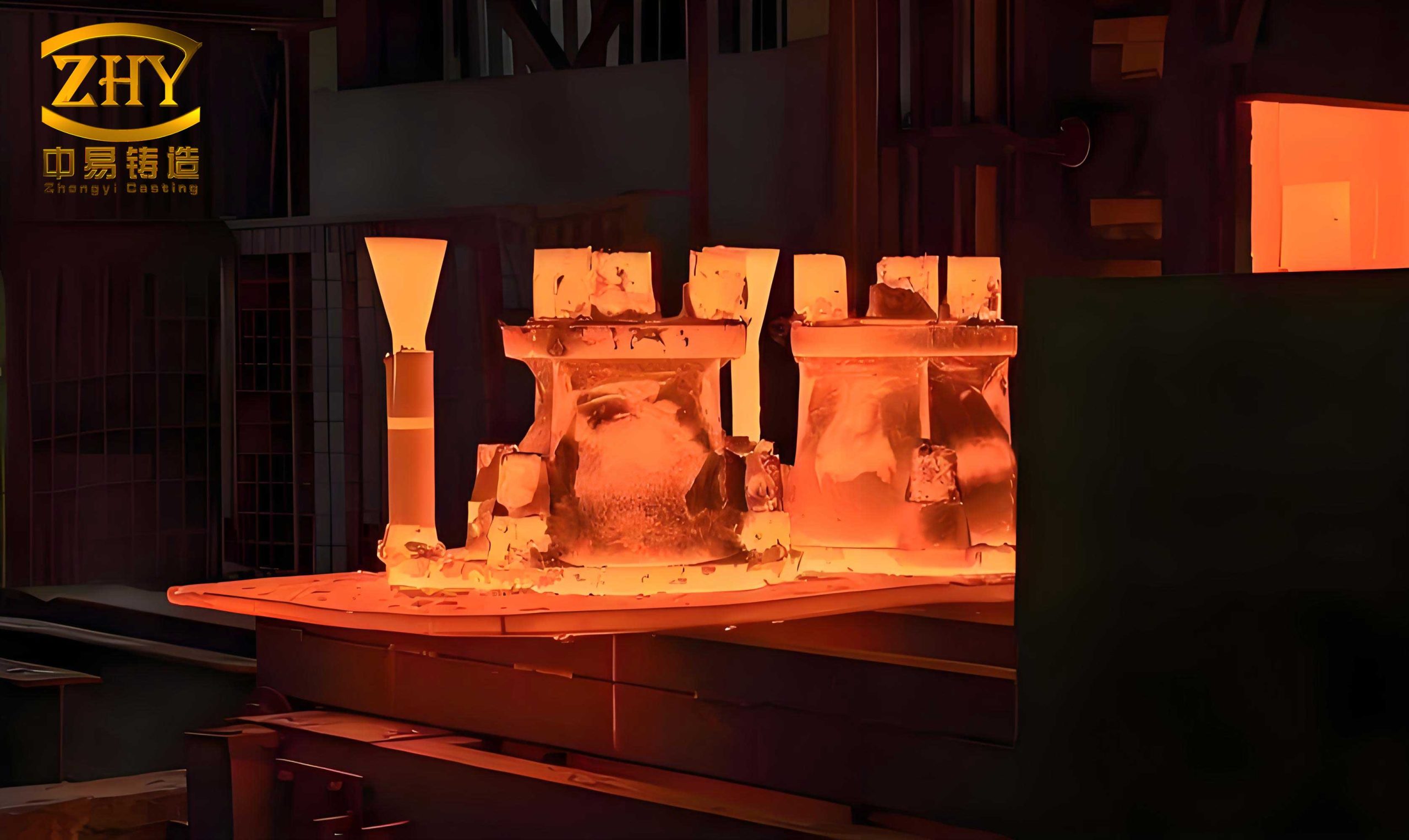
The image above illustrates a typical heat treatment setup for castings, emphasizing the importance of rapid quenching to mitigate heat treatment defects. In my implementation, ensuring a short delay between die ejection and water quenching is critical; delays can cause surface temperature drops, leading to premature precipitation and reduced hardness—a classic heat treatment defect. For mass production, I recommend maintaining ambient temperatures around 20°C, especially in winter, to minimize thermal losses and avoid such defects. The kinetics of precipitation during cooling can be described by the Johnson-Mehl-Avrami-Kolmogorov (JMAK) equation:
$$ f = 1 – \exp(-k t^n) $$
where \( f \) is the transformed fraction, \( k \) is a rate constant, \( t \) is time, and \( n \) is the Avrami exponent. By quenching rapidly, we keep \( f \) low for supersaturated solutions, ensuring effective aging later.
The advantages of the T6′ process are substantial. First, it reduces energy consumption by eliminating the 8-hour solution treatment, saving approximately 650 kWh per furnace load. For an annual production of 300 tons, this translates to a cost reduction of around $30,000, based on local energy prices. Second, it shortens the production cycle by several hours, increasing throughput. Third, it maintains the original silver-white surface appearance of the castings, which is often marred by oxidation during conventional solution treatment—another common heat treatment defect. Moreover, the consistency in hardness reduces scrap rates, further lowering costs associated with heat treatment defects. The overall benefit can be expressed as a cost function:
$$ C_{\text{total}} = C_{\text{energy}} + C_{\text{labour}} + C_{\text{scrap}} $$
With T6′, \( C_{\text{energy}} \) and \( C_{\text{scrap}} \) decrease significantly due to fewer defects, while \( C_{\text{labour}} \) remains similar, yielding a lower \( C_{\text{total}} \).
However, the T6′ process is not without limitations. It is less suitable for very small castings, as their high surface-area-to-volume ratio causes rapid temperature drop after ejection, increasing the risk of α-phase precipitation and resultant heat treatment defects like low hardness. For such cases, conventional T6 or adjusted quenching parameters may be necessary. Additionally, the process requires precise control of die temperature and quenching delay; any deviation can introduce heat treatment defects. I recommend real-time temperature monitoring and automated handling systems to ensure consistency. The quenching rate \( \dot{T} \) should exceed a critical value to avoid nose curves in time-temperature-transformation (TTT) diagrams, which can be estimated as:
$$ \dot{T}_{\text{crit}} = \frac{T_{\text{eutectic}} – T_{\text{quench}}}{t_{\text{nose}}} $$
where \( T_{\text{eutectic}} \) is the eutectic temperature (~577°C for Al-Si alloys), \( T_{\text{quench}} \) is the quenching medium temperature, and \( t_{\text{nose}} \) is the time at the nose of the TTT curve for precipitate formation. For ADC12, \( \dot{T}_{\text{crit}} \) is approximately 100°C/s to prevent heat treatment defects.
In conclusion, my improved T6′ heat treatment process for ADC12 aluminum-silicon alloy castings offers a viable alternative to conventional T6, effectively balancing mechanical performance with economic and operational benefits. By leveraging direct quenching from the as-cast state, we reduce energy usage, shorten cycle times, and minimize common heat treatment defects such as uneven hardness or distortion. This approach is particularly advantageous for medium to large castings produced via low-pressure die casting, where thermal mass aids in maintaining quenching temperatures. Future work could explore extending this method to other aluminum-silicon alloys with similar Cu and Mg content, always with a focus on mitigating heat treatment defects through optimized parameters. As industries strive for sustainability and efficiency, such innovations in heat treatment play a pivotal role in enhancing manufacturing resilience and product quality.
To further elaborate on the prevention of heat treatment defects, it is essential to consider the role of alloy composition and process variables. For instance, the concentration of copper and magnesium directly influences the volume fraction of strengthening precipitates during aging. An imbalance can lead to heat treatment defects like insufficient strengthening or excessive brittleness. Using phase diagram calculations, the equilibrium phase fractions at different temperatures can be predicted. For a multicomponent system like ADC12, the lever rule applied to the Al-Si-Cu-Mg phase diagram helps estimate phase amounts:
$$ f_{\text{phase}} = \frac{C_0 – C_{\alpha}}{C_{\beta} – C_{\alpha}} $$
where \( C_0 \) is the overall composition, \( C_{\alpha} \) and \( C_{\beta} \) are the compositions of the α and β phases at a given temperature. This guides alloy adjustments to avoid heat treatment defects.
Moreover, the aging response after quenching is critical. Artificial aging at 155°C for 6 hours optimizes precipitate nucleation and growth. The strengthening effect from precipitates can be modeled using Orowan strengthening theory:
$$ \Delta \sigma = \frac{M G b}{L} $$
where \( \Delta \sigma \) is the increase in yield strength, \( M \) is the Taylor factor, \( G \) is the shear modulus, \( b \) is the Burgers vector, and \( L \) is the inter-precipitate spacing. Proper aging avoids heat treatment defects like over-aging, where \( L \) increases, reducing strength. Monitoring aging kinetics through hardness measurements ensures that peak aging is achieved without defects.
In summary, the T6′ process represents a significant advancement in heat treatment technology for ADC12 alloys. By integrating direct quenching with controlled aging, we not only achieve desired mechanical properties but also proactively address heat treatment defects, leading to higher product consistency and lower production costs. This holistic approach underscores the importance of continuous improvement in metallurgical processes to meet evolving industrial demands.