
In my experience as an engineer involved in foundry operations, the casting of large components such as driving wheels for agricultural machinery presents significant challenges, particularly when using nodular cast iron. Nodular cast iron, known for its excellent mechanical properties and ductility, is a preferred material for heavy-duty parts due to its high strength and wear resistance. This article details the process improvements implemented to address defects in the casting of a driving wheel made from nodular cast iron, specifically grade GGG60 according to DIN 1693. The wheel, with an outer diameter of 916 mm, height of 526 mm, and mass of 260 kg, features 19 uniformly spaced teeth around its circumference, each with isolated hot spots at the roots and no draft angles allowed on the tooth profiles to ensure proper fit with tracks. Internal quality requirements included radiographic inspection to Level 2, with dissection standards permitting shrinkage porosity less than 12.7 mm in diameter within a 38.1 mm × 38.1 mm area. Surface quality allowed for pores up to 2 mm in diameter, with no more than 5 in the same area. Initial casting trials revealed issues with shrinkage cavities and surface blowholes, prompting a comprehensive redesign of the process.
The material properties of nodular cast iron are critical for performance. Table 1 summarizes the mechanical requirements for GGG60, which guided our material selection and heat treatment processes.
| Property | Requirement |
|---|---|
| Tensile Strength | ≥ 600 MPa |
| Yield Strength | ≥ 370 MPa |
| Elongation | ≥ 3% |
| Hardness (HBW) | 187–269 |
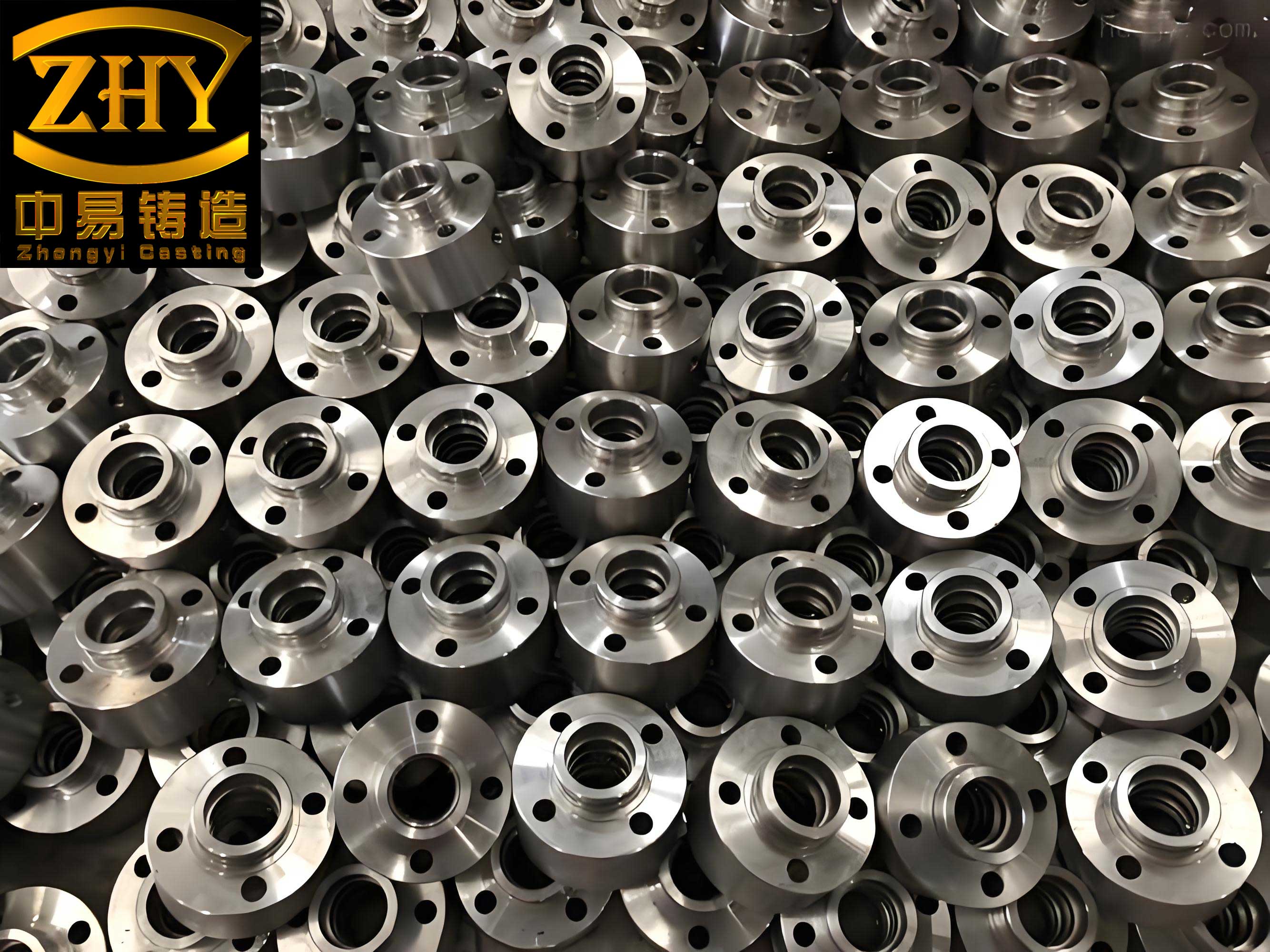
To visualize the complex geometry of the driving wheel, consider the following representation, which highlights the tooth arrangement and overall structure:
The absence of draft angles on the teeth necessitated a core assembly approach to achieve precise contours and minimize flash. In our initial design, the parting line was set at the axial center of the wheel, allowing symmetric molding. Each tooth was formed by assembling two sub-cores (labeled 1# and 2#) into a larger core (3#), with three such cores positioned within定位 cores (4# and 5#) to create a segment (6#). Six segments were then placed in the bottom mold box. This core assembly method reduced flash at the tooth roots and ensured dimensional accuracy. The molds were made using resin sand, while the cores were produced with shell-coated sand via hot-box processes, which offered good surface finish but introduced challenges related to gas evolution.
However, preliminary casting trials using this design revealed internal shrinkage defects in the tooth centers, exceeding the allowable limits. To analyze this, I employed ProCAST simulation software to model the solidification and feeding behavior. The simulation predicted shrinkage porosity at the core of each tooth, with defect sizes larger than specified. This is a common issue in nodular cast iron castings due to the expansion during graphite precipitation, which can lead to microporosity if not properly fed. The simulation results indicated that the isolated hot spots at the tooth roots were not adequately fed by the existing gating system. After multiple iterations, it was found that adding risers above each tooth and placing chills at the bottom could mitigate shrinkage. The risers provide supplemental feeding, while chills accelerate cooling to reduce the hot spot size.
The design of risers and chills involved calculations based on modulus theory. For each tooth, the modulus (M) was calculated as the ratio of volume (V) to cooling surface area (A): $$ M = \frac{V}{A} $$ Given the tooth mass \( G_c = 4.44 \, \text{kg} \), volume \( V_c = 6.03 \times 10^{-3} \, \text{m}^3 \) (or 6030 cm³ for simplicity in cm units), and surface area \( A_c = 5.58 \times 10^{-2} \, \text{m}^2 \) (558 cm²), the modulus was: $$ M_c = \frac{V_c}{A_c} = \frac{6030 \, \text{cm}^3}{558 \, \text{cm}^2} \approx 10.8 \, \text{mm} = 1.08 \, \text{cm} $$ The mass circumference quotient \( Q_m \) is defined as: $$ Q_m = \frac{G_c}{M_c^3} = \frac{4.44 \, \text{kg}}{(1.08 \, \text{cm})^3} \approx 3.52 \, \text{kg/cm}^3 $$ For a controlled pressure riser, the riser modulus \( M_R \) is given by: $$ M_R = f_1 f_2 f_3 M_c $$ where \( f_1 = 1.19 \), \( f_2 = 0.76 \), and \( f_3 = 1.2 \) are factors derived from empirical data for nodular cast iron. Thus: $$ M_R = 1.19 \times 0.76 \times 1.2 \times 1.08 \, \text{cm} \approx 1.17 \, \text{cm} $$ The riser neck modulus \( M_N \) is: $$ M_N = f_p f_4 M_R $$ with \( f_p = 0.65 \) and \( f_4 = 0.9 \), yielding: $$ M_N = 0.65 \times 0.9 \times 1.17 \, \text{cm} \approx 0.68 \, \text{cm} $$ For a cylindrical riser, the diameter \( D \) and height \( H \) are related by the solidification coefficient \( K = H/D = 1.8 \). Using standard riser dimensions, we selected a riser of diameter 80 mm and height 120 mm. The gating system was modified to include a horizontal runner connecting 19 such blind risers, with ingates linking the risers to the teeth. Pouring temperature was set at 1355–1365°C to ensure fluidity while minimizing gas absorption. Additionally, chills made of cast iron were placed at the bottom of each tooth to enhance directional solidification towards the risers. Table 2 summarizes the key process parameters after improvement.
| Parameter | Value |
|---|---|
| Pouring Temperature | 1355–1365°C |
| Riser Dimensions (per tooth) | Ø80 mm × 120 mm |
| Riser Type | Blind Cylindrical |
| Chill Material | Cast Iron |
| Chill Placement | Tooth Bottom |
| Molding Sand | Resin Sand |
| Core Sand | Shell-Coated Sand |
After implementing these changes, sample castings were produced and dissected. The results showed that shrinkage porosity was eliminated in most teeth, with only minor microporosity in the upper regions of a few teeth, well within specification. However, surface blowholes appeared, likely due to gas evolution from the shell-coated sand cores. Nodular cast iron is particularly sensitive to gas defects because of its high carbon content and the presence of magnesium, which can react with moisture or binders. To address this, we focused on reducing gas generation and improving venting. First, the core sand was changed to a coarser grade (50/100 mesh) for the 1# and 2# sub-cores to decrease specific surface area and gas emission. The gas evolution rate \( G \) can be approximated by: $$ G = k \cdot S \cdot t $$ where \( k \) is a material constant, \( S \) is the surface area, and \( t \) is time. Using coarser sand reduces \( S \), thus lowering \( G \). Second, assembled core segments (6#) were baked in an oven at 180°C for 4 hours to drive off volatile compounds. The baking process reduces residual gases by promoting polymerization of the resin binder. Third, additional venting channels were incorporated into the mold design to facilitate gas escape during pouring. The effectiveness of these measures is reflected in the elimination of blowholes in over 120 castings produced subsequently.
The combined improvements in feeding and gas control significantly enhanced the quality of nodular cast iron driving wheels. Table 3 compares defect rates before and after process optimization, based on dissection and radiographic data from multiple batches.
| Defect Type | Before Improvement (%) | After Improvement (%) |
|---|---|---|
| Shrinkage Porosity | 25 | ≤5 |
| Surface Blowholes | 30 | ≤2 |
| Dimensional Inaccuracy | 15 | ≤3 |
In conclusion, the use of core assembly for complex geometries without draft angles is effective in minimizing flash and ensuring precision in nodular cast iron castings. The application of modulus-based riser design, coupled with strategic chill placement, successfully addresses internal shrinkage defects by enhancing feeding and controlling solidification patterns. Moreover, reducing gas evolution through sand selection and baking, along with improved venting, mitigates surface blowholes. These practices are broadly applicable to other heavy-section nodular cast iron components, contributing to higher yield and reliability. Future work could explore advanced simulation techniques to optimize riser and chill layouts further, as well as investigate alternative binder systems for cores to reduce environmental impact while maintaining quality in nodular cast iron production.