
In my extensive experience within the foundry industry, precision investment casting has consistently proven to be an indispensable method for manufacturing complex, near-net-shape components with exceptional dimensional accuracy and surface finish. As a lead engineer at a specialized foundry, my primary focus has been on refining these processes to eliminate defects in critical pressure-bearing components, such as valve bodies. The journey of optimizing the precision investment casting process for a specific valve body with thickened, irregular flanges—termed “dispersed hot spots”—demonstrates the intricate balance between gating design, thermal management, and material science. This article details my first-hand account of systematically overcoming gas porosity and shrinkage porosity through iterative design changes, culminating in a robust, production-ready methodology that leverages bottom gating, external chills, and chromite sand application. Throughout this discussion, the term precision investment casting will be repeatedly emphasized, as it forms the foundational technique upon which all improvements were built, highlighting its versatility and the necessity for continuous innovation in high-integrity casting applications.
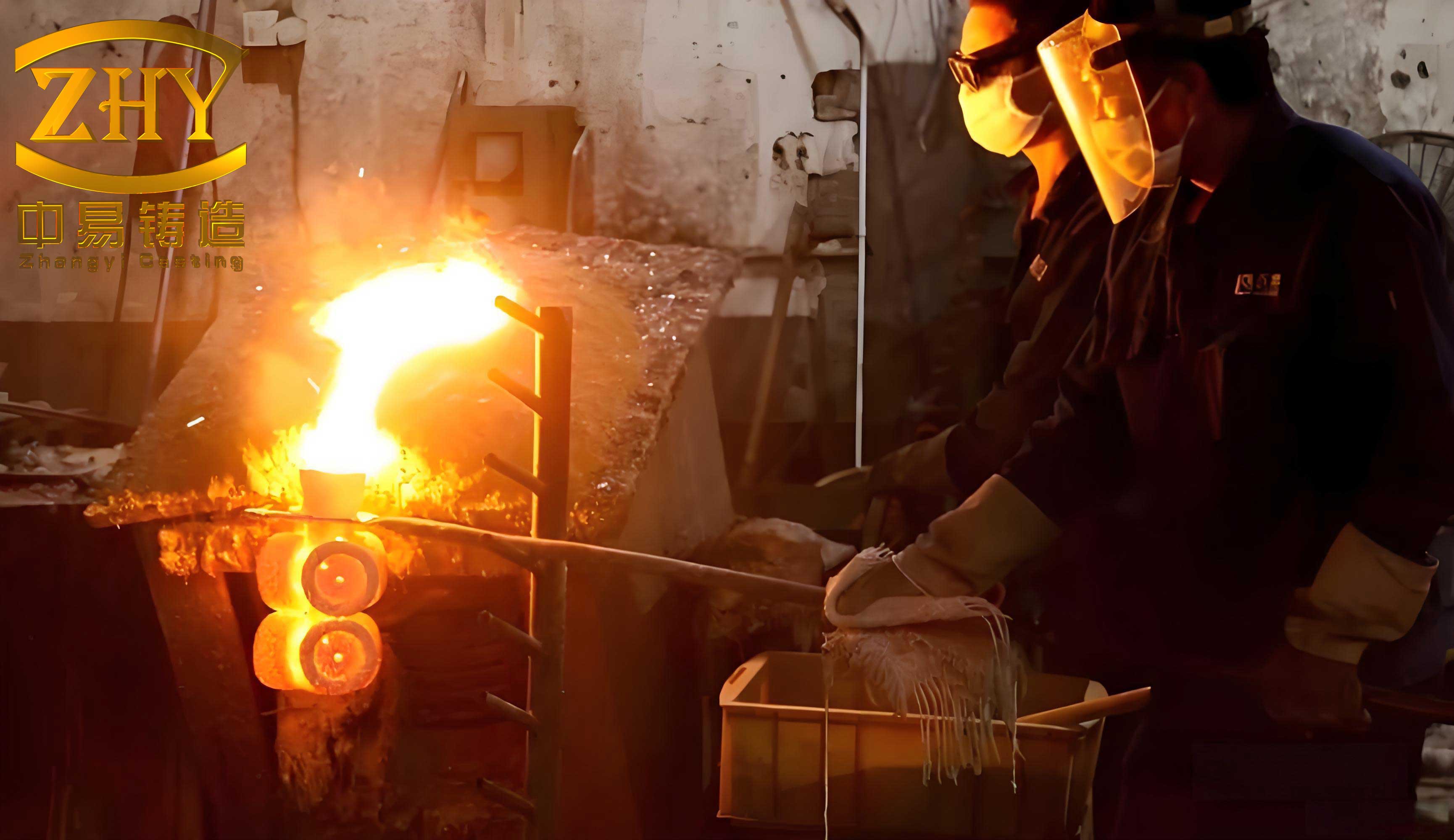
The valve body in question, manufactured via precision investment casting, featured a main wall thickness of 7 mm in WCB steel, with thickened flanges that created isolated thermal masses or “dispersed hot spots.” These regions are prone to defects due to differential solidification, which is a common challenge in precision investment casting. Initial production runs using conventional gating strategies resulted in unacceptable leakage during hydrostatic testing at 2.5 MPa, traced to micro-shrinkage and gas holes in the flange areas. This prompted a deep dive into the thermodynamics of solidification within the precision investment casting framework. The core issue was identified as inadequate feeding and venting in regions where thick sections connected to thinner walls, causing thermal gradients that hindered directional solidification. In precision investment casting, the ceramic shell’s properties significantly influence heat extraction, but for such concentrated hot spots, supplementary cooling measures become essential. My approach involved re-evaluating every aspect of the process, from gating system hydraulics to localized cooling enhancements, always anchored in the principles of precision investment casting to ensure repeatability and quality.
The conventional precision investment casting setup for such valve bodies typically employed side gating from the flanges, intended to serve both as filling inlets and feeding sources. However, this layout failed to address the dispersed nature of the hot spots. The modulus method, a key calculation in precision investment casting for predicting solidification times, revealed the inadequacy. The modulus \( M \) for a section is given by:
$$ M = \frac{V}{A} $$
where \( V \) is the volume and \( A \) is the surface area. For the flange ears, \( M \) was significantly higher than in the main wall, indicating slower solidification. The feeding distance \( L_f \) in precision investment casting can be estimated using:
$$ L_f = k \sqrt{t_s} $$
where \( k \) is a material constant and \( t_s \) is the local solidification time. In the initial design, \( L_f \) exceeded practical limits for the ears, leading to shrinkage porosity. The following table summarizes the modulus values and observed defects for key sections under the conventional precision investment casting scheme:
| Section | Volume (cm³) | Surface Area (cm²) | Modulus (cm) | Observed Defect |
|---|---|---|---|---|
| Main Wall | ~50 | ~200 | 0.25 | None |
| Flange Ear | ~15 | ~40 | 0.375 | Shrinkage Porosity |
| Flange Base | ~30 | ~60 | 0.5 | Gas Holes |
To tackle gas porosity, venting channels were incorporated into the gating system, a standard adjustment in precision investment casting to allow trapped gases to escape during pouring. This modification successfully eliminated gas holes, confirming that shell permeability and vent design are critical in precision investment casting. However, shrinkage persisted, necessitating a more radical redesign. The first alternative explored was a bottom-gating system via the flanges, which aimed to promote progressive solidification from the bottom upward. In precision investment casting, bottom gating reduces turbulence and oxide inclusion, but it can exacerbate thermal gradients if not paired with effective feeding. The solidification time \( t_s \) for a section under this scheme can be modeled using Chvorinov’s rule:
$$ t_s = C \left( \frac{V}{A} \right)^2 $$
where \( C \) is a casting constant. For the lower flange-to-neck junction, \( t_s \) increased, leading to severe macro-shrinkage. This failure underscored that merely altering filling direction in precision investment casting is insufficient without compensatory cooling or feeding for isolated hot spots. The complexity of assembly for this bottom-gated precision investment casting mold also rendered it unsuitable for mass production, a key consideration in industrial precision investment casting.
Returning to the conventional layout, I introduced “ram” or “羊角” (sheep-horn) extensions to create artificial feeding paths to the dispersed hot spots. This technique, sometimes used in precision investment casting for complex geometries, effectively channels molten metal to shrink-prone areas. The feeding efficiency \( \eta_f \) can be expressed as:
$$ \eta_f = \frac{V_{feed}}{V_{shrinkage}} \times 100\% $$
where \( V_{feed} \) is the volume of fed metal and \( V_{shrinkage} \) is the shrinkage volume. With the extensions, \( \eta_f \) approached 95% in trials, eliminating leakage. However, this method increased cutting and grinding efforts post-casting, raising costs and cycle times—a drawback in high-volume precision investment casting. The economic impact is summarized below:
| Process Step | Conventional Precision Investment Casting (Hours/Part) | With Extensions (Hours/Part) | Cost Increase (%) |
|---|---|---|---|
| Shell Removal | 0.5 | 0.7 | 40 |
| Gating Cut-off | 0.3 | 0.8 | 167 |
| Grinding | 0.4 | 1.2 | 200 |
| Total | 1.2 | 2.7 | 125 |
This cost inefficiency drove the development of a more elegant solution within the precision investment casting paradigm: the use of external chills and chromite sand. Chills, often applied in precision investment casting to locally increase cooling rates, were implemented as “dark chills” (embedded within the shell) to avoid direct contact with molten metal while enhancing heat extraction. The heat transfer coefficient \( h \) for a chill in precision investment casting can be approximated by:
$$ h = \frac{k_c}{\delta_c} $$
where \( k_c \) is the thermal conductivity of the chill material (e.g., steel) and \( \delta_c \) is the effective thickness of the interfacial layer. To boost chilling power, chromite sand—with its high heat capacity and conductivity—was sprinkled around the hot spots during shell building. The cooling rate \( \dot{T} \) at a hot spot with combined chill and sand is given by:
$$ \dot{T} = -\left( \frac{h A_s}{\rho V C_p} \right) (T – T_0) $$
where \( A_s \) is the surface area, \( \rho \) is density, \( C_p \) is specific heat, \( T \) is metal temperature, and \( T_0 \) is ambient temperature. For chromite sand, the effective thermal diffusivity \( \alpha \) is higher than that of regular ceramic shell materials, accelerating solidification. The implementation in precision investment casting involved securing steel chills with wire after three shell layers, then applying three layers of chromite sand slurry before completing the backup layers. This integrated approach is a testament to the adaptability of precision investment casting, where multi-material shells can be tailored for thermal management.
The success of this final precision investment casting method was validated through rigorous testing. Statistical data from batch productions showed a defect rate reduction to near zero. The table below compares key performance metrics across the different precision investment casting iterations:
| Precision Investment Casting Scheme | Gas Porosity Incidence (%) | Shrinkage Porosity Incidence (%) | Hydrostatic Test Pass Rate (%) | Production Viability |
|---|---|---|---|---|
| Conventional Gating | 15 | 20 | 65 | Low |
| Bottom Gating | 5 | 25 | 70 | Very Low |
| Conventional + Extensions | 2 | 3 | 95 | Medium |
| Chills + Chromite Sand | 1 | 1 | 99 | High |
The metallurgical principles behind this improvement are deeply rooted in the science of precision investment casting. The use of chills effectively increases the gradient \( G \) and solidification rate \( R \), which together influence grain structure and porosity. The well-known criterion for avoiding shrinkage in precision investment casting is \( G/R > \Delta T / D \), where \( \Delta T \) is the freezing range and \( D \) is a diffusivity constant. By elevating \( G \) locally, the chill-sand combination ensures this inequality holds. Furthermore, chromite sand’s high refractoriness minimizes interfacial reactions, a common concern in precision investment casting when introducing foreign materials. The economic benefits are substantial: chills are reusable, and chromite sand usage is minimal, reducing material costs in precision investment casting operations. This aligns with the industry trend toward sustainable precision investment casting practices.
In my reflection on this project, several broader lessons for precision investment casting emerge. First, computational simulation tools, such as finite element analysis (FEA) for thermal stress, could further optimize chill placement. The temperature field \( T(x,y,z,t) \) in a precision investment casting mold can be solved using the heat equation:
$$ \frac{\partial T}{\partial t} = \alpha \nabla^2 T + \dot{q} $$
where \( \dot{q} \) is the heat source from solidification. Integrating such models into precision investment casting design workflows can preempt defects. Second, the choice of shell materials in precision investment casting—like zircon sand or fused silica—interplays with cooling aids; their thermal properties can be characterized by the Biot number \( Bi = h L / k_s \), where \( L \) is a characteristic length and \( k_s \) is shell conductivity. For the valve body, a low \( Bi \) number initially contributed to slow cooling, remedied by chills. Third, precision investment casting for pressurized components demands not just defect-free castings but also consistent mechanical properties. Post-casting heat treatment, often part of precision investment casting processes, was applied to relieve residual stresses from rapid cooling, with parameters derived from the Larson-Miller parameter \( P = T (\log t + C) \), where \( T \) is temperature and \( t \) is time.
Looking ahead, the integration of additive manufacturing with precision investment casting—such as 3D-printed ceramic shells—could revolutionize how chills and vents are incorporated, enabling more complex cooling geometries. This synergy represents the next frontier in precision investment casting. Additionally, real-time monitoring of cooling curves during precision investment casting, using thermocouples embedded in shells, could provide data to refine chill designs dynamically. The empirical relationship between chill mass \( m_c \) and achieved cooling rate \( \dot{T} \) in precision investment casting might be expressed as:
$$ \dot{T} \propto \frac{m_c^{0.5}}{d^2} $$
where \( d \) is the distance from the chill, offering a guideline for scaling.
In conclusion, the journey to perfect the precision investment casting process for valve bodies with dispersed hot spots highlights the iterative, problem-solving nature of foundry engineering. By combining bottom gating for smooth filling, venting for gas escape, and innovative cooling via chills and chromite sand, a reliable, cost-effective production method was achieved. This case underscores that precision investment casting is not a static technique but a dynamic field where material science, thermal dynamics, and practical ingenuity converge. The repeated emphasis on precision investment casting throughout this narrative stresses its centrality in manufacturing high-integrity components. As demands for lighter, stronger, and more complex castings grow, continued innovation in precision investment casting will be paramount, with lessons from this valve body project serving as a valuable blueprint for tackling similar challenges in aerospace, automotive, and energy sectors. The final precision investment casting setup not only met all quality benchmarks but also demonstrated scalability, proving that even the most stubborn defects can be overcome through systematic refinement within the precision investment casting framework.