
In my experience working with abrasion-resistant steel alloys, high manganese steel casting stands out as one of the most prevalent materials. Since its invention over a century ago, this steel has been widely adopted in engineering machinery, mining, and metallurgy due to its exceptional work-hardening properties. For bulldozer blades, components like blade corners are typically produced as high manganese steel castings. However, a persistent challenge in manufacturing these high manganese steel castings is achieving satisfactory surface quality, primarily due to chemical burning-on and sand adhesion issues. This article delves into the factors affecting surface quality and presents a study on using magnesium olivine sand as molding sand to enhance the appearance of high manganese steel castings.
The core of high manganese steel casting lies in its composition and heat treatment. The standard high manganese steel, often designated as ZGMn13, contains carbon (C) and manganese (Mn) within specific ranges to balance hardness and toughness. The chemical composition varies based on application, as summarized in Table 1.
| Grade | C | Mn | Si | S | P | Application |
|---|---|---|---|---|---|---|
| ZGMn13-1 | 1.10–1.50 | 11.00–14.00 | 0.30–1.00 | ≤0.050 | ≤0.090 | Low-impact parts |
| ZGMn13-2 | 1.00–1.40 | 0.30–1.00 | ≤0.080 | General parts | ||
| ZGMn13-3 | 0.90–1.30 | 0.30–0.80 | ≤0.070 | Complex parts | ||
| ZGMn13-4 | 0.90–1.20 | 0.30–0.80 | ≤0.070 | High-impact parts |
The relationship between carbon and manganese significantly influences the properties of high manganese steel casting. As manganese content increases and carbon decreases, toughness improves while hardness reduces. This can be expressed approximately by an empirical formula for hardness (HB) as a function of composition: $$ \text{HB} \approx k_1 \cdot [\text{C}] – k_2 \cdot [\text{Mn}] + c $$ where $k_1$, $k_2$, and $c$ are constants derived from experimental data. However, the as-cast microstructure of high manganese steel casting consists of austenite, carbides, and pearlite, which renders it brittle. To dissolve carbides and achieve a uniform austenitic structure, a heat treatment known as water toughening is essential.
Water toughening involves heating the high manganese steel casting to a critical temperature range of 1050–1100°C, holding for a duration based on section thickness (typically 1 hour per 25 mm), followed by rapid quenching in water. This process suppresses carbide precipitation, resulting in a single-phase austenite with high toughness and a surface hardness below 229 HBS. The kinetics of carbide dissolution can be modeled using the Arrhenius equation: $$ \frac{d[ \text{Carbide} ]}{dt} = -A \exp\left(-\frac{E_a}{RT}\right) $$ where $A$ is a pre-exponential factor, $E_a$ is activation energy, $R$ is the gas constant, and $T$ is temperature. After water toughening, high manganese steel castings exhibit remarkable work-hardening upon impact, with surface hardness escalating to 450–550 HBW, providing superior wear resistance. The mechanical properties typically include tensile strength ($\sigma_b \geq 637–735 \text{ MPa}$), yield strength ($\sigma_s \geq 396 \text{ MPa}$), and impact toughness ($a_k \geq 15 \times 10^5 \text{ J/m}^2$).
Despite these excellent properties, surface defects in high manganese steel casting often arise from chemical burning-on. This occurs because high manganese steel melt contains manganese oxide (MnO), which is basic and reacts with acidic silica (SiO$_2$) in conventional molding sands or coatings. The reaction proceeds as: $$ \text{MnO} + \text{SiO}_2 = \text{MnO} \cdot \text{SiO}_2 $$ The product, manganese silicate (MnO·SiO$_2$), has a low melting point and good fluidity, infiltrating sand interstices and adhering to the casting surface upon cooling. Factors exacerbating this include secondary oxidation, poor deoxidation, and excessive pouring temperature. For bulldozer blade corners, which are used as-cast without machining, surface roughness and dimensional accuracy are critical. Initially, using quartz sand—whether artificial or natural—resulted in severe chemical burning-on, with rejection rates due to surface defects reaching 15–25%. Even switching to magnesia-based coatings offered only partial relief.
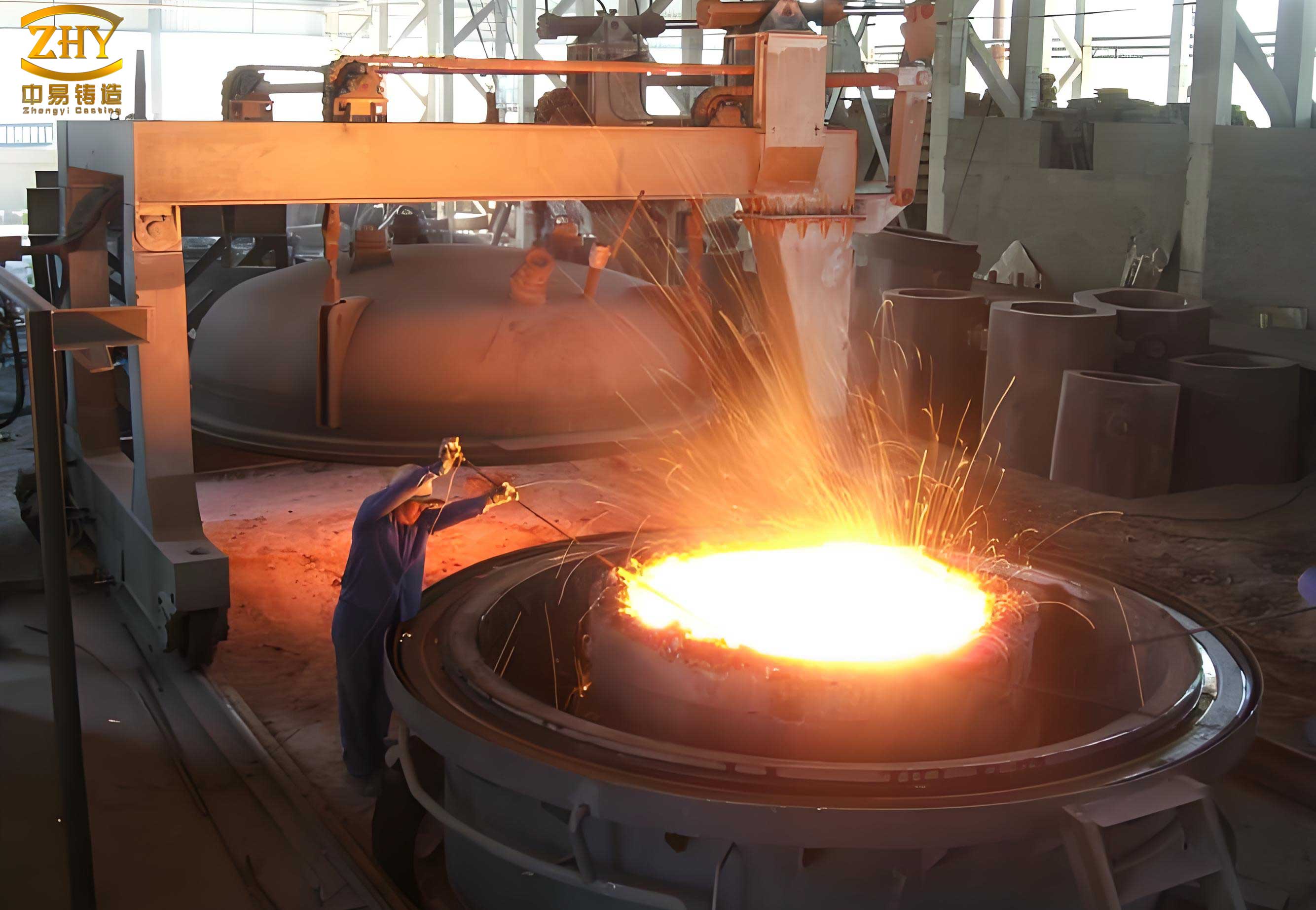
To address this, I investigated non-silica sands like zircon, chromite, olivine, and alumina. Magnesium olivine sand [ (Mg,Fe)$_2$SiO$_4$ ] emerged as a promising alternative due to its neutral chemical nature and high refractoriness. Its properties are detailed in Table 2.
| Grade | MgO (mass %) | SiO$_2$ (mass %) | Loss on Ignition (mass %) | Refractoriness (°C) | Moisture Content (mass %) |
|---|---|---|---|---|---|
| 1 | ≥47 | ≤40 | ≤1.5 | ≥1690 | ≤0.5 |
| 2 | ≥44 | ≤41 | ≤1.5 | ≥1690 | ≤0.5 |
Magnesium olivine sand comprises a solid solution of forsterite (Mg$_2$SiO$_4$, melting point 1870°C) and fayalite (Fe$_2$SiO$_4$, melting point 1205°C). Commercial grades with 5–10% fayalite have melting points of 1600–1760°C and a sintering point around 1200°C. Its density is 3.2–3.6 g/cm$^3$, bulk density 1.6–1.7 g/cm$^3$, and Mohs hardness 6.5–7.5. Importantly, it contains no free SiO$_2$, eliminating the reaction with MnO. The thermal expansion of magnesium olivine sand is lower and more gradual than quartz sand, reducing risks of veining and scabbing. The linear expansion coefficient $\alpha$ can be approximated as: $$ \alpha(T) = \alpha_0 + \beta T $$ where $\alpha_0$ is the initial coefficient and $\beta$ is a temperature-dependent factor, typically lower for olivine. After proper processing to remove impurities like serpentine, which can cause pinholes, magnesium olivine sand proves ideal for high manganese steel casting.
In my experiments, I formulated molding sands using magnesium olivine sand as the base, with calcium bentonite as binder. The sand was graded by particle size, as shown in Table 3.
| Group | Screen Size (mm) and Residual Mass (%) |
|---|---|
| 15 (70/140 mesh) | ≤15% on 0.425 mm, ≥75% on 0.3–0.106 mm, ≤10% on 0.075 mm and pan |
| 10 (100/200 mesh) | ≤15% on 0.3 mm, ≥75% on 0.212–0.075 mm, ≤10% on 0.053 mm and pan |
Three sand mixtures were prepared for casting bulldozer blade corners, all with magnesium olivine sand (100%) but varying bentonite content. The formulations and properties are summarized in Table 4.
| Mix | Composition (%) | Mixing Time (min) | Process Properties |
|---|---|---|---|
| A | Olivine sand: 100, Calcium bentonite: 10 | 8–13 | Green strength: 0.08 MPa, Permeability: 200, Moisture: 5%, Compactability: 55% |
| B | Olivine sand: 100, Calcium bentonite: 8 | Green strength: 0.075 MPa, Permeability: 280, Moisture: 4%, Compactability: 50% | |
| C | Olivine sand: 100, Calcium bentonite: 6 | Green strength: 0.050 MPa, Permeability: 320, Moisture: 3%, Compactability: 55% |
These mixtures served as facing sand, with ordinary clay sand as backing sand. All sands were mixed in an S114 mixer, and the molds were coated with magnesium olivine powder-based refractory paint. Pouring temperature was controlled around 1470°C. After cooling and shakeout, the high manganese steel castings were evaluated.
Results showed that high manganese steel castings produced with Mix B exhibited easy shakeout, clear contours, smooth surfaces, and a self-peeling black oxide layer that left a finish comparable to precision castings. The used sand showed no burning and could be recycled. In contrast, Mix A required manual cleaning with pneumatic tools, and Mix C suffered from sand drop and inclusion defects. Thus, Mix B was selected for mass production, reducing rejection rates from 15–25% to below 3% for high manganese steel casting components like blade corners.
To optimize cost and performance, I adjusted the formulation further: olivine sand 100%, bentonite 5–7%, mixing time about 10 minutes, moisture 3–4%. The facing sand thickness can be limited to 20–30 mm, backed by ordinary clay sand, without compromising surface quality of high manganese steel castings. Moreover, about 90% of the olivine sand can be reused due to its resistance to thermal degradation.
In conclusion, the surface quality of high manganese steel castings for bulldozers is profoundly influenced by molding materials. Chemical burning-on, driven by reactions between MnO and SiO$_2$, can be mitigated by adopting magnesium olivine sand. This neutral, high-refractoriness sand minimizes adhesion and thermal expansion defects. Through rigorous formulation testing, a balance of green strength and permeability—achieved with 5–7% bentonite—yields high-quality high manganese steel castings with excellent appearance and dimensional accuracy. Future work could explore the thermodynamic modeling of sand-metal interactions or the effects of alternative binders on high manganese steel casting properties. Ultimately, this approach enhances the viability of high manganese steel casting in demanding applications where surface integrity is paramount.
The success of this method hinges on meticulous mold preparation, proper gating design, controlled pouring parameters, and optimized sand composition. For high manganese steel casting, the use of magnesium olivine sand represents a significant advancement, combining economic feasibility with superior performance. As industries push for longer-lasting components, such improvements in high manganese steel casting processes will continue to play a crucial role in manufacturing durable machinery parts.