
In my experience, the appearance quality of machine tool castings plays a critical role in the overall perception of product quality. Users often form an intuitive impression based on how well the external surfaces of machine tool castings align, which can psychologically influence their satisfaction and purchasing decisions. A smooth and aesthetically pleasing exterior not only enhances user confidence but also becomes a key factor in expanding market reach and entering international markets. Machine tool castings constitute a significant portion of various machine tools, and the alignment of their mating surfaces is paramount for achieving high appearance quality. However, improving the matching quality of machine tool castings is a complex task that involves multiple production stages, from design and casting processes to machining and assembly. This article explores the entire production process, highlighting how each环节 impacts the alignment of mating surfaces and proposes strategies to enhance the quality of machine tool castings through detailed analyses, tables, and formulas.
Design aspects are foundational to achieving high matching quality in machine tool castings. Often, design drawings fail to specify mating part numbers or requirements for mating surfaces, leading to inconsistencies in subsequent processes. For instance, when two mating machine tool castings are produced in different specialized factories or departments, the lack of clear “mating” information prevents coordinated efforts to control dimensions. Moreover, unified and rational dimensioning of mating surfaces is essential. Consider a scenario where the width dimensions of mating surfaces on machine tool castings are annotated differently, resulting in cumulative tolerances that cause misalignment. The following table summarizes the maximum cumulative tolerances for different dimensioning methods, illustrating how unified approaches can reduce errors:
| Dimensioning Method | Maximum Cumulative Tolerance for Misalignment (mm) | Maximum Cumulative Tolerance for Width Difference (mm) |
|---|---|---|
| Original Drawing | ±2.5 | ±3.0 |
| Type I (Unified) | ±1.5 | ±2.0 |
| Type II (Optimized) | ±1.0 | ±1.5 |
In the dimension chain analysis, the cumulative error can be expressed as: $$ \Delta = \sum_{i=1}^{n} \delta_i $$ where $\Delta$ is the total tolerance and $\delta_i$ is the tolerance of each component in the chain. For machine tool castings, minimizing the number of “composition rings” in the dimension chain and placing the “closed ring” on non-mating surfaces can significantly reduce misalignment. Additionally, complex contours in machine tool castings, such as uneven centerlines, exacerbate alignment issues. Simplifying these contours by unifying heights or adopting square shapes can improve appearance. Structural designs, like circular bosses on exposed surfaces, are prone to misalignment due to casting tolerances; replacing them with counterbored holes has proven effective in enhancing the matching quality of machine tool castings.
Casting processes directly influence the dimensional accuracy and surface alignment of machine tool castings. A common issue is the absence of mating requirements in casting工艺 documents, which hinders the transmission of “mating” information to production. To address this, annotating “net dimensions” on critical mating sizes can simplify model manufacturing and control. The choice of parting plane is crucial: when the parting plane is perpendicular to the mating surface, it introduces slopes and size changes; aligning the parting plane with the mating surface maintains contour but alters dimensions; and keeping them parallel preserves both shape and size. The following formula relates shrinkage rates to dimensional stability in machine tool castings: $$ L_c = L_m \times (1 + S) $$ where $L_c$ is the cast dimension, $L_m$ is the model dimension, and $S$ is the shrinkage rate. For mating machine tool castings with different materials or structures, empirical adjustments are necessary to compensate for varying shrinkage rates. Furthermore, the position of gates should avoid mating surfaces to prevent irregularities, and reliable positioning devices in mold equipment are essential to control dimensions. Inconsistencies between casting and machining processes, such as using uneven datum points, can lead to misalignment; coordination between departments is vital to resolve these issues.
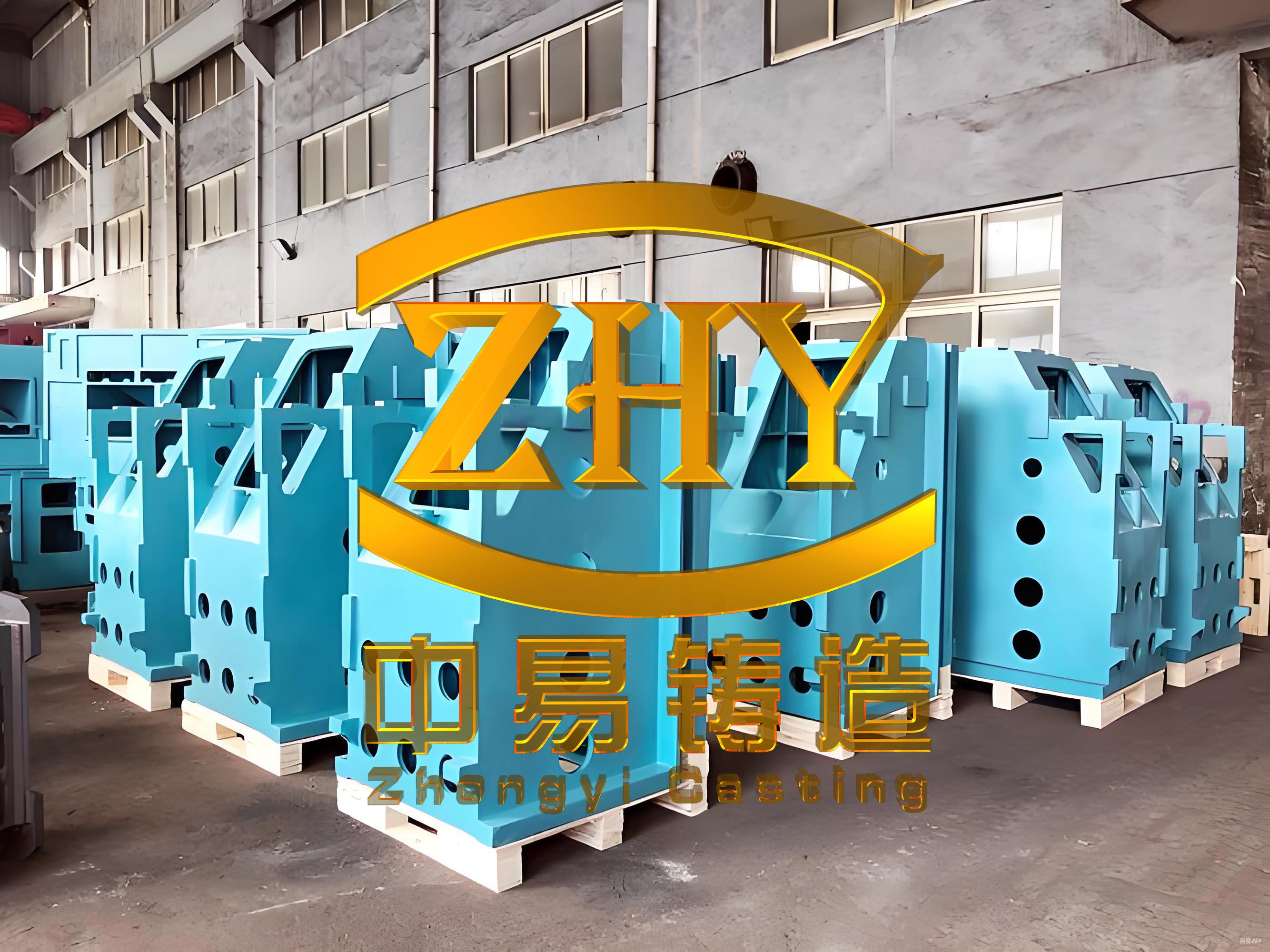
Machining processes also play a significant role in the matching quality of machine tool castings. Often, machining工艺 files do not specify mating requirements, leading to uncoordinated production. Improper machining methods can exacerbate misalignment. For example, in machining a column for a surface grinder, if the process does not account for casting deviations, the mating surfaces may require extensive rework. The compensation effect in machining can be modeled as: $$ C = D_a – D_n $$ where $C$ is the compensation amount, $D_a$ is the actual dimension, and $D_n$ is the nominal dimension. By adjusting machining sequences and datums, it is possible to mitigate casting tolerances. The use of inappropriate fixtures, such as scribed lines for positioning, introduces errors; switching to contour-matching fixtures improves accuracy. Additionally, aligning machining datums with casting datums reduces cumulative errors. For instance, when machining a bed way, using the same datum as in casting ensures better alignment of mating surfaces on machine tool castings.
Other production aspects, such as model manufacturing and casting operations, contribute to variations in machine tool castings. Multiple models for the same part number often have inconsistent dimensions due to material wear or structural instability. Controlling small radii on mating surfaces is critical; oversized radii, as shown in some cases, lead to increased mating gaps. In casting production, low sand compaction causes mold deformation, while improper core assembly and box closing result in dimensional shifts. The cumulative error from these factors can be expressed as: $$ E_t = E_m + E_c + E_p $$ where $E_t$ is the total error, $E_m$ is the model error, $E_c$ is the casting error, and $E_p$ is the processing error. During machining, non-adherence to processes, such as incorrect leveling of workpieces, leads to rotational misalignment. The table below summarizes key error sources and their impacts on machine tool castings:
| Error Source | Effect on Matching Quality | Typical Tolerance (mm) |
|---|---|---|
| Model Dimensional Variance | Inconsistent mating contours | ±1.0 |
| Casting Shrinkage | Size deviations | ±0.5 to ±1.5 |
| Machining Datum Misalignment | Rotational errors | ±0.3 |
To achieve high matching quality in machine tool castings, it is essential to integrate design and process controls. The allowable misalignment values should vary based on the location of mating surfaces—stricter for front and top exposed surfaces, and lenient for non-visible areas. Redesigning mating surfaces to have non-matching dimensions can eliminate rework. For instance, enlarging one component’s profile while reducing the other’s creates a gap that avoids misalignment. Economically, specifying tight tolerances on drawings or pre-assembly adjustments are effective but costly; alternatively, post-assembly grinding is efficient but may affect paint integrity. In summary, enhancing the matching quality of machine tool castings requires a holistic approach: designers should optimize dimensioning and structures,工艺 engineers must coordinate casting and machining, and production teams need to adhere to standardized processes. By focusing on these areas, manufacturers can significantly improve the appearance and performance of machine tool castings while maintaining cost-effectiveness.